UPSC Current Affairs

15 topicsGS-1: 2GS-2: 5GS-3: 8
0/15 done
GS-2Polity

1.IT Intermediary Rules Amendment 2025 (Intermediary Guidelines)

New Indian Express

What & Where

Amendment to IT Rules 2021, notified by MeitY, India, governing digital intermediaries

Effective from 1 Nov 2025 across all digital platforms operating in India

Covers takedown orders, synthetic media labelling, and compliance duties for Significant Social Media Intermediaries

Quick Facts for MCQs

Legal & Policy

  • Seniority: Only Joint Secretary or DGP can sign takedown orders post-1-11-2025
  • Justification: Every order must cite specific statute and targeted URLs
  • Oversight: Secretary-level officer reviews actions monthly for necessity and proportionality

Tech & Schemes

  • Definition: “Synthetic information” covers AI-generated or algorithmically altered content appearing authentic
  • Labelling: Platforms embed visible tags or metadata covering ≥10 % on deepfake visuals or audio
  • Detection: SSMIs deploy automated tools and collect user declaration during upload

Security Dimension

  • Safeguard: Rules aim to curb identity theft, misinformation, and electoral manipulation via deepfakes
  • Compliance: Breach triggers loss of safe-harbour protection under IT Act 2000
  • Transparency: Clear senior-level process intended to boost citizen trust in digital governance

Key Data Points

FeatureData-Point
Notification authorityMeitY
Effective date1 Nov 2025
Eligible officers for takedownJoint Secretary or DGP
Review levelSecretary-level monthly audit
Labelling coverage≥10 % surface or duration
Key term introducedSynthetically generated information
Non-compliance resultLoss of safe-harbour under IT Act 2000

Related UPSC Prelims PYQs

ESE_GS 2026PYQ 1

Which Ministry released the India AI Governance Guidelines in 2025?
GS-3Economy

2.New Sevilla Sovereign Debt Forum (Sovereign Debt Reform)

ANI

What & Where

Forum: Spanish-led New Sevilla Forum on Debt, multilateral platform promoting fair, transparent, sustainable sovereign-debt solutions

Location: Announced at UNCTAD16, Geneva, under the Sevilla Platform for Action; backed by UNCTAD and UN DESA

Scope: Sustains global dialogue on debt-architecture reform, responsible borrowing-lending, and North–South cooperation on debt sustainability

Quick Facts for MCQs

Institutional Framework

  • Alignment: Embeds FfD outcomes into UNCTAD follow-up mechanisms
  • Oversight: Reports progress to UNCTAD and UN DESA for global monitoring
  • Continuity: Provides standing venue beyond ad-hoc debt negotiations

Objectives & Functions

  • Dialogue: Maintains structured borrower-creditor engagement on systemic debt reform
  • Capacity: Delivers technical assistance for predictable, equitable debt management practices
  • Reform: Advocates rules enhancing responsible lending and borrowing norms

Stakeholder Inclusion

  • Participation: Equal voice to governments, private lenders, multilaterals, CSOs, academia
  • Cooperation: Facilitates North–South knowledge exchange on debt sustainability strategies

Key Data Points

FeatureData-Point
Formal typeMultilateral sovereign-debt platform
Lead countrySpain
UN support bodiesUNCTAD, UN DESA
Launch venueUNCTAD16, Geneva
Parent roadmapSevilla Platform for Action
Preceding processFourth Int’l Conf. on Financing for Development (FfD4)
Stakeholder mixGovernments, creditors, civil society, experts
Key tasksTrack debt initiatives, give technical support
UNCTAD creation year1964
UNCTAD HQ cityGeneva, Switzerland
GS-3Economy

3.India-WTO Investment Facilitation Dispute (WTO Investment Pact)

Economic Times

What & Where

Investment Facilitation for Development (IFD) Agreement — proposed plurilateral WTO pact to simplify investment procedures and boost FDI.

Process: builds legally binding, MFN-based rules on transparency, administrative cooperation, open accession for any WTO member.

Reach: backed by 127 members (90 developing, 27 LDCs); China leads, India questions inclusion in WTO framework.

Quick Facts for MCQs

Legal & Policy

  • Plurilateral format avoids full-membership consensus, binding only consenting states.
  • MFN clause extends any investor concession to all other signatories.
  • Focus on streamlining approvals, transparency, single-window mechanisms.

India’s Concerns

  • Views IFD as mandate-skewing, risks diluting member-driven WTO process.
  • Fears precedent of selective deals undermining collective bargaining power.
  • Seeks to safeguard domestic regulatory space over foreign investment.

WTO Reform Agenda

  • India prioritises Doha issues: public stockholding, special safeguard in agriculture.
  • Demands restoration of two-tier dispute settlement before new subjects.
  • Insists on retaining Special & Differential Treatment for developing nations.

Key Data Points

FeatureData-Point
Agreement typePlurilateral, to sit in Marrakesh Agreement Annex 4
Support tally127 WTO members ≈ 75 % of membership
Developing & LDC share90 developing + 27 LDCs
Core objectiveFacilitate, increase FDI for sustainable development
Key principleMost-Favoured-Nation treatment among signatories
Accession ruleOpen to any WTO member anytime
Principal proponentChina
India’s positionOpposes; calls it non-mandated, non-multilateral

Related UPSC Prelims PYQs

CDS_GK, GEO_GS 2024PYQ 1

Which one of the following institutions is not in the 'World Bank Group'?

CDS_GK, GEO_GS 2024PYQ 2

If India enters into Free Trade Agreements (FTAs) with other nations, then the growth of exports of India would depend upon which of the following?

GS-3Environment

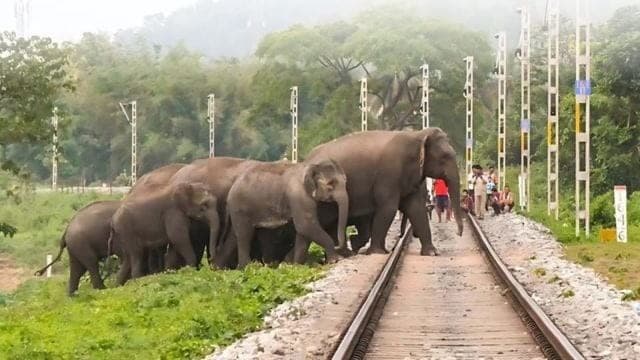
4.Elephant Corridor Intrusion Detection System (Human-Wildlife Conflict)

Indian Express
Illustration for Elephant Corridor Intrusion Detection System (Human-Wildlife Conflict)

What & Where

Definition: AI-sensor fibre-optic Intrusion Detection System (IDS) guarding railway elephant corridors

Process: Trackside cables sense vibrations, send instant alerts to control rooms; drivers slow or halt trains

Geography: Deployed by Northeast Frontier Railway in Alipurduar, Lumding, Rangiya, Tinsukia divisions, Northeast India

Quick Facts for MCQs

Tech & Schemes

  • Hardware: Vibration-sensitive fibre optic cable linked to AI analytics platform
  • Alerts: Real-time messages reach control room, loco pilots for speed modulation
  • Data-use: Movement logs inform future route planning, conservation action

Environmental Impact

  • Collision-prevention: IDS addresses leading cause of rail-elephant deaths in Northeast
  • Coexistence: System balances wildlife safety with uninterrupted train operations
  • Habitat-aid: Continuous data helps map corridors, prioritize habitat preservation

Implementation Timeline

  • Pilot: Four sections live, covering 64.03 km since 2024
  • Scale-up: 146.4 km additional coverage slated before April 2026
  • Goal: Achieve 210 km protected corridor length under NFR

Key Data Points

FeatureData-Point
Launching agencyNortheast Frontier Railway, Ministry of Railways
Primary aimCut elephant fatalities on tracks
Technology usedVibration-sensitive optical fibre + AI analytics
Operational stretch (2024)64.03 km across four divisions
Planned expansionExtra 146.4 km by April 2026
Total target network210 km elephant corridors
GS-3Environment

5.Global Forest Resources Assessment 2025 Findings (Global Forest Assessment)

FAO
Illustration for Global Forest Resources Assessment 2025 Findings (Global Forest Assessment)

What & Where

GFRA 2025 – comprehensive five-year FAO audit of world forests across 236 countries

Scope – tracks extent, management, use through remote sensing, national reports, modelling

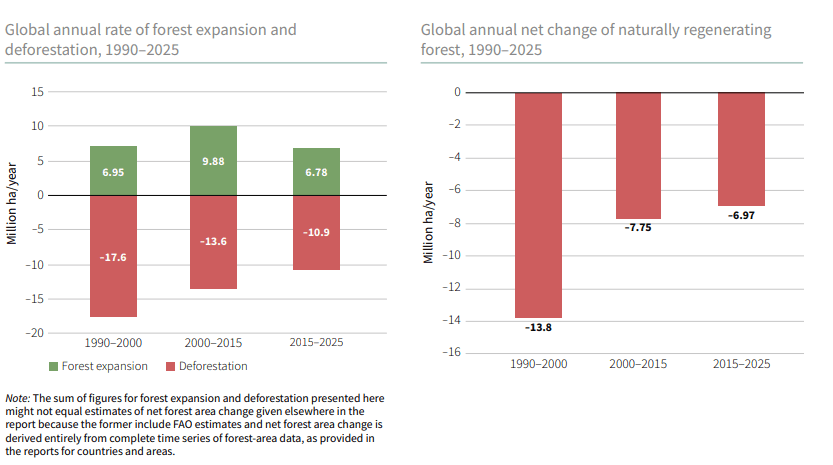
Geography – tropical belt holds 45 % of 4.14 billion ha global forest cover

Quick Facts for MCQs

Global Trends

  • Concentration Russia Brazil Canada USA China host >50 % global forests
  • Decline Annual deforestation slowing via policy reforms and Asian South American afforestation
  • Ownership Public sector 71 %, private or community 24 %, indicating inclusive management rise

India Initiatives

  • Missions Green India, CAMPA, NAP spearhead restoration and compensatory afforestation
  • Community Van Dhan Yojana, Joint Forest Management merge livelihoods with conservation
  • Compliance Biodiversity corridors, mangrove projects bolster NDC carbon-sink commitments

Challenges

  • Hotspots Agricultural and mining conversion still threaten tropical ecosystems
  • Degradation Wildfires pests climate stress reduce forest quality despite net gains
  • Finance Long-term restoration constrained by funding and institutional gaps

Tech & Data

  • Platforms ISRO Bhuvan and AI mapping sharpen monitoring and transparency
  • Accounting Satellite-based tools planned for precise carbon stock and emission audits
  • Cooperation FAO urging South–South knowledge exchange for large-scale restoration

Key Data Points

FeatureData-Point
Edition year2025
PublisherFAO, UN
Assessment cycleEvery 5 years
Nations covered236
Global forest extent4.14 billion ha
Tropical share45 %
Annual deforestation 2015-2510.9 million ha
Annual forest gain6.78 million ha
Planted forest share8 %
Protected forest area813 million ha (20 %)
Global carbon stock714 Gt
Public ownership71 %
India forest-area rank9th
India forest-gain rank3rd

Related UPSC Prelims PYQs

CDS_GK, ESE_GS 2023PYQ 1

There is an increase in forest cover area of India between 2011 and 2021. However, there is a decrease in forest cover area of India during the same period in

CDS_GK, ESE_GS 2026PYQ 2

According to Environmental Accounting on forest 2025 report, which state showed the highest rise in Recorded Forest Area (RFA) share?

GS-3Environment

6.Delhi Declaration 2025 on Urban Climate (Urban Climate Action)

PIB
Illustration for Delhi Declaration 2025 on Urban Climate (Urban Climate Action)

What & Where

Declaration: city-led Delhi Declaration 2025 on multilevel urban climate governance, adopted at ARISE Cities Forum, New Delhi.

Scope: commits Global South cities to NDC-linked mitigation, adaptation, just transition, citizen participation, predictable climate finance.

Next stop: to be tabled at COP30 (2025) in Belém, Brazil under ICLEI South Asia stewardship.

Quick Facts for MCQs

Policy & Governance

  • Multilevel-NDC: cities to embed measurable targets within national climate pledges.
  • Data-systems: urges transparent, accountable, evidence-based urban decision-making.
  • South-South: promotes peer learning, innovation exchange across developing cities.

Finance

  • Direct-access: demands predictable, city-level channels for global climate funds.
  • Circular-economy: positions waste valorisation and resource efficiency for revenue generation.

Indian Schemes

  • NMSH focuses on building efficiency, mobility, solid-waste reforms.
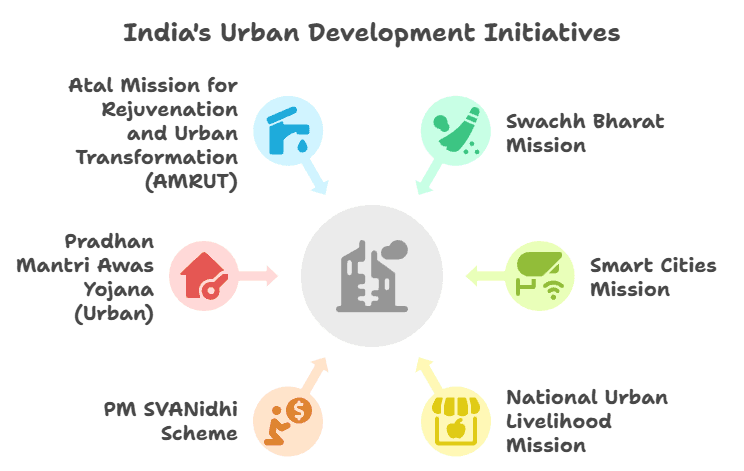
  • Smart Cities Mission integrates command centres, renewable infrastructure in 100 cities.
  • CSCAF benchmarks 5 themes—energy | mobility | water | waste | urban-planning.

Social Inclusion

  • Just-transition guarantees equity for workers, urban poor during net-zero shift.
  • Participation expands roles of women, youth, communities in climate governance.

Key Data Points

FeatureData-Point
Adoption year2025
Hosting cityNew Delhi
Presenting venueCOP30, Belém (Brazil)
Forum acronym ARISEAdaptive Resilient Innovative Sustainable Equitable
Lead networkICLEI South Asia
Urban share of CO₂> 70 % worldwide
Global urban population now50 % +
Projected urban share 205068 % (UN)
India’s annual urban influx≈ 10 million people

Related UPSC Prelims PYQs

CAPF_GAI, GS1 2018PYQ 1

The Partnership for Action on Green Economy (PAGE), a UN mechanism to assist countries' transition towards greener and more inclusive economies, emerged at

CAPF_GAI, GS1 2024PYQ 2

Which one among the following statements with regard to the United Nations Climate Change Conference (COP28) is NOT correct?

GS-3Species

7.Blackbuck Revival in Chhattisgarh (Blackbuck Reintroduction)

Indian Express

What & Where

Blackbuck Revival Programme (2021-26): re-establish Antilope cervicapra in Barnawapara WLS, Chhattisgarh, after 2017 local extinction.

Location: 245 km² teak-sal forest with open grass patches, Raipur district; flanked by Balamdehi (W) & Jonk (NE) tributaries of Mahanadi.

Goal: self-sustaining, breeding herd as flagship for central-Indian grassland conservation.

Quick Facts for MCQs

Conservation Actions

  • Translocation trucks fitted with sand-layer flooring, ventilation, vet escort for <12 h journey.
  • Post-release soft-enclosure used for acclimatisation, predator monitoring, radio-collaring.
  • Five-year funding cleared by Chhattisgarh State Wildlife Board, periodic population audits.

Habitat Management

  • Sand layering & drainage overhaul cut pneumonia deaths seen in 2018 outbreak.
  • Weed removal & native grass seeding improved forage quality across 200 ha.
  • Waterholes desilted; solar pumps ensure perennial availability.

Legal & Symbolic Status

  • Schedule I violation invites ≥3 yrs imprisonment; acts as poaching deterrent.
  • State-animal tag leverages local cultural pride for community vigilance.
  • Appendix III listing enables export permit requirement, aiding international monitoring.

Site Geography

  • Sanctuary sits on Vindhyan outliers with 280–400 m elevation range.
  • Mixed moist & dry deciduous tracts create mosaic ideal for both browsers & grazers.
  • Seasonal riverine grasslands crucial for fawn nursery zones.

Key Data Points

FeatureData-Point
Scientific nameAntilope cervicapra
Common nameBlackbuck / Indian antelope
IUCN statusLeast Concern
Wildlife (Protection) ActSchedule I
CITES listingAppendix III
Programme period2021-2026
Blackbucks translocated77 (50 NZP-Delhi, 27 Kanan Pendari-Bilaspur)
Current population (2025)190 +
Core habitat typeOpen grassland & scrub
State animal ofPunjab, Haryana, Andhra Pradesh
Sanctuary area~245 km² (undulating hillocks)
Main riversBalamdehi (W), Jonk (NE), other Mahanadi tributaries
Other key faunaGaur, Cheetal, Sambhar, Nilgai, Wild boar

Related UPSC Prelims PYQs

CDS_GK, GEO_GS 2023PYQ 1

Cheetahs, brought from Namibia, were introduced in India to which one of the following National Parks?

CDS_GK, GEO_GS 2022PYQ 2

Which one of the following was recently considered to be a suitable site for introducing African cheetah in India?

GS-3S&T

8.Quantum Echoes Algorithm Advantage (Quantum Advantage)

The Hindu

What & Where

Quantum Echoes: algorithm leveraging out-of-time-order correlators to track information spread, scramble, reverse in quantum systems

Run on Willow 72-qubit superconducting processor at Google Quantum AI, Santa Barbara, USA

Provides first experimentally verifiable quantum advantage via time-reversal “echo” measurement

Quick Facts for MCQs

Tech & Schemes

  • Time-reversal protocol sends signal, lets system evolve, then inverses gates to extract echo
  • Small midway perturbation maps interference pattern, confirming genuine quantum behaviour
  • Framework scalable; results cross-checkable on independent quantum hardware

Performance Metrics

  • Echo computation classically intractable beyond ~47 qubits; Willow succeeded at 70+ logical steps
  • Error-mitigation yields high-fidelity modelling of atomic interactions
  • Demonstrated constructive interference hallmark absent in classical simulations

Application Areas

  • Drug-discovery: simulates ligand-receptor quantum chemistry with higher precision
  • Materials-science: guides design of superconductors, polymers, quantum components
  • NMR-like structure mapping: refines molecular geometry analysis beyond current limits

Key Data Points

FeatureData-Point
DeveloperGoogle Quantum AI & Collaborators
HardwareWillow superconducting quantum processor
Qubit count72 physical qubits
Core principleOut-of-time-order correlators (OTOC)
VerificationConstructive quantum interference echo
Speed gain≈13,000 × fastest classical supercomputer code
Key metricVerifiable quantum advantage
Perturbation stepMid-computation kick tests scrambling
Announced2024
Potential usersPhysics, chemistry, materials science labs
GS-3S&T

9.Chandrayaan-2 Findings on Lunar Exosphere (Lunar Exosphere)

The Hindu
Illustration for Chandrayaan-2 Findings on Lunar Exosphere (Lunar Exosphere)

What & Where

Lunar exosphere: ultra-thin, collision-less gas envelope hugging Moon’s surface.

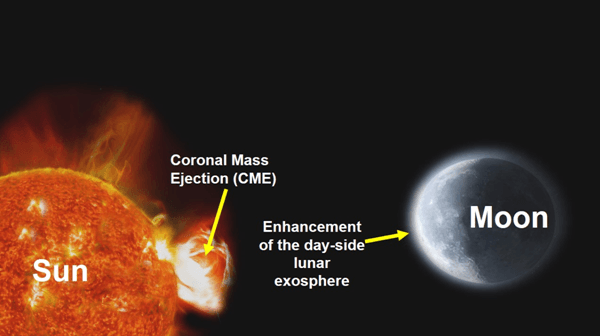
Coronal Mass Ejection (CME): giant plasma-magnetic blast from solar corona, key space-weather driver.

Detection site: Chandrayaan-2 orbiter using CHACE-2 instrument, first to spot CME influence on lunar exosphere.

Quick Facts for MCQs

Tech & Schemes

  • CHACE-2 measures neutral species densities from 1–100 amu with quadrupole mass spectrometer technology.
  • Chandrayaan-2 orbits polar, ~100 km altitude, offering continuous dayside–nightside sampling.
  • ISRO uses orbiter’s 14+ instruments to maximise science post-lander loss.

Space Weather

  • CME impacts accelerate solar wind ions, altering exospheric density and composition around Moon.
  • Solar events guide mission safety for astronauts, satellites, power grids on Earth.
  • Observation refines space-weather models for bodies lacking global magnetic fields.

Scientific Observation

  • Surface sputtering by CME ions liberates He, Ar, Ne from regolith into exosphere.
  • Low gravity plus high thermal velocities cause rapid particle escape, sustaining tenuous atmosphere.
  • Temperature on lunar surface ranges roughly −173 °C night to 127 °C day due to thin exosphere.

Key Data Points

FeatureData-Point
MissionChandrayaan-2 (lunar orbiter)
InstrumentCHACE-2 (Chandra’s Atmospheric Composition Explorer-2)
New findingFirst CME effect observed on Moon’s exosphere
Dominant exosphere gasesHelium, Argon, Neon
Exosphere sourcesRadioactive decay, solar wind, meteoroid impacts
CME contentSuper-heated plasma of protons & electrons
CME origin layerSolar corona
Exosphere traitCannot retain heat → extreme temperature swings
GS-2Polity

10.Financial Action Task Force Standards (FATF Standards)

The Hindu

What & Where

FATF — intergovernmental body setting global standards against money-laundering, terrorist & proliferation financing

Core processes: 40 Recommendations, Mutual Evaluations, Grey & Black listing of non-compliant jurisdictions

Geography: HQ Paris, France; hosted by OECD; 200+ partner jurisdictions worldwide

Quick Facts for MCQs

Mandate & Scope

  • Standard-setting: updates Recommendations to shield global financial system integrity
  • Safeguarding: urges coordinated action to cut illicit trans-border financial flows
  • Identification: flags high-risk states aiding terror or laundering

Monitoring Tools

  • Mutual Evaluation: peer-review audits gauge legal, regulatory, operational effectiveness
  • Listing mechanism: Grey signals deficiencies, Black triggers counter-measures
  • Follow-up: jurisdictions must submit progress reports till delisting

Global Collaboration

  • Membership extends policy reach to 200+ economies through regional bodies
  • Works with IMF, World Bank, UN to embed standards in lending & technical aid
  • Coordinates typology studies, training, capacity-building missions

Emerging Risks

  • Research highlights cryptocurrency & virtual asset misuse for rapid, opaque transfers
  • Focus on state-sponsored terror financing; topic on current plenary agenda
  • Tracks proliferation finance trends linked to WMD supply networks

Key Data Points

FeatureData-Point
Formation year1989
Founded byG7 countries, Paris Summit
HeadquartersParis, France
Host organisationOrganisation for Economic Co-operation and Development
Core mandateCombat money-laundering, terrorist & proliferation financing
Main standardsFATF Recommendations
Compliance reviewMutual Evaluation process
Sanction toolsGrey List (Increased Monitoring), Black List (High-Risk)
Current plenary venueParis, February 2024
Collaboration networkIMF, World Bank, UN, 200+ jurisdictions

Related UPSC Prelims PYQs

CDS_GK 2022PYQ 1

Recently which of the following countries were placed in the ‘Grey List’ of Financial Action Task Force ?

GS-2Scheme

11.SOAR School AI Skilling Program (AI Skilling)

PIB
Illustration for SOAR School AI Skilling Program (AI Skilling)

What & Where

Flagship Skill India Mission initiative, launched Jul 2025, embeds AI literacy in Classes 6-12 nationwide

Implemented by MSDE with Ministry of Education, delivered through schools and Skill India Digital Hub across urban-rural India

Curriculum offers three 15-hr student modules and one 45-hr educator module, stressing hands-on projects and AI ethics

Quick Facts for MCQs

Tech & Schemes

  • Modules: three 15-hr student courses, one 45-hr advanced educator course, project-based pedagogy
  • Platform: SIDH streams content, enables assessments, offers offline rural access
  • Apprenticeship: NAPS-2 funds roles like AI Data Engineer and Machine Learning Engineer

Budget & Infrastructure

  • Funding: Union Budget 2025-26 allocates ₹500 crore for Centre of Excellence in AI in Education
  • Infrastructure: Centre hosts labs, sandbox datasets, remote teacher-training studios
  • Partnerships: IITs, AICTE, industry co-develop specialised AI and ML courses, internships

Human Capital

  • Inclusion: Low-bandwidth, local-language content narrows urban-rural digital divide
  • Vision: Aligns with Atmanirbhar Bharat and Viksit Bharat 2047 for tech-driven development
  • Ethics: Dedicated training ensures responsible and unbiased AI use among youth and educators

Key Data Points

FeatureData-Point
Launch dateJuly 2025
Core ministriesMSDE + Ministry of Education
Target groupStudents Classes 6-12
Student module hours15 hrs × 3
Educator module hours45 hrs
Budget 2025-26₹500 crore for Centre of Excellence
Digital platformSkill India Digital Hub (SIDH)
Apprenticeship schemeNAPS-2
AI apprentices FY 2022-261,480 persons
Key partnersIITs, AICTE, private firms

Related UPSC Prelims PYQs

CDS_GK 2025PYQ 1

“Million Minds Augmenting National Aspirations and Knowledge” (MANAK), a scheme under the flagship programme, Innovation in Science Pursuit for Inspired Research (INSPIRE), caters to:

GS-2Scheme

12.PM-SHRI Model School Scheme (School Upgradation)

The Hindu

What & Where

Centrally Sponsored PM-SHRI upgrades ≈14,500 existing schools into NEP-2020 model institutions

Operative window 2022-23 → 2026-27 across India; upkeep after 2027 rests with States/UTs

Competitive Challenge-mode selection; Kerala now seeks funds for cash-strapped education sector

Quick Facts for MCQs

Funding Pattern

  • Gradient: General 60:40, Special region 90:10, UT non-legislature 100% Centre
  • Total outlay approx ₹27,360 cr with Centre share ₹18,128 cr
  • Maintenance post-scheme borne entirely by respective State/UT governments

Selection Process

  • MoU signing mandatory; dissent by Punjab, West Bengal, conditional by Tamil Nadu, Kerala
  • Benchmarking via UDISE+ threshold, then challenge scorecard, finally physical verification
  • Expert committee provides final nod based on criteria compliance

Key Features

  • Infrastructure: Smart classrooms, integrated science labs, Atal Tinkering Labs enhance STEM exposure
  • Pedagogy: Competency, inquiry, learner-centric methods aligned with NEP-2020 vision
  • Sustainability: Solar panels, rain-water harvesting, waste-to-wealth activities mandated

Federal Dynamics

  • Centre paused Samagra Shiksha funds to non-MoU states, intensifying fiscal pressure
  • States allege conditionality infringes fiscal autonomy; Centre cites accountability and quality benchmarks
  • Kerala’s aid request underscores negotiation leverage within cooperative federal framework

Key Data Points

FeatureData-Point
Launch year2022
Scheme typeCentrally Sponsored
Target schools≈14,500
TenureFY 2022-23 to 2026-27
Post-2027 liabilityState/UT maintenance
General State sharing60 : 40 (Centre:State)
NE/Himalaya/J&K sharing90 : 10
UTs w/o legislature100 % Centre
Selection mode3-stage Challenge using UDISE+
Monitoring toolSchool Quality Assessment Framework
Core ministryEducation (DoSE&L)
Pedagogy focusCompetency-based, experiential
Infra add-onsSmart class, ICT lab, Atal Tinkering Lab
Green thrustSolar, water conservation, waste recycling
Linked flagshipSamagra Shiksha funding conditional on MoU

Related UPSC Prelims PYQs

CDS_GK, NDA_GAT 2022PYQ 1

भारत सरकार द्वारा हाल ही में आरम्भ की गई ‘SHRESHTA’ योजना के बारे में निम्नलिखित में से कौन-सा/कौन-से कथन सही है/हैं?

CDS_GK, NDA_GAT 2025PYQ 2

NEP 2020 के दिशा-निर्देश के अनुसार, 'पोषण और पढ़ाई पूर्व' (PPBP), निम्नलिखित में से किस कार्यक्रम के अंतर्गत प्रारंभ की गई है?

GS-2SchemeQuick Bite

13.Special Campaign 5.0 Governance Drive (Pending Disposal)

PIB

What & Where

Initiative: Special Campaign for Disposal of Pending Matters 5.0 (SCDPM 5.0), Government-wide drive.

Process: fast-track grievance/appeal disposal, file review, workplace cleanliness, e-waste handling.

Geography: all Union Ministries/Departments & attached offices across India, Oct 2 – 31 2025.

Quick Facts for MCQs

Legal & Policy

  • Mandate: derives administrative powers under Allocation of Business Rules, 1961 for DARPG.
  • Compliance: e-waste actions must align with 2022 Rules overseen by MoEF&CC.
  • Documentation: closure of old physical/e-files shifts record-keeping to e-Office platform.

Administrative Targets

  • Pendency-cut: expedite disposal of grievance/appeal backlogs before fiscal-end reviews.
  • File-weeding: review, digitise, then close decades-old files to reduce physical storage.
  • Dashboard-monitor: ministries update disposal stats daily for PMO and Cabinet Secretariat.

Environment & Swachhata

  • Cleanliness-drive: offices, corridors, record rooms, public counters sanitized under Swachh Bharat ethos.
  • Scrap-auction: segregated metal, plastic, paper sold via GeM for revenue + space gain.
  • Awareness-events: staff briefings on waste segregation and single-use plastic ban.

Digital Governance

  • e-Office-push: migration to paperless workflow reduces manual file movement delays.
  • Analytics-use: real-time pendency heat-maps identify lagging divisions for corrective action.
  • Outcome-metric: percentage reduction in grievances versus baseline September 2025 figures.

Key Data Points

FeatureData-Point
Current edition5.0 (since 2021 annual runs)
Lead entityDept. of Administrative Reforms & Public Grievances
Campaign window 20252–31 October
Tagline“Minimizing Pendency and Institutionalizing Swachhata”
Core pillarsPendency clearance; Digital file closure; Cleanliness drives; Scientific e-waste disposal
E-waste rule citedE-Waste Management Rules, 2022
Targeted mattersPublic grievances, appeals, inter-ministerial references
Beneficiary officesWorkplaces plus public-facing counters
Reporting mechanismDaily online dashboards to DARPG
GS-1Editorial

14.Sex-Determination Rackets and Son Preference (Sex Ratio at Birth)

FL
Illustration for Sex-Determination Rackets and Son Preference (Sex Ratio at Birth)

What & Where

Rackets: covert agent-clinic-pharmacy chains offering foetal sex tests and sex-selective abortions.

Modus: cross-district/State mobility, portable ultrasound/NIPT, OTC abortion drugs to dodge PCPNDT tracking.

Hotspots: Karnataka–Andhra border, Haryana–U.P. belt, Gujarat corridors, Delhi NCR.

Quick Facts for MCQs

Legal & Policy

  • Prohibition: PCPNDT bans pre/post-conception sex selection, mandates sonography logs, appeal against acquittals.
  • Complement: MTP allows abortion on medical, not sex-choice, grounds; Drugs Act controls abortion pill sales.
  • Newer Acts: ART & Surrogacy 2021 forbid embryo sexing, demand IVF clinic registration.

Implementation Gaps

  • Oversight: District/State PCPNDT committees meet irregularly; inspections sporadic, letting centres reopen quietly.
  • Prosecution: Few appeals, weak evidence, medical bodies shield members, yielding low conviction rates.
  • Market: Rural OTC abortion-kit sales and referral networks thrive where enforcement thin.

Tech & Schemes

  • Technology: Non-invasive prenatal testing, handheld ultrasounds outpace licensing checks, complicating detection.
  • Monitoring: Proposed geotagged scans, e-forensics, data-linking PCPNDT–CRS–HMIS for anomaly flags.
  • Advocacy: Beti Bachao Beti Padhao, conditional cash transfers, daughter property rights to shift son preference.

Social Concerns

  • Demography: Persistent male surplus fuels marriage squeeze, trafficking, social unrest.
  • Economics: Dowry, inheritance norms cast daughters as liabilities, sustaining bias.
  • Trust: Women-focused surveillance alienates communities; clinics largely escape stigma.

Key Data Points

FeatureData-Point
PCPNDT Act first passed1994 (amended 2003)
Abortions law governingMTP Act 1971, amended 2021
India SRB (SRS 2021-23)917 females/1,000 males
Natural SRB benchmark~952 females/1,000 males
Delhi SRB fall933 (2020) → 920 (2024)
CRS 2023 overall SRB928 females/1,000 males
Highest SRB state 2023Arunachal Pradesh – 1,085
Lowest SRB state 2023Jharkhand – 899
Estimated “missing” girls/yr>8 lakh (~5% births)

Related UPSC Prelims PYQs

GS1 1999PYQ 1

Assertion (A): According to statistics, more female children are born each year than male children in India.

GS-1Editorial

15.Global Multidimensional Poverty Index 2025 Insights (Multidimensional Poverty)

Down to Earth
Illustration for Global Multidimensional Poverty Index 2025 Insights (Multidimensional Poverty)

What & Where

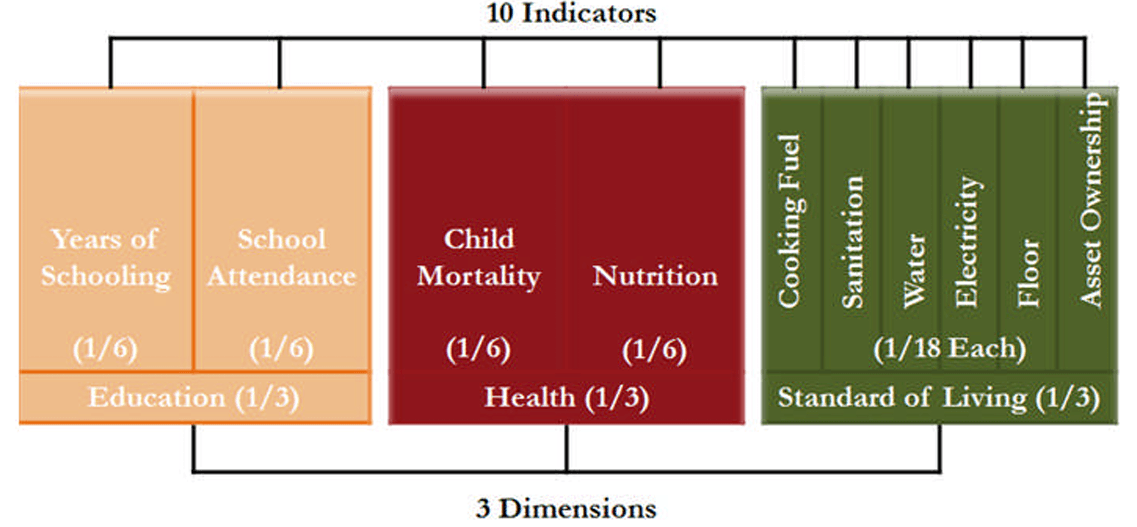
MPI: UNDP-OPHI index measuring simultaneous deprivations in health, education, living-standards across 109 countries

2025 edition: first overlay of high heat, drought, floods, air-pollution hazard maps onto poverty data

India: sharp MPI fall yet large pockets facing combined poverty-climate risks; Kerala to declare extreme-poverty-free

Quick Facts for MCQs

Global Poverty Stats

  • Incidence: extreme poverty could nearly double by 2050 without mitigation
  • Middle-income hotspots: 55.5 % poor in lower-middle, 9 % in upper-middle group
  • Major gaps: 487 million children out of school, 635 million undernourished

India Highlights

  • Reduction: 415 million Indians exited MPI poverty between 2005-06 and 2019-21
  • Kerala model: 64 000 families mapped, micro-plans delivering housing, documents, livelihood aid
  • Ongoing concern: large regions concurrently suffer poverty, heat, floods, toxic air

Climate Overlap

  • Hazard frequency: 32 million people displaced by climate disasters in 2022 alone
  • Triple burden: poor areas lacking assets and social protection endure compounding shocks
  • Policy need: integrate poverty programmes with climate-resilient agriculture, insurance, infrastructure

Key Data Points

FeatureData-Point
Countries analysed109
Global population covered6.3 billion
Acutely multidimensionally poor1.1 billion (18.3 %)
Poor in middle-income nations64.5 %
Poor with 3-4 overlapping hazards309 million
India MPI fall55.1 % → 16.4 % (2005-06 vs 2019-21)
Fastest recent MPI reducerBenin (2017-18 → 2021-22)
Commonest deprivationClean cooking fuel – 970 million people
MPI poverty cut-off≥ 33.3 % weighted deprivation
Kerala extreme-poverty line< USD 3/day (2021 PPP)

Related UPSC Prelims PYQs

CDS_GK, GEO_GS 2026PYQ 1

According to the World Bank Poverty and Equity Brief (October 2025), 46% of India’s poor lived in which of the following States?

CDS_GK, GEO_GS 2023PYQ 2

According to the National Multi-dimensional Poverty Index (MPI) constructed by the NITI Aayog, a household is considered deprived if

Ready to practice?

Test your knowledge with our UPSC test series.

Start Free Trial