UPSC Current Affairs

11 topicsGS-2: 4GS-3: 7
0/11 done
GS-2Editorial

1.Fiscal Empowerment of Municipal Bodies (Municipal Finance)

The Hindu

What & Where

Urban Local Bodies (ULBs): constitutionally recognised city governments under 74th Constitutional Amendment Act, 1992.

Types: Nagar Panchayat, Municipal Council, Municipal Corporation across Indian States/UTs.

Context: Urban India generates ≈65 % GDP, yet ULBs control <1 % national tax revenue, causing fiscal mismatch.

Quick Facts for MCQs

Fiscal Imbalance

  • Grants-dependence: tied/discretionary transfers delay projects, hinder planning.
  • GST effect: octroi & entry tax subsumed, shrinking own revenue by ~19 %.
  • Service-fund gap: ULBs manage waste, housing, climate resilience without matching fiscal tools.

Legislative Framework

  • 74th CAA: Part IX-A, State Election Commissions, reservations, five-year polls ensured urban self-governance.
  • Finance Commissions: 12th FC pushed GIS-based property tax; 14th FC enabled vacant land levy authority.
  • Credit-rating lacuna: metrics ignore predictable state/central transfers, lowering borrowing potential.

Reform Measures

  • Incentive schemes: AMRUT 2.0 & SASCI reward property-tax reforms, bond issuance for capital projects.
  • Proposed fixes: treat shared taxes as stable income, allow GST compensation as borrowing collateral, adopt formula-based transfers.
  • Innovative finance: promote Social Stock Exchanges, Value Capture Financing, PPPs to fund urban infrastructure.

Key Data Points

FeatureData-Point
74th Amendment year1992
Constitutional articles243P–243ZG
Schedule listing ULB functions12th Schedule
Urban share of national GDP≈ 65 %
ULB share of national tax< 1 %
Revenue loss post-GST≈ 19 %
Mandatory ULB election cycle5 years
SASCI Part-IV release (2023-24)₹ 3,298.23 crore
Cities with municipal bondsAhmedabad, Pune, Surat, Hyderabad, Lucknow
Finance Commission urging vacant-land tax14th FC

Related UPSC Prelims PYQs

GS1 1995PYQ 1

89. Which one of the following is incorrect in respect of Local Government in India?

GS1 2012PYQ 2

Which of the following is/are among the noticeable features of the recommendations of the Thirteenth Finance Commission?

GS-2PolityQuick Bite

2.EPF Withdrawal Rules 2025 Update (EPF Withdrawal)

The Hindu
Illustration for EPF Withdrawal Rules 2025 Update (EPF Withdrawal)

What & Where

Employees’ Provident Fund (EPF): mandatory retirement‐cum-social-security savings for organised-sector workers across India.

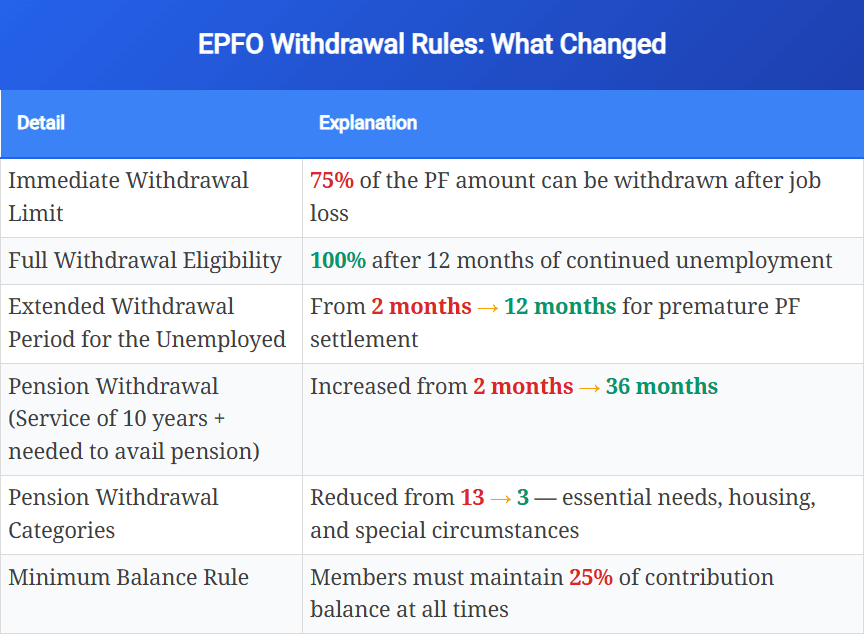
New 2025 withdrawal rules: 13 clauses collapsed into 3 purposes; access to both employee & employer shares with 25 % balance floor.

Administered nationwide by EPFO, a statutory body under Labour Ministry’s Central Board of Trustees.

Quick Facts for MCQs

Legal & Policy

  • Simplification: 13 disparate provisions merged, ensuring uniform interpretation and faster claim processing.
  • Employer-share access: statutory change lets members tap full accumulations instead of employee portion only.
  • CBT approval: guidelines issued under para 68 of EPF Scheme; no parliamentary amendment needed.

Economic Angle

  • Corpus protection: 25 % lock-in aims to curb premature depletion, boosting retirement adequacy.
  • Pension sustainability: 36-month wait discourages early pension withdrawals; tackles 50 % accounts < ₹20,000.
  • Liquidity boost: early, repeat advances for marriage, education, illness improve short-term cash without resorting to loans.

Social Concerns

  • Ease-of-living: fewer forms, online claim options accelerate funds during emergencies.
  • Inclusivity: housing category enables lower-income workers to mobilise down payments.
  • Financial discipline: staged access balances immediate needs with long-term security.

Key Data Points

FeatureData-Point
Governing ActEPF & Misc. Provisions Act, 1952
Eligibility thresholdEstablishments employing ≥ 20 persons
Contribution rate12 % wages each by employer & employee
New unemployment withdrawal75 % any time after exit
Full PF withdrawalAfter 12 months’ unemployment (was 2 months)
Pension corpus withdrawalOnly after 36 months (was 2 months)
Minimum balance rule25 % of own contributions must stay
Categories for advanceEssential needs, housing, special circumstances
EPFO tripartite chairUnion Labour & Employment Minister
EPFO schemesEPF-1952, EPS-1995, EDLI-1976
GS-3Economy

3.India’s Critical Minerals Geopolitics Strategy (Critical Minerals)

STV
Illustration for India’s Critical Minerals Geopolitics Strategy (Critical Minerals)

What & Where

Definition: Critical minerals = economically vital, supply-risk elements (rare earths, lithium, cobalt, gallium, germanium) powering EVs, defence, electronics.

Key processes: Mining → beneficiation → chemical refining → alloy/component manufacturing; processing is the main choke-point.

Core geography: China controls ~70 % mining & ~90 % refining; notable Indian reserves in Andhra Pradesh, Tamil Nadu, Rajasthan, Reasi (J&K).

Quick Facts for MCQs

Chinese Dominance

  • Monopoly: State-backed firms, subsidies, overseas mining stakes (Congo, Myanmar) ensure vertical resource control.
  • Weaponisation: Recurrent quotas/export bans convert market power into diplomatic leverage.
  • Tech fusion: Integrated EV, defence, electronics factories lock in downstream dependence.

Indian Strategy

  • Policy: Critical Minerals Mission 2023, KABIL JV, Atmanirbhar reforms push exploration & foreign asset acquisition.
  • R&D: Hub-and-spoke tie-ups with IITs, CSIR, GSI for eco-friendly extraction, recycling.
  • Circularity: Urban mining of e-waste proposed to recover lithium, cobalt, rare earths.

Allied Initiatives

  • US–Australia pact targets China-free lithium, cobalt, rare-earth supply chains.
  • Quad coordination aims diversified Indo-Pacific sourcing and stockpiles.
  • Bilateral mineral diplomacy: India engaging Namibia, Argentina, Afghanistan for strategic reserves.

Structural Challenges

  • Ecology: Radioactive, chemical waste from rare-earth mining threatens soil & water.
  • Capacity: India lacks modern metallurgical/refining plants, hindering value-chain climb.
  • Finance: High-risk, capital-heavy exploration deters private investment, slows scaling.

Key Data Points

FeatureData-Point
China share in global rare-earth mining≈70 %
China share in global rare-earth processing≈90 %
India share in world rare-earth reserves≈6 %
India share in world rare-earth output<1 %
Recent Indian lithium findReasi district, Jammu & Kashmir
2023 mission for domestic mineralsCritical Minerals Mission
JV securing overseas minesKABIL (Khanij Bidesh India Ltd.)
First Chinese export curb case2010 ban on Japan
Elements under current Chinese export restrictionGallium, Germanium
Quad forum handling mineral resilienceTech Working Group

Related UPSC Prelims PYQs

GS1 2012PYQ 1

Recently, there has been a concern over the short supply of a group of elements called ‘rare earth metals’. Why?

GS1 2025PYQ 2

Consider the following statements:

GS-3Environment

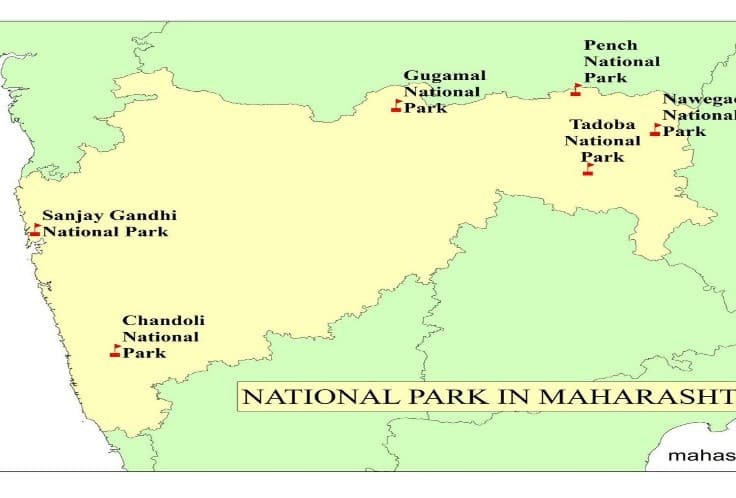
4.Sanjay Gandhi National Park Conservation (National Parks)

The Hindu
Illustration for Sanjay Gandhi National Park Conservation (National Parks)

What & Where

Protected-status: National park and reserved forest spanning 104 sq km inside Mumbai-Thane metropolitan zone

Location: Northern suburbs — Borivali, Malad, Kandivali, Bhandup, Mulund — stretching toward Thane city

Significance: Urban green lung buffering pollution, heritage host of Kanheri Caves, renamed Sanjay Gandhi in 1996

Quick Facts for MCQs

Legal & Policy

  • Committee: Bombay HC forms high-powered panel headed by ex-Allahabad CJ to curb SGNP encroachments
  • Mandate: periodic oversight, boundary demarcation, restoration of encroached zones within park limits

Biodiversity Profile

  • Flora: >1,000 species; teak, bamboo, Karvi dominating; seasonal Karvi mass bloom draws researchers, tourists
  • Fauna: 40 mammals incl. leopards, bonnet macaques; 250+ birds such as hornbills, drongos; reptiles, butterflies

Urban Ecology Value

  • Buffer: shields Mumbai from climate extremes, supports rainfall infiltration, sustains drinking-water lakes inside park
  • Sequestration: dense canopy absorbs CO2, mitigates air pollution in world's most densely populated metro belt
  • Microclimate: forest regulates urban heat, humidity, providing natural cooling corridors across northern suburbs

Key Data Points

FeatureData-Point
Area104 sq km
Renamed1996
StateMaharashtra
Karvi bloom cycle8 years
Mammal species~40
Bird species>250
Heritage siteKanheri Caves (1st c. BCE)
Ecological roleGreen lung for Mumbai

Related UPSC Prelims PYQs

CDS_GK, GS1 2025PYQ 1

‘नीलगिरि’, ‘सूट्र’ और ‘वायशार्क’ के बारे में निम्नलिखित में से कौन-सा कथन सही है?

CDS_GK, GS1 2017PYQ 2

पारिस्थितिक दृष्टिकोण से, पूर्वी घाटों और पश्चिमी घाटों के बीच एक अच्छा जैविक सम्पर्क किसके रूप में अधिक महत्त्व रखता है ?

GS-3Environment

5.Central Asian Mammals Initiative Conservation Plan (Migratory Species)

Down to Earth
Illustration for Central Asian Mammals Initiative Conservation Plan (Migratory Species)

What & Where

CAMI: CMS-backed framework conserving migratory/nomadic mammals across Central Asian steppe-desert-mountain belt.

Geography: 14+ range states from Mongolia to Iran; India participates for snow leopard & urial ranges.

Process: Joint six-year action plan tackling barriers, data gaps, poaching through transboundary coordination.

Quick Facts for MCQs

Legal & Policy

  • Alignment: Complements CMS, CITES, national wildlife laws for seamless cross-border enforcement.
  • Mechanism: National Action Plans, MoUs, data-sharing protocols mandated for signatories.
  • Barrier removal: Calls for wildlife-friendly fences, railway passes, corridor zoning.

Threats & Challenges

  • Fragmentation: Roads, railways, border fences disrupting centuries-old ungulate routes.
  • Illegal hunting: Poaching for horns, skins persists despite domestic bans.
  • Climate stress: Droughts, pasture loss escalating migration distances and mortality.

Species Focus

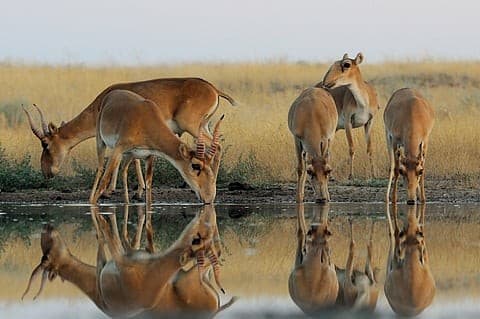
  • Ungulates: Saiga, Argali sheep, Urial critical for grassland health and predator prey-base.
  • Big cats: Snow leopard, Persian leopard flagged for apex-predator ecosystem balance.
  • Endemic camelids: Bactrian & Wild camel populations under 1,000; high extinction risk.

Stakeholders & Funding

  • Actors: Range-state ministries, IUCN SSC, WWF, Snow Leopard Trust collaborate.
  • Community role: Pastoralists engaged via incentive-based livestock insurance, anti-poaching patrols.
  • Finance: Seeks GEF, bilateral aid, eco-tourism revenues for corridor management.

Key Data Points

FeatureData-Point
Launch year2014 (CMS-COP11, Quito)
Latest revisionCOP13, Gandhinagar 2020
Plan period endorsed 20246 years (2024-29)
Governing treatyConvention on Migratory Species
Flagship species count17
Sample speciesSaiga antelope, Snow leopard, Wild camel
Key aimPreserve migratory connectivity
Participating region nickname“Serengeti of the North”
GS-3Environment

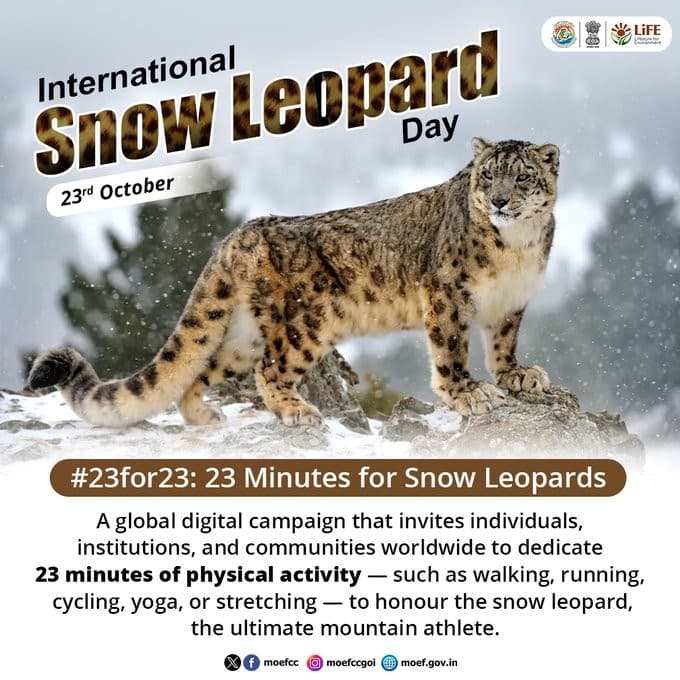
6.23for23 Snow Leopard Conservation Campaign (Snow Leopard)

PIB
Illustration for 23for23 Snow Leopard Conservation Campaign (Snow Leopard)

What & Where

Snow leopard (Panthera uncia) — medium-sized big cat of cold, arid Asian mountains, apex keystone of Himalayan ecology

Indian range spans UTs/states: Ladakh, J-K, Himachal Pradesh, Uttarakhand, Sikkim, Arunachal Pradesh between 3,000–5,000 m

2025 first national census mapped 718 individuals across entire Indian Himalayan landscape

Quick Facts for MCQs

Conservation Initiatives

  • Campaign #23for23 crowdsources citizen awareness for high-altitude ecosystem security
  • Project Snow Leopard anchors field actions, monitoring and compensation mechanisms
  • GSLEP provides transnational policy umbrella for 12 range countries

Population Insights

  • Ladakh alone houses ~66 % of national population ensuring continental stronghold
  • Combined Arunachal-Sikkim hold 61 individuals indicating eastern Himalayan niche importance
  • Jammu & Kashmir (ex-Ladakh) contributes 58, underscoring need for Pir Panjal habitat corridors

Species Traits

  • Morphology smoky-grey rosetted coat, 35–55 kg weight ensures cliff-face camouflage
  • Activity pattern solitary, crepuscular; dubbed Ghost of the Mountains for elusive behaviour
  • Ecological role regulates bharal, ibex herbivore numbers preventing overgrazing

Collaborations & Stakeholders

  • Local communities engaged via community-based tourism, predator-proof corrals, compensation funds
  • Scientific partners deploy camera traps, genetic scat analysis for non-invasive counts
  • Army and ITBP sensitised for habitat vigilance along high-altitude borders

Key Data Points

FeatureData-Point
Int’l Snow Leopard Day23 October
2025 campaign tag#23for23
Census lead agencyMoEFCC
Total snow leopards India718
Highest state/UT countLadakh – 477
Lowest recorded stateHimachal Pradesh – 51
IUCN statusVulnerable
Scientific namePanthera uncia
Global range countries12
Indian habitat altitude3,000–5,000 m
Unique vocal traitCannot roar
Breeding intervalEvery ~2 years
Cubs per litter1–2
Global platformGSLEP
Key NGO partnersWWF-India, Snow Leopard Trust

Related UPSC Prelims PYQs

GS1 2012PYQ 1

Consider the following :

GS-3Species

7.Pilot Whale Species Profile (Marine Mammals)

DD News

What & Where

Definition : Pilot whales are large oceanic dolphins of genus Globicephala, prone to group strandings.

Key species : Short-finned (G. macrorhynchus) in warm seas; Long-finned (G. melas) in cold–temperate oceans.

Core range : Atlantic, Pacific, Indian Oceans; coasts of Australia, New Zealand, Japan, India.

Quick Facts for MCQs

Biological Traits

  • Bulbous head and curved dorsal fin aid identification
  • Males remain lifelong in maternal pod, females may disperse slightly
  • Deep-diving physiology adapted for mesopelagic squid hunting

Conservation & Policy

  • Protected trade under CITES II requires export permits
  • CMS listing encourages international cooperation on migratory corridors
  • IUCN Least Concern but local threats include bycatch, naval sonar, climate shifts

Social & Cultural Angle

  • Māori iwi lead carcass recovery, impose rahui restricting beach use
  • Strandings elicit community rescue efforts due to whale sociability
  • Pods’ refusal to abandon injured members heightens mass mortality

Key Data Points

FeatureData-Point
FamilyDelphinidae
Adult male lengthUp to 7 m
Adult male weight> 2 tonnes
Social unit size20 – 100 individuals
Group typeMatrilineal pods
Dive depth≈ 1,000 m
Main dietSquid, small fish
IUCN statusLeast Concern
CITES listingAppendix II
CMS listingListed species
Short-finned habitatTropical & warm-temperate waters
Long-finned habitatCold-temperate & sub-polar waters
Recent stranding siteTwilight Beach, New Zealand
Cultural responseMāori rahui (spiritual closure)
Strandings cause linkStrong social cohesion/herding
GS-3EnvironmentQuick Bite

8.Global Forest Resources Assessment 2025 (Forest Assessment)

PIB

What & Where

GFRA 2025 = quinquennial FAO audit of world forest resources for policy, climate and biodiversity conventions

India: 9ᵗʰ largest forest area (72.7 mn ha) and 3ʳᵈ in annual forest gain

Largest forest holders: Russia 832.6 mn ha, Brazil 486 mn ha, Canada 368.8 mn ha

Quick Facts for MCQs

Legal & Policy

  • Forest (Conservation) Act 1980 mandates Centre approval for non-forest diversion
  • Wildlife (Protection) Act 1972 creates National Parks, Sanctuaries, Conservation Reserves
  • Forest Rights Act 2006 recognizes community rights to manage and conserve forests

Schemes & Missions

  • Green India Mission under NAPCC boosts ecosystem services and carbon sequestration
  • CAMPA channels diversion levies into compensatory afforestation projects
  • Ek Ped Maa Ke Naam public campaign urges tree planting honoring mothers

International Context

  • GFRA outputs feed UNFCCC, CBD and SDG reporting
  • Uses standardized national data ensuring comparability across 236 countries
  • Guides global sustainable forest management benchmarking

Key Data Points

FeatureData-Point
Assessment nameGlobal Forest Resources Assessment
Edition year2025
Conducting bodyFAO
FrequencyEvery 5 years
India forest area72.7 million ha
India rank (area)9ᵗʰ
India rank (annual gain)3ʳᵈ
Top countryRussia – 832.6 mn ha
SecondBrazil – 486 mn ha
ThirdCanada – 368.8 mn ha

Related UPSC Prelims PYQs

CDS_GK, ESE_GS 2023PYQ 1

There is an increase in forest cover area of India between 2011 and 2021. However, there is a decrease in forest cover area of India during the same period in

CDS_GK, ESE_GS 2026PYQ 2

According to Environmental Accounting on forest 2025 report, which state showed the highest rise in Recorded Forest Area (RFA) share?

GS-2Editorial

9.United Nations 80th Anniversary Reflection (United Nations)

The Hindu

What & Where

Organisation; inter-governmental body created 1945 to prevent war and uphold international law

Geography; HQ New York City, major offices Geneva, Vienna, Nairobi

Membership; 193 states today, up from 51 Charter signatories

Quick Facts for MCQs

Historical Evolution

  • Cold-War; forum for US-USSR rivalry yet advanced decolonisation resolutions
  • Post-1991; peacekeeping/humanitarian ops in Namibia, East Timor broadened remit
  • 21st century; priorities include climate, sustainable development, digital ethics

Indian Engagement

  • Peacekeeping; over 200,000 Indians served, highest fatalities among troops
  • Soft-power; Yoga Day, Vaccine Maitri bolster UN ideals of shared humanity
  • Reform push; champions G4 + African seat, equity for Global South

Structural Challenges

  • UNSC veto; P5 blockage on Ukraine, Gaza, Syria stalls action
  • Finance; arrears trigger WFP, WHO cutbacks, staff furloughs
  • Bureaucracy; centralised, slow systems ill-suited for pandemics, cyber threats

Key Data Points

FeatureData-Point
Founding date24 Oct 1945
80-year span1945 – 2025
Principal veto organUN Security Council (P5)
Current members193
India’s statusOriginal member; top-three troop contributor
Key norm textsUDHR 1948, SDGs 2015-30
Reform demandNew permanent seats: India, Brazil, Japan, Africa
Typical funding gap causeDelayed US assessed dues

Related UPSC Prelims PYQs

GEO_GS, GS1 2024PYQ 1

Which one among the following statements about the United Nations (UN) is not correct?

GEO_GS, GS1 2005PYQ 2

Consider the following statements:

GS-2Polity

10.UNESCO Anti-Doping Convention Overview (UNESCO Anti-Doping)

DD News

What & Where

Treaty: UNESCO International Convention against Doping in Sport curbs performance-enhancing drug use worldwide.

Adoption: Agreed 19 Oct 2005 at 33rd UNESCO General Conference, Paris; effective 1 Feb 2007.

Coverage: 192 States Parties, second-most-ratified UNESCO pact; India sits in Asia-Pacific Bureau seat.

Quick Facts for MCQs

Legal & Policy

  • Alignment: States must legislate per WADA Code for uniform anti-doping rules.
  • Objective: Harmonise global standards, ensure level playing field and athlete health.
  • Oversight: Convention monitors emerging risks like gene doping.

Governance & Bodies

  • COP: Biennial meeting elects Bureau, Approval Committee, sets compliance strategy.
  • Bureau: Five regional vice-chairs; India re-elected for Group IV through 2025.
  • Partners: Cooperates with WADA, IOC for policy synchronisation.

Funding & Cooperation

  • Fund: Anti-Doping Fund supports capacity-building, education, research projects.
  • Cooperation: Encourages government, sport bodies, labs to share data and best practices.
  • Support: UNESCO offers technical assistance for national anti-doping programmes.

Key Data Points

FeatureData-Point
COP session10th COP, Paris
India’s roleVice-Chairperson, Bureau Group IV (Asia-Pacific)
Adopted on19 Oct 2005
Entered into force1 Feb 2007
States Parties192
Funding toolAnti-Doping Fund
Core legal anchorWorld Anti-Doping Code
Oversight bodiesCOP Bureau & Approval Committee

Related UPSC Prelims PYQs

GS1 2019PYQ 1

निम्नलिखित कथनों पर विचार कीजिए :

GS-3Security

11.Defence Procurement Manual 2025 Highlights (Defense Procurement)

Business Standard
Illustration for Defence Procurement Manual 2025 Highlights (Defense Procurement)

What & Where

Defence Procurement Manual 2025: revenue-procurement rulebook for Armed Forces/MoD entities, supersedes DPM 2009.

Scope: goods, services, ICT, consultancy; annual outlay ≈ ₹1 lakh crore.

Geography: released New Delhi; applies to all India-based defence establishments from 1 Nov 2025.

Quick Facts for MCQs

Ease of Doing Business

  • Streamlined procedures expedite decisions, trim bureaucratic layers.
  • Vendor access simplified via NOC removal and higher limited-tender threshold.
  • Start-ups/MSMEs actively encouraged through relaxed entry barriers.

Indigenisation Push

  • Assured multi-year orders incentivise domestic R&D and manufacturing.
  • Lower LD rate tailored to nurture indigenous projects’ cash-flows.
  • Chapters on Innovation anchor Aatmanirbhar Bharat goals.

Penalty Regime

  • LD ceiling reduced from earlier 0.5 %/week to 0.1 % for indigenisation.
  • Overall LD now capped at 10 %, balancing deterrence with vendor viability.

Structural Format

  • Volume I houses core rules; Volume II nests forms, appendices, MoD orders.
  • Separate chapters clarify ICT buys and consultancy procurement norms.

Key Data Points

FeatureData-Point
Effective date1 Nov 2025
ReplacesDPM 2009
Annual procurement covered~₹1 lakh crore
Liquidated Damages cap10 % (major delays)
LD rate for indigenisation0.1 % per week
Limited Tender ceiling₹50 lakh
Assured long-term ordersUp to 5 years +
NOC from OFBNo longer required
Upfront growth for repairs15 % (ships, aviation overhaul)
Document structure2 Volumes (Provisions; Forms & Orders)
New chapters addedInnovation & Indigenisation, ICT Procurement, Consultancy

Ready to practice?

Test your knowledge with our UPSC test series.

Start Free Trial