UPSC Current Affairs

15 topicsGS-1: 1GS-2: 4GS-3: 10
0/15 done
GS-2PolityQuick Bite

1.16th Finance Commission Tenure Extended (Finance Commission)

Economic Times

What & Where

Finance Commission (FC): constitutional body under Article 280, formed by President to recommend Centre-State fiscal devolution

Reconstituted every five years or earlier; report laid before both Houses of Parliament

16th FC chaired by economist Arvind Panagariya; coverage period 1 Apr 2026 – 31 Mar 2031

Quick Facts for MCQs

Composition & Eligibility

  • Chairman experience: public affairs per 1951 Act
  • Other members: expertise as HC judge, finance & accounts, financial administration, economics
  • Members hold office for period set by President; reappointment permissible

Mandated Functions

  • Tax devolution: vertical and horizontal distribution criteria
  • Grants-in-aid principles under Article 275
  • Measures to augment resources of Panchayats and Municipalities

Timeline Updates

  • Government order: tenure extended by one month to finalise recommendations
  • Report submission now aligned with parliamentary winter session calendar

Key Data Points

FeatureData-Point
Constitutional articleArticle 280
Constituting authorityPresident of India
Usual periodicityEvery 5 years
Current commission number16th
ChairpersonArvind Panagariya
Statutory member count1 Chairperson + 4 members
Extension grantedTill 30 Nov 2025
Original report due31 Oct 2025
Coverage cycleFY 2026-27 to FY 2030-31
Key law on qualificationsFinance Commission Act 1951

Related UPSC Prelims PYQs

CAPF_GAI, GS1 2024PYQ 1

Population of the year 2011 was first introduced in the tax devolution formula for sharing Union tax revenue with the States by

CAPF_GAI, GS1 2002PYQ 2

Which one of the following authorities recommends the principles governing grants-in-aid of the revenues to the states out of the Consolidated Fund of India?
GS-3Economy

2.Urban Fiscal Architecture Challenges (Municipal Finance)

The Hindu

What & Where

Urban fiscal architecture: assignment of tax powers, grants, borrowing limits to India’s 4,800+ Urban Local Bodies (ULBs).

Anchored in 74th Constitutional Amendment; actors include municipal corporations, municipalities and nagar panchayats.

Pan-India scope; case studies cite Mumbai, Bengaluru, Pune.

Quick Facts for MCQs

Revenue–Responsibility Gap

  • Dependence: ULBs derive >75 % budgets from state/central transfers (CAG 2024).
  • Bengaluru faces ₹3,000 cr annual service-delivery deficit (NITI Aayog 2023).
  • Property/professional tax hikes need state nod, delaying mobilisation.

GST Impact

  • GST 2017 subsumed octroi, entry tax, surcharges—30 % of Mumbai revenue vanished overnight.
  • No direct GST-loss compensation to ULBs; flows retained by states.
  • Overall 19 % municipal own-revenue erased, deepening centralisation.

Municipal Bonds

  • Only 40 + cities tapped bond market; Pune’s 2017 ₹200 cr issue pioneered.
  • Credit ratings prize “own revenue,” ignore constitutionally assured grants, depressing scores.
  • Global lenders push property tax & user-charges as self-reliance model.

Reform Roadmap

  • Call for formula-based GST compensation via 16th Finance Commission.
  • Proposed Municipal Financing Authority patterned on Sweden’s Kommuninvest for pooled low-cost loans.
  • RBI-led governance-weighted credit index to replace revenue-centric ratings.

Key Data Points

FeatureData-Point
Cities’ share in national GDP66 %
ULB share in total tax revenue< 1 %
Municipal revenue sources lost to GST19 %
Budget share from transfers (avg.)> 75 %
Mumbai octroi loss post-GST₹7,000 cr/yr
Cities that have issued muni-bonds40 +
Property-tax coverage, Tier-II60–65 %
Smart City funds centrally monitored70 %

Related UPSC Prelims PYQs

CAPF_GAI, GS1 2024PYQ 1

Arrange the following sources of revenue of the Central Government in ascending manner in terms of percentage contribution to the total revenues of the Central Government in 2023-24:

CAPF_GAI, GS1 2012PYQ 2

Which of the following is/are among the noticeable features of the recommendations of the Thirteenth Finance Commission?

GS-3Economy

3.Minimum Support Price Reforms (MSP Policy)

PIB

What & Where

MSP: Government floor price for 22 crops + FRP sugarcane, guaranteeing ≥50 % profit over cost.

Process: CACP (1965) recommends; CCEA chaired by PM approves; procurement via FCI, NAFED, CCI, JCI.

Current move: RMS 2026-27 aims 297 LMT buy, pivot to pulses-oilseeds self-sufficiency.

Quick Facts for MCQs

Policy Evolution

  • Diversification: Higher MSP for ragi, mustard, nigerseed to shift from water-hungry paddy.
  • Inclusion: Cotton & jute have no procurement ceiling; new emphasis on nutri-cereals.
  • Scale-up: Procurement volume up 54 % in a decade.

Fiscal & Implementation Issues

  • Costly-procurement: Heavy FCI subsidy burden; storage costs balloon.
  • Skewed-benefit: Few states, mainly wheat-rice, corner majority MSP gains.
  • Inefficient-reach: 94 % farmers outside MSP safety net.

Tech & Schemes

  • Digitisation: e-Samriddhi, e-Samyukti, Kapas Kisan App enable online registration, quality check, DBT payments.
  • PM-AASHA: PSS arm ensures pulses, oilseeds, copra procurement with enhanced funding.

Key Data Points

FeatureData-Point
MSP formula since2018-19 (1.5 × cost)
Mandated MSP crops14 Kharif + 6 Rabi + 2 commercial = 22
CACP set-up year1965
FY 2024-25 MSP beneficiaries1.84 crore farmers
Foodgrains bought 2014-15761 LMT
Foodgrains bought 2024-251,175 LMT
RMS 2026-27 target297 LMT
PM-AASHA budget rise₹45,000 cr → ₹60,000 cr
Pulses self-sufficiency goal2027 (100 % procurement till 2028-29)
Farmers actually getting MSP (Shanta Kumar)6 %

Related UPSC Prelims PYQs

CAPF_GAI, GS1 2020PYQ 1

Consider the following statements :

CAPF_GAI, GS1 2021PYQ 2

किसानों को प्रोत्साहन देने के लिए प्रत्येक वर्ष विभिन्न फसलों के लिए सरकार द्वारा घोषित की जाने वाली कीमत को क्या कहते हैं?

GS-1MappingQuick Bite

4.Mount Lewotobi Laki-laki Volcano (Pacific Ring Volcanism)

TW
Illustration for Mount Lewotobi Laki-laki Volcano (Pacific Ring Volcanism)

What & Where

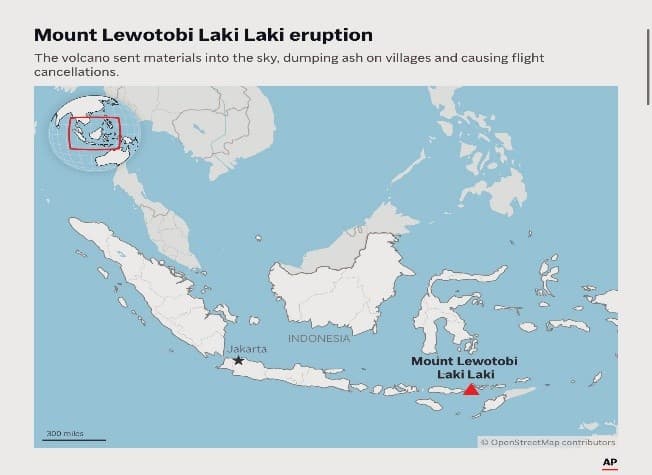
Definition: Active stratovolcano, male peak of Lewotobi complex on Flores Island, Indonesia

Process: Built by Indo-Australian subducting under Eurasian along Sunda–Banda Arc within Pacific Ring of Fire

Geography: ~30 km southeast of Maumere, East Nusa Tenggara; summit elevation 1 584 m

Quick Facts for MCQs

Geology & Tectonics

  • Subduction: Indo-Australian plate under Eurasian along Sunda–Banda Arc driving magma generation
  • Structure: Composite cone with summit craters <2 km apart forming husband–wife pair
  • Eruptions: Explosive style producing pyroclastic flows, ash plumes, volcanic bombs

Disaster Impact

  • Aviation: 10 km high ash column threatens flight routes, triggers highest alert level, potential closure
  • Evacuation: Surrounding villages, agriculture, livestock periodically relocated due to ashfall and lahars
  • Economy: Crop damage and transport disruption impose recurring recovery costs on regional communities

Cultural Context

  • Folklore: Male Laki-laki and female Perempuan peaks symbolize balance, duality in Flores oral traditions
  • Identity: Volcano complex features in local rituals, influencing names of nearby settlements

Key Data Points

FeatureData-Point
Volcano typeStratovolcano
Twin counterpartLewotobi Perempuan (female)
Elevation1 584 m
IslandFlores
ProvinceEast Nusa Tenggara
Distance from Maumere~30 km SE
Latest ash plume10 km height
Alert statusLevel IV highest
Plate boundaryIndo-Australian vs Eurasian
Volcanic arcSunda–Banda
GS-3Environment

5.IUCN Lists Western Ghats, Manas, Sundarbans (World Heritage Outlook)

The Hindu

What & Where

IUCN World Heritage Outlook: 3-4-yearly global check-up on natural UNESCO sites’ health.

Uses four status tags: Good; Good w/ Some Concerns; Significant Concern; Critical.

Outlook-4 (2025) flags Western Ghats, Manas NP, Sundarbans NP as Significant Concern for India.

Quick Facts for MCQs

Threat Profile

  • Climate change now supersedes hunting as prime Asian pressure.
  • Tourism load and invasive alien species rank second and third respectively.
  • Roads/railways fragment habitats, spike wildlife mortality, newly enter threat leaderboard.

Site-Specific Issues

  • Western Ghats: 5 % evergreen-forest loss, urbanisation, linear projects escalate stress.
  • Manas NP: habitat degradation, poaching, floods, invasives along India-Bhutan landscape.
  • Sundarbans NP: sea-level rise, shoreline erosion, tourism footprint heighten risk.

India Status

  • Single ‘Good’ rating restricts India to 1/7 natural sites.
  • Four marquee parks hold ‘Good w/ Some Concerns’, needing focused mitigation.
  • Rising threat spectrum signals urgency despite unchanged overall category mix.

Key Data Points

FeatureData-Point
Assessment cycleEvery 3–4 years
Current editionWorld Heritage Outlook 4 (2025)
Asian sites evaluated63
Indian natural WHS total7
‘Good’ Indian siteKhangchendzonga NP, Sikkim
‘Good w/ Some Concerns’ IndiansKaziranga; Nanda Devi; Valley of Flowers; Keoladeo; Great Himalayan NP
‘Significant Concern’ IndiansWestern Ghats; Manas NP; Sundarbans NP
Asia share in Significant Concern26 % (2020) → 30 % (2025)
Top widespread threatClimate change
New top-5 threatRoads & railways

Related UPSC Prelims PYQs

GEO_GS, NDA_GAT 2022PYQ 1

The International Union for Conservation of Nature (IUCN) has recently categorized the Red Sanders (Red Sandalwood) into

GEO_GS, NDA_GAT 2024PYQ 2

According to IUCN Red list, a ‘vulnerable’ species is one which:

GS-3Environment

6.Forest Declaration Assessment 2025 Findings (Global Deforestation)

Indian Express
Illustration for Forest Declaration Assessment 2025 Findings (Global Deforestation)

What & Where

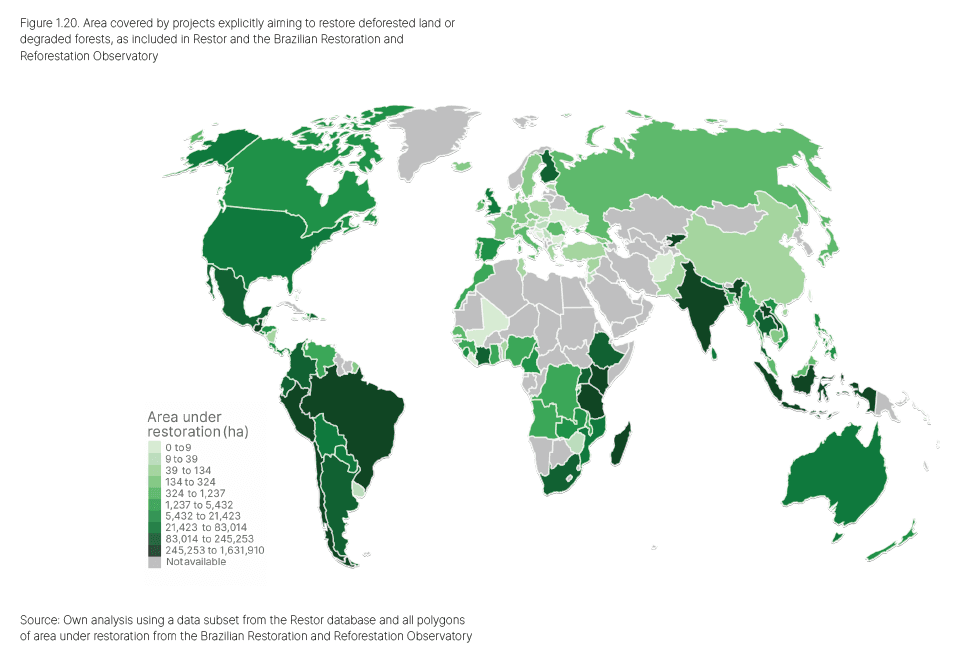
Assessment: Annual Forest Declaration Assessment gauges progress toward zero deforestation by 2030 under Glasgow + Kunming-Montreal pledges

Scope: Tracks forest loss, degradation, emissions, restoration; uses satellite data and national reports

Geography: 94 % of 2024 deforestation in tropical Latin America, Africa, SE-Asia

Quick Facts for MCQs

Status Indicators

  • Integrity Global deforestation + degradation equal 150 % of US energy CO₂ emissions
  • Biodiversity Primary-forest loss threatens endemic species, raises extinction risk
  • Restoration Current pace insufficient for 2030 Kunming ‘30 × 30’ target

Drivers

  • Agriculture Pasture, soy, palm conversions explain 86 % forest clearing
  • Extractives Mining, roads fragment habitats, spur illegal logging influx
  • Governance Weak law-enforcement, land speculation, corruption accelerate loss

Restoration & Tech

  • Frameworks FAO-FERM, Restor, GFW enable near-real-time monitoring
  • Models Agroforestry, community-led projects marry livelihoods with carbon storage
  • Regional >70 % restoration projects situated in Latin America and Asia

Finance & Policy

  • Subsidies Present incentives still favour expansion over conservation; reforms urged
  • Legalities Call for binding national laws with measurable audits, transparent reporting
  • Rights Recognising Indigenous tenure boosts sustainable, inclusive forest governance

Key Data Points

FeatureData-Point
Global deforestation 20248.1 million ha
Forest degradation 20248.8 million ha
Off-track level (zero-loss 2030)63 % behind
Carbon emitted 20243.1 Gt CO₂e
Share of tropical regions94 % total loss
Primary forest destroyed6.7 million ha
fKBA tree-cover loss2.2 million ha
Agriculture driver share86 %
Area under restoration10.6 million ha
Restoration vs potential0.3 % achieved
Amazon 2024 fire emissions791 Mt CO₂e
Climate finance to forests<10 % share
India restoration goal 203026 million ha

Related UPSC Prelims PYQs

GS1, NDA_GAT 2021PYQ 1

With reference to the ‘New York Declaration on Forests’, which of the following statements are correct?

GS1, NDA_GAT 2022PYQ 2

The forests of Uttarakhand, Kullu Valley in Himachal Pradesh and Dzukuo Valley in Nagaland and Manipur were in the news on account of which one of the following reasons?

GS-3Environment

7.Graded Response Action Plan (Air Pollution Control)

The Hindu
Illustration for Graded Response Action Plan (Air Pollution Control)

What & Where

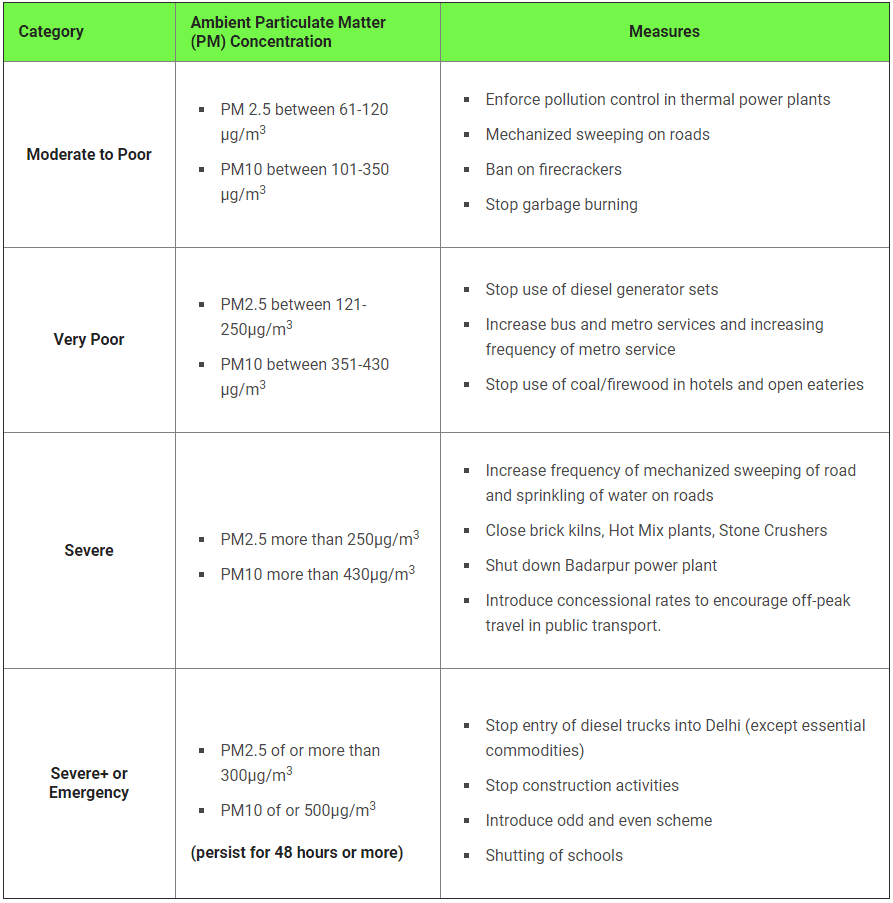
Framework: Graded Response Action Plan (GRAP) for staged pollution control in Delhi–NCR.

Categories: Moderate-Poor, Very Poor, Severe, Severe+/Emergency; actions cumulative and invoked after 48-hr threshold breach.

Geography: Delhi plus NCR districts of Haryana, Punjab, Rajasthan, Uttar Pradesh.

Quick Facts for MCQs

Legal & Policy

  • Statute: CAQM Act gives legal backing, replacing ad-hoc EPCA directives.
  • Nature: GRAP notification under Environment (Protection) Act for compulsory compliance.
  • Incrementality: Moving to higher AQI band mandates retention of all lower-band measures.

Institutional Setup

  • CAQM: Apex multi-state body coordinating pollution curbs, monitoring, enforcement.
  • Members: Secretaries of MoEF&CC, MoRT&H, CPCB Chair, chief secretaries of five states.
  • Reporting: CAQM submits periodical status to Supreme Court and Parliament.

Fiscal Levers

  • EPC: Aims to discourage large diesel SUVs, channel funds to air-quality programmes.
  • ECC: Designed to divert through-traffic away from Delhi, fund pollution mitigation.

Operational Triggers

  • Moderate-Poor: Vacuum road sweeping, dust suppression, waste burning ban.
  • Very Poor: Generator ban, enhanced parking fee, increased bus/metro frequency.
  • Severe & above: Construction halt, odd-even for cars, entry ban on heavy trucks.

Key Data Points

FeatureData-Point
Notification year2017
Originating SC caseM.C. Mehta vs Union of India (2016)
Parent ministryMoEF&CC
Current oversight bodyCommission for Air Quality Management (since 2020)
Pre-2020 overseerEPCA
Newest AQI tierSevere + / Emergency
Persistence needed to trigger GRAP48 hours in given AQI band
EPC on ≥2000 cc diesel cars1 % of sale price (2016)
ECC on trucks entering DelhiImposed 2015
States coveredDelhi, Haryana, Punjab, Rajasthan, Uttar Pradesh

Related UPSC Prelims PYQs

GEO_GS, GS1 2022PYQ 1

WHO के वायु गुणवत्ता दिशानिर्देशों के संदर्भ में, निम्नलिखित कथनों पर विचार कीजिए :

GEO_GS, GS1 2022PYQ 2

Which of the following major parameters are considered while deriving the Air Quality Index (AQI) of an area in India?

GS-3Economy

8.India's Biotech Startup Boom (Biotech Industry)

The Hindu
Illustration for India's Biotech Startup Boom (Biotech Industry)

What & Where

Biotechnology: integration of biology, engineering, AI for health, agriculture, energy, manufacturing

India: 94 incubators across 25 States; key clusters Bengaluru, Hyderabad Genome Valley, Mumbai–Pune corridor

Policy locus: BioE3 2025 and BIRAC under Dept. of Biotechnology target $300 bn bioeconomy by 2030

Quick Facts for MCQs

Growth Metrics

  • Exponential: 20-fold startup rise 2018-25 driven by low-cost R&D and STEM talent
  • AI adoption: Startups using AI/data analytics for faster drug discovery, diagnostics
  • Vaccine dominance: India maintains Pharmacy of World status with DPT, BCG, measles exports

Schemes & Policies

  • BioE3: Unified bio-manufacturing, agri, energy, pharma aligned with SDG, Atmanirbhar Bharat
  • BIRAC programmes: BIG, SBIRI offer seed, grants, incubation to early-stage firms
  • PLI & FDI: Incentivise domestic inputs; allow global investors 100 % equity

Bottlenecks

  • Funding gap: Scarce Series B/C money stalls lab-to-market transition
  • Fragmented infra: Few end-to-end GMP or pilot plants; startups shuttle cities
  • Regulatory lag: Outdated trial, patent rules delay CRISPR, gene therapy approvals

Reform Agenda

  • Cluster creation: Bio Commons in Genome Valley, Mumbai–Pune to pool GMP, QA, regulators
  • Financing tools: National Bio-Venture Fund using blended equity, venture debt, insurance capital
  • Talent pullback: Reverse brain drain via tax breaks, relocation grants, micro-credential upskilling

International Benchmarks

  • Boston, Seoul clusters cut scale-up costs 25 % through shared facilities
  • EU AI Act, US FDA adaptive models guide proposed Indian risk-based regulation
  • Israel Return Home Program increased R&D workforce 20 %; template for India’s talent schemes

Key Data Points

FeatureData-Point
Startup count500 (2018) → 10,000 (2025)
Incubators94 in 25 States
Global vaccine share60 % of immunisation doses
Bioeconomy target$300 bn by 2030
BIRAC-backed startups6,000+
PLI focusBulk drugs & critical raw materials
FDI rule100 % automatic route in biotech
Scale-up funding 2023-25India $3 bn; China $12 bn
PhD brain drain>40 % move abroad
EMA-approved biosimilars15 % of Indian submissions

Related UPSC Prelims PYQs

CAPF_GAI, CDS_GK 2024PYQ 1

Biotechnological research is promoted through the development of "Biotechnology Parks". Which of the following is/are essential to bring technology to market?

CAPF_GAI, CDS_GK 2020PYQ 2

Which one of the following Indian institutes was approved by the Drugs Controller General of India for conducting human trials of the Oxford-AstraZeneca Covid-19 vaccine candidate?

GS-3S&T

9.Ring Formation Around Chiron (Outer Solar Objects)

DD News

What & Where

Centaur object Chiron (2060) — asteroid–comet hybrid — orbits Sun between Jupiter & Neptune.

Present path lies between Saturn & Uranus; completes one solar revolution in ~50 years.

Astronomers have now witnessed its ring system forming in real time.

Quick Facts for MCQs

Discovery & Classification

  • FirstCentaur discovered, triggering hunt for similar icy–rocky bodies
  • OfficialDesignation by Minor Planet Center as small Solar System body
  • HybridNature shows both asteroid solidity and cometary activity

Orbital & Physical Details

  • OrbitPeriod about 50 years between Jupiter and Neptune regions
  • SizeApprox 200 km diameter; mixture of rock, ice, organic compounds
  • CometaryActivity sporadic gas–dust jets observed near perihelion

Ring System

  • RingCount four; three dense inner, one diffuse outer structure
  • InnerRingRadii 273 km, 325 km, 438 km; outer ring near 1 400 km
  • FormationCause likely impact debris or surface ejecta coalescence

Scientific Significance

  • LiveObservation provides rare testbed for ring evolution theories
  • ComparativeInsight confirms rings not exclusive to giant planets
  • DiskDynamics study may refine models of satellite and planet formation

Key Data Points

FeatureData-Point
Discovery year1977
DiscovererCharles Kowal
Official designation(2060) Chiron
Object classCentaur
Mean diameter≈ 200 km
Orbital period≈ 50 years
CompositionRock, water ice, organics
Ring count4
Inner ring radii273 km, 325 km, 438 km
Outer ring radius≈ 1 400 km
Ring materialWater ice + dust
Probable ring originCollision/ejected debris
Other small-body ringsChariklo, Haumea, Quaoar
GS-3S&T

10.Quantum True Random Number Generation (Quantum Computing)

Indian Express

What & Where

True Random Numbers: sequences drawn from intrinsic quantum events; zero algorithmic predictability.

Global first generation on a commercial quantum computer by Raman Research Institute (RRI), Bengaluru, Oct 2025.

Falls under India’s National Quantum Mission (NQM, 2023-31) covering computing, communication, sensing, materials.

Quick Facts for MCQs

Tech & Schemes

  • Superposition, Entanglement, Tunnelling exploited for computing, sensing, secure links.
  • Hub-Spoke-Spike ensures centralized labs, project spokes, individual spikes for rapid scaling.
  • Quantum materials: superconductors, topological insulators, novel qubit devices targeted.

Security Dimension

  • Unpredictable TRNs block seed-based brute attacks, vital for post-quantum cryptography.
  • Protects critical infrastructure: banking, defence, satellites, IoT.
  • Replaces deterministic pseudorandom generators vulnerable to future quantum computers.

Commercial & Strategic

  • First major globally-relevant output from NQM boosts India’s quantum start-up ecosystem.
  • Scalable time-separated setup lowers cost, easing industry uptake.
  • Enhances India’s stature in global quantum standards and supply chains.

Key Data Points

FeatureData-Point
Lead institutionRaman Research Institute, Bengaluru
Experimental twistTime-separation in single particle replaces bulky spatial separation
Source of randomnessPhoton superposition / electron spin etc.
Core applicationQuantum-grade encryption, Quantum Key Distribution (QKD)
Mission umbrellaNational Quantum Mission, Ministry of S&T
NQM duration2023-24 → 2030-31
Target qubits20-50 (3 yrs), 50-100 (5 yrs), 50-1000 (8 yrs)
Secure link goalSatellite QKD up to 2000 km
Implementation modelHub-Spoke-Spike
T-Hub locationsIISc-BLR, IIT-Madras, IIT-Bombay, IIT-Delhi

Related UPSC Prelims PYQs

NDA_GAT 2022PYQ 1

for India's future P / mathematics and mathematical thinking Q / will be very important R / it is recognized that S

GS-2MiscQuick Bite

11.Ahmedabad Bid for 2030 Commonwealth Games (Commonwealth Games)

New Indian Express

What & Where

Commonwealth Games – quadrennial multi-sport meet for 56 Commonwealth nations, fostering peace and inclusivity.

2030 Centenary edition provisionally awarded to Ahmedabad, Gujarat, India.

Final host vote at Commonwealth Sport General Assembly, Glasgow, 26 Nov 2025.

Quick Facts for MCQs

Governance

  • Evaluation criteria: athlete experience, technical readiness, infrastructure, governance compliance.
  • Commonwealth Sport Executive Board recommended Ahmedabad; full membership retains final vote.
  • CGF oversees transparent ballot, simple-majority outcome.

Infrastructure

  • Showcase facilities: 1.32-lakh capacity Narendra Modi Stadium, new aquatics and football arenas.
  • Sardar Vallabhbhai Patel Sports Enclave designed as integrated, multi-discipline hub.
  • Planned upgrades target seamless athlete village, transport, broadcast readiness.

History

  • Games evolution: British Empire Games (1930) → Commonwealth Games (1978 onward).
  • Centenary return to India would end 20-year gap since 2010 edition.
  • Hamilton’s 1930 legacy underpins commemorative branding for 2030.

Development Agenda

  • Gujarat positioning itself as global sports capital under state sports policy.
  • Bid aligns with national economic blueprint Viksit Bharat 2047, leveraging sports-led urban regeneration.
  • Potential catalyst for tourism, youth sports participation, global visibility.

Key Data Points

FeatureData-Point
Edition year2030 (Centenary)
Recommended host cityAhmedabad, Gujarat
Rival finalist bidAbuja, Nigeria
Final decision date26 November 2025
Decision forumCommonwealth Sport General Assembly
Oversight bodyCommonwealth Games Federation
Event periodicityEvery 4 years
Member nations56
First Games venueHamilton, Canada (1930)
Original nameBritish Empire Games
India’s previous host2010 New Delhi Games
Flagship Ahmedabad venuesSardar Vallabhbhai Patel Sports Enclave; Narendra Modi Stadium
Vision linkageViksit Bharat 2047 initiative

Related UPSC Prelims PYQs

CDS_GK 2020PYQ 1

Which one of the following States is planned to host the Khelo India Youth Games (4th Edition)?

GS-3SecurityQuick Bite

12.Samudra Shakti 2025 Naval Exercise (Bilateral Exercises)

PIB
Illustration for Samudra Shakti 2025 Naval Exercise (Bilateral Exercises)

What & Where

Exercise Samudra Shakti; bilateral Indo-Indonesian naval drill testing high-end maritime operations

Fifth edition 2025 hosted by Eastern Naval Command at Visakhapatnam on Bay of Bengal coast

Embedded in India’s Act East Policy; targets Indo-Pacific interoperability and regional stability

Quick Facts for MCQs

Security Dimension

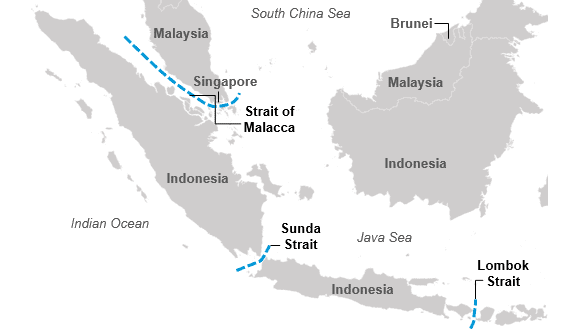
  • Enhancement of maritime domain awareness; strengthens patrols along critical Malacca Strait and Andaman Sea lanes
  • Deterrence against piracy, terrorism, illegal fishing; supports rules-based Indo-Pacific order
  • Showcases blue-water reach of both navies, signaling commitment to regional deterrence

Operational Features

  • Inclusion of live weapon firings, replenishment approaches, tactical ship manoeuvres for high-tempo sea readiness
  • Conducts Military Interdiction Operations and cross-deck helicopter landings validating joint boarding and aviation SOPs
  • Air-defence drills integrate ship sensors with embarked aircraft for layered defence envelope

Bilateral Defence Ties

  • Complements Garuda Shakti (armies) and IND-INDO CORPAT, creating land-sea continuum of cooperation
  • Deepening strategic partnership established through 2018 Comprehensive Strategic Partnership declaration
  • Advances India-ASEAN connectivity agenda; positions both nations as net security providers in eastern Indian Ocean

Key Data Points

FeatureData-Point
Exercise nameSamudra Shakti
Edition (2025)5th
Launch year2018
2025 host locationVisakhapatnam, Andhra Pradesh
Partner naviesIndia, Indonesia
Policy frameworkAct East Policy
Core operationsMIO, cross-deck landings, air-defence drills
Main objectiveInteroperability & Indo-Pacific peace
Related army drillGaruda Shakti
Joint maritime patrolIND-INDO CORPAT (Andaman Sea–Malacca Strait)

Related UPSC Prelims PYQs

CDS_GK 2023PYQ 1

The eighth edition of the Exercise Garuda Shakti, a bilateral military-to-military exercise, was conducted recently between the special forces of India and

CDS_GK 2023PYQ 2

The 16th edition of Indo-Nepal annual joint training exercise in jungle warfare and counter-terrorism operations was held in December 2022 at Nepal Army Battle School, Saljhandi. What is the name of this exercise?

GS-3Security

13.Declining Left Wing Extremism (Left Wing Extremism)

Indian Express

What & Where

Definition Maoism: communism variant pursuing state capture via protracted armed insurgency, mass mobilisation, strategic alliances.

Genesis Naxalite: 1967 Naxalbari peasant revolt; CPI(M) splinter launched armed challenge to Indian state.

Geographical spread: 126 violence-hit districts (2013) shrank to 18 in 2025; core pocket- Bastar division, Chhattisgarh.

Quick Facts for MCQs

Legal & Policy

  • Policy: 2015 National Policy-Action Plan integrates security, development, rights.
  • Strategy: SAMADHAN matrix aims Naxal-free Bharat, Growth Corridors by Mar 2026.
  • Proscription: CPI (Maoist) & fronts banned under UAPA 1967.

Security Dimension

  • Deployment: CAPFs, IR Battalions execute intel-led raids like Operation Black Forest (Kagar).
  • Infrastructure: Fortified police stations, security camps, night helipads funded via SIS & SRE.
  • Finance: NIA, ED disrupt extortion networks and arms-money trails.

Development Schemes

  • Roads: RRP-I & RCPLWE building 12,000-km network for access, commerce, patrol.
  • Telecom: Mobile coverage & 4G saturation for all LWE blocks due Dec 2025.
  • Abhiyan: Dharti Aaba 2024 upgrading amenities in 15,000 tribal villages.

Challenges

  • Terrain: Dense forests, hills hinder surveillance, ease guerrilla movement.
  • Governance: Limited services, corruption breed alienation exploitable by Maoists.
  • Propaganda: Insurgents leverage grievances, social media, fronts for recruitment.

Way Forward

  • Governance: Empower panchayats; expedite grievance redressal in tribal belts.
  • Livelihoods: Skill training, cooperatives, entrepreneurship schemes absorb rural youth.
  • Security: Tighten border checks on arms, funds; enhance inter-state intel fusion.

Key Data Points

FeatureData-Point
Peak affected districts 2013126
Affected districts Mar 202518 (6 “Most Affected”)
Incidents decline 2004-14 vs 2014-23> 50 %
National Policy & Action Plan2015
Elimination target yearMarch 2026
Largest Maoist outfitCPI (Maoist), 2004
Ban legislationUAPA 1967
4G reach to all LWE blocksDecember 2025
GS-2Scheme

14.Pradhan Mantri Jan Arogya Yojana (Health Insurance)

Times of India

What & Where

PM-JAY: Ayushman Bharat’s health-assurance arm, cashless secondary-tertiary care for poorest 40%.

Launched 23 Sep 2018, Ranchi; benefits portable across India’s empanelled hospitals.

NHA Conclave 2025: Chhattisgarh awarded best-performing state for near-zero claim pendency.

Quick Facts for MCQs

Scheme Features

  • Cashless, paperless treatment across public & private empanelled facilities.
  • Portability ensures beneficiary can avail services pan-India.
  • Pre-existing diseases covered from day one.

Eligibility & Beneficiaries

  • Socio-Economic Caste Census 2011 drives household inclusion.
  • Senior citizens 70+ auto-included irrespective of deprivation criteria.

State Performance

  • Chhattisgarh conducted 32,000+ claim audits for fraud control.
  • Near-zero pending claims highlighted by NHA ranking.

Key Data Points

FeatureData-Point
Annual cover₹5 lakh per family (floater)
Target families12 crore (≈55 crore persons)
Family size/age capNo limit
Medical procedures1,929 listed
Pre-/post-hospital care3 days + 15 days
Funding100% Govt; Centre–State cost share
Eligibility baseSECC-2011; + citizens ≥70 yr
Launch venueRanchi, Jharkhand
2025 best stateChhattisgarh
Active empanelled hospitals in CG97%

Related UPSC Prelims PYQs

CDS_GK, GEO_GS 2020PYQ 1

Which one of the following is not a feature of the Ayushman Bharat Scheme?

CDS_GK, GEO_GS 2020PYQ 2

Centrally sponsored scheme Ayushman Bharat is a national health insurance system for:

GS-2SchemeQuick Bite

15.Fare Se Fursat Airfare Scheme (Regional Aviation)

PIB

What & Where

Fare Se Fursat: fixed-fare scheme of government-owned Alliance Air, India

Provides single ticket price on regional routes, valid even for same-day bookings

Rolled out Oct 2025 by Civil Aviation Ministry to bolster UDAN connectivity

Quick Facts for MCQs

Tech & Schemes

  • Fixed-fare: eliminates dynamic pricing on Alliance Air routes
  • UDAN-link: pricing aligns with ₹2,500-per-hour affordable flying vision
  • Transparency: published tariffs remove hidden surcharges, boost consumer trust

Economic Angle

  • Revenue: Indian aviation forecast 15-20 % growth FY24, 10-15 % FY25
  • Traffic: Domestic passengers FY23 306.79 mn; international 69.64 mn
  • Affordability: Stable pricing expected to attract price-sensitive first-time rural flyers

Infrastructure Expansion

  • Airports: number rose 74 (2014) to 157 (2024)
  • Target: 350–400 operational airports by 2047, doubling connectivity
  • Regional: Scheme mainly feeds Tier-2/3 city network created under UDAN

Social Impact

  • Predictability: constant fares cut last-minute travel anxiety for families
  • Inclusivity: Scheme focuses middle & lower-middle income flyers
  • Migration: Improved connectivity may reduce rural-urban relocation pressures

Key Data Points

FeatureData-Point
LaunchOct 2025
Operator ownership100 % Government (Alliance Air)
Fare modelSingle constant price; no dynamic pricing
Policy linkageSupports UDAN “Ude Desh ka Aam Nagrik”
India’s domestic market rank3rd after USA, China
Operational airports 201474
Operational airports 2024157
Airport target 2047350–400
Domestic passengers FY23306.79 mn (+13.5 % YoY)
International passengers FY2369.64 mn (+22.3 % YoY)
Revenue growth outlook15–20 % FY24; 10–15 % FY25

Related UPSC Prelims PYQs

NDA_GAT 2022PYQ 1

उड़े देश का आम नागरिक (उड़ान) योजना के बारे में निम्नलिखित कथनों पर विचार कीजिए :

Ready to practice?

Test your knowledge with our UPSC test series.

Start Free Trial