
Who is the recipient of the 2023 International Prize in Statistics, considered equivalent to the Nobel Prize in Mathematics?
- (a)David R. Cox
- (b)Bradley Efron
- (c)Calyampudi Radhakrishna Rao
- (d)Nan Laird
Correct — C, Calyampudi Radhakrishna Rao (C.R. Rao). The Indian-American statistician — then 102 years old — was awarded the 2023 International Prize in Statistics, often described as the field's equivalent of a Nobel Prize (statistics has no Nobel category), for his foundational 1945 paper in the Bulletin of the Calcutta Mathematical Society, which established results — including the Cramér-Rao bound and the Rao-Blackwell theorem — that still underpin modern statistical theory nearly 80 years on.
- (a)David R. Cox — British statistician who won the inaugural International Prize in Statistics in 2017, for the Cox proportional hazards model — not the 2023 award.
- (b)Bradley Efron — US statistician who won the award in 2019, for developing the 'bootstrap' resampling method — not the 2023 award.
- (d)Nan Laird — US biostatistician who won the award in 2021, for methods of analysing longitudinal-study data — not the 2023 award.
The International Prize in Statistics, first awarded in 2017 and given once every two years, is jointly sponsored by leading statistical societies (including the American Statistical Association, Royal Statistical Society, Institute of Mathematical Statistics and the International Statistical Institute) to honour a major, lasting contribution to statistics. It is widely called statistics' equivalent of a Nobel Prize, since the Nobel Prizes have no dedicated statistics or mathematics category.
The question's four options are, in fact, all four real past laureates of this same prize — the trap is knowing only that each name is 'a famous statistician who won the prize', without pinning down which one won specifically in 2023.
- International Prize in Statistics: first awarded 2017, given once every two years.
- Past laureates in order: 2017 David Cox, 2019 Bradley Efron, 2021 Nan Laird, 2023 C.R. Rao.
- C.R. Rao won in 2023, aged 102, for his 1945 paper establishing the Cramér-Rao bound and the Rao-Blackwell theorem.
- Rao, born in 1920 in present-day Karnataka, is also a Padma Vibhushan (2002) recipient for his contributions to statistics.
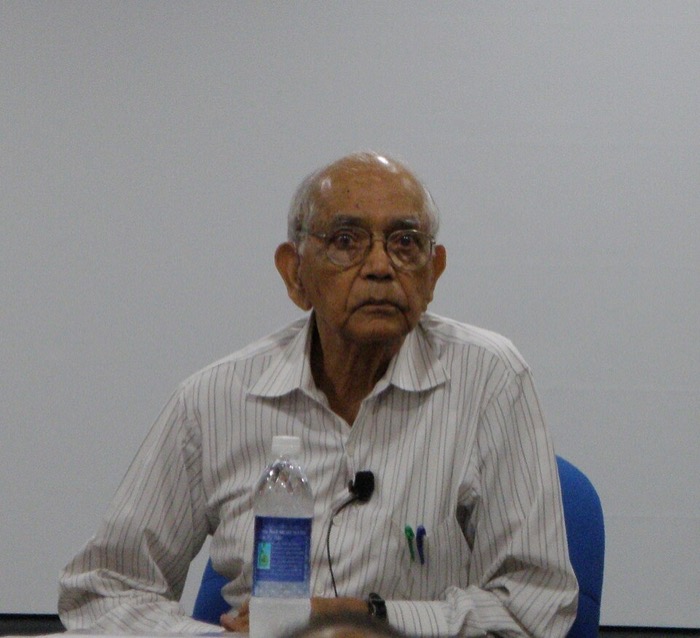
Awarded once every two years since 2017 — C.R. Rao is the fourth and most recent (2023) laureate, at age 102.
- Picking any name in the option set without matching it to its correct award year — all four options are genuine past laureates of this same prize.
- Confusing this statistics-specific prize with the Nobel Prize in Economics, a separate award some statistically-minded economists have also won.
MPPSC/UPSC often test 'who won award X in year Y' using a set of genuine past laureates as distractors — anchor each name to its exact year, not just the award's existence.
No directly related past PYQ was found in the UPSC store — the International Prize in Statistics is a niche current-affairs award without a matching UPSC prelims question.
- practice — not a real PYQ
C.R. Rao, the 2023 International Prize in Statistics laureate, is credited with establishing which of the following in his celebrated 1945 paper?
- (a)The Cramér-Rao bound and the Rao-Blackwell theorem
- (b)The bootstrap resampling method
- (c)The Cox proportional hazards model
- (d)The Central Limit Theorem
Answer(a) The Cramér-Rao bound and the Rao-Blackwell theorem.
- practice — not a real PYQ
The International Prize in Statistics, regarded as statistics' equivalent of a Nobel Prize, is awarded at what interval?
- (a)Annually
- (b)Once every two years
- (c)Once every four years
- (d)Once every five years
Answer(b) Once every two years — first awarded in 2017.