
Where is the most famous Kailash temple located among the cave temples?
- (a)In the caves of Ajanta
- (b)In the caves of Ellora
- (c)In the caves of Elephanta
- (d)In the caves of Kanheri
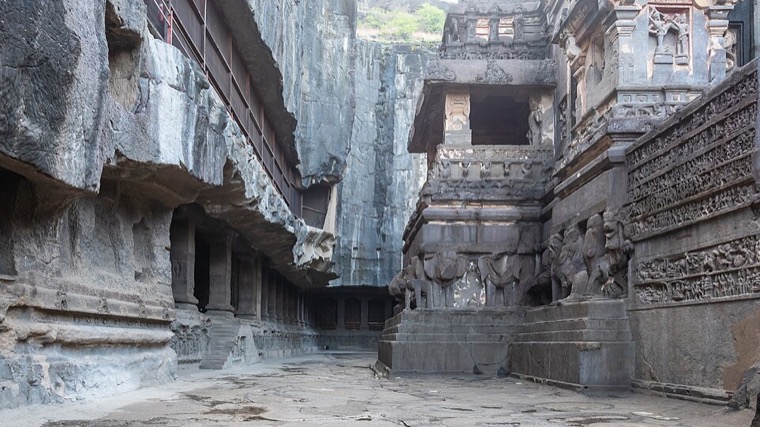
Correct — B, in the caves of Ellora. The Kailasa (Kailash) temple at Ellora — Cave 16 of the Ellora rock-cut complex in Maharashtra's Aurangabad (Chhatrapati Sambhajinagar) district — is a single, monolithic Hindu temple dedicated to Shiva, carved top-down out of one basalt rock face on the orders of the Rashtrakuta king Krishna I in the 8th century CE. It is the most celebrated shrine at Ellora, a UNESCO World Heritage site that uniquely combines Buddhist, Hindu, and Jain excavations together — which is why it is 'the most famous Kailash temple among the cave temples.'
- (a)In the caves of Ajanta — Ajanta (also in Maharashtra) is an exclusively Buddhist rock-cut complex, famed for its Gupta-era paintings and viharas/chaityas — it has no Kailash temple.
- (c)In the caves of Elephanta — Elephanta, an island off Mumbai, is a separate rock-cut complex known for Shaivite sculpture including the Trimurti — not the site of the Kailasa/Kailash temple.
- (d)In the caves of Kanheri — Kanheri, near Mumbai, is a large Buddhist monastic cave complex of stupas and viharas — again a distinct site, with no Kailash temple.
Western India's Deccan basalt hosted several major rock-cut cave complexes — Ajanta, Ellora, Elephanta, and Kanheri chief among them. Ellora is unusual for combining Buddhist, Hindu, and Jain excavations at one site; its most celebrated shrine is the Kailasa (Kailash) temple (Cave 16) — a single monolithic Shiva temple cut top-down out of the rock face, commissioned by the Rashtrakuta king Krishna I in the 8th century CE.
MPPSC/UPSC test whether students can match a named rock-cut shrine to its correct site among these similarly-described Deccan cave complexes — anchor each site's defining trait (Ajanta = Buddhist paintings, Ellora = multi-faith + the Kailasa temple, Elephanta = Shaivite sculpture, Kanheri = large Buddhist monastic complex) rather than treating them as interchangeable 'old cave temples'.
- Ellora Caves (Aurangabad/Chhatrapati Sambhajinagar district, Maharashtra) — a UNESCO World Heritage rock-cut complex with Buddhist, Hindu, and Jain shrines at one site.
- The Kailasa (Kailash) temple is Cave 16 at Ellora — a single monolithic Shiva temple carved top-down out of one rock, commissioned by Rashtrakuta king Krishna I (8th century CE).
- Ajanta Caves — exclusively Buddhist, famed for Gupta-era paintings and viharas/chaityas.
- Elephanta Caves — an island near Mumbai, primarily a Shaivite (Hindu) rock-cut complex, famous for the Trimurti sculpture.
- Assuming all Deccan rock-cut cave sites are interchangeable — each has a distinct religious/artistic identity.
- Mixing up Ellora's Kailasa temple with Elephanta's Trimurti sculpture — both are celebrated Shaivite rock-cut works but at different sites.
MPPSC/UPSC test precise site-identification for named rock-cut shrines or sculptures among Ajanta/Ellora/Elephanta/Kanheri — anchor each site to its one defining trait.
With reference to the history of Indian rock-cut architecture, consider the following statements: 1. The caves at Badami are the oldest surviving rock-cut caves in India. 2. The Barabar rock-cut caves were originally made for Ajivikas by Emperor Chandragupta Maurya. 3. At Ellora, caves were made for different faiths. Which of the statements given above is/are correct?
- (a) 1 only
- (b) 2 and 3 only
- (c) 3 only
- (d) 1, 2 and 3
Answer(c) 3 only
UPSC 2013 directly tests the same identifying fact — that Ellora, unlike other rock-cut sites, was excavated for different faiths — the same site-identification skill used here to place the celebrated Kailasa/Kailash temple at Ellora rather than Ajanta/Elephanta/Kanheri.
- practice — not a real PYQ
The monolithic Kailasa (Kailash) temple at Ellora, carved out of a single rock, was commissioned by which Rashtrakuta ruler?
- (a)Krishna I
- (b)Amoghavarsha
- (c)Govinda III
- (d)Dhruva
Answer(a) Krishna I — commissioned the rock-cut Kailasa temple in the 8th century CE.
- practice — not a real PYQ
The rock-cut sculpture of the Shiva Trimurti, one of the most celebrated works of Indian rock-cut art, is located at:
- (a)Ellora Caves
- (b)Ajanta Caves
- (c)Elephanta Caves
- (d)Kanheri Caves
Answer(c) Elephanta Caves.