
Which one of the following statements is NOT correct?
- (a)In case of differences of opinion amongst the Chief Election Commissioner and other Election Commissioners, the matter is decided by the Law Commission.
- (b)The Election Commissioners cannot be removed from their office except on the recommendation of the Chief Election Commissioner.
- (c)The Chief Election Commissioner and other Election Commissioners enjoy equal powers.
- (d)The term of office of Election Commissioners is six years from the date they assume office or till the day they attain the age of 65 years, whichever is earlier.
Correct — A is the statement that is NOT correct. Under the Election Commission (Conditions of Service of Election Commissioners and Transaction of Business) Act, 1991, if the Chief Election Commissioner and other Election Commissioners differ in opinion on any matter, the matter is decided by the majority opinion of the Commission — the Law Commission has no role in this process at all.
- (b)The Election Commissioners cannot be removed from their office except on the recommendation of the Chief Election Commissioner. — This is a true, constitutionally correct statement — under the proviso to Article 324(5), an Election Commissioner can be removed only on the CEC's recommendation — so it is not the incorrect statement being asked for.
- (c)The Chief Election Commissioner and other Election Commissioners enjoy equal powers. — This is also true — in the functioning of the multi-member Election Commission, the CEC and the other Election Commissioners have equal say in decisions, so this statement is correct and not the answer.
- (d)The term of office of Election Commissioners is six years from the date they assume office or till the day they attain the age of 65 years, whichever is earlier. — This correctly states the statutory tenure rule, so it is a true statement, not the incorrect one being asked for.
Article 324 vests the 'superintendence, direction and control of elections' in the Election Commission of India, a multi-member body (the CEC plus other Election Commissioners, as the President may fix). Their service conditions — salary, term, removal, and how disagreements are resolved — are laid out mainly in the Election Commission (Conditions of Service of Election Commissioners and Transaction of Business) Act, 1991.
'Which statement is NOT correct' questions on the ECI swap in one false detail among several true ones — usually a wrong duration, wrong age, or a wrong deciding authority. Anchor the exact figures rather than the general shape of the rule.
- Differences of opinion among the CEC and other ECs on any matter are resolved by majority opinion of the Commission — not by the Law Commission.
- An Election Commissioner (other than the CEC) can be removed only on the recommendation of the CEC (proviso to Article 324(5)).
- The CEC and other Election Commissioners enjoy equal powers in the functioning of the Commission.
- Term of office: six years from assuming office, or till age 65, whichever is earlier.
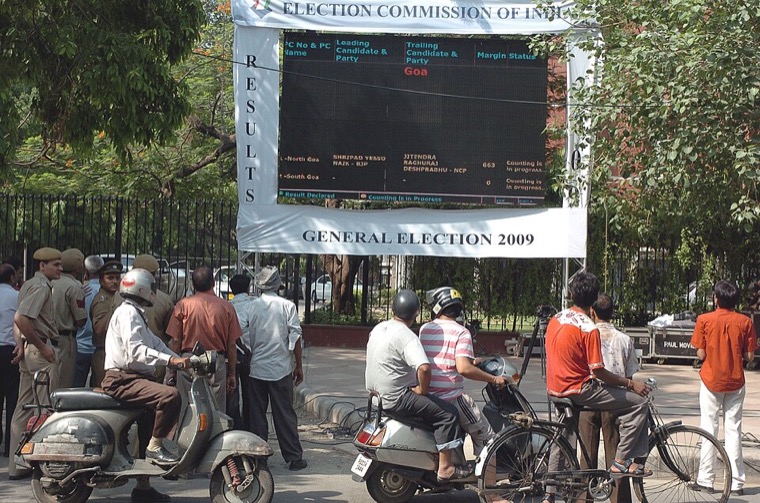
The false statement swapped the correct 'majority opinion' rule for a wrong deciding authority (Law Commission) — the other three statements are accurate.
- Assuming the CEC alone decides disagreements — it is actually the majority opinion of the full Commission
- Confusing the removal process of the CEC (impeachment-like) with that of other ECs (on the CEC's recommendation)
MPPSC/UPSC frequently frame ECI facts as 'which statement is NOT correct' — memorise the exact removal and term rules precisely, since options swap small details (e.g., five years vs six years, 62 vs 65, or a wrong deciding authority).
Consider the following statements with reference to India: 1. The Chief Election Commissioner and other Election Commissioners enjoy equal powers but receive unequal salaries. 2. The Chief Election Commissioner is entitled to the same salary as is provided to a judge of the Supreme Court. 3. The Chief Election Commissioner shall not be removed from his office except in like manner and on like grounds as a judge of the Supreme Court. 4. The term of office of an Election Commissioner is five years from the date he assumes office or till he attains the age of 62 years, whichever is earlier. Which of these statements are correct?
- (a) 1 and 2
- (b) 2 and 3
- (c) 1 and 4
- (d) 2 and 4
Answer(b) 2 and 3
UPSC 2002 tests the same set of Election Commission service-condition facts — equal powers, salary, removal protection, and the exact term/age figures — the same territory as this MPPSC question's true/false statements.
- practice — not a real PYQ
In case of a difference of opinion among the Chief Election Commissioner and other Election Commissioners on any matter, the matter is decided by:
- (a)The President of India
- (b)The Law Commission
- (c)The majority opinion of the Commission
- (d)The Chief Election Commissioner alone
Answer(c) The majority opinion of the Commission.
- practice — not a real PYQ
Under the Constitution of India, an Election Commissioner (other than the CEC) can be removed from office:
- (a)By the President without any recommendation
- (b)Only on the recommendation of the Chief Election Commissioner
- (c)By a Parliamentary impeachment process, like a Supreme Court judge
- (d)By the Chief Election Commissioner directly
Answer(b) Only on the recommendation of the Chief Election Commissioner (proviso to Article 324(5)).