
Who is the author of Yashodharman's Sondani inscription?
- (a)Kavi Madan
- (b)Vasul Kavi
- (c)Kakk
- (d)Ravikirti
Correct — B, Vasul Kavi. The Sondani pillar inscriptions, near Mandsaur (ancient Dashapura) in Madhya Pradesh, commemorate the 6th-century Malwa (Aulikara) king Yashodharman's victory over the Huna ruler Mihirakula. The official key credits their composition to the poet Vasul Kavi.
- (a)Kavi Madan — Not the poet credited with the Sondani inscription by the official key.
- (c)Kakk — Not the poet credited with the Sondani inscription by the official key.
- (d)Ravikirti — A real inscription-poet, but of a different king and a different, later inscription — Ravikirti composed the Aihole inscription praising the 7th-century Chalukya king Pulakeshin II, not Yashodharman's 6th-century Sondani pillars.
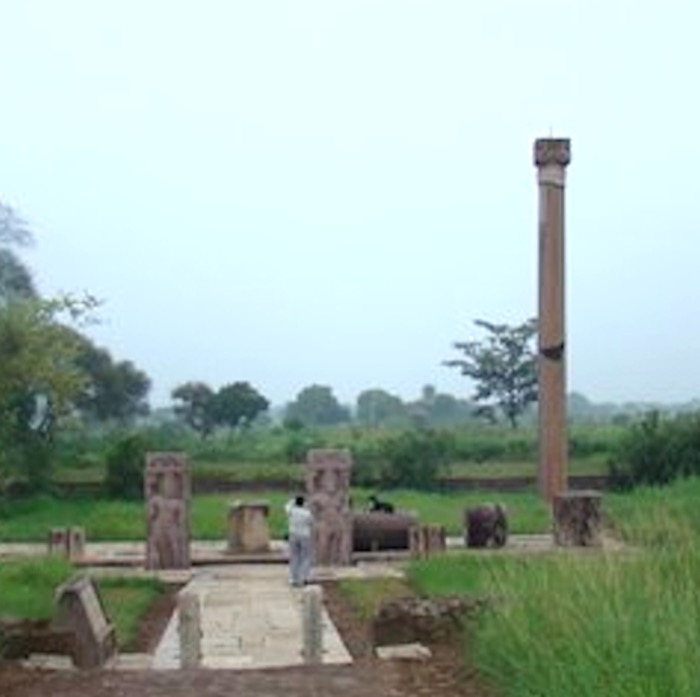
Yashodharman was a 6th-century CE ruler of Malwa (of the Aulikara line) who defeated the Huna king Mihirakula and helped check the Huna advance into India — a local ruler's victory commemorated independently of the Gupta empire. This triumph is recorded in pillar inscriptions at Sondani, near Mandsaur (ancient Dashapura), which extol Yashodharman's dominion in famously expansive terms.
MPPSC pairs a named Madhya Pradesh inscription with its poet-composer — the trap is substituting a genuinely real inscription-poet from a different dynasty and century (like Ravikirti, of Aihole) for the one actually credited here.
- Sondani pillar inscriptions (near Mandsaur, Madhya Pradesh): commemorate Yashodharman's victory over the Huna king Mihirakula, 6th century CE.
- Composed by the poet Vasul Kavi, per the official key.
- Ravikirti — a different poet, a century later — composed the Aihole inscription of the Chalukya king Pulakeshin II.
- Yashodharman's victory helped check Huna incursions into India in the early 6th century.
Two real inscription-poet pairs from different centuries and dynasties — the distractor (Ravikirti) borrows a real name from the wrong inscription.
- Swapping in Ravikirti (Aihole, Pulakeshin II) for the Sondani inscription's actual poet, Vasul Kavi — both are real inscription-poets, just for different kings.
- Confusing Mihirakula (the Huna king defeated by Yashodharman) with other rulers of the period.
MPPSC/UPSC like testing exact inscription-poet-ruler triads; a common distractor trick offers a real poet's name borrowed from a DIFFERENT inscription.
Emperor Harsha's southward march was stopped on the Narmada River by
- (a) Pulakesin-I
- (b) Pulakesin-II
- (c) Vikramaditya-I
- (d) Vikramaditya-II
Answer(b) Pulakesin-II
Tests the same Aihole inscription this question's distractor (Ravikirti) borrows from — confirming Ravikirti's inscription praises Pulakeshin II checking Harsha at the Narmada, not Yashodharman's Sondani pillars.
- practice — not a real PYQ
Yashodharman, the 6th-century Malwa ruler whose Sondani pillar inscriptions near Mandsaur commemorate his victory, defeated which invading ruler?
- (a)Mihirakula (Huna)
- (b)Toramana (Huna)
- (c)Harshavardhana
- (d)Pulakeshin II
Answer(a) Mihirakula, the Huna king.
- practice — not a real PYQ
The Aihole inscription, composed by the court poet Ravikirti, records the check of Harshavardhana's southward march at the Narmada by which Chalukya king?
- (a)Pulakeshin I
- (b)Pulakeshin II
- (c)Vikramaditya II
- (d)Kirtivarman I
Answer(b) Pulakeshin II.