UPSC Current Affairs

13 topicsGS-1: 4GS-2: 3GS-3: 6
0/13 done
GS-2Editorial

1.Digital Misinformation Regulation in India (Digital Misinformation)

The Hindu
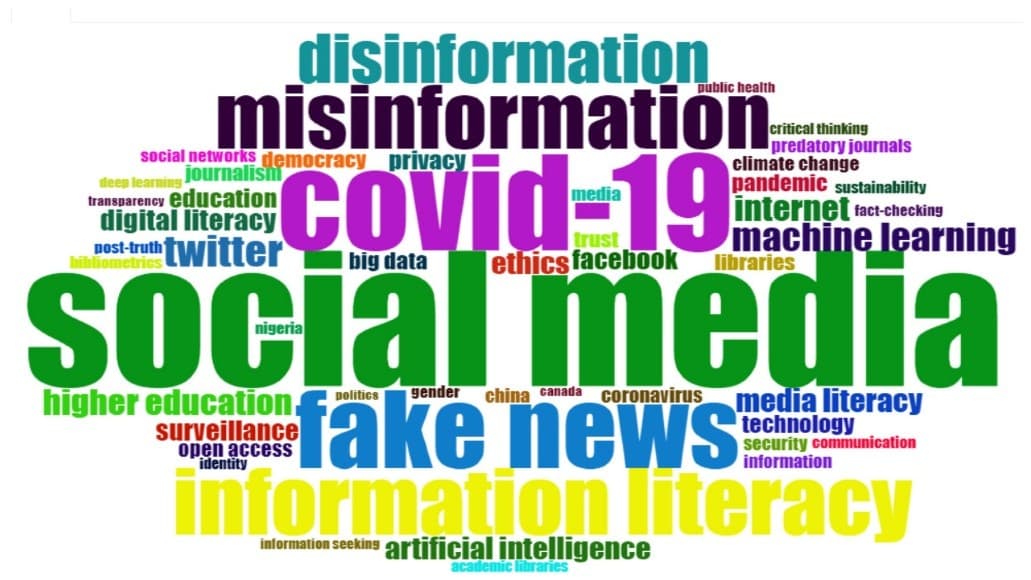
Illustration for Digital Misinformation Regulation in India (Digital Misinformation)

What & Where

Digital misinformation: false/misleading online content; De-influencing: influencers urging against purchases via half-truths, clickbait.

Hotspots: Indian Instagram, YouTube, TikTok ecosystems—high consumer reach, low fact-checking rigour.

India flagged by WEF Global Risks Report 2024 as among the most misinformation-vulnerable nations.

Quick Facts for MCQs

Legal & Policy

  • Multi-layer model: Constitution, CPA 2019, IT Act, platform guidelines.
  • Mandatory disclosure: paid posts must carry clear, prominent labels under ASCI/SEBI.
  • Non-compliance faces fines, takedowns, possible platform blacklisting.

Judicial Trends

  • Courts apply Public Trust principle—demand credentials, fact verification from influencers.
  • Delhi HC view: health-related speech enjoys narrower protection.
  • Increasing interim injunctions against deceptive viral content.

Social Concerns

  • Health misinformation: “liver detox”, “anti-cancer diets” bypass expert review, risk public safety.
  • Trust erosion: sensational negativity monetises audience credulity.
  • Absence of influencer registry hampers traceability, deterrence.

Way Forward

  • Proposed public registry for health/finance influencers listing credentials, compliance record.
  • Platform duties: AI detection, fact-check overlays, sponsor flagging on high-risk posts.
  • Government campaigns to boost digital literacy, reporting of misleading content.

Key Data Points

FeatureData-Point
Key trendDe-influencing on social media
Highest-risk nation tagIndia in WEF Global Risks Report 2024
Core constitutional baseArt 19(1)(a) with limits under Art 19(2)
Misleading ad lawConsumer Protection Act 2019, S.21
IT provisionsSec 66 & 67 + Intermediary Guidelines 2021
Sectoral codeASCI “Endorsement Know-hows” 2021
Market regulator ruleSEBI circular on influencer disclosure 2023
Landmark health caseIMA v Union of India—liability for false cures
Delhi HC 2024 holdingSpeech curb on brand-disparaging health claims
GS-2Editorial

2.Enhancing Parliamentary Oversight Mechanisms (Parliamentary Oversight)

The Hindu

What & Where

Parliamentary oversight – legislature’s tools for daily executive accountability, financial control and policy review.

Key processes – Question Hour, Zero Hour, Standing/Financial Committees, debates, no-confidence motions.

Location – Lok Sabha & Rajya Sabha within India’s Westminster-style Union Parliament.

Quick Facts for MCQs

Constitutional & Legal

  • Article 113 forbids spending sans Appropriation; Article 114 authorises draws from Consolidated Fund.
  • Article 105 privileges empower committees; Article 118 lets Houses set procedures.
  • Supreme Court in K. Ajith 2021 held privileges don’t override criminal law.

Oversight Successes

  • Transport Committee shaped 2017 Motor Vehicles Act; created National Road Safety Board, lifted insurance caps.
  • PAC exposed 2010 CWG corruption, elevating financial vigilance.
  • Estimates Committee urged new uranium mines, targeting import cuts.

Operational Deficits

  • Question Hour frequently adjourned; MPs often pose isolated, shallow questions.
  • Rotating DRSC membership curbs expertise; reports seldom debated, limiting influence.
  • Public access low—few translations, infographics, or dashboards on committee work.

Reform Proposals

  • Post-legislative sub-committees to audit laws 3–5 years after enactment.
  • AI and data analytics for budget, CAG and implementation tracking; searchable legislative databases.
  • PRIDE-linked Fellows Programme plus in-house research cell to boost MP capacity.

Key Data Points

FeatureData-Point
Constituent Assembly debate days167
Article on collective Cabinet responsibilityArt 75
Article for joint sittingArt 108
Article letting President return BillsArt 111
Zero Hour timingStarts right after Question Hour
17th LS Question Hour run-time60 % LS; 52 % RS
PAC average recommendations/yr≈180
Government acceptance of PAC advice≈80 %
Railways dividend waiver moveSC on Railways, 2015; applied 2016
SC case upholding legislative confidence testS.R. Bommai v Union, 1994
Missing practice in IndiaInstitutionalised post-legislative review

Related UPSC Prelims PYQs

GS1 2001PYQ 1

In what way does the Indian Parliament exercise control over the administration?

GS1 2017PYQ 2

The Parliament of India exercises control over the functions of the Council of Ministers through

GS-3Infrastructure

3.Inland Waterway Transport Push (Inland Waterways)

PIB

What & Where

Definition: Inland Waterway Transport moves goods & passengers through navigable rivers, canals, backwaters using barges, boats, ferries.

Geography: Major corridors include NW-1 (Ganga) & NW-2 (Brahmaputra); 111 stretches notified as National Waterways.

Advantage: Mode is fuel-efficient, eco-friendly and cheaper than rail/road haulage.

Quick Facts for MCQs

Legal & Policy

  • Legislation: National Waterways Act 2016 authorises central development of 111 waterways.
  • Mechanism: Jal Vikas Marg Society under IWAI administers World Bank–assisted works.
  • Mandate: IWAI promotes PPP models to attract private capital into IWT.

Schemes & Projects

  • Project: Jal Marg Vikas upgrades NW-1 via dredging, terminals, navigation aids.
  • Programme: Sagarmala integrates IWT with ports for improved hinterland connectivity.
  • Incentive: Jalvahak 2024 reimburses up to 35 % costs, spurring cargo shift to waterways.

Economic Angle

  • MoU: IWAI–Rhenus venture to operate 100 barges, boosting multimodal logistics capacity.
  • Saving: IWT consumes ~60–70 % less fuel than road, lowering freight expense & emissions.
  • Decongestion: Waterway cargo diversion expected to ease highway traffic and logistics bottlenecks.

Key Data Points

FeatureData-Point
IWAI Establishment1986 (under IWAI Act 1985)
Nodal MinistryPorts, Shipping & Waterways
HeadquartersNoida, Uttar Pradesh
National Waterways declared111 (National Waterways Act 2016)
Key World Bank projectJal Marg Vikas Project on NW-1
Jalvahak subsidy rateUp to 35 % operating cost
New MoU partnerRhenus Logistics India
Planned fleet100 cargo barges & pusher tugs (from late 2025)

Related UPSC Prelims PYQs

CAPF_GAI, CDS_GK 2025PYQ 1

Consider the following pairs with reference to National Waterways (NW) in India and the associated rivers:

CAPF_GAI, CDS_GK 2024PYQ 2

On which among the following is National Waterway No. 2 situated?

GS-1History

4.Piprahwa Buddha Relics Dispute (Buddha Relics)

New Indian Express

What & Where

Piprahwa relics – bone fragments, jeweled caskets, sandstone coffer excavated 1898 at Piprahwa, Siddharthnagar, U-P

Site identified with ancient Kapilavastu, capital of Shakya republic, clan of Prince Siddhartha

Sotheby’s London planned auction of items kept by Peppé family, now legally contested by India

Quick Facts for MCQs

Historical Significance

  • Stupa considered one of original eight built post-cremation ~480 BCE
  • Constructed by Sakya clan to enshrine Buddha relics
  • Relics venerated globally as intangible Buddhist heritage

Legal & Policy

  • India serves legal notice to halt sale, claims relics inalienable cultural property
  • Auction viewed as breach of Treasure Trove Act transfer conditions
  • UNESCO 1970 & UNIDROIT 1995 norms cited against commercialisation

Religious & Cultural

  • Buddhist institutions worldwide condemn commodification of sacred relics
  • Relics regularly sent on exposition to Buddhist countries for diplomatic outreach

International Dimension

  • Case spotlights repatriation debates on colonial-era finds
  • Could set precedent for claims on privately held sacred objects abroad

Key Data Points

FeatureData-Point
Excavation year1898
ExcavatorWilliam Claxton Peppé
District & StateSiddharthnagar, Uttar Pradesh
Ancient capital linkedKapilavastu (Shakya republic)
Main relic contentBone fragments believed of Buddha
Other artefactsCrystal & soapstone caskets, gold ornaments, pearls, rubies, topaz, sapphires
Indian law citedTreasure Trove Act, 1878
Museum holding 4/5 shareIndian Museum, Kolkata
Retained share1/5 by Peppé family (deemed duplicates)
Auction houseSotheby’s, London
International pacts invokedUNESCO & UNIDROIT conventions on cultural property
GS-1Environment

5.Anak Krakatau Volcano Monitoring Insights (Volcano Monitoring)

Scitechdaily
Illustration for Anak Krakatau Volcano Monitoring Insights (Volcano Monitoring)

What & Where

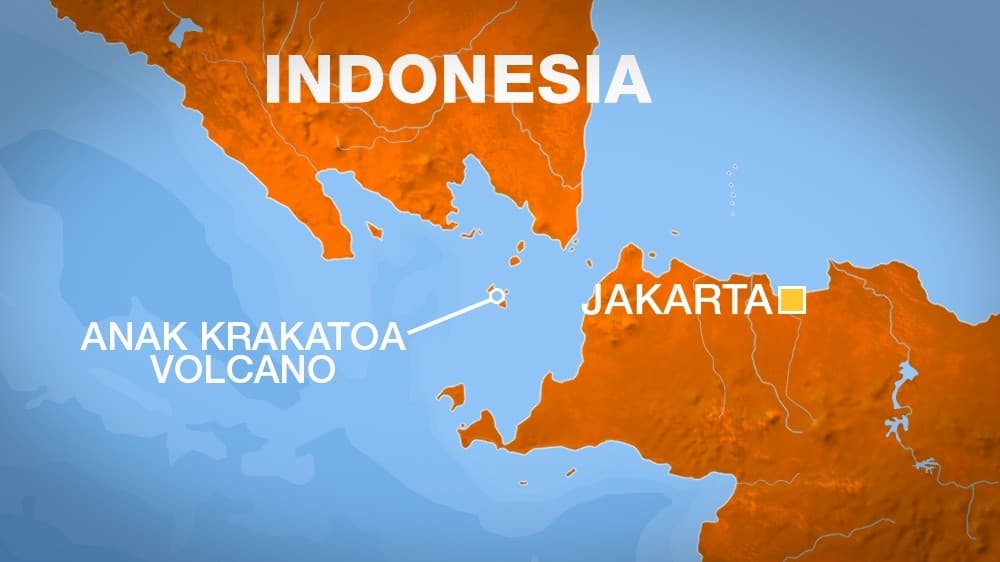
Anak Krakatau = active Indonesian stratovolcano in Sunda Strait between Java & Sumatra

Sits on convergent Indo-Australian–Eurasian plate margin; segment of Pacific Ring of Fire

Notorious 2018 flank-collapse tsunami; ongoing deformation monitored via satellites

Quick Facts for MCQs

Tech & Schemes

  • InSAR enables near-real-time remote deformation tracking where ground GPS unviable
  • Multi-mission radar archives allow retrospective hazard assessment for isolated volcanoes
  • Potential integration with Indonesian tsunami early-warning frameworks under discussion

Geological Process

  • Slow gravitational flank creep began 2006, signalling structural instability
  • Magma pressure and hydrothermal alteration likely weakened southwest sector
  • Marine volcanoes face added seaward sliding risk from undercutting waves

Disaster Impact

  • Flank collapse generated ~5 m local tsunami waves hitting coastal Banten & Lampung
  • Event highlighted non-seismic tsunamis lack regional alert systems
  • Incident prompted review of volcano-linked tsunami zoning in Indonesia

Early Warning

  • Slip acceleration months before failure provides crucial lead-time window
  • Automated InSAR triggers could flag ≥5 cm/month motion thresholds
  • Requires continuous radar tasking and swift ground agency response

Key Data Points

FeatureData-Point
Volcano typeStratovolcano
Strait/locationSunda Strait, Indonesia
Plate boundaryIndo-Australian vs Eurasian (convergent)
2018 hazardSouthwest flank collapsed, tsunami
2018 deaths400 + fatalities, thousands injured
Flank slip 2006-18~15 m cumulative
Key precursorSlip acceleration months pre-collapse
Monitoring toolInSAR (satellite radar interferometry)
Accuracy rangeCentimetre–millimetre deformation detection
Satellite sourcesALOS-1, COSMO-SkyMed, Sentinel-1
Observation span10 + years of data
GS-3S&T

6.India's New Satcom Guidelines (Satcom Guidelines)

The Hindu
Illustration for India's New Satcom Guidelines (Satcom Guidelines)

What & Where

Satellite communication: wireless signal relay through Earth-orbiting satellites for broadband, TV, GPS, remote connectivity.

India regulates via DoT (operational nods) and TRAI (spectrum, pricing).

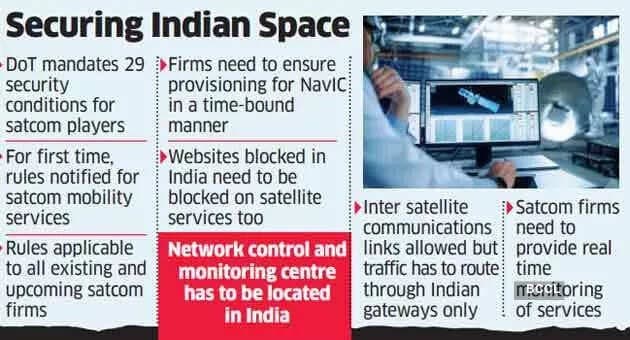
New Satcom Guidelines 2025 apply nationwide; extra 50 km monitoring belts along borders & EEZ.

Quick Facts for MCQs

Indigenisation Drive

  • Roadmap: operator submits phased localisation schedule within 90 days of licence.
  • Milestone: 20 % India-made ground equipment mandatory by fifth year.
  • Aim: deepen domestic value chain under Aatmanirbhar Bharat.

Data Localisation

  • Traffic: all user data, DNS, control links must physically reside in India.
  • Gateways: foreign PoPs/gateways strictly prohibited for commercial traffic.
  • Oversight: real-time lawful interception and user monitoring capability compulsory.

Security Dimension

  • Curtailment: govt may suspend, throttle satcom during war, terror, natural disaster.
  • Zones: Special Monitoring Zones within 50 km border/EEZ enable tighter surveillance.
  • Alerts: operators must instantly report unregistered or foreign user terminals.

Key Data Points

FeatureData-Point
Guideline versionSatcom Guidelines 2025
Manufacturing plan span5 years
Indigenous ground segment≥ 20 % by Year-5
Data routing ruleNo foreign gateways/PoPs allowed
NavIC full complianceDeadline 2029
Monitoring belt width50 km from borders & coastal EEZ

Related UPSC Prelims PYQs

GS1 2006PYQ 1

Consider the following statements in respect of India's advanced satellite INSAT–4A :

GS-3S&TQuick Bite

7.DRDO Stratospheric Airship Trials (Stratospheric Airship)

PIB

What & Where

Airship: unmanned helium vessel acting as High-Altitude Pseudo-Satellite (HAPS) for persistent surveillance & communication

Altitude band: stratosphere 17–22 km; maiden DRDO trial achieved ~17 km

Station-keeping: stays over one area, augmenting satellites and UAVs for earth observation

Quick Facts for MCQs

Tech & Schemes

  • Helium buoyancy allows long-endurance flight without continuous propulsion
  • Sensor datasets harvested to build high-fidelity simulation models
  • Indigenous effort aligns with Defence indigenisation & Make-in-India thrust

Security Dimension

  • Platform strengthens India’s earth observation and ISR capabilities
  • Data gathered aids future high-altitude defence mission planning

International Examples

  • Project Loon used stratospheric balloons to supply internet to remote areas, launched 2011
  • Shutdown in 2020 due to insufficient commercial viability

Geography Basics

  • Stratosphere extends from tropopause to ~50 km altitude
  • Ozone layer within stratosphere absorbs harmful UV radiation

Key Data Points

FeatureData-Point
Developing agencyDRDO
Flight trial dateMay 2025
Trial altitude≈ 17 km
Lift mediumHelium
Platform classHigh-Altitude Pseudo-Satellite
Stratosphere ceiling~50 km above sea level
Similar global projectProject Loon (2011-2020)

Related UPSC Prelims PYQs

CDS_GK 2024PYQ 1

भारत का ‘मिशन शक्ति’ (DRDO) निम्नलिखित में से किससे संबंधित है?

GS-2Economy

8.India–UK Free Trade Pact (India-UK FTA)

Times of India

What & Where

Free Trade Agreement: bilateral pact eliminating or cutting customs duties, easing rules for goods, services, investments

India–U.K. FTA: talks began Jan 2022, concluded May 2025, awaits U.K. parliamentary ratification

Double Contribution Convention: waives dual social-security payments for Indians on ≤3-year U.K. assignments

Quick Facts for MCQs

Tariff Provisions

  • Whisky, gin, autos, cosmetics, salmon, chocolates gain phased or quota-based tariff relief
  • U.K. extends near-universal zero-duty access, covering labour-intensive Indian exports
  • Safeguard clause available for sensitive agri products to curb import surges

Services & Mobility

  • Quota: 1,800 Indian chefs, yoga instructors, artists, engineers assured annual entry
  • ENT removal grants hassle-free market entry across IT, finance, education, telecom
  • MRAs targeted for architects, accountants, nurses, boosting credential portability

Economic Gains

  • Textiles: knitwear share in U.K. market projected 9 %→20 %, lift for Tiruppur cluster
  • Leather, gems, auto components, generics receive tariff-free or simplified regulatory access
  • Social-security waiver cuts cost for service exporters, especially IT & consulting firms

Concerns & Mitigation

  • Farmers, MSMEs fear cheaper lamb, salmon, processed foods undercutting domestic prices
  • Low FTA literacy; facilitation centres and export-readiness training proposed for MSMEs
  • Real-time dashboard, adjustment funds, swift MRAs recommended to monitor and cushion impacts

Key Data Points

FeatureData-Point
Operational FTAs worldwide350+
India tariff cut coverage90 % of U.K. goods
U.K. duty-free access to India99 % of Indian exports (≈100 % trade value)
Whisky/Gin duty path150 % → 75 % → 40 % over 10 yrs
Auto import duty100 %+ → 10 % within quota
Skilled-worker quota1,800 visas / year
Service subsectors opened by U.K.137
MRA deadlinewithin 36 months
Short-term assignment periodup to 3 years
ENT/quota on Indian servicesNil

Related UPSC Prelims PYQs

CDS_GK, GS1 2024PYQ 1

If India enters into Free Trade Agreements (FTAs) with other nations, then the growth of exports of India would depend upon which of the following?

CDS_GK, GS1 2017PYQ 2

निम्नलिखित कथनों पर विचार कीजिए :

GS-3Security

9.India's Civil Defence Framework (Civil Defence)

DH
Illustration for India's Civil Defence Framework (Civil Defence)

What & Where

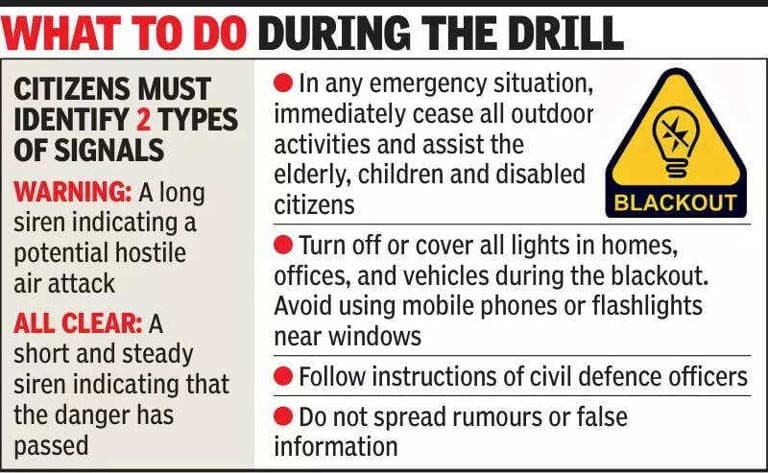
Definition: Civil defence = organised civilian protection during war, natural or man-made disasters

Geography: Active units only in tactically vulnerable zones—border states, metros, critical infra hubs, coasts

Event: Nationwide mock drill ordered by MHA for 244 districts on 7 May 2025

Quick Facts for MCQs

Legal & Policy

  • Origin: 1968 Act followed 1962 Sino-Indian and 1965 Indo-Pak conflicts
  • Amendment: 2009 broadened mandate beyond war to all disasters
  • District tag: Civil Defence District notified under Section 4 for targeted implementation

Structure & Volunteers

  • Composition: Community volunteers, civil servants, professionals, students
  • Training: First aid, fire-fighting, evacuation, communication, crowd control
  • Activation: Terror strikes, fires, floods, explosions, earthquakes

Strategic Geography

  • Border proximity: Punjab, Rajasthan, Gujarat, J-K prioritised for units
  • Coastal sensitivity: Tamil Nadu, Kerala, West Bengal safeguard maritime assets
  • Urban density: Metros receive evacuation and shelter planning

Security Dimension

  • Critical infra: Nuclear plants, oil refineries, telecom hubs treated as high-risk zones
  • Early response: Units bridge gap till NDRF, SDRF, armed forces arrive
  • Mock drills: Evaluate coordination among civil defence, police, fire, health agencies

Key Data Points

FeatureData-Point
Parent lawCivil Defence Act 1968
Key amendment2009 (Act 3 of 2010) added disaster management
Admin ministryUnion Ministry of Home Affairs
Six global pillarsPrevention, mitigation, preparedness, response, evacuation, recovery
Core manpowerTrained volunteers from varied professions
Focus windowCritical initial minutes before official responders
Drill date7 May 2025
Drill coverage244 districts
Selection basis for districtsStrategic vulnerability criteria by MHA
Typical locationsNuclear plants, ports, military bases, dams, refineries, metro cities

Related UPSC Prelims PYQs

CDS_GK, ESE_GS 2024PYQ 1

'Scheme for Expansion and Modernization of Fire Services in the States' from the allocation of preparedness and Capacity Building Funding Window under the National Disaster Response Fund for strengthening fire services in the States was introduced by which Union Ministry?

CDS_GK, ESE_GS 2025PYQ 2

राष्ट्रीय आपदा प्रबंधन संस्थान (NIDM) के संदर्भ में निम्नलिखित में से कौन-सा/कौन-से कथन सही है/हैं?

GS-3Security

10.Operation Sindoor Precision Strikes (Operation Sindoor)

PIB
Illustration for Operation Sindoor Precision Strikes (Operation Sindoor)

What & Where

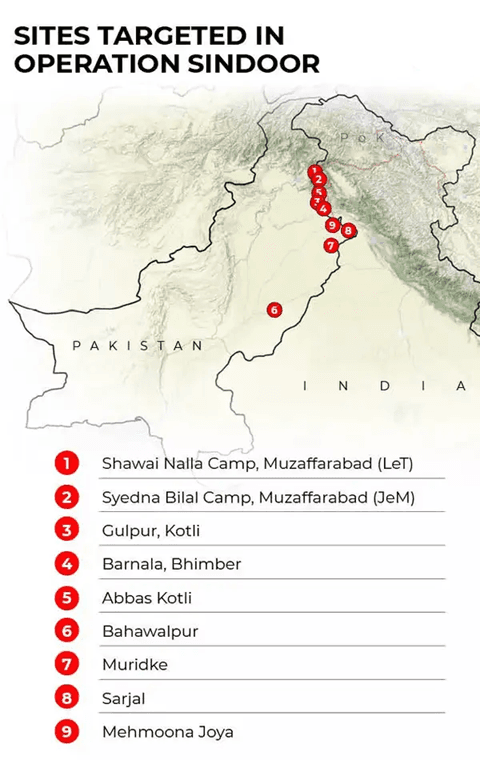
Operation Sindoor – tri-service precision retaliation, launched 7 May 2025 from Indian territory

Targets: nine JeM/LeT/Hizbul sites inside Pakistan & Pakistan-occupied J&K

Trigger: April 2025 Pahalgam terror, name honours attack widows

Quick Facts for MCQs

High-Precision Weapons

  • SCALP: MBDA long-range cruise, earlier used in Iraq, Libya, Syria, Ukraine
  • HAMMER: Safran modular bomb with GPS/IR/Laser guidance, medium-range agile strikes
  • Loitering munitions: kamikaze drones provide ISR plus autonomous engagement, minimise operator risk

Past Indo-Pak Operations

  • 1965: Ops Riddle & Ablaze countered Gibraltar, led to Tashkent Agreement
  • 1971: Ops Trident, Python, Cactus Lily hastened Karachi blockade and Dhaka fall
  • 1999–2019: Ops Vijay, Safed Sagar, 2016 Surgical Strikes, 2019 Bandar show escalating precision response

Security Dimension

  • Objective: dismantle cross-border terror infrastructure threatening Indian hinterland
  • Execution: stand-off weapons allowed strikes without crossing frontier, limiting collateral damage
  • Messaging: projects rapid punitive capability while centring empathy for civilian victims

Key Data Points

FeatureData-Point
Strike date7 May 2025
Strike sites9 (Pakistan + PoJK)
ForcesArmy + Navy + Air Force
Main groups hitJeM, LeT, Hizbul
Key missileSCALP “Storm Shadow”
Other PGMsHAMMER bombs
Drones usedLoitering munitions
SCALP originMBDA, Europe
HAMMER originSafran, France
Launch jetRafale
Prior air strikeOperation Bandar (2019)
Naming motiveTribute to Pahalgam widows

Related UPSC Prelims PYQs

CAPF_GAI, CDS_GK 2025PYQ 1

Which one of the following military operations was not undertaken by India ?

CAPF_GAI, CDS_GK 2025PYQ 2

भारत द्वारा पाकिस्तान के विरुद्ध संचालित निम्नलिखित सैन्य अभियानों (military operations) को सही कालानुक्रमानुसार व्यवस्थित कीजिए :

GS-3SecurityQuick Bite

11.Bagram Airfield Strategic Significance (Afghan Airbase)

Indian Express
Illustration for Bagram Airfield Strategic Significance (Afghan Airbase)

What & Where

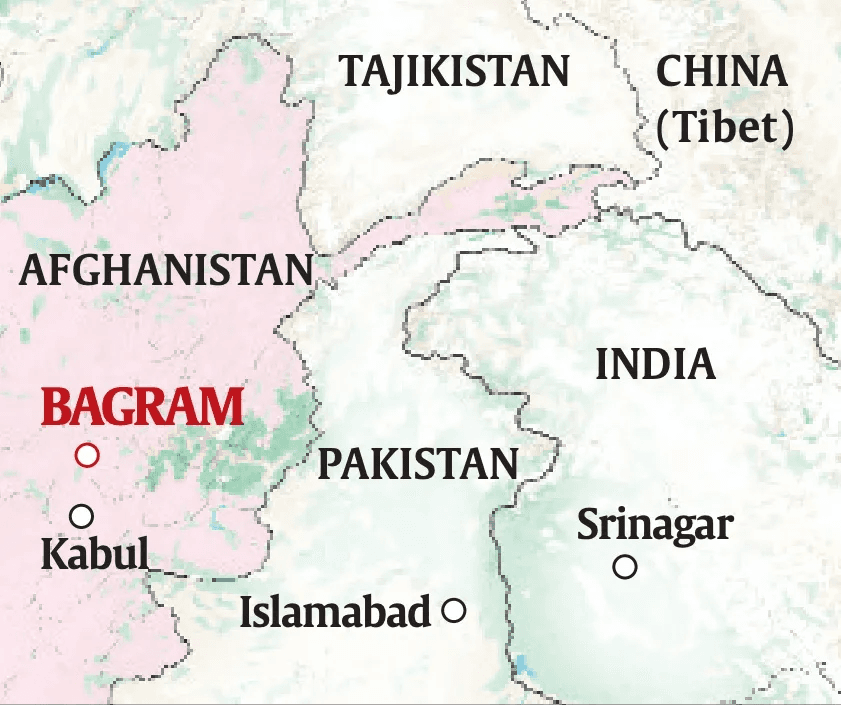
Bagram Airfield – Afghanistan’s largest military base; Soviet-built; reportedly under current Chinese presence.

Located in Parwan province, ~60 km north of Kabul; overlooks Salang Pass and converging highways.

Serves as hub for north–south Afghan control; crucial in Soviet–Afghan War and US War on Terror.

Quick Facts for MCQs

Historical Timeline

  • 1950s Soviet construction expanded for Cold War bomber operations.
  • 1979-89 Soviet-Afghan War made Bagram frontline logistics centre.
  • Post-2001 War on Terror saw continuous US hub until July 2021 withdrawal.

Connectivity & Terrain

  • Salang Tunnel under Hindu Kush ensures year-round Kabul–north movement.
  • Parwan highways give rapid access to Ghazni, Kandahar, Bamiyan.
  • Holding Bagram secures Afghanistan’s central transport choke-points.

Security Dimension

  • 2025 US claim: China leveraging Taliban ties for strategic foothold.
  • Airfield sits ~2,000 km from China’s Lop Nur nuclear range.
  • Location allows monitoring of Central and South Asian air corridors.

Key Data Points

FeatureData-Point
ProvinceParwan
Distance from Kabul~60 km north
Built byUSSR, 1950s
US forces vacated2021
Salang Tunnel length2.6 km
Salang Tunnel linksKabul–Mazar-e-Sharif
Key highways lead toGhazni, Kandahar, Bamiyan
Distance to Lop Nur~2,000 km
Nearby Chinese nuclear siteKoko Nur, Qinghai
Status claim (May 2025)China occupying airfield
GS-1Editorial

12.Human Development Report 2025 Highlights (HDI Rankings)

Down to Earth
Illustration for Human Development Report 2025 Highlights (HDI Rankings)

What & Where

HDR 2025: UNDP global report merging life expectancy, schooling, per-capita GNI into HDI

Classification: Very-High ≥ 0.800; High 0.700-0.799; Medium 0.550-0.699; Low < 0.550

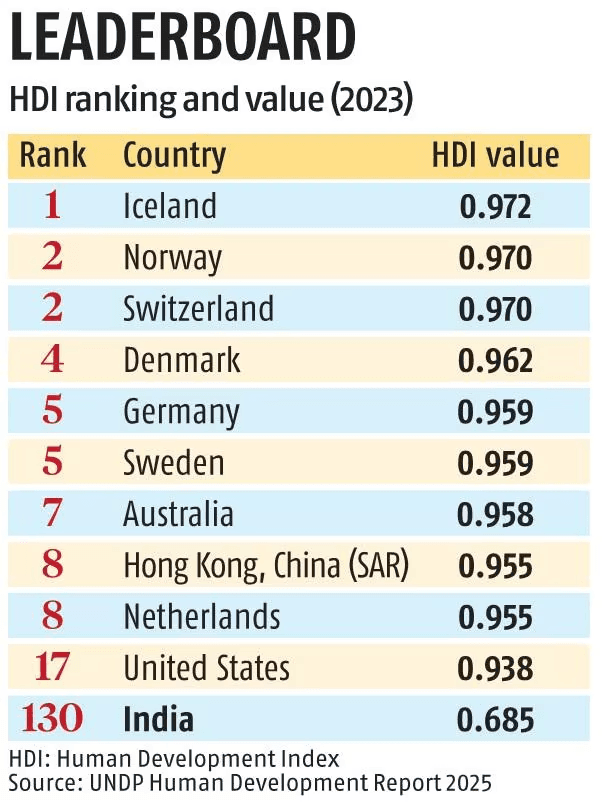
Coverage: 193 nations; Iceland top 0.972, South Sudan bottom 0.388; India 130th 0.685

Quick Facts for MCQs

Trends & Rankings

  • Stagnation: Pre-Covid path to universal very-high HD delayed by decades
  • Region: China 78th, Sri Lanka 89th, Bhutan 125th, Bangladesh 130th co-ranked
  • Gap: High-HDI states progressing; low-HDI group near standstill

Progress Drivers

  • Health: NHM, Ayushman Bharat, JSY, Poshan Abhiyaan pushed life expectancy to 72
  • Education: RTE, NEP-2020, Samagra Shiksha lifted expected schooling to 13 years
  • Income: GNI quadrupled since 1990; 135 mn exited multidimensional poverty

Inequality & Gender Gaps

  • Inequality: 30.7 % HDI loss plus Gini 0.410 (2023)
  • Gender: One-third legislative reservation via 106th Amendment targets better political presence
  • Workforce: Female LFPR ~41.7 %; Mudra & Stand-Up India boost entrepreneurship

AI Potential

  • Penetration: India leads world in self-reported AI skills
  • Economy: Google projects AI adds ₹33.8 lakh cr to GDP by 2030
  • Governance: MuleHunter.AI & Bhashini improve fraud detection, multilingual service delivery

Key Data Points

FeatureData-Point
Global HDI trendSmallest rise since 1990 (ex 2020-21)
Iceland HDI0.972 (Rank-1)
South Sudan HDI0.388 (Rank-193)
India rank130 / 193
India HDI value0.685
Inequality loss India30.7 %
Life expectancy India72 yr (2023)
Schooling expectancy13 yr
GNI per capita (PPP)USD 9,046
Poverty exit count135 mn (2015-21)
Female LFPR41.7 %
AI researchers retained20 % (↑ from ~0 % in 2019)

Related UPSC Prelims PYQs

CDS_GK, GEO_GS 2021PYQ 1

According to UNDP's Human Development Report – 2020, in which of the HDI components has India improved in recent years?

CDS_GK, GEO_GS 2026PYQ 2

With reference to the Human Development Report (2023–2024), consider the following countries:

GS-1Polity

13.Caste Census Implementation Challenges (Caste Census)

PIB

What & Where

Definition: Caste census = nationwide head-count of jati identities during decennial Population Census

Process: Enumeration discontinued after 1951 for all except SC/ST; now restored for delayed Census 2021

Geography: India; state surveys already in Bihar, Karnataka, Telangana

Quick Facts for MCQs

Historical Trail

  • British-era: caste recorded 1881-1931; 1941 collected but unpublished due to WWII
  • Post-1951: only SC/ST counted; states allowed their own OBC lists from 1961
  • National revival attempt: SECC 2011 combined socio-economic and caste but data un-validated

Policy Drivers

  • Data-gap: no credible national figures for ~5,000 OBC communities hindering quota calibration
  • Affirmative-action: fresh numbers may guide sub-categorisation, welfare targeting, political representation
  • SDG 16: evidence-based governance cited as global compliance motive

Operational Hurdles

  • Classification: absent unified caste code causes duplication, mislabeling, surname confusion across states
  • Self-report bias: upward prestige claims or downward benefit claims distort accuracy
  • Capacity: Census lacks dedicated verification & coding unit; risk of SECC-like error repeat

Safeguard Measures

  • Pre-codification: Registrar General to publish vetted all-India caste list after stakeholder consultation
  • Verification: Aadhaar linkage, AI-based anomaly checks, multi-tier grievance redressal at village-block levels
  • Equity: implement Rohini recommendations; monitor outcome to deter political misuse

Key Data Points

FeatureData-Point
First regular caste enumeration1881 Census (British Raj)
Last published all-India caste data1931 Census
Article enabling backward-class identificationArticle 340
SECC 2011 raw caste entries46.7 lakh; >8 crore errors
Bihar 2023 survey OBC + EBC share63.1 % of population
Mandal-era 1931 OBC estimate52 %
Reservation ceiling set by Indra Sawhney50 % (commonly rounded 51 %)
Commission on OBC sub-quotaJustice Rohini, 2017
Supreme Court nod to sub-classify SC/STState of Punjab v Davinder Singh, 2024

Related UPSC Prelims PYQs

CDS_GK, GEO_GS 2024PYQ 1

Consider the following statements:

CDS_GK, GEO_GS 2024PYQ 2

Consider the following statements with reference to Census in India:

Ready to practice?

Test your knowledge with our UPSC test series.

Start Free Trial