UPSC Current Affairs

17 topicsGS-1: 3GS-2: 6GS-3: 8
0/17 done
GS-2Polity

1.Karnataka Medical Boards for Passive Euthanasia (Passive Euthanasia)

Indian Express
Illustration for Karnataka Medical Boards for Passive Euthanasia (Passive Euthanasia)

What & Where

Passive euthanasia = withholding/stopping life-sustaining treatment, letting natural death occur

Karnataka hospitals to host Medical Boards for euthanasia requests per SC guidelines

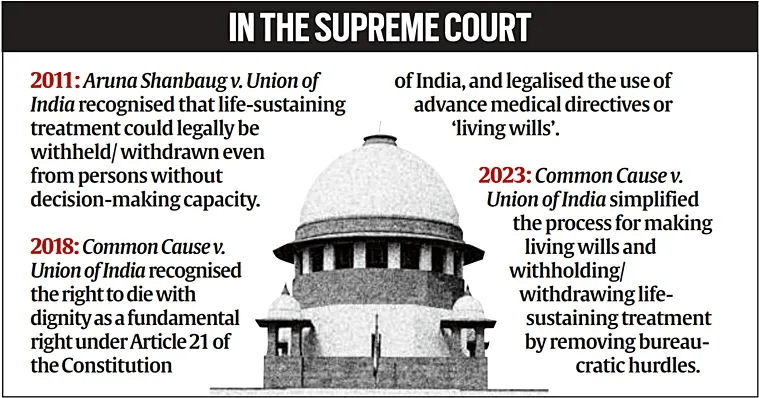
Applies nationwide under Article 21 right to die with dignity, affirmed 2018 & eased 2023

Quick Facts for MCQs

Legal & Policy

  • Supreme Court recognises passive euthanasia as constitutional, active euthanasia still illegal
  • Karnataka notification enables decentralised hospital-level compliance with SC framework
  • State move aligns with Union Health Ministry Model Guidelines 2023

Procedural Steps

  • Treating doctor initiates Withdrawal of Life-Sustaining Therapy review
  • Two Medical Boards sequentially evaluate patient condition and Living Will authenticity
  • Boards forward signed opinion to JMFC for final authentication within 48 hours

Patient Autonomy

  • Living Will records treatment refusal, ensures dignity during irreversible illness
  • AMD storage mandated in hospital records and National Digital Health Mission repository
  • Proxies empowered to decide only upon certified loss of patient capacity

Key Data Points

FeatureData-Point
Landmark caseCommon Cause vs Union of India (2018)
Latest SC orderJan 2023, simplified passive euthanasia norms
Constitutional basisArticle 21, right to life & dignity
Key documentLiving Will / Advance Medical Directive (AMD)
AMD executantAdult of sound mind, digital or paper filing
Minimum healthcare proxyTwo individuals named in AMD
Board structurePrimary & Secondary, 3 registered practitioners each
Additional approverDistrict Health Officer nominee
Final legal nodJudicial Magistrate First Class (JMFC)
Required family roleNext-of-kin consent to board decision
GS-2Polity

2.SC Strikes Down Domicile Medical Quota (Domicile Quota)

The Hindu

What & Where

Domicile quota : state-level reservation of PG medical seats for resident candidates within state 50 % counselling share

SC case : Tanvi Behl v. Shrey Goel & Ors (2025) struck down such quota across India

Geography : applies to all state-run/ aided medical colleges nationwide; Centre’s 50 % All-India Quota unaffected

Quick Facts for MCQs

Constitutional Basis

  • Equality : Court held domicile quota violates Article 14 by creating resident-non-resident discrimination
  • Mobility : Article 19 guarantees right to reside, practise profession anywhere; quota deemed restrictive
  • Reservation scope : Articles 15–16 permit only socio-economic, not territorial, preferences

Judicial Precedent

  • Reference : 1984 verdict allowed limited UG residence quota due to state investment rationale
  • Distinction : Same logic rejected for PG as students already qualified professionals
  • Continuity : Earlier High Court order scrapping Punjab-Haryana quota upheld

Pros & Cons Debate

  • Pros listed : local representation, economic uplift, regional workforce retention
  • Cons flagged : rights violation, national disintegration risk, private sector talent loss, ignores root infrastructure issues

Policy Way Forward

  • Merit focus : PG admissions to rely solely on NEET ranking plus constitutionally valid community reservations
  • Capacity build : Upgrade rural education, counselling, skill centres to make locals competitively eligible
  • Transitional aid : Time-bound support for backward groups without permanent regional quotas

Key Data Points

FeatureData-Point
Supreme Court bench size3 judges
Articles invoked14, 19, 5 (domicile definition)
Past precedent citedDr Pradeep Jain v. Union of India 1984
UG vs PG standResidence quota allowed in MBBS, barred in PG
NEET roleSole merit criterion for PG seats
Impact on past admissionsNo retrospective disturbance
Single domicile conceptOnly “Domicile of India”, not state-wise
GS-3Economy

3.Insurance Sector FDI Cap Hike (Insurance FDI)

BT

What & Where

Insurance sector; offers life, health, general risk-cover products within financial services industry

Key processes; premium collection, risk pooling, claim settlement

Geography; India—10th largest global insurance market, targeting ‘Insurance for All by 2047’

Quick Facts for MCQs

Legal & Policy

  • Budget 2025-26; FDI liberalisation aimed at innovation, capital inflow
  • GST review; potential premium rate cut debated, no change yet
  • Penetration metric; gauges insurance maturity via premiums-to-GDP ratio

Economic Angle

  • Density jump; eight-fold rise since 2001 indicates higher per-capita spend
  • Rank ambition; sixth largest by 2033 aligns with USD 222 bn target 2026
  • Declining penetration; warns of growth lag despite premium expansion

Public vs Private

  • LIC dominance; retains nearly two-thirds new life premiums
  • Private surge; general & health market share crossed 60 % in 3 years
  • Competitive landscape; FDI hike expected to intensify private participation

Key Data Points

FeatureData-Point
New FDI cap (Budget 2025-26)100% (up from 74%)
Condition on new FDIEntire premium must be invested domestically
India’s global rank (2023)10th overall; 2nd among emerging markets
Projected rank by 20336th, overtaking Germany & Canada
Market size targetUSD 222 bn by 2026
Insurance density 2001 → 2023-24USD 11.1 → USD 95
Life vs Non-life density 2023-24USD 70 vs USD 25
Overall penetration 2023-243.7 % of GDP (down from 4 %)
Life vs General penetration2.8 % vs 1 %
LIC share in new life business62.58 % (FY23)
Pvt share in general & health62.5 % (FY23; up from 48.03 % in FY20)
Current GST on premiums18 % (rationalisation under discussion)

Related UPSC Prelims PYQs

CDS_GK 2025PYQ 1

Union Budget 2025 increased the sectoral cap of FDI to 100 per cent from 74 per cent for:

CDS_GK 2024PYQ 2

Consider the following statements:

GS-3Economy

4.Presumptive Taxation for Electronics-Sector Non-Residents (Presumptive Taxation)

Indian Express

What & Where

Presumptive taxation: income assumed at fixed profit rate instead of actual books, easing compliance

New Sec 44BBD applies to non-resident service/technology providers to India’s electronics & semiconductor manufacturing units

Operative nationwide from AY 2026-27, announced in Union Budget 2025-26

Quick Facts for MCQs

Legal & Policy

  • Clarification deletes SEP risk for export purchases improving treaty certainty
  • Provision dovetails with Make in India and Semiconductor Mission incentives

Economic Angle

  • Incentive lowers entry barrier attracting foreign technicians and IP transfer
  • Expected uptick in FDI catalyses component ecosystem and downstream jobs

Compliance Impact

  • Presumptive regime removes audit, ledger maintenance for covered non-residents
  • Predictable sub-10 % levy aids bidding and contract pricing for global vendors

Key Data Points

FeatureData-Point
Relevant Budget2025-26 Union Budget
IT Act section44BBD
Eligible taxpayersNon-residents offering services/tech to electronics makers
Deemed income rate25 % of gross receipts
Tax on deemed income35 %
Effective overall tax< 10 % of gross receipts
Compliance start date1 April 2026
SEP treatmentGoods bought for export not counted as Significant Economic Presence
Sector focusElectronics manufacturing, semiconductors
Activities excludedGoods carriage, agency, detailed-bookkeeping professions

Related UPSC Prelims PYQs

GS1 2018PYQ 1

अवासी इकाइयों द्वारा दी जा रही ऑनलाइन विज्ञापन सेवाओं पर भारत द्वारा 6% ‘समतुल्य कर’ (Equalisation Levy) लगाए जाने के निर्णय के सन्दर्भ में निम्नलिखित कथनों पर विचार कीजिए:

GS-3Economy

5.Union Budget 2025 Key Highlights (Budget 2025)

The Hindu
Illustration for Union Budget 2025 Key Highlights (Budget 2025)

What & Where

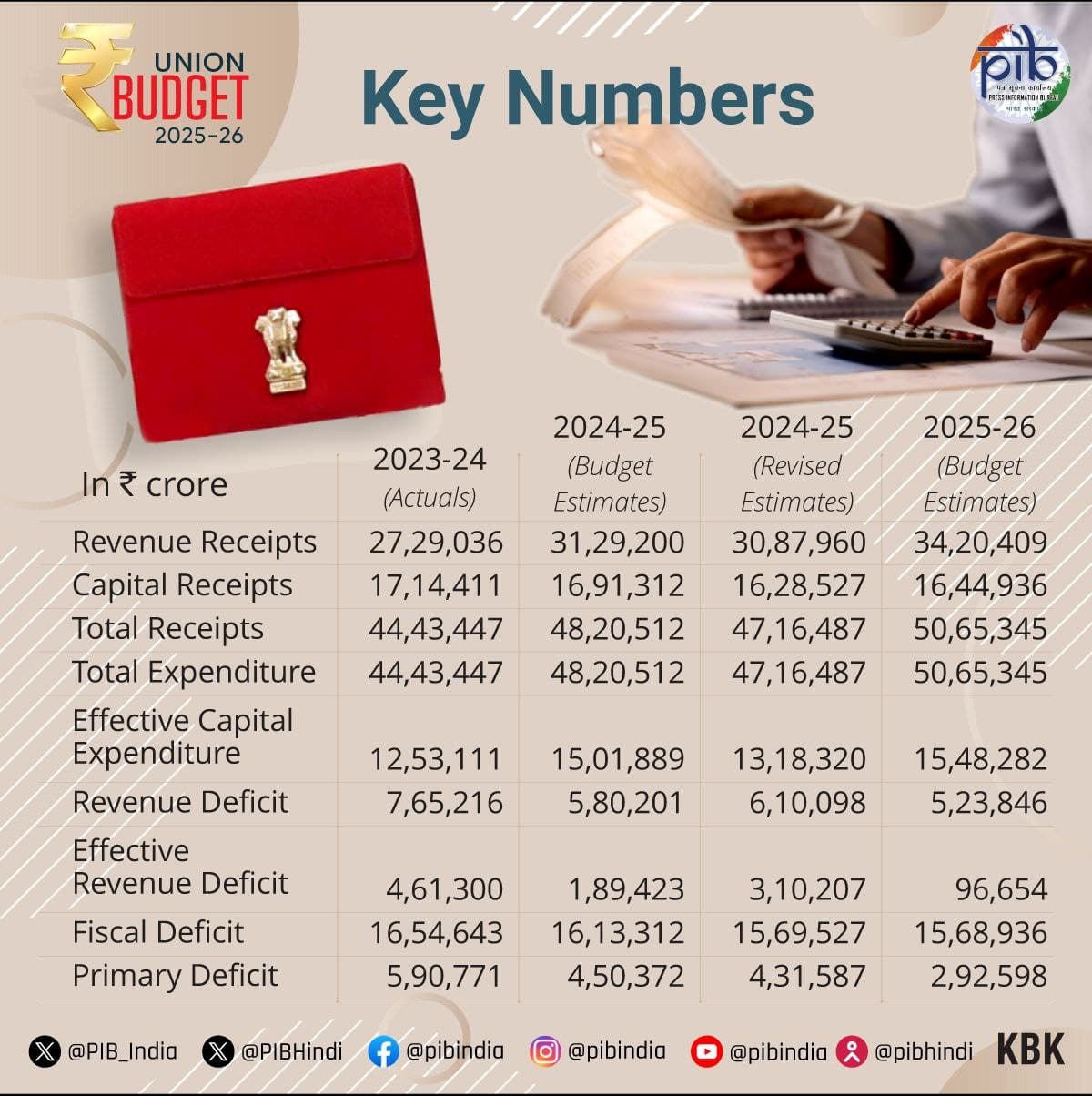
Union Budget 2025: GoI’s annual financial statement for FY 2025-26, presented in Lok Sabha on 1 Feb 2025

Processes: revenue mobilisation, expenditure allocation, fiscal-deficit setting under Article 112 & FRBM Act

Coverage: Measures span rural districts, MSME hubs, transport corridors, clean-energy sites across India

Quick Facts for MCQs

Tax & Revenue

  • Exemption: No tax till ₹12 lakh; relief costs ~₹1 lakh cr yet income-tax growth pegged at 14.4 %
  • Diversify: Government to widen GST base, rationalise slabs for steadier receipts

Infrastructure Push

  • Capex ₹11.21 lakh cr; railways ₹2.3 lakh cr, expressways ₹1.3 lakh cr under multi-modal upgrade
  • UDAN-II adds 120 destinations; PPP encouraged in smart cities and energy corridors to crowd-in private funds

Sectoral Schemes

  • Manufacturing & Energy: PLI extension for semiconductors; ₹20,000 cr for five SMRs by 2033; ₹10,000 cr for Li-ion recycling
  • Agriculture: Dhan-Dhaanya Yojana for 100 low-yield districts; KCC limit ₹5 lakh; rural credit push ₹1.2 lakh cr

Fiscal Health & Risks

  • Deficit set at 4.4 % GDP; net market borrowings ₹11.54 lakh cr; revenue growth assumption 11.2 %
  • Risk: High public capex versus muted private investment could elevate medium-term debt levels

Key Data Points

FeatureData-Point
Income-tax nil limit₹12 lakh
Capital expenditure outlay₹11.21 lakh cr (+10 %)
Fiscal deficit target FY264.4 % of GDP
Jobs promised22 lakh
SMR Mission funding₹20,000 cr
UDAN new destinations120

Related UPSC Prelims PYQs

CAPF_GAI 2025PYQ 1

The Union Budget for which of the following years announced the issue of Sovereign Green Bonds to reduce the carbon intensity of the economy?

CAPF_GAI 2025PYQ 2

Which one among the following is the estimated fiscal deficit as a percentage of GDP of India in the Budget Estimates of 2025-26?

GS-3Economy

6.Strengthening Financial Regulatory Bodies Impact (SEBI Oversight)

LiveMint
Illustration for Strengthening Financial Regulatory Bodies Impact (SEBI Oversight)

What & Where

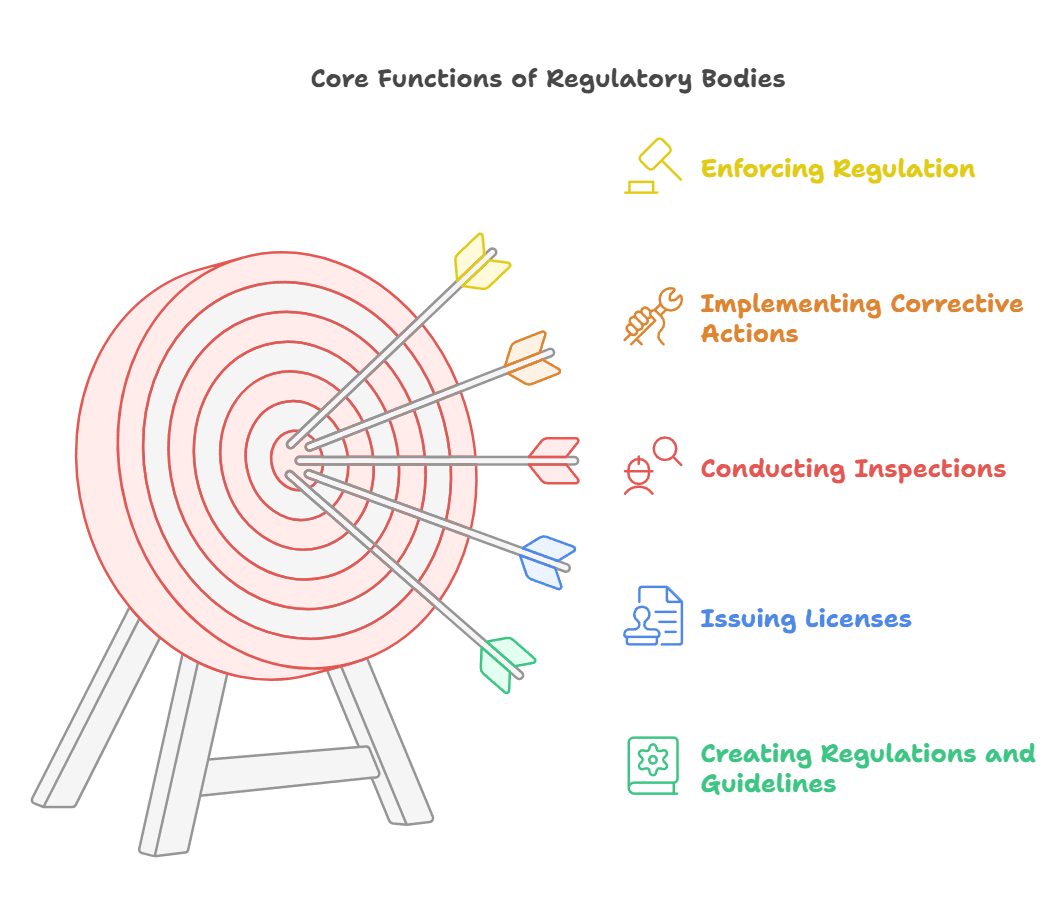
Regulatory bodies: sector-specific watchdogs ensuring fair practice & public interest across Indian economy

Two kinds: Statutory (SEBI, RBI) and Self-regulatory (Bar Council of India)

Post-1991 boom: >30 regulators spanning banking, insurance, capital, energy, telecom sectors

Quick Facts for MCQs

Governance Issues

  • Interference: Line ministries influence TRAI, others; autonomy weakened
  • Fragmentation: Separate insurance & bond regulators slow credit-default swaps, debt market depth
  • Appointments: Retired bureaucrats dominate, limiting sectoral expertise & credibility

Reform Suggestions

  • ARC-12: Simplify, make processes transparent; boost internal supervision; encourage self-regulation
  • ARC-13: Uniform appointment/tenure; “Management Statement” by ministries; stronger Standing-Committee scrutiny
  • Current ideas: CAG audit of regulator spend; external reviews via NISM, IIMs

SEBI Basics

  • Statutory, non-constitutional body protecting investors & regulating securities market
  • Board: Chairman plus whole-time & part-time members; decisions quasi-judicial
  • Functions: Facilitate fund-raising, ensure disclosure, foster competitive intermediaries

International Examples

  • UK Regulatory Policy Committee & Australia Productivity Commission showcase cross-sector coherence
  • Brazil telecom regulator independent; council nominated by President, ratified by Parliament

Key Data Points

FeatureData-Point
SEBI statutory statusSEBI Act, 1992
Non-statutory formation date12 Apr 1988
Appeals against SEBI ordersSecurities Appellate Tribunal
Pre-SEBI capital market regulatorController of Capital Issues, 1947 Act
Nature of most regulatorsQuasi-judicial
ARC reports on regulators12th & 13th
Approx. number of regulators30+

Related UPSC Prelims PYQs

ESE_GS, GS1 1995PYQ 1

To prevent recurrence of scams in Indian Capital Market, the Government of India has assigned regulatory powers to

ESE_GS, GS1 2024PYQ 2

To increase transparency and consumer awareness and handle customer complaints, a 'Centralised Receipt and Processing Centre' and an 'Integrated Ombudsman Scheme' have been set up. These two schemes are related to which one of the following institutions?

GS-1MappingQuick Bite

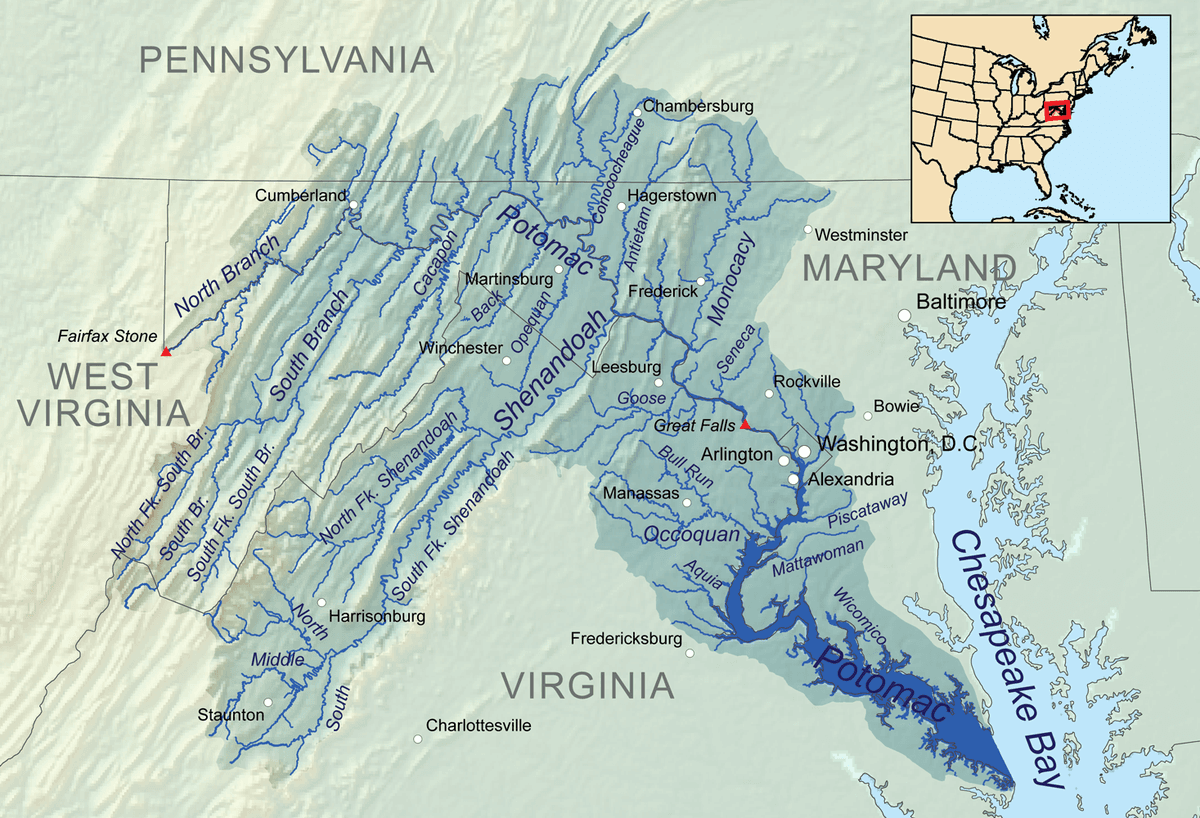
7.Potomac River and Chesapeake Bay Mapping (Potomac River)

The Hindu
Illustration for Potomac River and Chesapeake Bay Mapping (Potomac River)

What & Where

Potomac River originates in Potomac Highlands, West Virginia; flows through Virginia, Maryland, Washington D.C.; drains into Chesapeake Bay

Chesapeake Bay is a semi-enclosed estuary where freshwater meets Atlantic saltwater; largest in USA, 3rd worldwide

3 Feb 2025: US military helicopter and passenger plane collided over Washington, crashing into the Potomac River

Quick Facts for MCQs

Physical Geography

  • Potomac River path: WV highlands → Virginia → Maryland → Washington D.C. → Chesapeake Bay
  • Chesapeake Bay forms broad semi-enclosed Atlantic estuary, receiving Potomac discharge
  • Bay is United States’ largest estuarine water body

Ecological Significance

  • Estuary: zone where riverine freshwater mixes with oceanic saltwater, creating unique brackish ecosystem
  • Mixing fosters high nutrient turnover supporting diverse aquatic life

Disaster Incident

  • 2025 mid-air collision: US military helicopter & passenger plane fell into Potomac River near Washington
  • Initial reports indicate no known survivors

Key Data Points

FeatureData-Point
OriginPotomac River Highlands, West Virginia
Empties intoChesapeake Bay
States/District crossedVirginia, Maryland, Washington D.C.
Chesapeake Bay size rank1st in USA; 3rd in world (estuaries)
Potomac nickname“America’s River”
GS-1Mapping

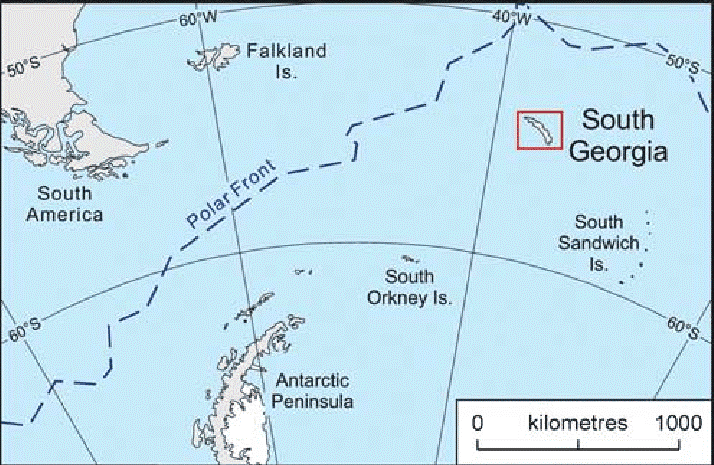
8.South Georgia Island Mapping (South Atlantic Island)

SW
Illustration for South Georgia Island Mapping (South Atlantic Island)

What & Where

Iceberg A-23A: world’s largest tabular iceberg now drifting from Weddell Sea toward South Georgia Island, South Atlantic.

South Georgia Island: remote, glaciated sub-Antarctic island forming part of UK-ruled South Georgia & South Sandwich Islands (SGSSI).

Terrain: Allardyce Range peaks (Mt Paget 2 935 m), glacier-fed short rivers, fjord-indented northern coastline.

Quick Facts for MCQs

Environmental Impact

  • Wildlife risk: Drifting iceberg may disrupt seal & penguin feeding routes, alter plankton blooms.
  • Ecosystem stress: Grounding could scrape seabed, reshaping benthic habitats.
  • Climate signal: Movement indicates changing Southern Ocean currents & wind regimes.

Geographical Features

  • Glaciation: Island largely ice-clad, numerous valley glaciers reaching sea.
  • Hydrography: Short, steep rivers sourced from melting ice caps.
  • Harbour sites: Grytviken & Cumberland Bay benefit from fjord shelter.

Governance & Demography

  • Sovereignty: Direct UK administration via Commissioner based in Falkland Islands.
  • Human presence: Seasonal researchers, fisheries officers; no permanent civilian settlement.
  • Legal framework: Protected Area status enforces strict biosecurity and fishery regulations.

Key Data Points

FeatureData-Point
Ocean settingSouth Atlantic
Political statusBritish Overseas Territory
Admin-capitalKing Edward Point
Highest peakMount Paget – 2 935 m
Major rangeAllardyce Range
Indigenous populationNone
Coast morphologyFjords & natural harbours on north
Dominant coverExtensive glaciers

Related UPSC Prelims PYQs

GEO_GS 2026PYQ 1

A23a refers to

GS-3Species

9.New Cardamom Species in Western Ghats (Cardamom Species)

The Hindu

What & Where

Spice; aromatic capsule of Elettaria cardamomum, family Zingiberaceae, hailed as Queen of Spices.

Native; evergreen Western Ghats rainforests, cultivated chiefly in Kerala, Karnataka, Tamil Nadu.

Newly added; Elettaria facifera (Periyar TR) & Elettaria tulipifera (Agasthyamalai–Munnar) raise genus to seven.

Quick Facts for MCQs

Taxonomic Update

  • Reclassification; both species moved from genus Alpinia to Elettaria via morphological + DNA evidence.
  • Facifera bears fissured fruits; tulipifera shows tulip-shaped bracts, aiding field ID.
  • Discovery underscores Western Ghats status as biodiversity hotspot.

Agro-Climatic Needs

  • Rain-fed humid tropics; 1500–4000 mm, 10–35 °C, shaded evergreen canopy.
  • Prefers acidic, humus-rich loamy soils on gentle slopes for rhizome health.
  • Altitude window 600–1500 m optimises flowering and volatile-oil content.

Production Geography

  • Kerala Idukki estates dominate national output; successive monsoon spells crucial.
  • Karnataka’s Kodagu & Chikmagalur plantations supply significant auction volumes.
  • Nilgiri hills Tamil Nadu cultivate smaller, high-aroma lots.

Economic Angle

  • India major exporter; discovery may widen genetic pool for disease-resistant, high-yield cultivars.
  • Premium spice fetches up to ₹2000 /kg; livelihood for >1 lakh growers.
  • Enhanced biodiversity narrative supports GI tag marketing and eco-tourism.

Key Data Points

FeatureData-Point
Annual rainfall need1500 – 4000 mm
Temperature range10 °C – 35 °C
Altitude band600 – 1500 m
Optimal soil pH5.0 – 6.5
Kerala share in India≈58 % (mainly Idukki)
New species namesE. facifera; E. tulipifera
Discovery sitesPeriyar TR; Agasthyamalai & Munnar
Genus Elettaria species nowSeven
India global rankSecond after Guatemala

Related UPSC Prelims PYQs

CAPF_GAI 2021PYQ 1

In India, Cardamom Hills are regarded as a continuation of the

GS-3EnvironmentQuick Bite

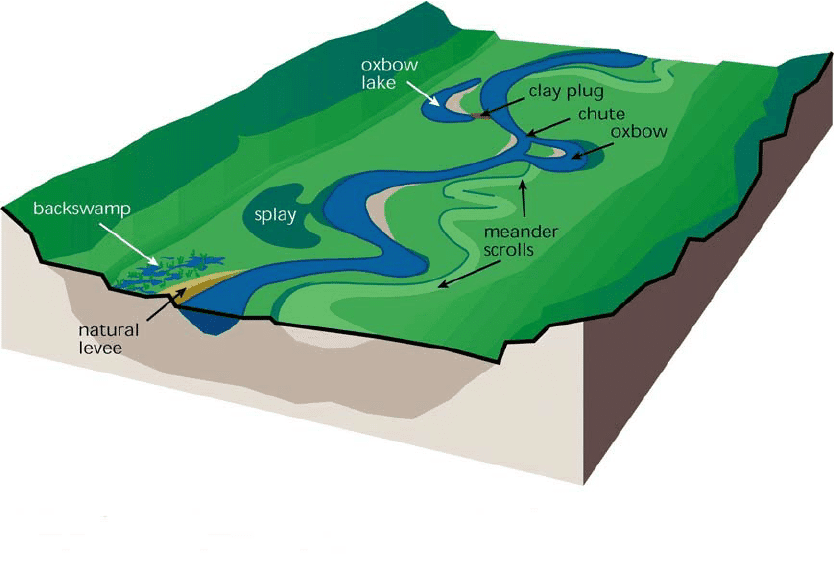
10.World Wetlands Day 2025 Highlights (Ramsar Sites)

PIB
Illustration for World Wetlands Day 2025 Highlights (Ramsar Sites)

What & Where

Wetlands: water-saturated ecosystems—marshes, swamps, mangroves, peatlands, oxbow lakes—link land and water regimes.

Ramsar Convention 1971, Iran: treaty for wise-use; Montreux Record lists sites with changing ecological character.

Parvati-Arga Ramsar Site: twin rain-fed oxbow lakes in Terai plains, Gonda district, Uttar Pradesh.

Quick Facts for MCQs

Schemes & Initiatives

  • Amrit Dharohar: conserves Ramsar sites through four-pillar strategy; encourages community-based ecotourism revenue.
  • Nature-culture corridor: Ayodhya–Devi Patan stretch announced to boost pilgrimage-plus-wetland tourism.
  • Tikri Forest near Parvati-Arga being upgraded as complementary ecotourism hub.

Ecology & Biodiversity

  • Endangered raptors: refuge for three vulture species, boosting scavenger guild conservation.
  • Winter visitors: Eurasian coot, mallard, greylag goose, northern pintail, red-crested pochard utilise lakes.
  • Invasive check: water hyacinth proliferation threatens native flora, dissolved oxygen, bird foraging.

Legal & Policy

  • Ramsar sites gain international importance tag; designated states manage under Wetlands (Conservation & Mgmt.) Rules 2017.
  • Montreux Record inclusion signals past, present or potential ecological change requiring priority action.
  • Annual World Wetlands Day events used by MoEFCC for outreach, citizen science and policy announcements.

Key Data Points

FeatureData-Point
World Wetlands Day2 Feb each year
2025 Theme“Protecting Wetlands for our Common Future”
New Ramsar sites 2025Udhwa Lake (JH), Theerthangal & Sakkarakottai (TN), Khecheopalri (SK)
First-time Ramsar statesJharkhand, Sikkim
India Ramsar tally89 sites (Feb 2025)
Top state countTamil Nadu – 20 sites
Uttar Pradesh count10 sites
Key Parvati-Arga faunaWhite-rumped, Indian, Egyptian vultures
Main invasive at siteWater hyacinth
Largest wetland threatIndustrial & domestic effluent pollution
Amrit Dharohar launchJune 2023
Amrit Dharohar pillarsSpecies, Nature-tourism, Livelihood, Carbon

Related UPSC Prelims PYQs

CAPF_GAI, GEO_GS 2025PYQ 1

The Ramsar Convention is an intergovernmental treaty which provides the framework for national action and international cooperation for the conservation of

CAPF_GAI, GEO_GS 2025PYQ 2

Which one of the following pairs of Ramsar Sites and States is not correctly matched?

GS-3S&T

11.AI-Driven Genetic Testing Advances (Genomic AI)

The Hindu

What & Where

AI-driven genetic testing = use of ML/Deep Learning to sequence, analyse and interpret human genomes.

Key processes: AI-powered sequencing, deep-learning mutation detection, CRISPR off-target prediction, predictive risk modelling.

Active in global research hubs (Johns Hopkins, EU labs) & consumer genomics firms; links to Genome-India Project.

Quick Facts for MCQs

Technological Applications

  • Sequencing: ML spots SNPs, structural variants rapidly.
  • CRISPR: AI models rank guide RNAs, predict off-targets, improving gene-therapy success.
  • Integration: Genetic reports synced with wearables & EHRs for real-time alerts.

Health & Economic Advantages

  • Early-warning: Predicts Alzheimer’s, diabetes, cancers enabling preventive lifestyle or prophylactic drugs.
  • Precision-drug discovery: Maps gene–drug interactions, shortens R&D cycles.
  • Affordability: Automation halves lab manpower and reagent expenditure.

Ethical, Security & Regulatory Risks

  • Privacy: Large-scale leaks enable identity theft, insurance or employment discrimination.
  • Bias: Under-representation of non-European genomes skews risk scores for Global South populations.
  • Regulation gap: HIPAA & many national laws silent on AI model reuse, secondary data sales.

Key Data Points

FeatureData-Point
Junk-DNA tumour links found (2024)1,200 elements
Gene Box AI prediction accuracy98 %
Alzheimer’s genes flagged via AI80 loci
Sequencing time cut by AIWeeks → hours
Cost reduction claimed≈ 50 %
23andMe breach (2023)6.9 million profiles
Euro-centric datasets in studies≈ 90 %
Alzheimer’s markers still unverified≈ 40 %
CRISPR accuracy boost via AIOff-target risk reduced (qualitative)
GDPR stanceExplicit consent needed for genetic data
GS-3Security

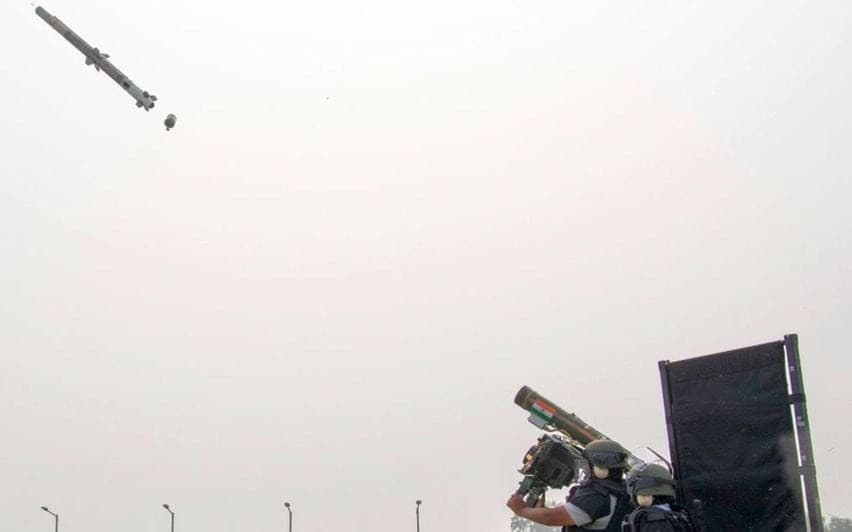
12.DRDO Man-Portable Air Defence System (VSHORADS Missile)

Indian Express
Illustration for DRDO Man-Portable Air Defence System (VSHORADS Missile)

What & Where

MANPAD (VSHORADS): lightweight, shoulder-fired missile for very-short-range air defence against low-altitude drones, helicopters, aircraft

Indigenous; conceived, designed, tested by DRDO-RCI, Hyderabad (Telangana) with 3 successful flight trials

Meant to replace ageing Russian Igla inventory across Indian Army, IAF, Navy deployments in varied terrains

Quick Facts for MCQs

Technical Highlights

  • Imaging infrared seeker allows interception of targets with reduced thermal signature
  • Fibre-reinforced launcher body ensures lighter weight without compromising structural integrity
  • Capable daylight-night, all-weather operation with quick-reaction engagement cycle

Indigenisation Drive

  • Aligns with Atmanirbhar Bharat push for self-reliant defence production
  • Reduces import dependency for MANPADS segment, enhancing strategic autonomy
  • Provides export potential to friendly nations under Defence Export Promotion Policy

Operational Context

  • Designed for rapid deployment in mountainous, desert, urban battlefields
  • Enhances last-mile air defence layer complementing Akash & SPYDER systems
  • Portable ergonomics allow single-soldier carriage through difficult terrain

Security Dimension

  • Counters emerging drone swarm threats over sensitive border installations
  • Strengthens critical infrastructure defence against low-altitude incursions
  • Adds deterrence by denying enemy close-air-support advantages

Key Data Points

FeatureData-Point
Missile classVery-Short-Range Air Defence System (VSHORADS)
Launch modeShoulder-fired or tripod-mounted
Total weight20.5 kg (launcher + missile)
Effective range0.25 km – 6 km
Max speedMach 1.5 ≈ 1,850 km/h
Warhead2 kg adaptive proximity-fuzed
Primary targetsLow-flying drones, helicopters, fixed-wing aircraft
DeveloperDRDO – Research Centre Imarat, Hyderabad
Key aimIndigenous replacement for Russian Igla MANPADS
Trial status3 flight tests completed successfully

Related UPSC Prelims PYQs

CDS_GK 2022PYQ 1

The term ‘Terminal High Altitude Area Defense’, sometimes mentioned in news, refers to

CDS_GK 2025PYQ 2

भारत के सैन्य आयुध (military arsenal) के बारे में निम्नलिखित में से कौन-सा/कौन-से कथन सही है/हैं?

GS-2Scheme

13.Gyan Bharatam Manuscript Conservation Mission (Manuscript Heritage)

The Print
Illustration for Gyan Bharatam Manuscript Conservation Mission (Manuscript Heritage)

What & Where

National Culture-ministry mission to survey, document, conserve India’s manuscript heritage

Covers collections in universities, museums, libraries, private holders across the country

Announced in Union Budget 2025-26; targets mapping of >1 crore manuscripts nationwide

Quick Facts for MCQs

Funding & Scale

  • Allocation jump 17-fold from ₹3.5 cr to ₹60 cr under National Mission for Manuscripts
  • Survey aims nationwide enumeration and status grading of manuscript holdings
  • Budget supports both physical preservation and digital archiving drives

Tech & Schemes

  • Digitization via high-resolution imaging ensures access while preventing handling damage
  • Conservation uses advanced, non-invasive techniques for brittle or ink-fading folios
  • Autonomous agency planned for streamlined procurement, training, monitoring

Stakeholder Collaboration

  • Institutional catalogues integrated for unified national manuscript database
  • Private collectors incentivised to register rare texts for documentation
  • Scholars and public to receive portal access once metadata uploaded

Key Data Points

FeatureData-Point
Mission nameGyan Bharatam Mission
Launch contextUnion Budget 2025-26
Nodal ministryCulture
FY25-26 outlay (NMM)₹60 crore
Previous outlay₹3.5 crore
Scale target>1 crore manuscripts
Core activitiesSurvey, conservation, digitization
Implementation bodyProposed autonomous agency
Key partnersAcademia, museums, libraries, private collectors

Related UPSC Prelims PYQs

NDA_GAT 2025PYQ 1

Which Ministry has initiated the “Dhara”, a special initiative dedicated to Indian Knowledge System (IKS)?

GS-2Scheme

14.Prime Minister Dhan-Dhaanya Krishi Yojana (Agriculture Productivity)

Times of India

What & Where

Scheme; Prime Minister Dhan-Dhaanya Krishi Yojana announced in Union Budget 2025-26

Geography; 100 identified low-productivity agricultural districts pan-India

Implementer; Ministry of Agriculture & Farmers’ Welfare via convergence of existing programmes

Quick Facts for MCQs

Tech & Schemes

  • Convergence; merges ongoing irrigation, storage, credit and seed missions
  • Infrastructure; promotes micro-irrigation, village-level cold storages, hybrid seed kits
  • Monitoring; district-level dashboards for yield, credit uptake, water use

Economic Angle

  • Allocation; pulses highest share ₹1,000 crore highlighting protein security push
  • Diversification; funds fruits-vegetables to reduce cereal dependence and raise farm income
  • Credit; easier KCC limit enhancements for beneficiary districts

Social Concerns

  • Inclusion; emphasis on women self-help groups for post-harvest handling units
  • Landless; supports custom-hiring centres enabling asset-light farming livelihoods
  • Equity; priority lending rates for SC-ST-headed farm households

Environmental Impact

  • Sustainability; promotes millets, pulses to lower water and fertiliser footprints
  • Soil health; incentivises crop rotation with legumes, bio-fertiliser usage
  • Climate resilience; irrigation funds favour micro-sprinklers, drip reducing evapotranspiration

Key Data Points

FeatureData-Point
Budget year2025-26 Union Budget
Scheme natureCentrally sponsored, convergence-based
Total new allocationNil; leverages re-prioritised funds
Pulses component₹1,000 crore
Fruits & vegetables component₹500 crore
Hybrid seeds component₹100 crore
Primary goalsProductivity rise, diversification, post-harvest, irrigation, credit
Target districts100 low-yield districts
Key beneficiariesSmall & marginal farmers, rural women, landless families
Storage levelPanchayat & block warehouses

Related UPSC Prelims PYQs

CAPF_GAI, ESE_GS 2025PYQ 1

Which one among the following schemes focuses on developing modern infrastructure and optimizing supply chain from farm to retail in Indian agriculture sector?

CAPF_GAI, ESE_GS 2025PYQ 2

Which one of the following Yojanas replaces two schemes – National Agricultural Insurance Scheme (NAIS), 1999 as well as the Modified National Agricultural Insurance Scheme (MNAIS), 2010 – by incorporating the best features of all these schemes while removing the previous shortcomings and weaknesses?

GS-2Scheme

15.Minority Community Empowerment Initiatives (Minority Welfare)

PIB
Illustration for Minority Community Empowerment Initiatives (Minority Welfare)

What & Where

Ministry of Minority Affairs (2006) drives socio-economic uplift of six centrally notified minorities across India.

Instrument set: scholarships, concessional credit, skill-heritage support (PM VIKAS), infra funding (PMJVK), Haj facilitation, Jiyo Parsi.

Coverage spans minority-concentrated districts; Haj operations to Mecca, Parsis concentrated in Maharashtra-Gujarat belt.

Quick Facts for MCQs

Legal & Policy

  • Article 29 protects language, script, culture; Article 30 grants right to run educational institutions.
  • NCMA 1992 empowers Centre to notify minorities; enables National Commission for Minorities oversight.
  • Waqf Act 1995 governs religious endowments; Central Waqf Council drives digitisation.

Schemes Portfolio

  • PM VIKAS bundles USTTAD, Nai Manzil, Nai Roshni, Hamari Dharohar for skilling & heritage revival.
  • PMJVK funds health, sanitation, sports, women’s hubs in minority clusters.
  • Jiyo Parsi extends IVF, counselling, childcare grants to stem demographic decline.

Finance Trend

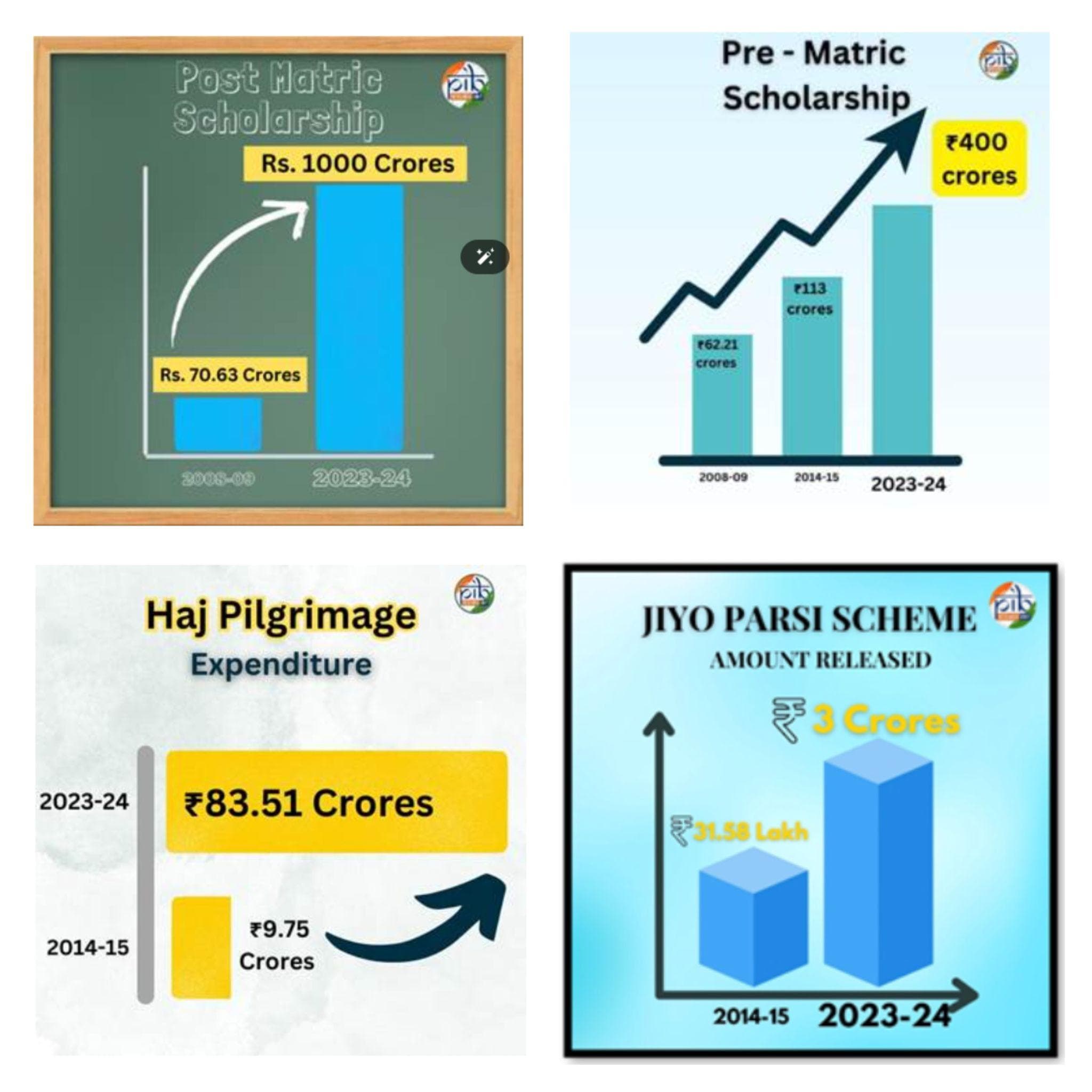
  • Scholarship allocation multiplied ~14× from 2008-09 to 2023-24, signalling priority on education.
  • Haj facilitation outlay jumped 8.5× (₹9.75 cr→₹83.51 cr) between 2014-15 and 2023-24.
  • NMDFC infusion modest, suggesting shift toward mainstream credit channels for minority entrepreneurs.

Key Data Points

FeatureData-Point
Notified minorities (NCMA 1992)Muslims, Sikhs, Christians, Buddhists, Parsis, Jains
Minority share in population19.3 % (Census 2011)
Post-Matric Scholarship launch2007
Post-Matric outlay 2023-24₹1,000 cr
Pre-Matric outlay 2023-24₹400 cr
NMDFC equity 2023-24₹3 cr
Haj facilitation spend 2023-24₹83.51 cr
Jiyo Parsi births aided400 +
PM VIKASMerger of 5 legacy schemes
PMJVK focusCommunity infrastructure in minority areas

Related UPSC Prelims PYQs

GS1 2011PYQ 1

In India, if a religious sect/community is given the status of a national minority, what special advantages is it entitled to?

GS1 2001PYQ 2

Consider the following statements about the minorities in India:

GS-2Scheme

16.Mutual Credit Guarantee Scheme for MSMEs (MSME Credit)

PIB
Illustration for Mutual Credit Guarantee Scheme for MSMEs (MSME Credit)

What & Where

Scheme: Mutual Credit Guarantee Scheme-MSME; partial guarantee to lenders for equipment/machinery loans.

Process: NCGTC covers 60 % default risk; Member Lending Institutions extend collateral-free credit.

Geography: Pan-India, open to Udyam-registered MSMEs across all States/UTs.

Quick Facts for MCQs

Legal & Policy

  • Notification: Union Cabinet approval February 2025 under Department of Financial Services.
  • Ownership: NCGTC a GoI-owned private limited company, Companies Act 1956 compliant.
  • Coverage: Manages 14 dedicated guarantee funds including CGFMU, ECLGS besides MCGS-MSME.

Economic Angle

  • Credit boost: Unlocks large-ticket collateral-free finance, easing MSME balance-sheet constraints.
  • Manufacturing push: Aligns with Make in India target 25 % GDP share.
  • Jobs: Manufacturing MSMEs already employ 27 million; scheme expected to scale hiring.

Institutional Setup

  • Trustee role: NCGTC administers guarantee, settles claims with MLIs.
  • MLIs obligation: Undertake due diligence, follow RBI lending norms.
  • Risk sharing: 40 % exposure retained by lender, enhancing credit discipline.

Key Data Points

FeatureData-Point
Loan purposeEquipment/Machinery purchase
Max loan size₹100 crore per borrower
Guarantee cover60 % by NCGTC
EligibilityMSME with valid Udyam Registration
Project composition≥75 % cost towards equipment/machinery
Scheme window4 years or ₹7 lakh crore guarantees, whichever earlier
Implementing trusteeNational Credit Guarantee Trustee Company Ltd
MLIsSCBs, NBFCs, AIFIs registered with NCGTC
Manufacturing GDP share aimRaise from 17 % to 25 %
Paid-up capital of NCGTC₹10 crore (GoI-owned)

Related UPSC Prelims PYQs

CAPF_GAI, GEO_GS 2024PYQ 1

Which of the following statements is NOT correct for Pradhan Mantri Mudra Yojana (PMMY)?

CAPF_GAI, GEO_GS 2021PYQ 2

Micro, Small & Medium Enterprises (MSMEs) contribute significantly in the economic and social development of the country. Which of the following measures is / are taken by the Government with respect to MSMEs?

GS-1Economy

17.Gender Budget 2025-26 Overview (Gender Budgeting)

PIB
Illustration for Gender Budget 2025-26 Overview (Gender Budgeting)

What & Where

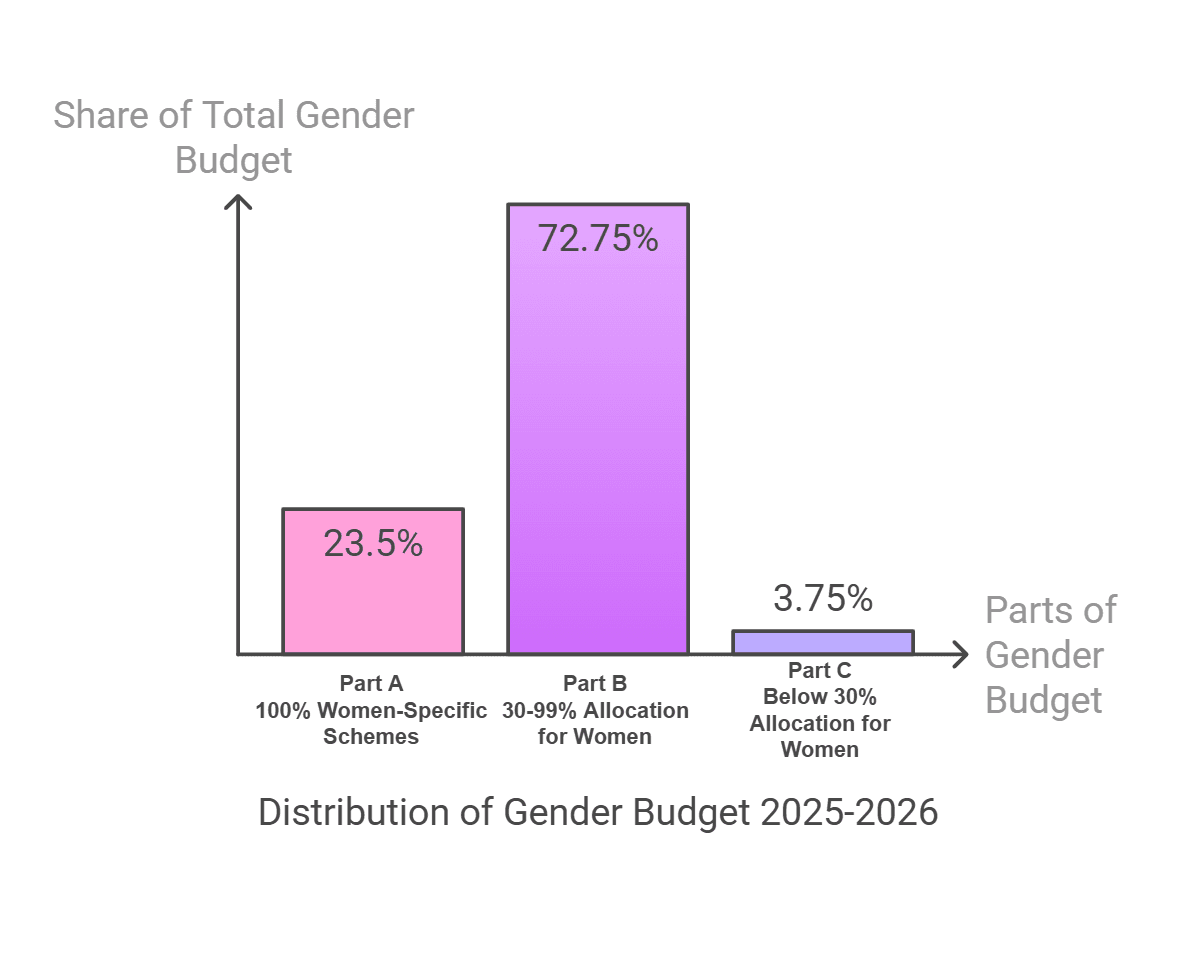
Gender Budget Statement (GBS): annual Union document mapping women-focused allocations across schemes

Three-part categorisation: Part A (100% women), Part B (30-99% women), Part C (gender mainstreaming within ministries)

Geography: applies pan-India; nodal at MWCD centrally, state WCD depts, district HEW hubs

Quick Facts for MCQs

Budget Numbers

  • Allocation concentrates 90 % in few schemes: PMGKAY, MGNREGS, PMAY-G
  • Long-term schemes like Ayushman Bharat inflate totals but delay immediate empowerment gains
  • PMAY-G Part A tags 100 % women yet only 23 % houses to women owners

Implementation Structure

  • Central MWCD issues guidelines; Finance Ministry compiles GBS
  • States use Finance, Planning, WCD departments; 26 states now publish gender budgets
  • District HEW hubs mandated one gender specialist for scheme vetting

Challenges

  • Methodology ambiguity skews classification; MGNREGS underreported despite 56 % female person-days
  • Weak monitoring; scarce gender-segregated data hinders impact assessment
  • Political prioritisation uneven, limiting cross-sector adoption

Way Forward

  • Integration of gender lens into infrastructure, rural development, climate budgeting
  • Transparency via public methodologies, periodic gender audits, real-time dashboards
  • Capacity-building for officials; UN urges stronger MWCD–Finance collaboration

Key Data Points

FeatureData-Point
FY 2025-26 Gender Budget₹4.49 lakh crore
Share in Union Budget8.86 %
YoY rise over FY 2024-2537.5 %
Reporting ministries/depts49
First GBS issued2005-06
India rank, 2024 Gender Gap129 / 146
Parent umbrellaSamarthya sub-scheme, Mission Shakti
Nodal ministry (Centre)MWCD

Related UPSC Prelims PYQs

CDS_GK 2025PYQ 1

“निर्भया कोष”, एक अक्षय कोष निधि (non-lapsable corpus fund) है, जिसका उपयोग विशेष रूप से महिलाओं की सुरक्षा एवं संरक्षा में सुधार हेतु अनुमोदित परियोजनाओं के लिए किया जाता है। इसे किसके द्वारा प्रोत्साहित किया जाता है?

CDS_GK 2021PYQ 2

Which one of the following statements in the context of social sector spending in India during 2014–19 (both States and the Union Government together) is true?

Ready to practice?

Test your knowledge with our UPSC test series.

Start Free Trial