UPSC Current Affairs

14 topicsGS-1: 3GS-2: 4GS-3: 7
0/14 done
GS-2Polity

1.Ensuring Election Commission Independence (Election Commission)

The Hindu

What & Where

Independence of Election Commission: election supervision free from executive, political, external influence across India

Key processes: appointment method, security of tenure, financial autonomy, collective decisions under Article 324

Core geography: Constitutional body headquartered New Delhi with jurisdiction over entire Union

Quick Facts for MCQs

Constitutional Safeguards

  • Security-of-tenure and service-condition shields embedded in Article 324(5)
  • Plenary power enables EC action even when statute silent (Mohinder Singh Gill 1978)
  • Multi-member design curbs individual bias by ensuring collective supervision

Judicial Verdicts

  • Indira Gandhi 1975: free, fair elections part of Basic Structure
  • T.N. Seshan 1995: Election Commissioners’ status equal to CEC, multi-member upheld
  • Anoop Baranwal 2023: CJI inclusion sought for neutral appointments

Operational Challenges

  • Executive-heavy panel enabled partisan appointments, e.g., two ECs filled March 2024
  • Financial dependence delayed emergency funds for 2025 Bihar roll scrutiny
  • Tech-driven de-duplication deleted 25 lakh genuine voters in Haryana 2025

Reform Proposals

  • Extend CEC-level removal safeguards to all Commissioners via Article 324(5) amendment
  • Charge EC expenditure to Consolidated Fund for purse-string insulation
  • Create independent secretariat; mandate physical hearings before voter deletions

Key Data Points

FeatureData-Point
Article vesting powersArticle 324(1)
Removal standard for CECSame as SC judge; proven misbehaviour/incapacity
Service conditions post-appointmentCannot be varied to CEC’s disadvantage
Multi-member status since1993 (three-member Commission)
Protection for other ECsWeaker; removable on CEC recommendation
Appointment panel (2024 Act)PM + Cabinet minister + LoP
Budget sourceVoted demand, not Consolidated Fund
Latest SC mandate on selectionAnoop Baranwal 2023 added CJI
Ongoing constitutional challengeJaya Thakur case 2024-26

Related UPSC Prelims PYQs

CDS_GK, GS1 2002PYQ 1

Consider the following statements with reference to India:

CDS_GK, GS1 2022PYQ 2

Which one of the following statements with regard to the Election Commission is not correct ?

GS-2Polity

2.Parliamentary Freedom of Speech Safeguards (Parliamentary Privileges)

The Hindu

What & Where

Parliamentary privilege; Article 105 grants MPs freedom of speech during House/committee proceedings across Lok Sabha & Rajya Sabha.

Immunity covers “anything said or any vote given”, shielding from civil/criminal action within Indian courts.

Rule-380 Lok Sabha Procedure allows Speaker to expunge unparliamentary words, moderating the privilege in practice.

Quick Facts for MCQs

Constitutional Provisions

  • Article 105 unique to Parliament; Article 194 mirrors for State Legislatures.
  • Privilege operates independent of Article 19 reasonable-restrictions regime.
  • Extension covers constitutionally entitled participants ensuring open executive-legislative dialogue.

Procedural Rules

  • Sub-judice bar; ongoing court matters cannot be debated.
  • Prior-notice needed before defamatory allegations against individuals.
  • Negative references to high constitutional authorities restricted for decorum.

Judicial Pronouncements

  • Tej Kiran Jain broadened “anything”, making privilege nearly absolute.
  • Raja Ram Pal allowed SC review when privilege breaches constitutional boundaries.
  • Sita Soren criminalised vote-linked bribery, narrowing immunity scope.

Checks & Limits

  • Committee of Privileges investigates misuse, recommends sanctions.
  • Speaker’s expunction decisions aim to balance free speech with dignity.
  • Courts barred from questioning speeches unless privilege itself violated.

Key Data Points

FeatureData-Point
Core freedom clauseArticle 105(1)
Legal immunity clauseArticle 105(2)
Judge-conduct discussion banArticle 121
Expunction authorityRule 380, Lok Sabha Rules
Non-member protectedAttorney General of India
First absolute-immunity caseTej Kiran Jain v. N. Sanjiva Reddy (1970)
Bribery immunity quashedSita Soren v. Union of India (2024)
1998 bribery immunity caseP.V. Narasimha Rao v. State
Privilege judicial-review caseRaja Ram Pal v. Speaker (2007)
Minister-speech liability caseKaushal Kishor v. State of UP (2023)

Related UPSC Prelims PYQs

CDS_GK, GS1 2020PYQ 1

Which of the following statements with regard to the privileges of the Members of the Parliament are correct?

CDS_GK, GS1 2025PYQ 2

With reference to the Indian polity, consider the following statements:

GS-3Economy

3.National Monetisation Pipeline 2.0 Roadmap (Asset Monetisation)

PIB

What & Where

National Monetisation Pipeline 2.0: FY 2026-30 roadmap to lease brownfield public assets across India.

Prepared by NITI Aayog; executed under Finance Ministry, monitored by CGAM & Cabinet Secretary.

Targets highways, rail, power, ports, coal, telecom, aviation, urban infra, tourism.

Quick Facts for MCQs

Economic Angle

  • Asset recycling lowers immediate budgetary CAPEX, freeing fiscal space for social spending.
  • Long-term private capital infusion expected to deepen domestic infrastructure bond market.
  • Monetisation proceeds envisioned to catalyse multiplier effect via fresh public investment.

Governance Mechanism

  • Inter-ministerial group led by Cabinet Secretary ensures continuous oversight and milestone tracking.
  • Standardised processes, time-bound approvals adopted after NMP 1.0 lessons.
  • Line ministries must place annual pipelines on the CPSE Asset Monetisation Dashboard.

Sectoral Allocation

  • Railways share 16% (₹2.62 lakh crore); focus on stations, freight corridors, warehouses.
  • Ports 16% (₹2.63 lakh crore) through berth concessions, container terminals, SEZ land parcels.
  • Coal 13% (₹2.16 lakh crore) via commercial mine auctions and MDO contracts.

Key Data Points

FeatureData-Point
Coverage Years2026-2030
Monetisation Value₹16.72 lakh crore
Expected Private Investment₹5.8 lakh crore
Top Sector ShareHighways + MMLPs + Ropeways 26%
Second-largest SectorPower 17%
Key Monetisation ModelsPPP, InvIT, cash-flow securitisation, auctions, partial divestment
Revenue DestinationConsolidated Fund, PSU coffers, State funds, direct private spend
Core Guidance DocMethodology & roadmap by NITI Aayog
Monitoring BodyCore Group of Secretaries on Asset Monetisation
AimRecycle assets to fund new CAPEX without extra fiscal burden
GS-3Economy

4.India-France DTAC Amendments (Double Taxation)

PIB

What & Where

India–France Amending Protocol to 1992 Double Taxation Avoidance Convention (DTAC), signed Feb 2026.

Updates capital-gains, dividend, MFN, FTS, Permanent Establishment, information-exchange and BEPS provisions.

Applies to taxpayers and cross-border transactions between India and France.

Quick Facts for MCQs

Taxation Changes

  • Capital gains: exclusive taxing rights to company-resident jurisdiction.
  • Dividends: flat 10 % replaced by split 5 %/15 % structure.
  • FTS & PE: US-style FTS definition and Service PE added.

BEPS & MFN

  • MFN clause formally removed, ending related disputes.
  • BEPS MLI anti-avoidance standards embedded into bilateral treaty.
  • Tax collection article enables cross-border recovery collaboration.

Economic Angle

  • Tax certainty improved, expected to boost bilateral investment and technology flows.
  • Clearer rules reduce litigation, enhancing investor confidence in both jurisdictions.

Key Data Points

FeatureData-Point
Original DTAC year1992
Amending Protocol year2026
SignatoriesIndia & France
Capital-gains taxing rightState where company is resident
MFN clauseDeleted
Dividend tax rates5 % (≥10 % holding); 15 % (others)
FTS definition basisAligned with India–US treaty
New PE categoryService PE
BEPS MLI provisionsIncorporated
New cooperation toolAssistance in Collection of Taxes

Related UPSC Prelims PYQs

GS1 2010PYQ 1

A great deal of Foreign Direct Investment (FDI) to India comes from Mauritius than from many major and mature economies like UK and France. Why?

GS-3Infrastructure

5.V.O. Chidambaranar Port Expansion Projects (Port Infrastructure)

PIB

What & Where

VOC Port – artificial, all-weather deep-sea harbour on Coromandel Coast, Tuticorin, Gulf of Mannar, Tamil Nadu

Gateway along East–West international sea route, key for trade with Mediterranean, Europe, United States

Naturally cyclone-sheltered by Sri Lanka lying southeast

Quick Facts for MCQs

Infrastructure Push

  • Expansion package targets deeper berths, mega-carrier handling via Outer Harbour
  • Artificial harbour allows 24×7 deep-draft operations without tidal constraint
  • Investment complements Sagarmala objectives of port-led growth

Tech & Green Initiatives

  • Green hydrogen generation powers selected port equipment, cuts fossil dependence
  • Digital Twin enables predictive maintenance, optimised cargo flow analytics
  • Energy projects part of broader green port vision under Maritime India-2030

Security Dimension

  • Anti-drone shield integrates radar detection and RF neutralisation, first at any Indian port
  • System strengthens critical maritime infrastructure security amid rising UAV threats

Cultural Heritage

  • Maritime Heritage Museum highlights Coromandel nautical history and Swadeshi movement legacy
  • Port renaming immortalises V.O. Chidambaranar’s challenge to British maritime monopoly

Key Data Points

FeatureData-Point
Original nameTuticorin Port
Renamed year2011
Named afterV.O. Chidambaranar, Swadeshi Steam Navigation pioneer
Minister’s Feb 2026 package₹1,500 crore; infra & green energy projects
Green hydrogen milestoneFirst Indian port with on-site production (pilot late 2025)
Digital Twin statusFirst Indian port to deploy real-time virtual replica
Anti-drone defenceRadar + RF system operational Feb 2026
Geographic settingGulf of Mannar, Coromandel Coast
Natural shelter factorSri Lanka buffers storms & cyclones
Future rolePlanned South-India trans-shipment hub via Outer Harbour

Related UPSC Prelims PYQs

CDS_GK, GS1 2023PYQ 1

Consider the following pairs:

CDS_GK, GS1 2021PYQ 2

Which one of the following sea ports has gained importance for the export of iron ore to Japan?

GS-3InfrastructureQuick Bite

6.E175 Regional Jets Assembly in India (Regional Aircraft)

Business Standard

What & Where

Final Assembly Line (FAL) for Embraer E175 regional jets to be set up in India

Partners: Adani Defence & Aerospace (India) and Embraer (Brazil)

Targets high-frequency Tier-2/3 routes under RCS-UDAN

Quick Facts for MCQs

Make in India Drive

  • Emphasis: Indigenous aviation ecosystem to cut import dependence
  • Objective: Position India as regional-jet manufacturing hub

Aircraft Demand

  • Projection: 500 regional jets needed by 2046 in 80–146 seat bracket
  • Usage: High-frequency shuttles connecting underserved Tier-2/3 markets

Industrial Scope

  • Coverage: Final assembly, component manufacturing, aftermarket services
  • Sustainability: Securing domestic & export orders to keep FAL viable

Key Data Points

FeatureData-Point
MoU statusEnhanced MoU signed Feb 2026
Aircraft modelEmbraer E175
Seating capacityUp to 88 passengers
Indian demand forecast≈ 500 aircraft (80–146 seat class) in 20 years
Key scheme linkageRCS-UDAN (Regional Connectivity)
Core programmeMake in India – Aviation
Ecosystem scopeManufacturing, supply chain, pilot training, aftermarket
Industrial partner nationalityBrazil (Embraer), India (Adani)
GS-1History

7.UNESCO Asia-Pacific Heritage Awards 2025 (Heritage Conservation)

DH
Illustration for UNESCO Asia-Pacific Heritage Awards 2025 (Heritage Conservation)

What & Where

UNESCO Asia-Pacific Awards: honours top cultural-heritage conservation projects across 45-nation Asia-Pacific region.

Established 2000, focuses on technical excellence, cultural authenticity, community participation & adaptive reuse.

2025 Award of Merit bagged by 16th-century Our Lady of Grace Cathedral, Papdy-Vasai, Maharashtra.

Quick Facts for MCQs

Award Criteria

  • Understanding-of-place, technical achievement, sustainability & community impact dominate jury metrics.
  • Accepts private or public-private initiatives; excludes wholly state-funded routine maintenance.
  • Heritage types span buildings, towns, archaeological sites, cultural landscapes, vernacular architecture.

Conservation Approach

  • Emphasis on using traditional materials; Vasai used stone, mud mortar, zero cement.
  • Adaptive reuse encouraged to ensure economic viability & long-term preservation.
  • Projects must document minimal intervention and reversibility where feasible.

Vasai Cathedral Highlights

  • Roof, façade, corridors, bell tower restored with hand-carved liturgical elements reflecting original craft.
  • Functions as living church, safeguarding tangible structure & intangible worship traditions.
  • Showcases Indo-Portuguese stone masonry, bolstering coastal Maharashtra’s colonial-era heritage tourism.

Key Data Points

FeatureData-Point
Administering bodyUNESCO
Award launch year2000
Geographic scopeAsia-Pacific region
Total projects honoured300+ across 27 countries
Eligibility windowCompletion within past 10 years
2025 prize categoryAward of Merit
Winning Indian siteOur Lady of Grace Cathedral, Vasai
Cathedral age≈ 475 years (16th century)
Architectural styleEarly Portuguese colonial ecclesiastical
Recent restoration cost~₹4.5 crore, community-funded
GS-1MappingQuick Bite

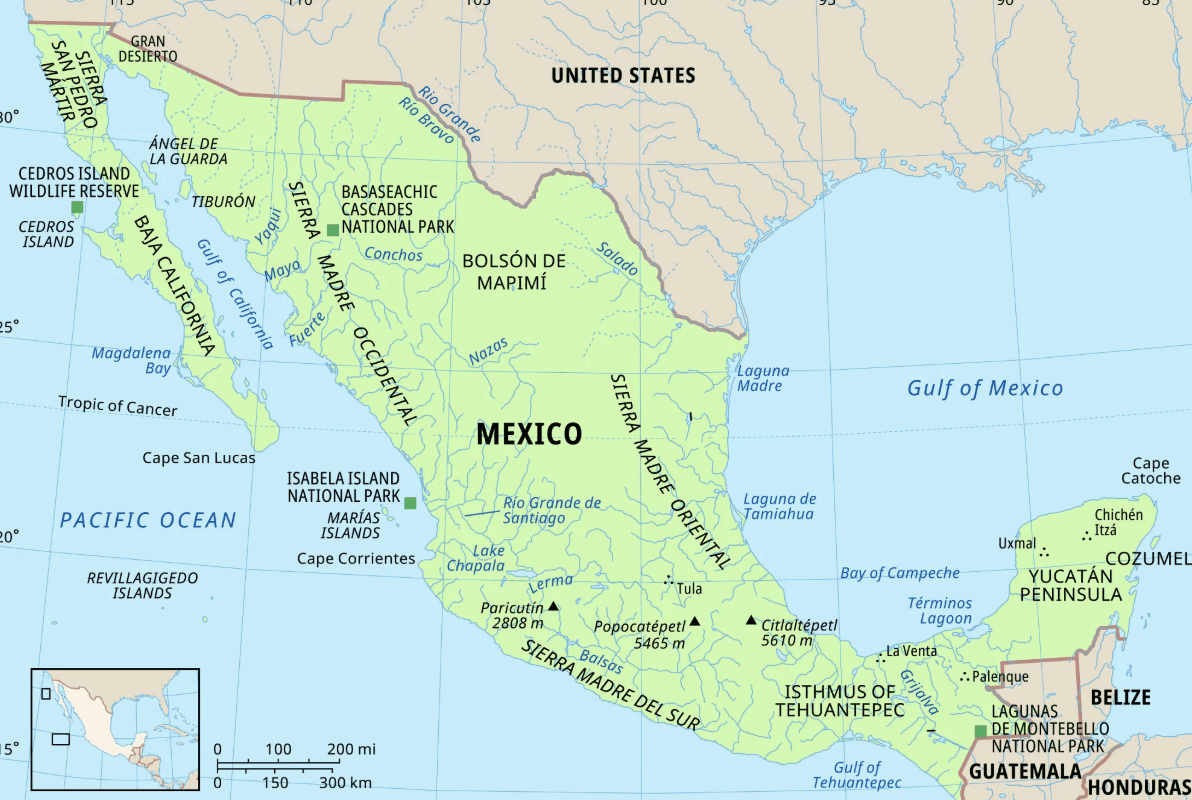
8.Mexico Geographical Overview (Mexico Geography)

IT
Illustration for Mexico Geographical Overview (Mexico Geography)

What & Where

Mexico (Estados Unidos Mexicanos): federal republic in southern North America linking U.S. and Central America.

Bordered by Pacific Ocean (W & S) and Gulf of Mexico–Caribbean Sea (E); in Pacific Ring of Fire.

Capital Mexico City sits on Mexican Plateau within Trans-Mexican Volcanic Belt.

Quick Facts for MCQs

Physical Geography

  • Ring-of-Fire setting causes frequent quakes and eruptions.
  • Sierra Madre Occidental (W) & Oriental (E) flank central plateau.
  • Coastal plains, plateaus, peninsulas create diverse climate zones.

Biodiversity & Tourism

  • Megadiverse nation hosting deserts, rainforests, coral reefs.
  • Yucatán cenotes, Mayan ruins, Cancún beaches draw global tourists.
  • Pacific resorts leverage whale-watching and surf-rich coastline.

Security Dimension

  • Cartel leader “El Mencho” death sparked multi-state violence.
  • Federal deployment of ~10,000 troops to restore order.
  • Persistent cartel conflict poses risk to investment and tourism.

Economic Angle

  • Manufacturing, agriculture, services power leading Latin-American GDP.
  • USMCA membership integrates supply chains with U.S.–Canada.
  • Land bridge location vital for north–south trade corridors.

Key Data Points

FeatureData-Point
CapitalMexico City
Northern neighbourUnited States
Southeastern neighboursGuatemala, Belize
Western & Southern water bodyPacific Ocean
Eastern water bodiesGulf of Mexico; Caribbean Sea
Major mountain rangesSierra Madre Occidental; Sierra Madre Oriental; Trans-Mexican Volcanic Belt
Highest volcanoCitlaltépetl (Pico de Orizaba)
Active volcano near capitalPopocatépetl
Key peninsulasYucatán; Baja California
Principal plateauMexican Plateau
Border river with U.S.Río Bravo (Rio Grande)
Troops deployed post-cartel violence≈10,000
Economic statusAmong largest Latin-American economies
GS-3S&T

9.New Delhi AI Impact Declaration (AI Governance)

PIB

What & Where

New Delhi Declaration on AI Impact 2026 – voluntary pact for equitable, trusted, democratic diffusion of AI

Adopted at India-AI Impact Summit, New Delhi; 89 signatories including US and China

Framework rests on seven Chakras; guided by Vasudhaiva Kutumbakam & Sarvajan Hitaya Sarvajan Sukhaya

Quick Facts for MCQs

Legal & Policy

  • Non-binding; lacks enforcement or red-lines on high-risk AI unlike EU AI Act
  • Calls for Charter on Democratic Diffusion, Trusted AI Commons, yet no verification mechanism
  • India introduces MANAV Vision for ethical, sovereignty-focused AI development

Economic Angle

  • USD 250 bn for datacentres and fabs; USD 20 bn earmarked for deep-tech venture capital
  • Pax Silica entry secures semiconductor supply and critical mineral diversification
  • UPI-style MSME AI Stack planned to raise small-business productivity

Tech & Schemes

  • Government adding 20 000 GPUs, aiming 1 lakh compute by 2026 under IndiaAI Mission 2.0
  • Sarvam-30B, Sarvam-105B and Param2 models mark indigenous frontier capabilities across 22 languages
  • Sarvam Kaze smart-glasses and Sutra AI anchor expand domestic AI product ecosystem

Social Concerns

  • 5.8 mn Indian IT jobs vulnerable; minimal labour-union voice at summit
  • Large-scale skilling via Reskilling Playbook and Bodhan AI proposed to prevent displacement
  • Risk of data-colony status if foreign firms retain high-value AI platforms

Environmental Impact

  • Data centres use ~1.1 mn L water daily; Bengaluru expansion aggravates urban scarcity
  • Declaration urges energy-efficient algorithms and renewable-powered Green AI
  • Guiding Principles and Resilient AI Infrastructure Playbook aim at resource efficiency

Key Data Points

FeatureData-Point
Adoption year2026
Signatory count89 countries & organisations
Binding natureNon-binding, voluntary
Structural pillars7 Chakras
Core mottoSarvajan Hitaya – Sarvajan Sukhaya
Key commonsGlobal AI Impact & Trusted AI Commons
India GPU target1 00 000 GPUs by 2026
Investment pledgesUSD 250 bn infra + USD 20 bn deep-tech VC
Semiconductor blocPax Silica Alliance
Proposed UN fundUSD 3 bn for Equitable AI

Related UPSC Prelims PYQs

GEO_GS 2024PYQ 1

Which of the following statements about GPAI (Global Partnership on Artificial Intelligence) is/are correct?

GS-2Polity

10.Maritime Labour Convention 2006 Milestone (Maritime Labour)

AN
Illustration for Maritime Labour Convention 2006 Milestone (Maritime Labour)

What & Where

Maritime Labour Convention (MLC), 2006 = global treaty setting minimum working-/living standards for seafarers; nicknamed “Seafarers’ Bill of Rights”.

Adopted 23 Feb 2006 at International Labour Conference, Geneva; applied worldwide irrespective of ship flag or crew nationality.

20th anniversary jointly spotlighted by International Labour Organization (ILO) and International Maritime Organization (IMO).

Quick Facts for MCQs

Legal & Policy

  • Consolidates >60 earlier maritime labour instruments into one coherent convention.
  • Applies to all ships engaged in commercial activities except fishing/naval/state vessels.
  • Aims fair competition by disallowing cost-cutting via substandard labour practices.

Labour Standards

  • Sets minima on age, medical fitness, professional training before boarding.
  • Mandates written employment contracts, timely wages, regulated work/rest hours, paid leave, repatriation rights.
  • Prescribes onboard accommodation, ventilation, lighting, recreational spaces.

Compliance & Enforcement

  • Flag State must issue Maritime Labour Certificate after inspections.
  • Port State control empowered to detain vessels violating MLC norms.
  • Regular survey cycle: initial, intermediate (2–3 yrs), renewal (5 yrs).

Social Impact

  • Global improvements in wages, safety, social-security coverage for ~1.9 million seafarers.
  • Provides onboard and shore-based medical care parity with land workers.
  • Strengthens grievance redressal via both onboard and onshore complaint mechanisms.

Key Data Points

FeatureData-Point
Treaty nicknameSeafarers’ Bill of Rights
Adopted on23 February 2006
Adopted byInternational Labour Conference, Geneva
Custodian UN agencyInternational Labour Organization
20th-anniversary partnersILO & International Maritime Organization
Key objectiveDecent work standards + fair competition in global shipping
GS-2Polity

11.US IEEPA 1977 Sanctions Authority (US Sanctions Law)

Indian Express

What & Where

Statute: US International Emergency Economic Powers Act enables presidential control over international commerce during declared external emergencies

Enacted: 1977, superseding 1917 Trading with the Enemy Act powers

Geography: Applies within United States jurisdiction but targets foreign entities/assets globally

Quick Facts for MCQs

Legal & Policy

  • Authority: Allows blocking of assets, restricting financial flows and regulating trade during emergencies
  • Limitation: Act designed for sanctions, not long-term tariff imposition
  • Replacement: Narrows earlier broad powers granted under 1917 Trading with the Enemy Act

Security Dimension

  • Trigger: Extraordinary external threats to national security, foreign policy or economy
  • Application: Frequently invoked against terrorism financiers, hostile regimes, cyberattacks
  • Statecraft: Instrument central to US sanctions diplomacy and coercive economic measures

Checks & Oversight

  • Declaration: President must issue formal national emergency under National Emergencies Act
  • Reporting: Ongoing transaction regulations require periodic updates to Congress
  • Review: Supreme Court can strike measures exceeding statutory or constitutional limits, as with recent tariff case

Key Data Points

FeatureData-Point
Enactment year1977
Parent legislation replacedTrading with the Enemy Act, 1917
Primary aimSwift response to external threats via economic measures
Core toolsetSanctions, asset freezes, transaction restrictions
Emergency basisRequires proclamation under National Emergencies Act
Oversight mechanismMandatory periodic reports to US Congress
Judicial checkMeasures subject to constitutional review by courts
Tariff power scopeNo explicit blanket authority for long-term duties
GS-3Security

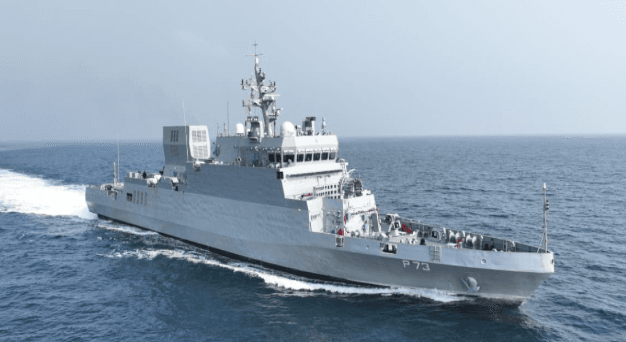
12.INS Anjadip Anti-Submarine Craft (ASW Craft)

PIB
Illustration for INS Anjadip Anti-Submarine Craft (ASW Craft)

What & Where

INS Anjadip ≈ state-of-the-art Anti-Submarine Warfare Shallow Water Craft of Indian Navy.

Third unit in 8-ship ASW-SWC project; to join Eastern Naval Command for littoral defence.

Indigenously designed by GRSE, Kolkata; hull fabrication/fit-out via PPP with L&T Shipyard, Kattupalli.

Quick Facts for MCQs

Tech & Schemes

  • Water-jet propulsion enhances manoeuvrability, noise reduction in shallow seas.
  • Abhay sonar provides high-resolution submarine detection ≤25 m depth.
  • Indigenous ASW rockets align with Make-in-India naval armament push.

Security Dimension

  • Vessel dubbed ‘Dolphin Hunter’; counters midget and conventional subs near coasts.
  • 25-knot dash speed enables rapid choke-point response in Eastern seaboard.
  • Mine-laying option bolsters anti-access strategies during heightened threat.

Industrial Ecosystem

  • PPP model leverages GRSE design with L&T modular construction efficiencies.
  • Project sustains domestic MSME supply chains for sensors, propulsion, ordnance.
  • Repeated hull design across 8 ships reduces unit cost, accelerates delivery timelines.

Key Data Points

FeatureData-Point
Class/TypeAnti-Submarine Warfare Shallow Water Craft
Project size8 vessels (Anjadip is 3rd)
BuilderGarden Reach Shipbuilders & Engineers (GRSE)
PPP partnerL&T Shipyard, Kattupalli
Length~77 m
PropulsionHigh-speed water-jet (largest IN class using it)
Top speed25 knots
SonarHull-mounted ‘Abhay’ (shallow-water optimised)
Main weaponsLightweight torpedoes, indigenous ASW rockets, mines
Multirole tasksASW, coastal surveillance, LIMO, SAR
Sister shipsINS Mahe, INS Malvan (launched/delivered)
Namesake legacyEx-Petya corvette INS Anjadip, decommissioned 2003

Related UPSC Prelims PYQs

CDS_GK, ESE_GS 2024PYQ 1

Which one of the following statements about 'INS Tarmugli' is not correct?

CDS_GK, ESE_GS 2024PYQ 2

Which one of the following ships does NOT come under Indian Navy's eight ASW Shallow Water Craft project?

GS-3Security

13.Prahaar National Counter-Terrorism Policy (Counter-Terror Doctrine)

DD News
Illustration for Prahaar National Counter-Terrorism Policy (Counter-Terror Doctrine)

What & Where

Prahaar = India’s first integrated national counter-terrorism doctrine.

Operative pan-India; synchronises central, state & district security set-ups.

Whole-of-government + society approach to prevent, respond, recover from terror.

Quick Facts for MCQs

Legal & Policy

  • Uniform SOPs unify Centre–State–District actions, replacing fragmented protocols.
  • Doctrine status; no separate Act passed but guides agencies & budget priorities.

Tech & Schemes

  • AI-enabled surveillance, SIGINT, cyber-forensics mandated for pre-emptive strikes.
  • Inter-agency data grid links IB, NIA, State ATS for real-time feeds.

Security Dimension

  • Targets hybrid threats combining terror, cyber warfare, organised crime.
  • Emphasises pre-emptive neutralisation over post-incident policing.

International Cooperation

  • Seeks wider extradition treaties, joint drills, shared watch-lists with QUAD, SCO, INTERPOL.
  • Aligns domestic measures with UNSC & FATF anti-terror frameworks.

Human Rights

  • Periodic rights audits ensure compliance with SC jurisprudence.
  • Recovery pillar provides victim assistance & community rehabilitation programmes.

Key Data Points

FeatureData-Point
Launch bodyGovernment of India
Policy modelProactive, intelligence-led doctrine
Pillars count7
Acronym PRAHAARPrevention, Response, Aggregation, Human-rights, Attenuation, Aligning, Recovery
Key tech focusDrones, encrypted apps, dark web, crypto funds
Core aimDisrupt finance, recruitment, logistics, cyber cells
Counter-radicalisationEducation, engagement, graded policing
Human-rights guardrailsLegal due process, redressal mechanisms
Global alignmentUN norms; extradition & intel-sharing pacts
Threat scopeTerrorism, hybrid cyber–crime convergences
GS-1Editorial

14.India Adolescent Mental Health Crisis (Adolescent Mental Health)

The Hindu

What & Where

Quiet Crisis = persistent adolescent anxiety-depression-digital addiction, often overlooked as mere behaviour phase

Onset early childhood (age 4-5); magnified during 10-19 yrs developmental window

Geography India-wide; exacerbated by 800 mn low-cost internet users and school exam culture

Quick Facts for MCQs

Drivers

  • Screen-time overload causing sleep disruption, emotional dysregulation, sensory play loss
  • Academic-rank focus elevating exam anxiety over well-being skills
  • Social-media FOMO fueling body-image issues, especially among girls

Government & Schemes

  • Tele-MANAS offers nationwide crisis counselling, digital addiction support
  • Ayushman Bharat Health & Wellness Centres integrate mental-health screening at primary level
  • Online Gaming Regulation Act 2025 targets addiction, financial harm from real-money games

Challenges

  • Manpower shortage of child psychiatrists, psych-social workers limits access
  • Tech-savvy minors bypass age-gates via VPNs, fake IDs undermining regulation
  • Persistent stigma keeps families silent till crisis, referral pathways remain fragmented

Proposed Actions

  • Digital-wellness curriculum introducing screen-time management and cyber-safety in schools
  • Mandatory daily physical activity to counter sedentary digital habits, improve neuroplasticity
  • Routine universal mental-health check-ups alongside physical growth monitoring in schools

Key Data Points

FeatureData-Point
Adolescent mental-illness prevalence7–10 % (National Mental Health Survey)
ADHD among school kids5–7 %
Indian internet users800 million
Avg child screen exposure6–7 hours/day
Psychiatrists available<10,000 for 1.4 bn population
Treatment gap estimate85 % (ANCIPS 2026)
Girls distressed by social comparison65 % (2025 study)
Teens using phone for social media76 % (ASER 2024)
Tele-MANAS helpline number14416, 24×7
Online Gaming (Reg.) ActEnacted 2025

Related UPSC Prelims PYQs

GEO_GS 2025PYQ 1

Which one of the following statements about Tele MANAS App is correct?

Ready to practice?

Test your knowledge with our UPSC test series.

Start Free Trial