UPSC Current Affairs

15 topicsGS-1: 3GS-2: 4GS-3: 8
0/15 done
GS-3Economy

2.India Power Sector 2025 Milestones (Power Sector Achievements)

PIB
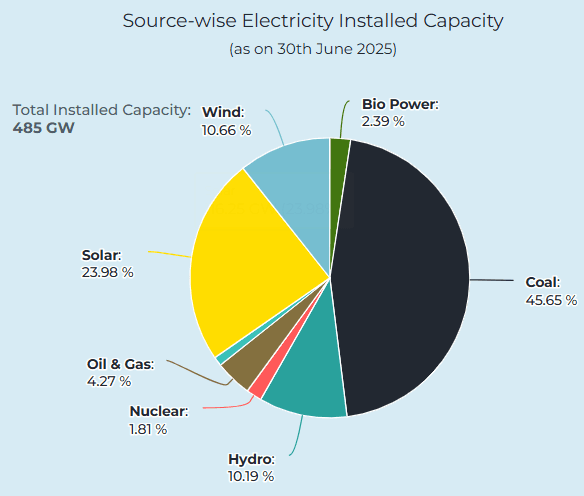
Illustration for India Power Sector 2025 Milestones (Power Sector Achievements)

What & Where

Carbon Credit Trading Scheme (CCTS); India’s new national market pricing one-tonne CO₂e reductions via tradable Carbon Credit Certificates.

Administered by Bureau of Energy Efficiency, guided by National Steering Committee for Indian Carbon Market.

Initial coverage: energy-intensive industries causing 16 % of national emissions; power sector may follow.

Quick Facts for MCQs

Capacity & Demand

  • Peak-demand 242.49 GW supplied; energy shortage only 0.03 %.
  • Installed capacity 509 GW; 104 % jump since 2014.
  • Coal capacity 226.23 GW; 13.32 GW fresh awards FY 25-26.

Renewables & Storage

  • Renewable gain 178 GW; solar 130 GW, wind 33 GW.
  • Pumped-storage aim 57 GW; BESS 43,220 MWh under VGF.
  • 50 % non-fossil capacity NDC met five years early.

Distribution & Consumers

  • RDSS okayed 19.79 cr prepaid smart meters; AT&C loss now 16.16 %.
  • ACS-ARR gap narrowed to ₹0.11 / kWh.
  • 13.65 lakh homes electrified via PM-JANMAN & DA-JGUA.

Regulatory & Market

  • Late Payment Surcharge rules slashed DISCOM dues to ₹8,005 cr.
  • Electricity Amendment 2025 allows consumer-owned storage systems.
  • CCTS introduces compliance + voluntary carbon trading nationwide.

Key Data Points

FeatureData-Point
FY 25-26 peak demand met242.49 GW
Installed capacity Nov 2025~509 GW
Capacity rise since 2014104.4 %
Renewable add-ons since 2014178 GW
Solar / Wind split130 GW / 33 GW
Rural / Urban supply22.6 h ; 23.4 h
AT&C loss FY 25-2616.16 %
Non-fossil share Oct 202551 %
Projected power investmentUSD 450 bn by 2032
Transmission target6.48 lakh ckm by 2032

Related UPSC Prelims PYQs

CAPF_GAI, GEO_GS 2026PYQ 1

India's installed solar capacity in 2025 is close to

CAPF_GAI, GEO_GS 2025PYQ 2

India’s key climate targets include

GS-1History

3.Jamma Bane Land Tenure Reform (Jamma Bane Tenure)

Indian Express

What & Where

Jamma Bane = hereditary military-service land grants (1600-1800) in Kodagu district, Karnataka

Holdings span paddy wetlands + forested highlands, now prime coffee belt of Western Ghats

Karnataka Land Revenue (2nd Amendment) Act 2025 brings their records under Karnataka Land Revenue Act 1964

Quick Facts for MCQs

Legal & Policy

  • Amendment creates distinct owner, occupant, holder columns replacing single pattedar entry
  • Provides for resurvey, digitised mutation, mortgage-ready titles

Historical Context

  • Grants span 17th-19th c; British codified but retained hereditary pattern
  • Tenure exempted land revenue yet bound grantees to supply armed men

Economic Angle

  • Clear titles expected to unlock institutional credit for coffee, pepper, cardamom growers
  • Marketability may raise estate values and tax compliance

Geographic Pointer

  • Kodagu on Western Ghats crest, 900–1750 m, >2500 mm monsoon rainfall

Cultural Notes

  • Kodava festivals: Kailpodh (arms worship), Puthari (paddy harvest) reflect martial-agrarian heritage

Key Data Points

FeatureData-Point
StateKarnataka
DistrictKodagu (Coorg)
New lawKarnataka Land Revenue (2nd Amendment) Act 2025
Legacy tenureJamma Bane
Original grantorsHaleri kings & British
Service owedMilitary duty by Kodavas
Land typesWet paddy fields; forested uplands
Today’s main cropCoffee (Robusta/Arabica)
Key river sourceKaveri at Talakaveri
Pre-amendment issueClouded title impeding sale, loans, inheritance
Alignment targetKarnataka Land Revenue Act 1964
Dominant communityKodavas
GS-1History

4.INSV Kaundinya Stitched Ship Voyage (Stitched Shipbuilding)

PIB

What & Where

INSV Kaundinya – India’s first stitched wooden ship reviving 2 000-year-old Tankai technique.

Tankai method – hull-first planks sewn with coir, no metal fasteners; flexible, rust-proof.

Maiden sea trial – Porbandar (Gujarat, India) to Port Sultan Qaboos, Muscat (Oman).

Quick Facts for MCQs

Technology & Craft

  • Revival – First modern build using Tankai after centuries of disuse.
  • Waterproofing – Natural dammar resin fills seams; animal fat coating prevents seepage.
  • Flexibility – Absence of nails allows hull to absorb wave shock, extending service life.

Historical Context

  • Textual-link – Yuktikalpataru by King Bhoja (9th CE) details similar ship measurements.
  • Visual-link – Ajanta murals display stitched vessels; provided proportional cues.
  • Legacy – Kaundinya’s voyage to Mekong delta seeded Indianised Funan kingdom.

International Linkages

  • Bilateral – Voyage commemorates India-Oman maritime ties dating to Indus Valley trade.
  • Global-tech – European Eutelsat’s OneWeb constellation offers real-time tracking/communication.

Cultural Symbols

  • Emblem – Gandabherunda echoes Kadamba dynasty strength; carved on prow.
  • Anchor – Harappan-style stone anchor nods to Indus coastal trade archaeology.

Key Data Points

FeatureData-Point
Ship classStitched wooden sailing vessel
Build methodTankai (ancient hull-first, coir-stitched)
Antiquity of method~2 000 years
Key materialsCoir rope, dammar resin, animal fat
Connectivity partnerEutelsat – OneWeb satellite link
Design referencesAjanta Cave V paintings; Yuktikalpataru text
Key motifsGandabherunda, Sun, Simha Yali, Harappan stone anchor
NamesakeMariner Kaundinya, Funan co-founder (1st century CE)
Test routePorbandar ➜ Muscat (~1 250 km)
PurposeShowcase shared maritime heritage India–Oman

Related UPSC Prelims PYQs

CAPF_GAI, CDS_GK 2023PYQ 1

Which one of the following Indian Naval Ships has recently concluded a 17,000-nm trans-ocean intercontinental voyage?

CAPF_GAI, CDS_GK 2024PYQ 2

Which one of the following statements about 'INS Tarmugli' is not correct?

GS-1Mapping

5.Muna Island Location Significance (Indonesian Island)

NT
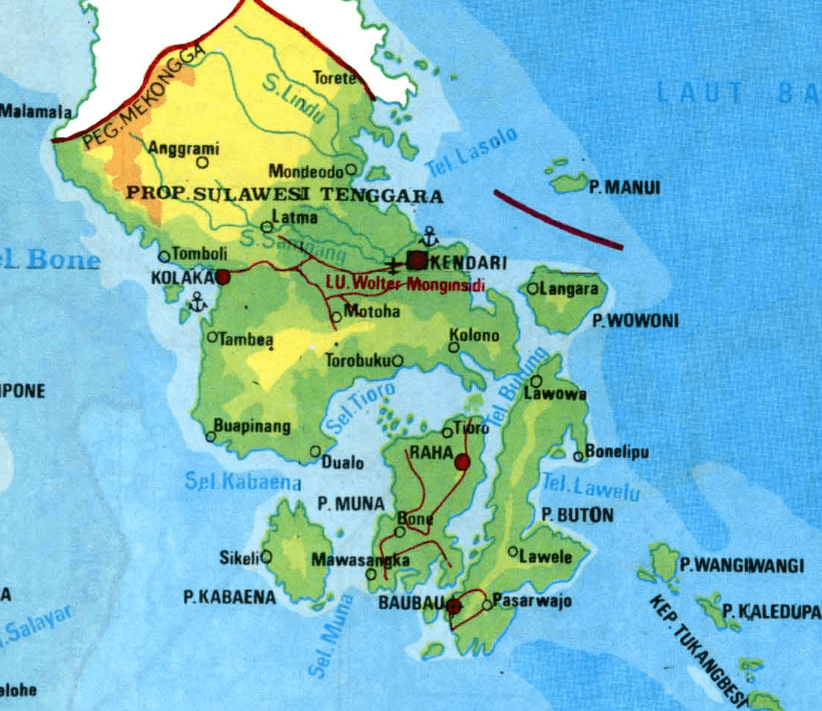
Illustration for Muna Island Location Significance (Indonesian Island)

What & Where

Muna Island: limestone-karst island in Southeast Sulawesi Province, Indonesia, within Wallacea zone, Flores Sea.

Liang Metanduno cave hosts world’s oldest known cave art, a hand stencil ≥67.8 ka old.

Acts as key waypoint on northern maritime route from Sunda to Sahul for early Homo sapiens.

Quick Facts for MCQs

Geological Setting

  • Limestone karst topography forms caves, rock shelters, speleothems aiding Uranium-series dating.
  • Calcite crusts over pigment provided datable layers securing minimum age benchmark.

Archaeological Significance

  • Hand stencil predates European cave art by >20 ka, revising timeline of symbolic behavior.
  • Finger alterations imply deliberate stylistic choices, evidencing complex cognition.

Human Migration

  • 67.8 ka presence supports early Homo sapiens use of northern maritime corridor toward Sahul (~65 ka).
  • Strengthens narrative of rapid cultural transmission across Island Southeast Asia.

Key Data Points

FeatureData-Point
SeaFlores Sea
Biogeographic zoneWallacea
Administrative divisionsMuna, West Muna, Central Buton regencies
Dominant lithologyLimestone karst
Highest elevation~445 m
Dating techniqueLaser-ablation U-series on calcite
Minimum art age67,800 years
Cave siteLiang Metanduno
Main motifHand stencil with modified fingers
Significance rankOldest cave art globally
GS-3Environment

6.UNEP Finance for Nature 2026 Report (Nature Finance Gap)

UNEP
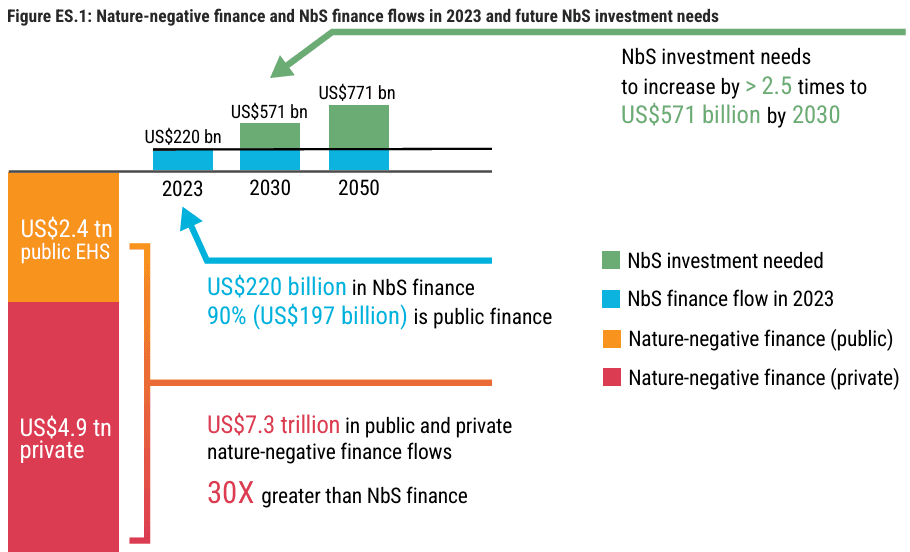
Illustration for UNEP Finance for Nature 2026 Report (Nature Finance Gap)

What & Where

UNEP’s State of Finance for Nature 2026 tracks global capital flows toward Nature-based Solutions (NbS) versus nature-negative activities

Fourth edition supplies financial roadmap for meeting Rio Convention goals via ecosystem protection, restoration, sustainable management

Global assessment; 2023 data show dominant harmful subsidies and private investments from fossil-fuel, utilities, industrials, energy sectors

Quick Facts for MCQs

Finance Gap & Subsidies

  • Gap; NbS investment must rise to 571 bn annually by 2030
  • Nature-negative finance outweighs NbS roughly 30 : 1 threatening economic stability
  • Governments spend 2.4 trn on harmful subsidies led by 1.13 trn fossil-fuel support

Private Sector & Markets

  • Private capital 4.9 trn flows to utilities, industrials, energy driving degradation
  • Private NbS 23.4 bn mainly via biodiversity offsets and certified commodity chains
  • Disclosure momentum; 730 + institutions apply TNFD to map nature risk

Instruments & Innovations

  • Eight debt-for-nature swaps since 2021 unlocked sizeable conservation funding in Ecuador, Belize, Gabon
  • Sustainable bonds; United Utilities UK issued GBP 300 m for peatland and riverbank restoration
  • Bio-innovation: bacteria-infused self-healing concrete and fungi-based leather replacing high-impact materials

Key Data Points

FeatureData-Point
Report edition4th (2026)
NbS current financeUS$220 billion
Public share of NbS finance90 % (US$197 billion)
Private NbS financeUS$23.4 billion
Nature-negative finance 2023US$7.3 trillion (≈7 % GDP)
Environmentally harmful subsidiesUS$2.4 trillion
Fossil-fuel subsidy shareUS$1.13 trillion
Required NbS finance 2030US$571 billion per year
Private negative flowsUS$4.9 trillion
Investment gap multiple2.5 × current NbS
Debt-for-nature swaps 2021-248 agreements
TNFD adopters730 + organisations
GS-3Species

7.Asiatic Wild Dog Status (Endangered Canid)

ETV
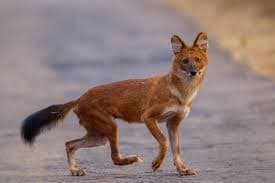
Illustration for Asiatic Wild Dog Status (Endangered Canid)

What & Where

Asiatic Wild Dog (Dhole, Cuon alpinus) — social, pack-hunting canid; apex/meso predator in South & Southeast Asia.

India strongholds: Central Indian forests, Western/Eastern Ghats; first-ever camera capture now in Ratapani Tiger Reserve, Madhya Pradesh.

Prefers dense forests & forest-grassland mosaics with continuous medium-large ungulate prey and low human disturbance.

Quick Facts for MCQs

Habitat & Range

  • Dense tropical forests, hilly mosaics; avoids open plains and very high altitudes.
  • Requires large, connected landscapes; packs may roam >100 km² annually.
  • Indian distribution fragmented; healthy populations align with well-protected tiger reserves.

Ecological Role

  • Apex/meso predator stabilising trophic pyramid by curbing herbivore overabundance.
  • Pack cooperation allows prey capture sizes overlapping yet distinct from solitary leopards.
  • Presence signals robust prey base and habitat integrity.

Conservation Concern

  • Endangered due to habitat loss, prey depletion, disease from domestic dogs.
  • Sightings in Ratapani indicate habitat recovery under tiger-oriented management.
  • Protection needs: corridor security, disease control, community-based conflict mitigation.

Key Data Points

FeatureData-Point
Common nameDhole
Scientific nameCuon alpinus
IUCN Red ListEndangered (EN)
CITES AppendixII
Pack size norm5–20 individuals
Key preyChital, sambar, medium-large ungulates
Hunting styleCooperative, daylight chases
Distinct traitsReddish coat, rounded ears, meat-shearing dentition
Recent recordCamera-trapped, Ratapani Tiger Reserve, MP
Ecological roleRegulates herbivore numbers; balances predator guild with tigers & leopards

Related UPSC Prelims PYQs

GS1 1999PYQ 1

"India has the largest population of the Asian X. Today, there are just about 20,000 to 25,000 X in their natural habitat spreading across the evergreen forests, dry thorn forests, swamps and grasslands. Their prime habitats are, however, the moist deciduous forests. The X population in India ranges from Northwest India where they are found in the forest divisions of Dehradun, Bijnor and Nainital districts of UP to the Western Ghats in the states of Karnataka and Kerala and in Tamil Nadu. In Cen

GS-3S&T

8.Reusable Launch Vehicle Technology Overview (Reusable Launch Vehicles)

The Hindu

What & Where

Reusable Launch Vehicle (RLV): rocket stage recovered, refurbished, reflown; contrasts with single-use expendable launchers.

Two recovery modes: VTVL (powered upright landing) & winged horizontal runway landing.

India tests at Chitradurga ATR, Karnataka using Pushpak (RLV-TD) for autonomous glide landings.

Quick Facts for MCQs

Operational Steps

  • Launch: reusable stage lifts payload, then separates after burnout.
  • Re-entry: GN&C maintains attitude; drag or retro-propulsion decelerates through atmosphere.
  • Recovery: vertical pad/barge landing or horizontal runway glide, followed by inspection and quick turnaround.

Tech & Schemes

  • Pushpak LEX-01/02/03 proved autonomous runway landing, 2023-24.
  • ADMIRE develops retro-propulsion, legs, grid-fins for Falcon-like VTVL.
  • NGLV targets reusable first stage, slated to replace PSLV fleet.

Limitations

  • Thermal-stress: high-temperature re-entry demands costly, inspection-heavy TPS.
  • Refurbishment: rising man-hours per flight can erode savings beyond certain reuse cycles.
  • Reliability: multiple flights necessitate stringent non-destructive testing to manage cumulative fatigue.

Economic Angle

  • Reusability lowers marginal cost per kg, enabling higher launch cadence and price-sensitive small-sat markets.
  • Hardware amortisation across flights unlocks private capital, shifting sector to commercial transport paradigm.

Key Data Points

FeatureData-Point
Projected space market, 2030> USD 1 trillion
Launch-cost cut via reusability5–20 times
Propellant+tank share in expendables> 90 % liftoff mass
Typical payload fraction< 4 %
Governing equationTsiolkovsky rocket equation
Indian winged demoPushpak (RLV-TD)
Indian VTVL test bedADMIRE
Future reusable launcherNGLV (Project Soorya)
GS-3S&TQuick Bite

9.World’s First Graviton Detector Plan (Graviton Detection)

The Hindu

What & Where

Graviton – hypothetical spin-2 quantum carrier of gravity, analogous to photon for electromagnetism

Proposed detection via superfluid-helium acoustic resonator cooled to quantum ground state

Experiment led by Stevens Institute of Technology and Yale University, USA

Quick Facts for MCQs

Detection Technique

  • Superfluid-helium offers ultra-high Q resonance, amplifying tiny energy deposits
  • Laser interferometry tracks membrane displacement with sub-attometer precision
  • Single graviton converts to one phonon, yielding discrete energy quantum

Challenges & Limitations

  • Gravity weakness causes interaction probabilities vastly below detector background thresholds
  • Classical gravitational waves can mimic single-quantum vibration, complicating attribution
  • Theoretically required detector mass may exceed practical laboratory scales

Scientific Significance

  • Successful detection bridges quantum mechanics and general relativity toward unified theory
  • Would empirically support spin-2 gauge boson assumptions in quantum gravity models
  • Opens avenue for testing string theory, loop quantum gravity, other beyond-Standard-Model frameworks

Key Data Points

FeatureData-Point
Particle statusHypothetical, not yet observed
Force mediatedGravity, weakest fundamental force
Spin expectation2 (tensor boson)
Detector mediumSuperfluid helium resonator
Operating temperatureNear absolute zero, ground state
Expected signalSingle phonon excited by gravitational wave
Read-out methodPrecision laser interferometry
Main obstacleExtremely low graviton–matter interaction cross section
Prior verdictSingle-graviton capture deemed practically impossible
Breakthrough impactWould confirm gravity as a quantum force

Related UPSC Prelims PYQs

GS1 2019PYQ 1

Recently, scientists observed the merger of giant 'blackholes' billions of light-years away from the Earth. What is the significance of this observation?

GS1 2017PYQ 2

What is the purpose of ‘evolved Laser Interferometer Space Antenna (eLISA)’ project?

GS-3S&TQuick Bite

10.Darwin’s Bark Spider Silk Strength (Spider Silk Strength)

The Hindu

What & Where

Species: Darwin’s bark spider (Caerostris darwini), endemic to Madagascar’s river-lake margins

Product: Dragline (major ampullate) silk registering record 1.6 GPa tensile strength

Producer subset: Ultra-tough silk made solely by large adult females, not males or juveniles

Quick Facts for MCQs

Evolution & Dimorphism

  • Selection pressure prioritises strength in females facing higher energetic, predatory demands
  • Extreme trait evolves only with clear survival payoff; juveniles/males retain cheaper silk

Silk Biochemistry

  • Proline abundance elevates toughness yet raises metabolic expense
  • Elasticity genetically conserved, implying separate regulation from strength pathways

Web Ecology

  • Sparse, high-strength threads bridge wide water bodies, enlarging prey capture zone
  • Denser yet weaker male/juvenile webs suit lower energy budgets and smaller ecological niches

Key Data Points

FeatureData-Point
Silk tensile strength≈1.6 gigapascals (≈3× iron)
Strong-silk makersLarge adult females only
Female size advantage3–5 times larger than males
Key amino acidProline—drives toughness & elasticity
Silk type studiedMajor ampullate (dragline)
Elasticity variationConstant across sexes & ages
Web architectureSparse, few but stronger threads
Habitat spanOver rivers/lakes, prey otherwise unreachable
Metabolic costHigh; strength produced only when needed
Strength benefitSupports gigantic orb webs for larger prey
GS-3S&TQuick Bite

11.DoT Delicenses 6 GHz WiFi Band (6 GHz WiFi)

The Hindu

What & Where

Spectrum: lower 6 GHz band (5,925–6,425 MHz) now licence-exempt for indoor Wi-Fi across India.

Technology: enables Wi-Fi 6E/7; devices can use Multi-Link Operation over 2.4 GHz + 5 GHz + 6 GHz.

Geography/Scope: fixed indoor sites only; barred in vehicles, trains, oil rigs to avoid interference.

Quick Facts for MCQs

Legal & Policy

  • DoT notification 24 Jan 2026 removes licensing under Indoor Low Power category.
  • De-licensing reduces regulatory uncertainty, releases 480 MHz additional router spectrum.

Tech & Schemes

  • Wi-Fi 6E employs 160 MHz channels in 6 GHz, easing congestion, boosting throughput.
  • Multi-Link Operation bonds 2.4 + 5 + 6 GHz channels, cutting latency, improving reliability.

International Examples

  • United States allocates complete 1,200 MHz 6 GHz band to Wi-Fi; China earmarks entire band for mobile.
  • Europe and India open lower half to Wi-Fi, reserve upper half for future 5G/6G IMT use.

Economic Angle

  • Clearance expected to unlock Wi-Fi 7 hardware launches, e.g., PlayStation 5 Pro, routers, AR/VR gear.
  • Extra unlicensed capacity can offload cellular networks, lowering telecom operators’ capital expenditure.

Key Data Points

FeatureData-Point
Frequency span5,925–6,425 MHz
Spectrum statusDe-licensed, indoor only
Eligible standardsWi-Fi 6E & Wi-Fi 7
Max theoretical speed9.6 Gbps
Key new featureMulti-Link Operation (MLO)
High-bandwidth usesVR, AR, cloud gaming
Global stance IndiaSplit band; mirrors Europe
Fully unlicensed modelUnited States
Mobile-only reservationChina
Prohibited environmentsCars, trains, oil rigs

Related UPSC Prelims PYQs

GS1 2011PYQ 1

What is the difference between Bluetooth and Wi-Fi devices?

GS1 2010PYQ 2

Consider the following :

GS-2Misc

12.WEF Global Future Councils (WEF Think Tank)

DD News
Illustration for WEF Global Future Councils (WEF Think Tank)

What & Where

Definition: WEF’s invitation-only, time-bound think-tank network producing future-looking insights on global challenges.

Process: ~37 interdisciplinary councils, members serve 2-year terms, outputs feed WEF initiatives & Davos agenda.

Geography: Annual meetings 2026-2030 to be hosted in Dubai, United Arab Emirates.

Quick Facts for MCQs

Structure & Membership

  • Composition: academics, business, civil society, public sector experts mixed per council.
  • Scale: each council capped for agility; entire network refreshed every two years.
  • Exclusivity: no open nominations; WEF curates based on domain leadership.

Objectives

  • Trend-spotting: track emerging technologies, risks, social shifts shaping global future.
  • Policy linkage: convert research insights into actionable briefs for governments & WEF programmes.
  • Sustainability: promote resilient, inclusive development models aligning with SDGs.

Operating Principles

  • Interdisciplinarity: mandate to bridge sectoral silos via systems thinking.
  • Evidence-basis: outputs anchored in data, peer research, not individual opinion.
  • Innovation-focus: encourage scanning of frontier tech and nascent issues for early action.

Key Data Points

FeatureData-Point
Launch year2013
Parent bodyWorld Economic Forum
Host partner 2026-2030United Arab Emirates (Dubai)
Membership modeInvitation-only
Term length2 years
Upcoming termMar 2025 – Dec 2026
Planned councils (2025-26)≈37
Experts currently involved≈700
Cumulative councils since 2013≈900
Total experts since 201312,000 +
GS-2Misc

13.Graça Machel Gets Indira Gandhi Peace Prize (Peace Prize)

The Hindu

What & Where

International annual award honouring peace, disarmament, development; instituted 1985 by Government of India.

Administered by Indira Gandhi Memorial Trust, New Delhi; decided by 5-9-member international jury.

Open to living individuals or organisations worldwide; prize money ₹1 crore plus citation and haematite-jasper trophy.

Quick Facts for MCQs

Objectives

  • Promote international peace, non-alignment, nuclear disarmament in a divided world order.
  • Encourage equitable global development with South–South cooperation emphasis.
  • Advance human freedom, dignity, social justice via science and technology for welfare.

Eligibility & Selection

  • Nomination accepted only for living entities; no bar on nationality, race, religion, gender.
  • Jury may split prize or withhold if no suitable candidate deemed fit.
  • Selection consensus ensures broad acceptability, reinforcing prize prestige.

Award Components

  • Cash ₹1 crore or foreign-exchange equivalent ensures global attractiveness.
  • Formal citation recognises creative contribution; trophy bears Jaipur miniature-style silver-rimmed portrait.
  • Stone sourced from Indira Gandhi’s samadhi symbolises continuity with her legacy.

Recent Laureate

  • Graça Machel, Mozambican humanitarian & women’s rights advocate, chosen for 2026 edition.

Key Data Points

FeatureData-Point
Instituted1985
FounderGovernment of India
Administering bodyIndira Gandhi Memorial Trust, New Delhi
Core focusPeace, Nuclear Disarmament, Equitable Development
EligibilityLiving individuals / organisations, any nationality
NominatorsMPs, past awardees, jury, reputed orgs, UN-state legislators
Jury size5–9 members
Decision ruleConsensus; final & binding
Award money₹10 million (₹1 crore)
Trophy materialHaematite Jasper from Shakti Sthal
FrequencyAnnual; may be withheld or split
Funding sourceGovernment of India endowment
Latest announced laureateGraça Machel (2026)

Related UPSC Prelims PYQs

GS1 2015PYQ 1

Indira Gandhi Prize for Peace, Disarmament and Development for 2014 was given to which one of the following?

GS1 2003PYQ 2

The Indira Gandhi Peace Prize, 2002 was awarded to

GS-2Scheme

14.ACC PLI Scheme for Batteries (Battery Manufacturing)

The Hindu

What & Where

Central-sector Production Linked Incentive to build domestic advanced chemistry cell (Li-ion, etc.) manufacturing.

Implemented nationwide under Ministry of Heavy Industries; plants chosen via competitive bids.

Target: 50 GWh cell capacity by 2026 to cut battery imports.

Quick Facts for MCQs

Tech & Schemes

  • Focus on advanced chemistry cells; excludes lead-acid technologies.
  • Performance metrics tied to actual cell sales to ensure market-relevant output.
  • Localization mandate pushes component, material ecosystem inside India.

Economic Angle

  • Aim to slash strategic battery import dependence, mainly on China.
  • Large fiscal incentive expected to crowd-in private capex, create scale economies.
  • Value-addition thresholds designed to deepen supply chain over five years.

Implementation Status

  • Only 1.4 GWh commissioned versus 50 GWh goal; significant schedule slippage.
  • Hyundai exit reduces effective allocated capacity, intensifying pressure on remaining bidders.
  • Report flags need for faster plant construction to meet 2026 deadline.

Key Data Points

FeatureData-Point
Scheme launchOctober 2021
Total outlay₹18,100 crore
Incentive natureOutput-linked subsidy
Per-kWh incentive cap≈ ₹2,000
Minimum firm investment₹1,100 crore
Domestic value add25 % in 2 yrs; 60 % in 5 yrs
Target capacity50 GWh by 2026
Current commissioned1.4 GWh (report)
Selected biddersOla Electric, Reliance New Energy, Rajesh Exports
Bidder exitHyundai Global withdrew
GS-2Scheme

15.PLI Scheme for ACs and LEDs (White Goods PLI)

News on Air

What & Where

PLI Scheme for White Goods: central sector, incentivises domestic manufacture of AC and LED components

Geography: Pan-India; administered by Department for Promotion of Industry & Internal Trade, Ministry of Commerce & Industry

Timeframe: Launched FY 2021-22; incentives payable for five years after one-year gestation, up to FY 2028-29

Quick Facts for MCQs

Financial Structure

  • Fund-limited design caps disbursal within Cabinet-approved ₹6,238 crore ensuring fiscal discipline
  • Incentive disbursed annually post verification of incremental sales and investment thresholds

Coverage & Scale

  • Segments targeted: high-value, low-value AC intermediates; LED core & other components
  • Sub-assemblies for indoor and outdoor AC units included to deepen domestic value chains

Eligibility & Accountability

  • Mandatory dual thresholds: minimum investment plus incremental sales to unlock yearly incentive
  • Non-compliance leads to forfeiture, fostering result-oriented asset creation

Employment & Industrial Impact

  • Scheme envisages robust electronics and appliance ecosystem, reducing import dependence and boosting jobs across supply chains

Key Data Points

FeatureData-Point
Total outlay₹6,238 crore
Latest round (4th) firms5 companies
Latest committed investment₹863 crore
Cumulative approved firms85 companies
Expected total investment~₹11,198 crore
Expected production value~₹1.9 lakh crore
Incentive rate4 % – 6 % on incremental sales
Base year for salesFY 2019-20
Eligible productsAC compressors, copper tubes, PCBAs, LED drivers, chip packaging
Implementing ministryCommerce & Industry (DPIIT)
Monitoring bodyEmpowered Group of Secretaries chaired by Cabinet Secretary
EligibilityGreenfield or brownfield manufacturing only
Priority weightageCore components & high investment proposals
Employment outcomeSignificant direct & indirect jobs (government estimate)

Ready to practice?

Test your knowledge with our UPSC test series.

Start Free Trial