UPSC Current Affairs

14 topicsGS-1: 3GS-2: 4GS-3: 7
0/14 done
GS-2Polity

1.Governor Address Power in States (Governor Address)

DH
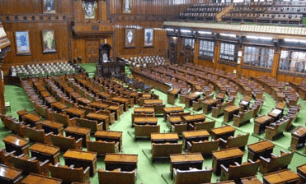
Illustration for Governor Address Power in States (Governor Address)

What & Where

Governor’s Address – mandatory speech at first session post-election and first session each calendar year of State Legislature.

Content drafted by elected Council of Ministers; Governor only delivers it.

Operative across all Indian States having Legislative Assembly (+ Council, if bicameral).

Quick Facts for MCQs

Constitutional Articles

  • Art. 176 mandates address, provides debate time via House rules.
  • Art. 175 allows separate messages but not alteration of Address text.
  • Discretion expressly limited to areas enumerated in Constitution.

Judicial Precedents

  • Nabam Rebia 2016: Governor bound by Cabinet on session dates.
  • Rajasthan HC 1966: partial reading still satisfies Art. 176, only irregularity.
  • Syed Habibullah (Calcutta HC): speech defects don’t vitiate House proceedings.

Procedural Nuances

  • Speech drafted by General Administration Dept., cleared by Cabinet, sent to Raj Bhavan unaltered.
  • House rules earmark discussion hours; motions of thanks enable scrutiny, not gubernatorial edits.

Federal Implications

  • Address practice underscores elected state supremacy, curbing potential gubernatorial activism.
  • Smooth delivery crucial to Centre-State harmony, preventing perception of parallel executive power.

Key Data Points

FeatureData-Point
Core ArticleArt. 176(1) & (2)
Aid-&-Advice clauseArt. 163
Summon/Prorogue powerArt. 174 (on Cabinet advice)
Governor’s message powerArt. 175
Leading SC verdictNabam Rebia 2016: no unilateral summoning

Related UPSC Prelims PYQs

GEO_GS, GS1 2019PYQ 1

With reference to the Legislative Assembly of a State in India, consider the following statements:

GEO_GS, GS1 2021PYQ 2

Which one of the following is NOT the ordinance making power of Governor?
GS-2PolityQuick Bite

2.Enforcement Directorate Juristic Person Status (ED Juristic Status)

The Hindu

What & Where

Juristic person — non-human entity with legal rights/duties, incl. capacity to sue or be sued

Directorate of Enforcement (ED) — statutory probe agency under FEMA 1999 & PMLA 2002, now questioned on juristic status

Article 226 — High Court power to issue writs nationwide for Fundamental & other legal rights

Quick Facts for MCQs

Legal & Policy

  • States argue statutory bodies need explicit power to sue, absent in FEMA/PMLA for ED
  • Abuse-of-process allegation — Tamil Nadu terms ED writs “misconceived, unmaintainable”
  • Supreme Court examination may redefine agency standing before High Courts

Federal Relations

  • Centre-State friction highlighted by States challenging central agency authority
  • Article 226 enables States to contest central actions without invoking Article 131 original SC jurisdiction
  • Potential impact on future inquiries by central bodies in State matters

Judicial Precedent

  • 2003 AP Forest case: right to sue is substantive, not mere procedure
  • States leverage precedent to deny ED automatic juristic status
  • Outcome could set template for other statutory authorities’ litigation rights

Key Data Points

FeatureData-Point
PetitionersStates of Kerala & Tamil Nadu
RespondentDirectorate of Enforcement
Core issueWhether ED is juristic person eligible for Article 226 writs
Governing laws for EDFEMA 1999; PMLA 2002
Key precedent citedChief Conservator of Forests v. Collector, 2003
Main writ sought by EDMandamus in Madras & Kerala HCs
Article 226 writ typesHabeas Corpus, Mandamus, Prohibition, Certiorari, Quo Warranto
Article 226 scopeFundamental rights + “any other purpose”
Distinction raisedStatutory body vs. body corporate
Apex court actionSupreme Court agreed to examine matter

Related UPSC Prelims PYQs

CDS_GK 2021PYQ 1

Which one of the following is not correct in respect of Directorate of Enforcement?

GS-3Economy

3.Supreme Court Upholds Tax on Flipkart Deal (DTAA & GAAR)

Indian Express

What & Where

Case: SC taxed Tiger Global’s USD 1.6 bn 2018 Flipkart stake sale under Indian law, rejecting Mauritius treaty shield

Process: GAAR applied over India–Mauritius DTAA; substance-over-form test trumped mere Tax Residency Certificates

Geography: Shares of Indian company; routing via Mauritius; effective control & management traced to USA

Quick Facts for MCQs

Legal & Policy

  • SupremeCourt affirmed GAAR supremacy over tax treaties, emphasising economic substance, control, management location
  • AAR’s anti-avoidance stance restored; Delhi HC termed arbitrary now reversed
  • TRC alone insufficient; claimant must show independent board, personnel, decision-making in treaty jurisdiction

Economic Angle

  • Ruling heightens capital-gains tax exposure, raising cost & scarcity of tax-risk insurance for VCs
  • Startup funding already down 30 % seed, 26 % late-stage in 2025; judgment may deepen slowdown
  • Investors must evidence genuine Mauritius operations to retain 0 % tax benefit

Tax Instruments

  • GAAR triggers: commercial-substance absence, misuse of law, non-arm’s-length, artificial rights-obligations
  • Consequences: deny DTAA relief, disregard conduit entities, re-characterise income, levy tax, interest, penalties
  • DTAA relief methods: exemption vs credit; India has 90+ treaties, now subject to LOB clauses and GAAR

Key Data Points

FeatureData-Point
Stake sale valueUSD 1.6 billion
Sale year2018
SC ruling dateJan 2026
Treaty invokedIndia–Mauritius DTAA, 1983
GAAR commencement1 Apr 2017
Grandfathering cut-offInvestments before 1 Apr 2017
AAR order year2020
Delhi HC verdictAug 2024 (overturned)
Startup funding 2025USD 10.5 bn; 17 % drop YoY
GS-3EconomyQuick Bite

4.Record Labour Force Participation 2025 (Labour Statistics)

Indian Express

What & Where

PLFS Monthly: NSSO survey tracking labour indicators for persons 15+ across India

Current Weekly Status: classifies employment over 7-day recall preceding interview

December 2025 release covers rural-urban, gender-wise labour force dynamics

Quick Facts for MCQs

Employment Metrics

  • LFPR shows six-month rise peaking at 56.1 % indicating expanding labour supply
  • WPR at 53.4 % marks yearly high signalling stronger job absorption
  • Unemployment steady at 4.8 % reflecting balanced labour demand

Rural-Urban Divide

  • Rural LFPR outpaces urban by 8.8 percentage points evidencing higher activity in agrarian areas
  • Urban unemployment exceeds rural by 2.8 percentage points pointing to slower urban job creation
  • Rural male employment dominant at 76 % versus urban overall WPR unmentioned but lower

Gender Dimension

  • Rural female WPR 38.6 % illustrates improved but still low female engagement
  • Urban female unemployment drops to 9.1 % from 9.7 % Oct 2025 showing recent gains
  • Gender gap persists despite marginal urban improvements

Trend Analysis

  • Indicators collectively denote post-pandemic recovery sustaining through December 2025
  • Stable unemployment with rising LFPR implies net job addition rather than discouraged workers
  • Rural sector drives overall momentum via robust male employment

Key Data Points

FeatureData-Point
Reference approachCurrent Weekly Status (7 days)
Working-age band15 years & above
Dec 2025 LFPR (overall)56.1 %
Dec 2025 WPR (overall)53.4 %
Dec 2025 Unemployment Rate4.8 %
Rural LFPR59.0 %
Urban LFPR50.2 %
Rural Unemployment Rate3.9 %
Urban Unemployment Rate6.7 %
Rural male WPR76.0 %
Rural female WPR38.6 %
Urban female Unemployment9.1 %

Related UPSC Prelims PYQs

CAPF_GAI, CDS_GK 2025PYQ 1

Consider the following statements regarding Annual Periodic Labour Force Survey (PLFS) report 2023–24 by the National Statistical Organization (NSO):

CAPF_GAI, CDS_GK 2020PYQ 2

Which of the following statements about employment situation in India according to Periodic Labour Force Survey 2017-18 is/are correct?

GS-1History

5.Netaji Subhas Chandra Bose Legacy (Freedom Movement Leader)

IT
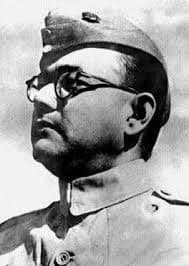
Illustration for Netaji Subhas Chandra Bose Legacy (Freedom Movement Leader)

What & Where

Parakram Diwas 2026 — Centre-led commemoration of Netaji’s 129th birth anniversary

Venue: Andaman & Nicobar Islands, linked to Netaji’s 1943 hoisting of tricolour at Port Blair

Focus: celebrate Bose’s armed-struggle legacy, courage, sacrifice, patriotism

Quick Facts for MCQs

Early Life & Education

  • Presidency & Scottish Church College topper; Cambridge for ICS preparation
  • Influenced by Swami Vivekananda and Aurobindo’s writings
  • Voluntary ICS exit marked protest against colonial service

Congress & Political Leadership

  • Haripura session agenda: Purna Swaraj, socialist planning, industrialisation
  • Tripuri crisis exposed rift with Gandhian non-violence bloc
  • Forward Bloc aimed to unite leftists, youth, labour under militant nationalism

Exile & Military Strategy

  • Axis outreach pragmatic anti-imperialist move, not fascist ideological tie
  • INA discipline, women’s Rani Jhansi Regiment, currency & courts asserted sovereignty
  • INA trials 1945-46 ignited pan-Indian solidarity, shook British legitimacy

Legacy & Recognition

  • Parakram Diwas instituted 2021 to honour indomitable spirit
  • Netaji statutes, stamps, Andaman’s Netaji Subhas Chandra Bose Dweep memorialise contributions
  • Courage narrative boosts contemporary defence, diaspora and youth outreach

Key Data Points

FeatureData-Point
Birth date23 Jan 1897
Birth placeCuttack, Odisha
ICS resignation1921 (after 1920 exam success)
Congress President1938 Haripura; 1939 Tripuri
National Planning CommitteeSet-up 1938
Forward Bloc launchMay 1939
Escape from IndiaJan 1941, via Kabul to Berlin
INA reorganisation1943, Singapore
Azad Hind Govt21 Oct 1943, Singapore
Battle frontsImphal & Kohima, 1944
Reported death18 Aug 1945, Taiwan plane crash
Iconic sloganGive me blood and I will give you freedom
Parakram Diwas date23 January (annual)

Related UPSC Prelims PYQs

GS1, NDA_GAT 2005PYQ 1

Which party was founded by Subhash Chandra Bose in the year 1939 after he broke away from the Congress?

GS1, NDA_GAT 2022PYQ 2

Where did Netaji Subhas Chandra Bose announce the formation of the Government of Free India in 1943?

GS-3Environment

6.Global Water Bankruptcy Report Findings (Global Water Stress)

Down to Earth
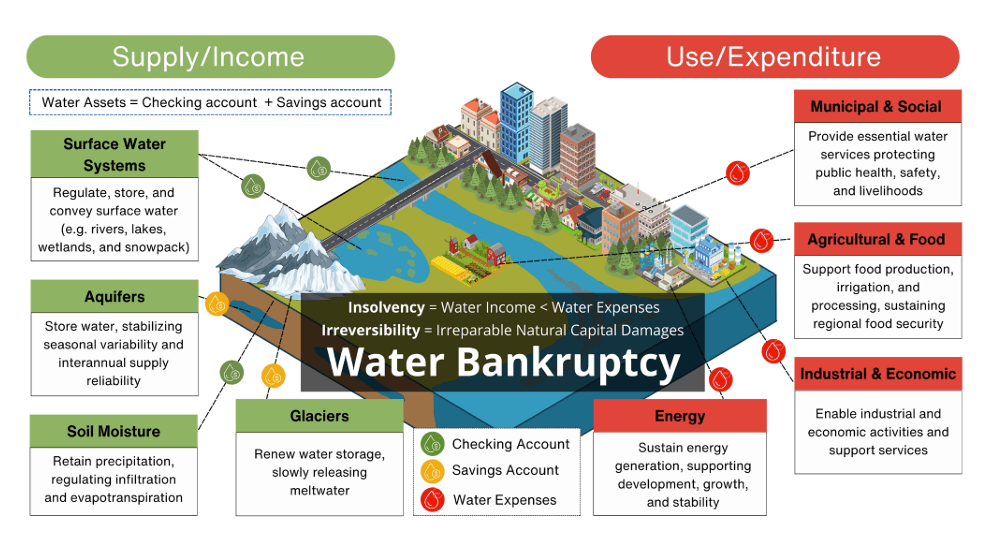
Illustration for Global Water Bankruptcy Report Findings (Global Water Stress)

What & Where

Definition Global Water Bankruptcy persistent post-crisis state where extraction exceeds renewable inflow, eroding natural capital irreversibly

Baseline Collapse terms water stress or crisis inadequate as many regions already beyond safe limits, eg Indo-Gangetic plain

Scale about three-quarters world population in water-insecure nations, 70 % major aquifers declining worldwide

Quick Facts for MCQs

Drivers & Causes

  • Over-extraction weak regulation triggers slow depletion eg Indo-Gangetic groundwater mining
  • Infrastructure overshoot dams and transfers expand demand beyond supply eg Chennai Day Zero risk
  • Climate catalyst glacier retreat and erratic rainfall magnify overshoot across Himalayan basins

Impacts

  • Food security threatened as shrinking storage cuts yields in key breadbaskets
  • Urban Day Zero repeated municipal outages undermining resilience eg Chennai 2019
  • Socioeconomic fallout distress migration and farmer protests highlight unequal burden

Recommendations

  • Diagnostics adopt bankruptcy assessments to recognise irreversible thresholds early
  • Agriculture transform by phasing out water-intensive crops and decoupling income from extraction
  • Justice lens provide social protection and use 2026 & 2028 UN Water meets to reset agenda

Key Data Points

FeatureData-Point
Population in water-insecure countries≈ 75 % (2026)
Global freshwater used by agriculture≈ 70 %
Irrigated cropland under high stress170 million ha
Major aquifers showing decline70 %
Maximum land subsidence observedup to 25 cm per year
Natural wetlands lost since 1970s≈ 410 million ha
Annual cost of anthropogenic droughtsUSD 307 billion

Related UPSC Prelims PYQs

GEO_GS, GS1 2023PYQ 1

Consider the following statements:

GEO_GS, GS1 2020PYQ 2

Which one of the following is the common term to describe the main source of water for human withdrawals?

GS-3Environment

7.India Groundwater Depletion Crisis (Groundwater Management)

PIB
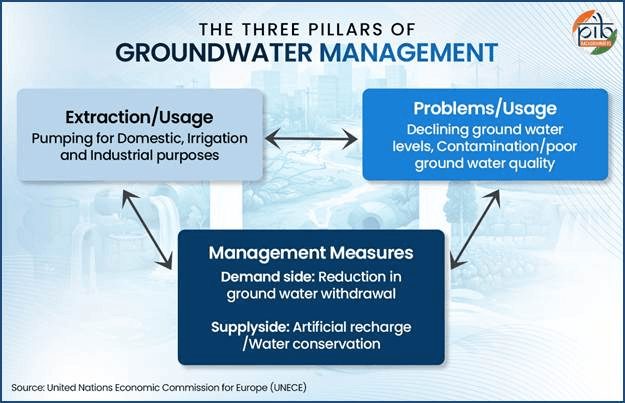
Illustration for India Groundwater Depletion Crisis (Groundwater Management)

What & Where

Groundwater = subsurface freshwater stored in porous rock/sediment aquifers, accounting for ~99 % of Earth’s liquid freshwater.

India’s aquifers supply 62 % irrigation, 85 % rural and 50 % urban water demand.

Southwest Monsoon provides ≈60 % recharge; national annual recharge pegged at 446.90 BCM (CGWB).

Quick Facts for MCQs

Depletion Drivers

  • Subsidies: Free farm electricity + MSP for paddy/sugarcane accelerate unmetered pumping.
  • Urbanisation: Impermeable surfaces curb infiltration; cones of depression cause land subsidence in Chennai, Delhi.
  • Climate: Erratic monsoon and higher evapotranspiration shrink natural recharge window.

Government Schemes

  • NAQUIM 2.0: Panchayat-level maps, quality-quantity profiling of every aquifer.
  • JSA-CTR & JSJB: Geo-tagging, abandoned-borewell revival, 39.6 lakh recharge interventions completed.
  • Atal Jal: Community-led extraction caps, outcome-linked grants supporting Jal Jeevan Mission.

Legal & Policy

  • Model Groundwater Bill 2017: Template for licensing, well spacing, impact assessments.
  • Easements Act 1882: Treats groundwater as landowner’s property, blocking commons management.
  • Reform push: Public-trust doctrine, Aquifer Management Committees with statutory powers.

Tech & Solutions

  • Monitoring: IoT sensors + AI dashboard ‘Bhu-Neer’ for real-time level, quality, abstraction alerts.
  • Agriculture: Drip, micro-irrigation, zero-tillage promoted via PMKSY convergence with Atal Jal.
  • Recharge: Managed aquifer recharge, urban rainwater-harvesting, mandatory treated-wastewater reuse to dilute saline/chemical intrusions.

Key Data Points

FeatureData-Point
Annual extraction245.64 BCM
Extraction-to-recharge rate60.47 %
Total annual recharge446.90 BCM
CGWB monitoring stations43,228
States/UTs with Model Bill21
JSJB recharge works (Jan 2026)39,60,333
Planned recharge structures (Master Plan 2020)1.42 crore
Extra recharge targeted185 BCM
Atal Bhujal Yojana coverage7 water-stressed States

Related UPSC Prelims PYQs

GS1 2020PYQ 1

Consider the following statements:

GS1 2023PYQ 2

Consider the following statements:

GS-3Mapping

8.Pangolakha Wildlife Sanctuary (Protected Area)

The Hindu
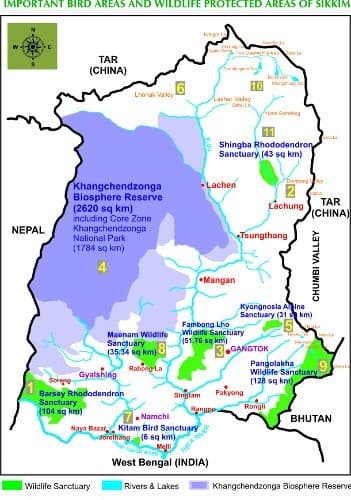
Illustration for Pangolakha Wildlife Sanctuary (Protected Area)

What & Where

High‐altitude Pangolakha Wildlife Sanctuary, East Sikkim; spans ~1,300 m–>4,000 m along India-China-Bhutan frontier.

Notified 2002; ~12,400 ha alpine-to-subtropical forest; designated Important Bird Area (IBA).

Links North Sikkim passes (Nathu La, Jelep La) to West Bengal’s Neora Valley NP, enabling trans-Himalayan wildlife movement.

Quick Facts for MCQs

Biodiversity

  • Species‐rich sanctuary hosts predators, high-altitude ungulates, 270+ bird species including Vulnerable Wood Snipe.
  • Migratory corridor via Himalayan passes supports seasonal movement between Tibet Plateau and eastern Himalayas.

Ecosystem Types

  • Subtropical broad-leaf valleys grade to temperate oak-fir belts and alpine pastures above 4,000 m.
  • High-altitude wetlands act as headwaters and climate buffers for Teesta catchment.

Security Dimension

  • Tri-junction proximity mandates Indian Army presence; access and conservation require military coordination.
  • Sanctuary overlooks strategic Nathu La–Jelep La corridor linking to Chumbi Valley (TAR).

Environmental Threats

  • Fire: January 2026 blaze highlights rising dryness, climate sensitivity.
  • Climate change: Reduced snowfall, glacier retreat threaten hydrology and alpine species resilience.

Key Data Points

FeatureData-Point
StateSikkim (East district)
Year Notified2002
Legal StatusWildlife Sanctuary, IBA
Area~12,400 ha
Altitude Range~1,300 m – >4,000 m
Biogeographic HotspotEastern Himalayas
Major BiomesEurasian High Montane; Sino-Himalayan Temperate; Sino-Himalayan Subtropical
Key FloraRhododendron, Silver Fir, Juniper, Oak, Bamboo
Key FaunaTiger, Takin, Musk Deer, Himalayan Monal, Wood Snipe
Wetland HighlightBedang Tso Lake
Northern BorderChina (TAR)
Eastern BorderBhutan
Southern LinkNeora Valley NP, West Bengal
Strategic PassesNathu La, Jelep La
Current Crisis (Jan 2026)Forest fire; ~12 ha affected

Related UPSC Prelims PYQs

ESE_GS 2026PYQ 1

Laokhowa Wildlife Sanctuary is located in which state?

GS-3S&T

9.LRAShM Hypersonic Anti-Ship Missile (Hypersonic Missile)

BL
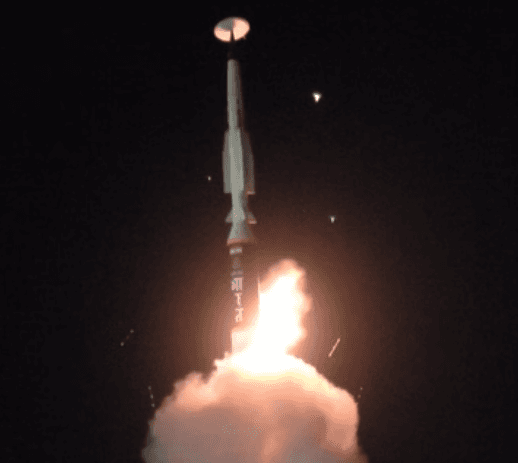
Illustration for LRAShM Hypersonic Anti-Ship Missile (Hypersonic Missile)

What & Where

LR-AShM = indigenous hypersonic glide missile to strike high-value enemy ships from standoff ranges.

Built by DRDO for Indian Navy; first public display slated at the 77th Republic Day parade, New Delhi.

Operational focus on Indian Ocean Region, boosting India’s coastal battery and maritime strike envelope.

Quick Facts for MCQs

Tech & Schemes

  • Architecture: boost-glide path enables high-altitude boost, then low-altitude manoeuvring glide.
  • Survivability: extreme speed plus unpredictable trajectory lowers interception probability.
  • Counter-ECM: dual navigation with radar seeker resists jamming and decoys.

Security Dimension

  • Deterrence: credible threat to carrier strike groups alters regional power calculus.
  • Club status: joins US, Russia, China in operational hypersonic anti-ship capability.
  • A2/AD: extends shore-based denial umbrella deep into Arabian Sea and Bay of Bengal.

Deployment & Platforms

  • Mobility: truck-mounted launcher eases dispersion along coastlines.
  • Future plans: naval surface vessels and long-range bombers eyed for integration.
  • Command chain: likely operated by Navy’s Coastal Defence Batteries under joint maritime theatre.

Key Data Points

FeatureData-Point
Full nameLong-Range Anti-Ship Hypersonic Glide Missile
DeveloperDRDO for Indian Navy
Speed bandHypersonic; boost up to ≈ Mach 10, glide ≈ Mach 5+
Stated range~1,500 km (longer variants planned)
PropulsionTwo-stage solid booster followed by unpowered hypersonic glide
Guidance suiteINS + satellite updates + active radar seeker
Primary targetsAircraft carrier groups & other surface combatants
Initial launcherLand-based mobile platform; ship/air versions proposed
Strategic roleA2/AD enhancement, maritime deterrence in IOR
First public debut77th Republic Day parade

Related UPSC Prelims PYQs

CAPF_GAI, CDS_GK 2022PYQ 1

The term ‘Terminal High Altitude Area Defense’, sometimes mentioned in news, refers to

CAPF_GAI, CDS_GK 2024PYQ 2

"Mission Shakti" (DRDO) is the name given by India to

GS-2SecurityQuick Bite

10.Shadow Fleet Sanctions Evasion Vessels (Sanctions Evasion Shipping)

Indian Express

What & Where

Shadow fleet: >3,000 tankers covertly moving sanctioned crude from Iran, Russia, Venezuela worldwide.

Core tricks: AIS-off sailing, GNSS spoofing, opaque shell owners, covert ship-to-ship transfers.

Registered mainly under lenient flags—Gabon, Marshall Islands, Cook Islands, Liberia, Panama, Mongolia.

Quick Facts for MCQs

Risk Categories

  • Dark fleet either fully sanctioned or deliberately concealing voyages; highest compliance threat
  • Grey fleet shows irregular routes, rapid ownership changes, structural opacity but not always sanctioned

Regulatory Weaknesses

  • Flags of convenience with lax maritime oversight enable ownership masking, easy re-registration
  • Limited insurance scrutiny permits ageing, under-maintained tankers to keep sailing

Strategic & Environmental Risks

  • Substandard vessels heighten spill, collision, fire hazards in busy chokepoints
  • Sanction evasion undermines effectiveness of Western economic pressure on target states

Indian Connection

  • Mumbai-based Gatik emerged 2022-23 as major Russian crude mover via shadow fleet
  • Heightened US-EU scrutiny forced Gatik to transfer tankers to affiliates by Aug 2023

Key Data Points

FeatureData-Point
Fleet size>3,000 vessels
Highest-risk subsetDark fleet
Dark tacticsAIS off, GNSS spoof, false flags, covert STS
Grey fleet birthAfter Russia-Ukraine war
Typical vessel ageOld, poorly insured
Common flag statesGabon, Marshall Islands, Cook Islands, Liberia, Panama, Mongolia
US responseIntensified military-led crackdown
Indian operatorGatik Ship Management, Mumbai
Gatik peak value≈ USD 1.5 billion
Gatik exitTankers shifted by Aug 2023
GS-2Misc

11.US Withdrawal from WHO (WHO Withdrawal)

Financial Express
Illustration for US Withdrawal from WHO (WHO Withdrawal)

What & Where

WHO; UN specialised agency coordinating international public-health action

Established 7 Apr 1948; HQ Geneva; 194 member states across all regions

USA served 1-year withdrawal notice under domestic law requirements

Quick Facts for MCQs

Legal & Policy

  • Withdrawal-law: US must notify 1 year ahead and settle outstanding dues
  • Compliance-issue: Arrears unpaid, legality of exit contested within WHO Executive Board
  • Succession-risk: Future US re-entry would require new congressional approval

Funding Impact

  • Budget-hit: Loss of 18 % threatens core programs and staffing
  • Programme-cuts: Polio, Ebola, COVID-19 response may face resource squeeze
  • Donor-realignment: WHO likely to court EU, China, philanthropies to plug gap

Health Security

  • Preparedness-gap: Global pandemic surveillance and early-warning networks weakened
  • Data-loss: US agencies lose rapid access to field outbreak information
  • Norm-setting: Reduced US voice in International Health Regulations, ICD updates

Key Data Points

FeatureData-Point
Establishment date7 April 1948
World Health DayCommemorates WHO founding
Headquarters cityGeneva
Total members194
US funding share≈18 % of WHO budget
Statutory notice for exit1 year
Exit preconditionFull payment of arrears
Notable successGlobal smallpox eradication
GS-3Security

12.Operation Megaburu Anti-Maoist Offensive (Counter-Insurgency Ops)

Times of India
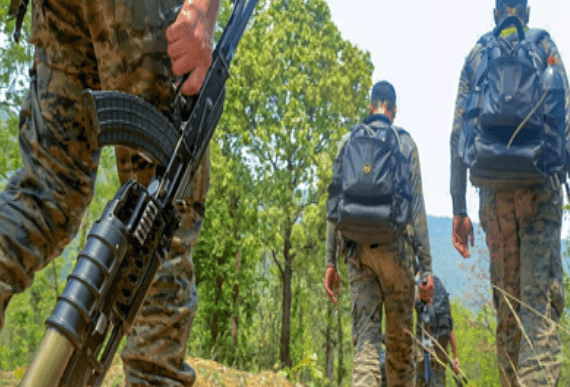
Illustration for Operation Megaburu Anti-Maoist Offensive (Counter-Insurgency Ops)

What & Where

Operation Megaburu = intelligence-led, large-scale counter-insurgency against CPI (Maoist) in Saranda forest tract.

Launched January 2026 at Kumdi area, Kiriburu police station, West Singhbhum district, Jharkhand.

Objective: wipe remaining Maoist command nodes, fulfilling GoI’s “end-Naxalism by Mar 2026” target.

Quick Facts for MCQs

Security Dimension

  • Leadership decapitation confines CPI (Maoist) to small forest pockets.
  • Marks highest single-encounter Maoist body recovery in Jharkhand.
  • Weakens Central Committee presence, reducing coordination capacity.

Operational Features

  • Intelligence pinpointed Central Committee meet, enabling surprise multi-axis strike.
  • Simultaneous elimination of area, sub-zonal, regional cadres, incl. women fighters.
  • Deep-jungle combat executed by terrain-trained CoBRA units with tech support.

Social Impact

  • Success expected to accelerate road, telecom, mining projects across tribal Saranda.
  • Enhances civilian trust, encouraging surrenders and local policing partnerships.
  • Positions Singhbhum for imminent “left-wing-extremism-free district” declaration.

Key Data Points

FeatureData-Point
Launch month–yearJanuary 2026
DistrictWest Singhbhum, Jharkhand
Core forestSaranda
Specific locationKumdi area, Kiriburu PS
Forces deployedCRPF CoBRA + Jharkhand Police
CoBRA strength≈1,500 commandos
Maoists killed16
Top leader slainAnal alias Patiram Manjhi
Govt deadlineMarch 2026 to end Naxalism
GS-1Editorial

13.Disability and Mental Health Law Reform (Disability Law)

The Hindu

What & Where

Rethinking-disability: shift from medical-deficit to social, rights-based model for cognitive impairments across India

Key-statutes: Mental Healthcare Act 2017, RPwD Act 2016, National Trust Act 1999

Grey-zone: dual intellectual + psychiatric disabilities left without clear guardianship or supported decision-making paths

Quick Facts for MCQs

Legal & Policy

  • MHA 2017 sets Mental Health Review Boards; replaces custodial 1987 Act
  • RPwD 2016 mandates reasonable accommodation in all public spheres; enlarges disability list 7→21
  • National-Trust 1999 offers limited guardianship mechanism for lifelong cognitive conditions

Judicial Enforcement

  • Supreme-Court uses Arts 14, 15, 21 to convert accessibility into enforceable right
  • Rajive Raturi 2024 declares accessibility non-negotiable; imposes 3-month deadline on Centre
  • Seema Girija Lal 2024 flags states lacking Disability Commissioners and Special Courts

Implementation Gaps

  • Many-states yet to constitute funds, regulatory bodies mandated under RPwD 2016
  • Puja Khedkar 2024 fake-certificate scandal tightened medical-board scrutiny; delays genuine claimants
  • NHRC 2023-24 finds 46 govt institutions detaining cured patients in inhuman conditions

International Examples

  • Sweden Social-Services Act requires least-restrictive community support before institutionalisation
  • Canada Accessibility Roadmap adopts sliding-scale retrofitting; pilots AI-guided navigation
  • Global models underline state accountability and tech-aided inclusion

Community & Finance

  • Pension: Indira-Gandhi National Disability Pension often ₹300–₹500; inadequate for survival
  • Lack-of halfway homes hampers shift from asylums to community living
  • Professional shortage; budget allocations stagnant despite rise in recognised disabilities

Key Data Points

FeatureData-Point
Disability categories under RPwD 201621
Govt-job reservation quota4 %
MHA 2017 unique rightAdvance Directive for future treatment
Suicide attempt status post-MHAPresumed severe stress; medical care not prosecution
Rajive Raturi v UoI 2024 orderDraft accessibility rules within 3 months
National Trust Act focusGuardianship for autism, CP, intellectual, multiple disabilities

Related UPSC Prelims PYQs

GS1 2011PYQ 1

India is home to lakhs of persons with disabilities. What are the benefits available to them under the law?

GS-1Editorial

14.Citizen-Centred Universal Health Coverage (Universal Health Coverage)

The Hindu

What & Where

Lancet Commission 2026 proposes citizen-centred Universal Health Coverage roadmap for India

Shift urged from fragmented, input-based care to integrated, outcome-oriented delivery mechanisms

India can spearhead Global South health agenda amid WHO funding stress and US retreat

Quick Facts for MCQs

Governance & Finance

  • Global-budget financing at district level enables flexible, outcome-linked resource use
  • Decentralization via PRIs & ULBs mirrors Kerala model, boosting local accountability
  • Private sector limited to gap-filling tertiary care under stringent regulation

Human Resources

  • ASHAs reclassified as salaried core staff with career pathways
  • Community Health Officers expanded to manage routine outpatient load
  • HR evaluation pivots to competencies, motivation and values over mere degrees

Tech & Data

  • Federated data architecture compliant with DPDP Act ensures patient-controlled sharing via consent managers
  • ABDM, AI & genomics deliver point-of-care diagnostics closer to communities
  • Digital public goods lower travel, transaction and infrastructure costs for rural patients

Key Data Points

FeatureData-Point
Report year2026
Report titleA Citizen-Centred Health System for India
Current public health spend< 2 % of GDP
NHP 2017 spend target2.5 % of GDP
Share of OOPE≈ 50 % of total health spend
Core UHC vehiclePublic finance & provision
Suggested budget toolDistrict Global Budgets
Recommended data modelFederated, consent-managed

Related UPSC Prelims PYQs

GEO_GS, GS1 2022PYQ 1

With reference to Ayushman Bharat Digital Mission, consider the following statements:

GEO_GS, GS1 2020PYQ 2

Centrally sponsored scheme Ayushman Bharat is a national health insurance system for:

Ready to practice?

Test your knowledge with our UPSC test series.

Start Free Trial