UPSC Current Affairs

16 topicsGS-1: 4GS-2: 6GS-3: 6
0/16 done
GS-2Polity

1.Section 17A Investigation Sanction Rule (Anti-Corruption Law)

The Hindu

What & Where

Section 17A: clause in Prevention of Corruption Act 1988 (amended 2018) governs India-wide corruption probes

Bars police enquiry, inquiry, investigation into offence tied to official decision without prior competent-authority nod

Exemption: trap cases where public servant caught accepting bribe red-handed

Quick Facts for MCQs

Legal & Policy

  • Objective: shield honest officials from vexatious probes while retaining bribery crackdown
  • Viswanathan: approval to be independent, ideally via Lokpal or Lokayukta channel
  • Difference: unlike Section 19, 17A operates pre-investigation not prosecution

Judicial Precedent

  • 1998 Vineet Narain struck Single Directive as Article 14 violation
  • 2014 Subramanian Swamy voided DSPE Act Section 6A for similar prior-approval filter
  • 2026 split verdict triggers referral to larger Supreme Court Bench

Administrative Procedure

  • Timeline: competent authority must convey decision within 3 + 1 months window
  • Exemption: trap operations proceed immediately, facilitating on-the-spot evidence collection

Key Data Points

FeatureData-Point
Insertion year2018 Amendment Act
Parent lawPrevention of Corruption Act 1988
Approval coversEnquiry, inquiry, investigation stages
Competent authorityUnion Govt / State Govt / removal-empowered authority
Trap case ruleNo prior approval needed
Decision deadline3 months + 1 month extension with reasons
Separate safeguardSection 19 sanction only for prosecution
2026 SC viewSplit: Viswanathan upholds conditionally; Nagarathna declares unconstitutional
GS-2Polity

2.Judicial Removal Procedure Loopholes (Judge Impeachment)

The Hindu

What & Where

Definition: Constitutional process removing Supreme Court or High Court judge for proved misbehaviour or incapacity

Coverage: Operates under Articles 124(4-5), 217(1)(b), 218 across all Indian courts

Trigger: Motion signed by 100 Lok Sabha or 50 Rajya Sabha MPs, handed to Speaker or Chairman

Quick Facts for MCQs

Constitutional Provisions

  • Article124(5) empowers Parliament to frame inquiry procedure
  • Judges Inquiry Act 1968 operationalises investigation and special majority vote
  • High Court judges covered identically through Article218 assimilation

Procedure Flow

  • Submission, Presiding Officer decides admissibility without stated reasons
  • Admitted motion triggers three-member committee to verify specific charges
  • If guilty, Houses vote; President issues final removal order

Systemic Loopholes

  • Discretion: Speaker or Chairman may summarily reject despite requisite signatures
  • Vagueness: Misbehaviour undefined, enabling subjective or ideological filtering
  • Finality: Threshold rejection ends process, prevents any evidentiary inquiry

Reform Suggestions

  • Codify admissibility criteria and misbehaviour categories in Judges Inquiry Act
  • Shift preliminary scrutiny to independent secretariat with fixed timelines
  • Enable Constitution Bench review of threshold rejections for transparency

Political Angle

  • Presiding officers aligned to ruling party act as partisan gatekeepers
  • 2018 CJI Dipak Misra and 2025 Swaminathan motions show high rejection risk
  • Supreme Court flagged Secretariat overreach in Yashwant Varma observations 2025

Key Data Points

FeatureData-Point
Grounds for removalProved misbehaviour or incapacity
Signature threshold100 LS or 50 RS Members
Inquiry committeeSC judge + HC Chief Justice + jurist
Voting requirementMajority of total strength & two-thirds present and voting in each House
Core Articles124(4), 124(5), 217(1)(b), 218
Misbehaviour case lawM Krishna Swami v Union of India 1992
Recent instanceDec 2025 notice against Justice G.R. Swaminathan

Related UPSC Prelims PYQs

GS1 2007PYQ 1

Consider the following statements:

GS1 2012PYQ 2

What is the provision to safeguard the autonomy of the Supreme Court of India?

GS-2History

3.Northeast Statehood Day Significance (State Reorganisation)

PIB
Illustration for Northeast Statehood Day Significance (State Reorganisation)

What & Where

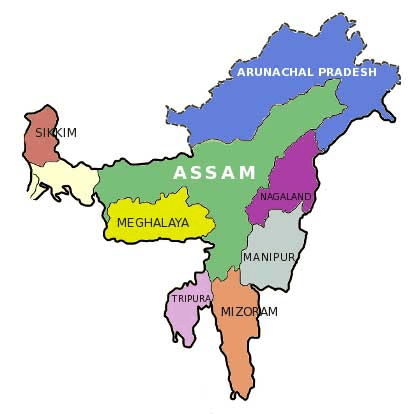
Statehood: Manipur, Tripura, Meghalaya became full states on 21 Jan 1972 via North Eastern Region (Reorganisation) Act 1971

Geography: All three lie in eastern Himalaya–Brahmaputra arc, bordering Bangladesh–Myanmar

Process: Princely accessions (1947-49) → Union Territories/Sub-state → 1972 statehood

Quick Facts for MCQs

Legal & Policy

  • Accession: Princely rulers signed Instruments of Accession pre-15 Aug 1947 ensuring defence-external affairs surrender
  • Merger: Separate agreements 1949 integrated Manipur, Tripura directly into Indian Union
  • Reorganisation: 1971 Act upgraded two UTs and one Sub-state to full constitutional statehood

Chronology

  • 1947 Accessions → 1948 Manipur election → 1949 Merger pacts → 1970 Meghalaya autonomy → 1972 tri-statehood
  • Sequence shows gradual political integration of NE frontier post-Independence

Political Significance

  • Manipur set precedent with universal adult franchise before national general elections
  • Statehood recognition addressed ethnic aspirations while strengthening Centre–periphery stability

Socio-Cultural Angle

  • Leaders annually laud rich tribal, dance, handloom traditions of the three states on 21 January Statehood Day

Key Data Points

FeatureData-Point
Statehood date21 January 1972
Enabling ActNorth Eastern Region (Reorganisation) Act 1971
Manipur Instrument of Accession11 Aug 1947 (Maharaja Bodhachandra)
Manipur Merger AgreementSept 1949, signed without Assembly consent
First universal franchise election in IndiaManipur, June 1948
Tripura merger with India15 Nov 1949
Regent signing Tripura mergerQueen Kanchan Prabha
King Bir Bikram’s death17 May 1947
Meghalaya autonomous state within Assam2 Apr 1970
Hills included in Meghalaya 1970United Khasi-Jaintia & Garo Hills
GS-3Economy

4.SIDBI Equity Infusion for MSMEs (MSME Finance)

Times of India

What & Where

Institution; principal lender-promoter for Micro, Small & Medium Enterprises across India

Processes; refinance to lenders, direct loans, venture debt, digital collateral-free credit

Geography; statutory HQ at Lucknow, operations pan-India via banks, SFBs, NBFCs, MFIs

Quick Facts for MCQs

Legal & Governance

  • Statutory foundation via Parliament Act; regulated and supervised by RBI as AIFI
  • Delinked from IDBI in March 2000, gaining independent board and shareholding pattern
  • Equity infusion needs CCI nod only if limits crossed; cabinet approves under Article 75 prerogative

Capital Infusion

  • ₹5,000 crore boosts Tier-I capital, enabling higher risk-weighted MSME exposure
  • Fresh equity leverages 10× lending, unlocking ~₹50,000 crore additional credit flow
  • Government shareholding rises, maintaining public sector character without breaching market float norms

Development Functions

  • Refinance; bulk low-cost funds to lenders to expand MSME book without balance-sheet stress
  • Direct credit; fixed asset, working capital, venture debt, startup financing for innovation scale-up
  • Support platforms; Udyami Mitra, advisory, handholding initiatives fostering formalisation, employment generation

Key Data Points

FeatureData-Point
Statutory birthSIDBI Act, April 1990
Parent originWholly-owned IDBI subsidiary till 2000
Present statusOne of five RBI-regulated AIFIs
Union Cabinet move 2024₹5,000 crore equity infusion
Headquarters cityLucknow, Uttar Pradesh
Other AIFIsNABARD, Exim Bank, NHB, NaBFID
Core mandatePromotion, financing, development of MSME sector
Key refinance targetsBanks, Small Finance Banks, NBFCs
Digital product focusCollateral-free, data-driven MSME credit
Grassroots reachFunds routed through Micro-finance Institutions

Related UPSC Prelims PYQs

GS1 2023PYQ 1

Consider the following statements with reference to India:

GS1 2016PYQ 2

With reference to ‘Stand Up India Scheme’, which of the following statements is/are correct?

GS-3Economy

5.MSME Green Transition Roadmap (MSME Decarbonisation)

PIB
Illustration for MSME Green Transition Roadmap (MSME Decarbonisation)

What & Where

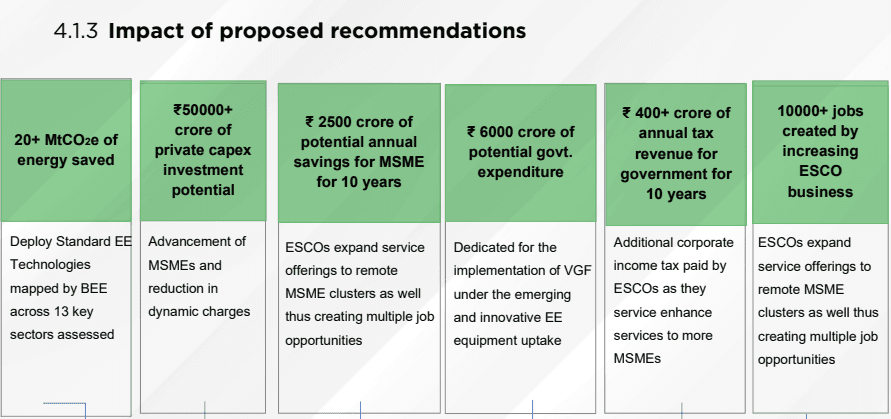
Strategic 10-year NITI Aayog roadmap steering 69 mn Indian MSMEs toward low-carbon, sustainable growth

Applies nationwide MSME clusters via three levers: Energy Efficiency, Green Electricity, Alternative Fuels

Envisions National Project Management Agency for on-ground rollout; aligns with Viksit Bharat 2047 & Net-Zero 2070

Quick Facts for MCQs

Legal & Policy

  • EU CBAM 2026 imposes carbon cost on exports like steel, textiles
  • BRSR mandates Scope 3 disclosure for top 1,000 listed firms, pressuring suppliers
  • Proposal NPMA and secretary-level RIA committee to streamline regulation

Economic Angle

  • Contribution 30 % GDP, 45.7 % exports underscores macro importance
  • Green upgrades yield 1–5 year payback, then direct profit gains
  • Demand aggregation can cut equipment costs via bulk procurement

Environmental Impact

  • Sector emitted 135 Mt CO₂e in 2022, heavy fossil reliance
  • Energy demand may jump 50 % by 2030 without efficiency push
  • MSME decarbonisation key to 500 GW renewable capacity target

Tech & Schemes

  • ADEETIE offers interest subvention plus technical hand-holding for efficient tech
  • GIFT finances waste, clean transport, other green projects at concessional rates
  • ZED certification drives Zero Defect Zero Effect manufacturing practices

Challenges

  • Finance gap from collateral shortage, high perceived risk among lenders
  • Awareness low; only 1 in 25 units monitor carbon emissions
  • Fragmented clusters limit biomass or gas access, hindering fuel switching

Key Data Points

FeatureData-Point
MSME share in GDP≈30 %
MSME share in exports45.7 %
Employment provided250 mn people
CO₂e emitted (2022)135 Mt
Industrial energy share>25 %
Major industrial clusters140 +
Projected energy demand rise50 % by 2030
EU CBAM start year2026
Cyclone Michaung MSME loss4,800 units; $360 mn
Green tech payback1–5 years

Related UPSC Prelims PYQs

CAPF_GAI, GEO_GS 2025PYQ 1

India’s key climate targets include

CAPF_GAI, GEO_GS 2022PYQ 2

The e-AMRIT web portal on electric vehicles, launched at COP26 Summit in Glasgow recently, has been developed by NITI Aayog in collaboration with the Government of

GS-3Economy

6.RBI Central Bank Digital Currency (Digital Currency)

Indian Express

What & Where

Definition: Central Bank Digital Currency = RBI-issued, blockchain-backed, sovereign fiat money in purely digital form.

Amendment: Draft change to RBI Act 1934 enlarges “bank note” to include digital currency.

Geography: Roll-out targeted for Indian economy; RBI examining pilot architecture.

Quick Facts for MCQs

Need & Rationale

  • Volatility: Private crypto swings; CBDC offers stable, regulated alternative.
  • Security: Shields India from US-China digital-currency proxy war.
  • Dollar-dependency: Enables rupee-settled trade, boosts currency sovereignty.

Significance & Benefits

  • Cost-saving: Reduces printing, transport, storage of cash in high cash-GDP economy.
  • Efficiency: Instant domestic & cross-border transfers without inter-bank settlement.
  • Seigniorage: Higher RBI revenue, lower settlement risk, robust legal-tender payments.

Issues & Challenges

  • Legislation: RBI Act, Coinage, FEMA, IT Act need aligned amendments.
  • Design: Technology, validation mechanism, retail vs wholesale distribution undecided.
  • Stability: Risk of sudden deposit flight from weak banks to CBDC wallets.

International Examples

  • China: DC/EP pilot commenced 2020 across select cities.
  • United Kingdom: Bank of England evaluating retail “Britcoin”.
  • El Salvador: Bitcoin adopted as legal tender Sep 2021.

Key Data Points

FeatureData-Point
Currency nameDigital Rupee (CBDC)
IssuerReserve Bank of India
Core Act to amendRBI Act, 1934
Other statutes impactedCoinage Act, FEMA, IT Act
Tech backboneBlockchain / Distributed Ledger
SC verdict on RBI crypto banBan struck down Mar 2020
1st Bitcoin-legal-tender nationEl Salvador, 2021

Related UPSC Prelims PYQs

GS1 2024PYQ 1

Consider the following statements in respect of the digital rupee:

GS1 2023PYQ 2

With reference to Central Bank digital currencies, consider the following statements:

GS-1HistoryQuick Bite

7.Rash Behari Bose Legacy (Freedom Fighter)

PIB

What & Where

Revolutionary Rash Behari Bose: early 20th-century nationalist who internationalised India’s freedom struggle

Key geographies: Bardhaman origin → Bengal & Delhi militancy → North America Ghadar links → refuge and organising base in Japan → death Tokyo

Pathway: underground bomb plots → exile activism → Indian Independence League → creation of Azad Hind Fauj handed to Subhas Bose

Quick Facts for MCQs

Early Militant Phase

  • Alipore Bomb Case spotlighted revolutionary credentials
  • Delhi bombing targeted Viceroy Hardinge, 1912 retaliation against Raj
  • Mentorship by Bagha Jatin intensified clandestine network building

Overseas Strategy

  • Ghadar links leveraged Indian diaspora arms and finance
  • Japan base secured diplomatic shielding, press propaganda, training aid
  • Indian Independence League unified expatriate patriots under single flag

Azad Hind Fauj

  • Force initially raised by Rash Behari Bose from POWs and settlers
  • Leadership ceded to Subhas Chandra Bose for charismatic command
  • INA symbolised armed wing of Provisional Government of Free India

Legacy & Recognition

  • Pioneer of globalised resistance predating NAM era networking
  • Japanese government later awarded him citizenship for contributions
  • Annual 21 Jan tributes led by Union Home Minister underscore enduring national memory

Key Data Points

FeatureData-Point
Birth25 May 1886, Bardhaman, Bengal
Death21 Jan 1945, Tokyo, Japan
Mentor MetJatin Mukherjee (Bagha Jatin), 1913
Notable CasesAlipore Bomb Case 1908; Hardinge assassination attempt 1912
Overseas EscapeReached Japan 1915 to evade British
Key MovementLeadership role in Ghadar Movement
Organisation FoundedIndian Independence League, Japan, 1942
Military Force RaisedAzad Hind Fauj, 1942
INA Leadership TransferHanded to Subhas Chandra Bose, 1942
FacilitatorVeer Savarkar enabled 1924 Bose-to-Bose meeting

Related UPSC Prelims PYQs

GS1 2008PYQ 1

During the Indian Freedom Struggle, who of the following raised an army called ‘Free Indian Legion’?

GS1 2003PYQ 2

With reference to Indian freedom struggle, which one of the following statements is correct?

GS-1HistoryQuick Bite

8.Zehanpora Kushan-Era Stupa Discovery (Buddhist Architecture)

Indian Express

What & Where

Kushan-era (1st–3rd CE) Buddhist stupa complex unearthed at Zehanpora, Baramulla, North Kashmir.

Covers ~10 acres; retains wooden superstructure and intact earthen mounds, making it Kashmir’s largest Buddhist site.

Lies within Jhelum valley’s Buddhist archaeological belt linking Kanispora to Parihaspora.

Quick Facts for MCQs

Archaeological Significance

  • Scale: 10-acre spread marks largest documented Buddhist excavation in Kashmir.
  • Integrity: Undisturbed mounds plus wooden remnants offer rare Kushan architectural evidence.
  • Chronology: Stupa style and ceramics align with early Common Era typology.

Historical Patronage

  • Ashokan: Invited Kashmiri monks to 3rd Council at Pataliputra c.250 BCE.
  • Kushan: Kanishka’s 4th Council in Kashmir entrenched Mahayana thought.
  • Indo-Greek: Menander–Nagasena debates highlight Hellenistic interaction with valley Buddhism.

Regional Spread

  • North: Kanispora, Ushkur, Zehanpora, Parihaspora cluster along Jhelum corridor.
  • Central: Harwan complex near Srinagar exhibits Gandhara-influenced tile art.
  • South: Semthan, Hutmur, Hoinar, Kutbal extend Buddhist footprint to Anantnag axis.

International Linkages

  • Archive: French museum holds early photo depicting three Zehanpora stupas.
  • Travelogues: Likely captured by British explorers, indicating colonial-era awareness.
  • Textual: Sri Lankan Mahavamsa records scholar exchanges involving Kashmir Buddhists.

Key Data Points

FeatureData-Point
EraKushan, 1st–3rd CE
DistrictBaramulla, North Kashmir
Excavated area≈ 10 acres
Key materialWooden superstructure over stupa mound
Earliest Buddhism arrivalAshoka, Mauryan period
First Buddhist king (Rajatarangini)King Surendra
4th Buddhist CouncilKashmir, ~72 AD under Kanishka
Indo-Greek dialogueMenander–Nagasena in Kashmir
Historic site photoFrench museum archive, 19th–20th C
Major North Kashmir sitesKanispora, Ushkur, Zehanpora, Parihaspora

Related UPSC Prelims PYQs

GS1 2001PYQ 1

Who among the following presided over the Buddhist Council held during the reign of Kanishka at Kashmir?

GS-1Mapping

9.Arabian Sea Boiling Phenomenon (Arabian Sea)

DH
Illustration for Arabian Sea Boiling Phenomenon (Arabian Sea)

What & Where

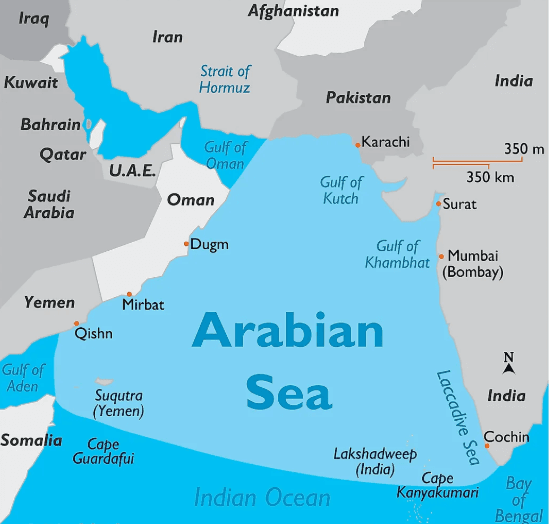
Arabian Sea; north-western arm of Indian Ocean; vital Europe–West Asia–Africa–South Asia shipping lane

Borders India, Pakistan, Iran, Oman, Yemen, Somalia; linked to Persian Gulf (Strait of Hormuz) & Red Sea (Bab-el-Mandeb)

Current alert zone off Gujarat coast showing unusual seawater bubbling

Quick Facts for MCQs

Geological Features

  • Collision-origin basin, seismically active ridges heighten tectonic, volcanic probabilities
  • Carlsberg & Murray Ridges potential gas escape conduits

Possible Causes

  • Methane seepage; underwater tectonic or volcanic discharge; industrial pipeline or ship leakage

Risks & Impact

  • Navigation hazard, fishing disruption, possible precursor to geological instability or industrial accident

Key Data Points

FeatureData-Point
Geological age~50 million years (post Indian–Eurasian collision)
Main deep basinsArabian Basin, Somali Basin
Active ridgesCarlsberg Ridge, Murray Ridge
Seasonal upwellingSouthwest monsoon along Somali & Arabian coasts
Recent anomalyIntense churning/bubbling near Gujarat, Arabian Sea
Suspected natural gasMethane seepage from seabed under probe
GS-3S&T

10.Severe Solar Radiation Storm Impacts (Space Weather)

Economic Times
Illustration for Severe Solar Radiation Storm Impacts (Space Weather)

What & Where

Solar radiation storm: surge of high-energy protons hurled by the Sun toward Earth after powerful eruptions.

Origin zone: solar corona; particles reach magnetosphere/upper atmosphere within minutes–hours despite 150 million km distance.

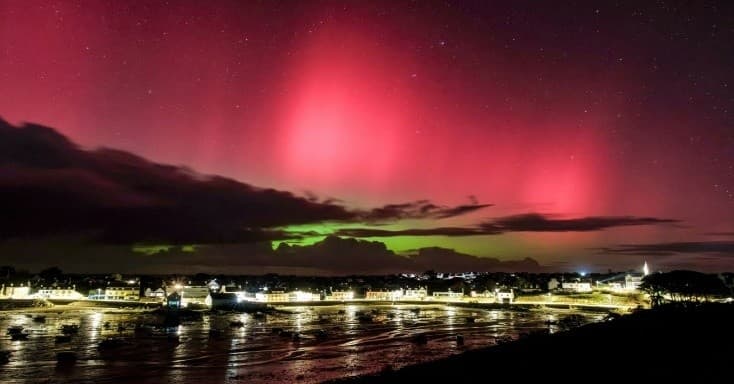
Current event rated S4 (Severe), biggest since 2003; produced mid-latitude auroras and tech disruptions.

Quick Facts for MCQs

Formation Drivers

  • X-class flare releases electromagnetic impulse accelerating protons to near-relativistic speeds
  • CME ejects magnetised plasma enhancing particle flux toward heliospheric magnetic field lines
  • Particles guided by interplanetary magnetic field funnel into polar regions

Technology Impact

  • Satellites: Single-event upsets, sensor saturation, increased atmospheric drag altering orbits
  • Power grids: Induced geomagnetic currents risk transformer overheating, voltage instability
  • Navigation: GPS signal scintillation causing position errors, timing glitches

Astronaut & Aviation Risk

  • ISS crews receive heightened radiation doses exceeding normal background shields
  • Polar flights face elevated exposure; airlines may reroute, limit HF comms
  • Radiation levels can exceed aviation safety threshold of 100 µSv per flight

Visual Phenomena

  • Aurora borealis/australis observed at mid-latitudes across Europe due to energetic particle precipitation
  • Storm intensity extends auroral oval equatorward by several hundred kilometres
  • Colour spectrum shifts with altitude, dominated by green and red oxygen emissions

Key Data Points

FeatureData-Point
NOAA severity scaleS1 (Minor) – S5 (Extreme)
Present storm levelS4 Severe
Proton energy threshold≥ 10 MeV
Primary triggerX-class solar flare + CME
Monitoring satellitesGOES, geosynchronous orbit
Sun–Earth particle travel timeMinutes to a few hours
Previous S4/S5 episodeHalloween Storms, Oct 2003
Key service hitPolar-route GPS / HF radio

Related UPSC Prelims PYQs

GS1 2022PYQ 1

If a major solar storm (solar flare) reaches the Earth, which of the following are the possible effects on the Earth ?

GS-2Polity

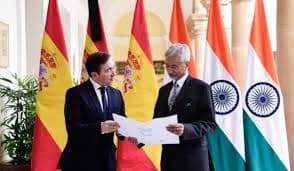
11.Spain Joins Indo-Pacific Oceans Initiative (IPOI Accession)

New Indian Express
Illustration for Spain Joins Indo-Pacific Oceans Initiative (IPOI Accession)

What & Where

IPOI: voluntary, non-treaty platform for practical maritime cooperation across the Indo-Pacific.

Covers entire Indian & Pacific Ocean continuum; open to all like-minded coastal or user states.

Operates through seven thematic pillars; countries may lead any pillar voluntarily.

Quick Facts for MCQs

Pillars & Focus

  • Maritime Security: shared MDA, anti-piracy, safe Sea Lanes of Communication.
  • Maritime Ecology & Resources: sustainability, blue economy, illegal fishing curb.
  • Capacity Building: training, technology transfer, infrastructure resilience.

Strategic Significance

  • Legitimacy boost: wider geographic spread counters “Asian-only” tag.
  • India image: reinforces net-security provider and agenda-setter role.
  • Rivalry mitigation: offers inclusive multilateralism amid US-China contestation.

European Dimension

  • Spain follows France, Germany, Netherlands’ Indo-Pacific outreach documents.
  • EU Connectivity Strategy aligns with IPOI trade & transport pillar.
  • Opens gateway for more Mediterranean NATO states to engage.

Key Data Points

FeatureData-Point
Launch year2019
Announced atEast Asia Summit, Bangkok
ProposerIndia
Doctrinal rootSAGAR (Security and Growth for All in the Region)
NatureNon-military, non-bloc, voluntary
Total thematic pillarsSeven
Spain’s statusFormal member since March 2024 (Declaration handed to EAM S. Jaishankar)
European significanceAdds first Southwestern European entrant
Key objectivesFree, open, inclusive, rules-based Indo-Pacific
Pillar leadershipSelf-selected by participating countries

Related UPSC Prelims PYQs

CAPF_GAI 2024PYQ 1

Which one among the following statements with regard to India’s maritime initiative, SAGAR, is correct?

GS-3SecurityQuick Bite

12.INS Sagardhwani Sagar Maitri V Mission (Ocean Research Mission)

PIB

What & Where

Sagar Maitri (SM): Indian Navy-DRDO joint oceanographic initiative in Indian Ocean Rim (IOR).

SM-5: 2026 voyage of INS Sagardhwani from Kochi, retracing 1962-65 expedition routes.

Core geography: Research tracks across tropical-subtropical Indian Ocean.

Quick Facts for MCQs

Tech & Schemes

  • Vessel-specific: INS Sagardhwani fitted with hull-mounted sensors, deployable buoys, onboard labs.
  • Programme-link: SM nests under MAHASAGAR vision; complements DRDO UDA tech road-map.
  • Capacity-building: MAITRI offers joint training, shared data platforms with IOR partners.

Security Dimension

  • UDA focus: Acoustic profiling aids submarine detection, anti-submarine warfare planning.
  • Maritime-security: Data sharing strengthens coordinated patrols, search-and-rescue readiness in IOR.
  • Strategic-reach: India projects soft-power via science diplomacy, reducing extra-regional influence.

Historical Context

  • Heritage-route: SM-5 mirrors INS Kistna tracks during seminal 1960s International Indian Ocean Expedition.
  • Continuity-signal: Revives multilateral ocean science cooperation paused post-Cold War era.
  • Legacy-upgrade: Modern instruments now yield higher-resolution data than 1960s analog records.

Key Data Points

FeatureData-Point
Parent visionMAHASAGAR (Mutual & Holistic Advancement for Security and Growth Across Regions)
Scientific armMAITRI – Marine & Allied Interdisciplinary Training & Research Initiative
Flag-off locationSouthern Naval Command, Kochi
Lead platformINS Sagardhwani – marine acoustic research vessel
DesignerNaval Physical & Oceanographic Laboratory, Kochi
BuilderGarden Reach Shipbuilders & Engineers, Kolkata
CommissionedJuly 1994
Earlier vessel honoredINS Kistna, 1962-65 International Indian Ocean Expedition
Lead agencyDRDO with Indian Navy
Prime goalCollection of oceanographic & acoustic data for Underwater Domain Awareness

Related UPSC Prelims PYQs

CAPF_GAI, NDA_GAT 2024PYQ 1

Consider the following statements about INS Sagardhwani:

CAPF_GAI, NDA_GAT 2023PYQ 2

Which one of the following Indian Naval Ships has recently concluded a 17,000-nm trans-ocean intercontinental voyage?

GS-3SecurityQuick Bite

13.Lokayan 26 Sail Training Expedition (Sail Training)

PIB

What & Where

Lokayan 26: 10-month transoceanic sail expedition by Indian Navy ship INS Sudarshini, flagged off 20 Jan 2026.

Route: >22,000 nautical miles touching 18 ports in 13 countries to display India’s maritime heritage.

Highlights: Tall-ship events Escale à Sète (France) & SAIL 250 (New York); aligns with MAHASAGAR regional vision.

Quick Facts for MCQs

Training & Capacity

  • Trainees: Over 200 cadets gain oceanic exposure under sail.
  • Skills: Long-range navigation, traditional seamanship, multinational crew interaction enhanced.

Security Vision

  • MAHASAGAR: Voyage reinforces Mutual and Holistic Advancement for Security and Growth Across Regions doctrine.
  • Partnerships: Planned joint maritime activities with host navies deepen interoperability.

Maritime Diplomacy

  • Showcasing: Participation in iconic tall-ship rallies projects Indian seafaring legacy globally.
  • Port calls: 18 foreign harbours enable goodwill visits, soft-power outreach and cultural exchange.

Key Data Points

FeatureData-Point
Expedition codenameLokayan 26
Launch date20 Jan 2026
Voyage duration~10 months
Distance planned>22,000 nautical miles
Foreign ports / countries18 / 13
Flagship eventsEscale à Sète, SAIL 250
Vision anchoredMAHASAGAR
Trainees embarked>200 Navy & Coast Guard
INS Sudarshini status2nd sail training ship after INS Tarangini
Miles already sailed by ship>1,40,000 nautical miles

Related UPSC Prelims PYQs

CAPF_GAI, CDS_GK 2023PYQ 1

Which one of the following Indian Naval Ships has recently concluded a 17,000-nm trans-ocean intercontinental voyage?

CAPF_GAI, CDS_GK 2021PYQ 2

Which one of the following ships was involved in ‘Mission Sagar – II’?

GS-2Scheme

14.Atal Pension Yojana Extension (Pension Scheme)

PMI

What & Where

Atal Pension Yojana (APY); voluntary, government-backed contributory pension for citizens aged 18-40, post-60 payout

Implemented pan-India through banks & post offices; regulated by Pension Fund Regulatory and Development Authority

Union Cabinet cleared continuation with funding support till FY 2030-31

Quick Facts for MCQs

Legal & Policy

  • Cabinet approval; ensures central funding for outreach, IT, incentives, gap-funding through 2030-31
  • Scheme established under Section 12(1) of PFRDA Act mandate for universal pension coverage
  • Income-tax payer exclusion aligns with notification dated 10 Aug 2022

Tech & Schemes

  • Auto-debit via National Automated Clearing House; reduces default risk
  • Central Recordkeeping Agency tracks contributions, generates annual statements
  • Grievance redressal through PFRDA’s online CRA-NSDL platform

Economic Angle

  • Guaranteed returns shift longevity risk from worker to government
  • Encourages small-ticket, formal savings among 80% workforce in unorganised sector
  • Complements NPS, PM-JJBY, PM-JSSY for comprehensive social security

Key Data Points

FeatureData-Point
Launch date9 May 2015
Administering bodyPFRDA
Implementing channelsScheduled banks, regional rural banks, post offices
Eligibility age band18–40 years
NationalityIndian citizens only
Contribution modeAuto-debit monthly/quarterly/half-yearly till 60
Pension slabs₹1 000/2 000/3 000/4 000/5 000 per month
Benefit to spouseEqual pension after subscriber death
Corpus after spouse deathPaid to nominee
Income-tax payer ruleNew enrolment barred from 1 Oct 2022
Investment regulationAs per PFRDA guidelines via approved pension funds
Latest Cabinet decisionContinuation & gap-funding up to 2030-31
Core aimOld-age income security for unorganised workers
Financial inclusion anglePromotes long-term retirement savings

Related UPSC Prelims PYQs

ESE_GS, GS1 2016PYQ 1

Regarding ‘Atal Pension Yojana’, which of the following statements is/are correct?

ESE_GS, GS1 2022PYQ 2

Which one of the following statements is NOT correct regarding the Pension Fund Regulatory and Development Authority (PFRDA)?

GS-2SchemeQuick Bite

15.GI Kaladi Upscaling Under ODOP (ODOP GI Product)

PIB

What & Where

Kaladi – stretchable, mozzarella-like cow-milk cheese traditionally hand-made in Udhampur district, Jammu & Kashmir.

Prepared by coagulating raw full-fat milk with leftover whey water, then sun-dried and pan-seared before eating.

Selected as Udhampur’s One District One Product (ODOP) item for scientific upscaling and wider marketing.

Quick Facts for MCQs

Legal & Policy

  • GI-tag grants exclusive territorial branding rights, elevating product valuation and rural youth employment.
  • ODOP aligns with PM-FME scheme targeting one signature product per district for cluster-based support.
  • Ministerial directive ensures scientific intervention while safeguarding traditional identity per IP protection norms.

Tech & Schemes

  • CSIR-CFTRI tasked with nutrient profiling, texture characterisation, recipe diversification and shelf-life extension studies.
  • CSIR-IIIM to explore bioactive compounds for value addition and functional food positioning.
  • Validation outputs expected to enable cold-chain, MAP packaging and standardised HACCP protocols.

Economic Angle

  • Upscaling aims to integrate Kaladi into organised dairy supply chains, boosting farmer and artisanal income.
  • Export positioning to showcase Dogra cuisine, tapping ethnic food demand in Gulf, EU diaspora markets.
  • Employment creation envisaged across production, packaging, logistics and agri-tourism niches.

Key Data Points

FeatureData-Point
Product categoryTraditional dairy cheese
Alias“Mozzarella of Jammu”
Production districtUdhampur, J&K
Geographical IndicationRegistered GI product
Scaling schemeODOP under PM-FME
Union ministry pushScience & Technology (MoS IC)
Technical partnersCSIR-CFTRI Mysuru; CSIR-IIIM Jammu
Natural coagulantWhey water
Major limitationShort shelf life without refrigeration
Market goalNational & international export
GS-1Polity

16.UGC Equity Regulations 2026 (Higher Education Equity)

The Hindu

What & Where

UGC (Promotion of Equity in Higher Education Institutions) Regulations 2026: enforceable anti-discrimination rules for all UGC-linked HEIs

Prohibit explicit/implicit bias on caste, religion, gender, birthplace, disability; add OBCs to protected groups

Operative across India; head of institution personally liable for compliance

Quick Facts for MCQs

Legal & Policy

  • Inclusion OBC closes earlier legal lacuna enhancing social-justice mandate
  • Penalties convert advisory 2012 rules into enforceable subordinate legislation under UGC Act 1956
  • Aligns with Art 15(4), Art 46 and SC/ST PoA Act 1989 commitments

Institutional Mechanisms

  • Equal Opportunity Centre houses Equity Committee, mobile squads, 24×7 helpline, Equity Ambassadors
  • Committee composition mandates SC, ST, OBC, women, persons with disabilities ensuring representativeness
  • Head-count based reports strengthen UGC oversight and data-driven interventions

Concerns

  • Removal of false-complaint penalty feared to encourage malicious usage
  • Compressed timelines risk compromising fair-hearing and evidence appraisal
  • Small colleges may struggle with staff, funds for round-the-clock compliance

Key Data Points

FeatureData-Point
Notification year2026
Replaces2012 Equity Regulations
Newly covered groupOther Backward Classes
Rise in reported cases173 (2019-20) → 378 (2023-24)
Definition spanCaste, religion, race, gender, place, disability
Mandatory bodyEqual Opportunity Centre
Equity Committee meetWithin 24 hours of complaint
Report submissionWithin 15 days
Action by HoIWithin 7 days
National monitoring meetsMinimum twice a year
Possible penaltiesDebarment, programme ban, derecognition
Reporting dutyBi-annual EOC + annual institutional report

Related UPSC Prelims PYQs

CDS_GK 2023PYQ 1

Which one of the following amendments to the Constitution of India has introduced reservations in education and in public employment for people from the Economically Weaker Sections (EWS) of society?

Ready to practice?

Test your knowledge with our UPSC test series.

Start Free Trial