UPSC Current Affairs

12 topicsGS-1: 1GS-2: 6GS-3: 5
0/12 done
GS-2Polity

1.Haryana Village Common Lands Amendment (Village Commons)

The Hindu

What & Where

Shamilat deh = Haryana village common land for grazing, water bodies, paths, other shared uses

Haryana Village Common Lands (Regulation) Act 1961 amended to let unauthorised occupants buy specified Shamilat plots

Comparable commons: Charnoi (Madhya Pradesh) & Panchami (Tamil Nadu) allotted mainly to Dalit households

Quick Facts for MCQs

Legal & Policy

  • Amendment enables conversion of de facto possession into de jure private title
  • Village commons exit protective framework, prioritising administrative efficiency over social justice
  • Gram panchayats gain revenue via land sales

Social Concerns

  • Landless lose grazing, fuel, subsistence safety net, intensifying rural inequality
  • Elite capture likely as paperwork and funds decide ownership
  • Dalit-focused safeguards in other states absent in Haryana amendment

Economic Angle

  • Formal titles improve cadastral records, easing planning and service delivery
  • Panchayat coffers swell, but long-term communal asset value may erode
  • Marketisation of commons could spur local real-estate speculation

Key Data Points

FeatureData-Point
State amending ActHaryana
Original Act year1961
Latest change2025 Assembly amendment*
Land category opened for saleCertain Shamilat deh parcels
Payment modeMarket-rate purchase from Gram Panchayat
Stated objectivesClear litigation, update records, raise panchayat revenue
Governance shiftRights-based protection → market ownership
High-risk groupsLandless, Dalit households
Potential winnersOccupants with money, documents, political clout
Similar common-land termsCharnoi (MP), Panchami (TN)
GS-2Misc

2.MoSPI New Logo and Mascot Launch (Official Statistics)

DD News
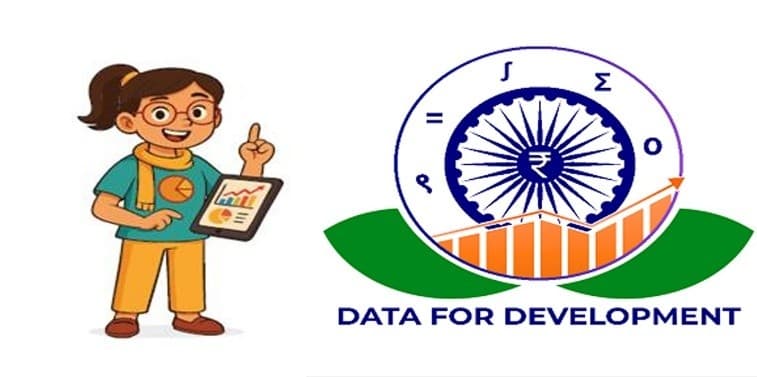
Illustration for MoSPI New Logo and Mascot Launch (Official Statistics)

What & Where

Initiative; MoSPI releases new institutional logo + mascot across India.

Purpose; boost “Data for Development” by making official statistics relatable.

Deployment; surveys, campaigns, educational & digital platforms nationwide.

Quick Facts for MCQs

Design Elements

  • Ashoka Chakra; integrity signal aligning with national emblem usage.
  • Rupee symbol; ties data collection to fiscal decision-making.
  • Growth bar; visual cue for evidence-based progress tracking.

Public Outreach

  • Mascot सांख्यिकी; citizen-centric character used in IEC material.
  • Multi-channel presence; print, digital, events to raise statistical literacy.
  • Aim; foster trust, encourage public cooperation in field surveys.

Governance Impact

  • Consistent branding; strengthens credibility of official datasets.
  • Enhanced data quality; supports transparent, evidence-led policymaking.

Key Data Points

FeatureData-Point
Nodal ministryMoSPI, Govt of India
Newly launchedLogo and mascot (सांख्यिकी)
Mascot roleSimplify statistical concepts for citizens
Logo core symbolsAshoka Chakra, Rupee sign, numerals, growth bar
Colour paletteSaffron-white-green-deep blue
Chakra meaningTruth, transparency, good governance
Rupee sign denotesEconomic planning relevance
Numerical + bar indicateModern data systems, progress
Tagline/theme“Data for Development”
Expected benefitHigher survey participation, better data quality
GS-3Economy

3.Central Excise Amendment Act 2025 (Indirect Taxation)

The Hindu
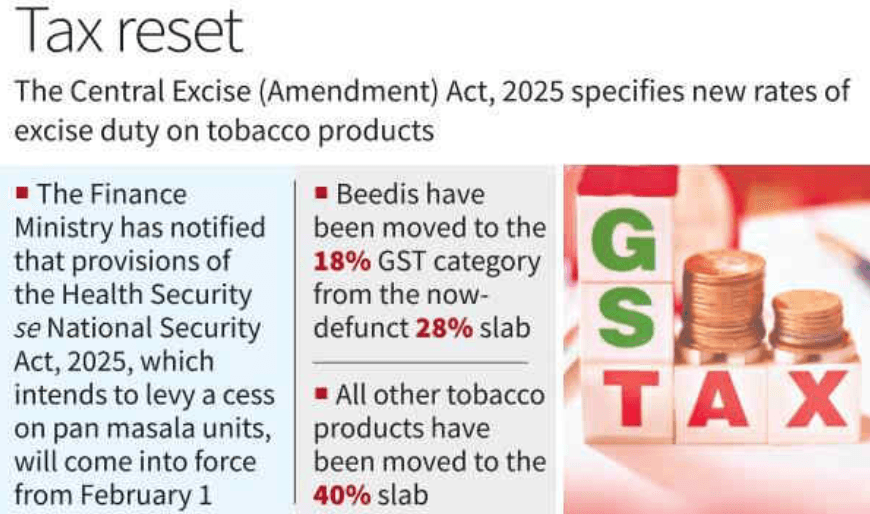
Illustration for Central Excise Amendment Act 2025 (Indirect Taxation)

What & Where

Central Excise (Amendment) Act 2025; revises tobacco duties under Central Excise Act 1944 after GST cess ends

Nationwide implementation; new excise slabs, GST rates, valuation rules effective 1 Feb 2026

GST compensation cess on all goods, incl. tobacco, ceases 1 Feb 2026; earlier loans to States serviced till Mar 2026

Quick Facts for MCQs

Legal & Policy

  • Amendment embeds higher specific and ad-valorem excise slabs for five tobacco categories outside GST base
  • Act maintains overall tax burden post-cess, aligning with GST (Compensation to States) Act mandates
  • Provision enables retail-price-linked valuation for smokeless products to curb mis-pricing

Fiscal Impact

  • Higher duties plus 18-40 % GST expected to offset ≈₹38,000 crore annual cess loss
  • Tobacco remains dual-taxed: central excise + GST, enlarging Centre’s pre-devolution pool
  • Cess inflows till Mar 2026 earmarked for servicing ₹2.7 lakh crore COVID-era loans to States

Public Health

  • Conforms to WHO advice; real tobacco prices set to outpace income growth, deterring initiation
  • 325 % duty on smoking mixtures targets rising hookah/pipe usage in urban lounges
  • Retail-price-based valuation counters under-declaration in loose smokeless segment, improving compliance

Key Data Points

FeatureData-Point
Enactment year2025
Operative date1 Feb 2026
Unmanufactured tobacco duty64 % → 70 %
Chewing tobacco duty25 % → 100 %
Smoking mixtures duty60 % → 325 %
Cigarette duty range₹200–₹735 → ₹2,700–₹11,000 /1000 sticks
GST rate – beedis18 %
GST rate – other tobacco40 %
GST compensation cess startJul 2017
Cess phase-out completion1 Feb 2026
Borrowings repaid via cess≈₹2.7 lakh crore

Related UPSC Prelims PYQs

CDS_GK 2024PYQ 1

Which one of the following statements regarding GST is not correct?

CDS_GK 2021PYQ 2

Following the Constitution (One Hundred and First Amendment) Act, 2016, the Parliament of India enacted quite a few GST Acts in the year 2017. Which one of the following does not fall in this category?

GS-1Environment

4.Dynamic Groundwater Resource Assessment Report 2024 (Groundwater Assessment)

PIB
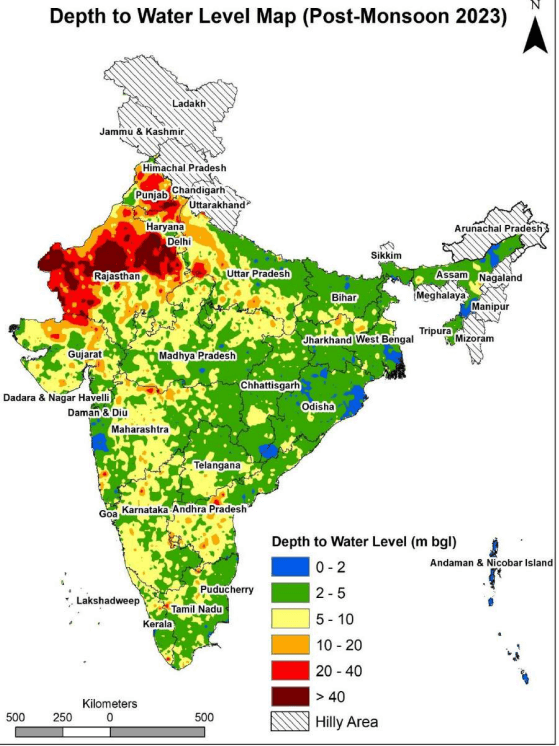
Illustration for Dynamic Groundwater Resource Assessment Report 2024 (Groundwater Assessment)

What & Where

Dynamic Ground Water Resource Assessment Report 2024: nationwide, block-level audit of recharge, extraction and category status of India’s aquifers.

Evaluates 6,932 assessment units across all States/UTs; classifies them Safe, Semi-critical, Critical, Over-exploited, Saline.

Considers two key processes—natural recharge (rainfall, return flow, structures) and anthropogenic draft (irrigation 62 %, domestic-industrial).

Quick Facts for MCQs

Status Trends

  • Improvement; national draft–recharge gap narrowed, Safe units ↑ by 10.8 percentage points since 2017.
  • Saline units 1.88 %, showing concurrent quality stress despite quantity gains.
  • Hard-rock peninsular belts remain hydro-geologically disadvantaged.

Drivers & Pressures

  • Agriculture extraction dominant; rice–sugarcane belts push 11 % units into over-exploitation.
  • Energy subsidies incentivise free pumping in Punjab, Haryana, Rajasthan, Tamil Nadu.
  • Urban-industrial demand rising, adds to 245.64 BCM annual draft.

Schemes & Tech

  • NAQUIM & NAQUIM 2.0 map aquifers, enable micro-planning.
  • Atal Bhujal Yojana focuses on community-led demand management in 8,220 Gram Panchayats.
  • Master Plan 2020 targets 1.42 crore recharge structures harvesting 185 BCM monsoon runoff.

Challenges

  • Governance fragmentation; groundwater is State subject, pricing and regulation uneven.
  • Climate variability; 75 % rainfall in four monsoon months causes temporal mismatch with year-round demand.
  • Quality hazards—arsenic, fluoride—coexist with depletion, complicating potable supply strategies.

Key Data Points

FeatureData-Point
Total annual groundwater recharge446.90 BCM (2024)
Annual groundwater extraction245.64 BCM
Stage of extraction60.47 %
Units categorised Safe73.4 % (up from 62.6 % in 2017)
Over-exploited units share11.13 % (2017 value 17.24 %)
Rainfall contribution to recharge≈61 %
Recharge from tanks/ponds/structures25.34 BCM; nearly doubled since 2017
States with most Critical/Over-exploited blocksPunjab, Haryana, Delhi, Rajasthan, Tamil Nadu, Karnataka, Telangana, Gujarat

Related UPSC Prelims PYQs

GS1 2020PYQ 1

Consider the following statements:

GS1 2023PYQ 2

Consider the following statements:

GS-3Editorial

5.Climate-Resilient Agriculture Strategy for India (Climate-Resilient Farming)

The Hindu

What & Where

Concept: Climate-Resilient Agriculture (CRA) fortifies crops, soils, systems against droughts, floods, heat while sustaining yields.

Key levers: climate-adapted seeds, water stewardship, soil-carbon practices, diversification, agroforestry, digital early-warning.

Indian context: 51 % net sown area rain-fed; NICRA pilots in 448 villages across all agro-climatic zones.

Quick Facts for MCQs

Schemes & Missions

  • NICRA, NMSA, PKVY, MOVCD-NER anchor field demonstrations, organic inputs, water efficiency.
  • Digital push via AgriStack, Kisan Drones, Soil Health Card, Bhashini for vernacular advisories.
  • BioE3 policy flags CRA as biotechnology priority for economy, environment, employment.

Challenges

  • Adoption gap: high cost, low awareness among 86 % smallholders slows CRA technologies.
  • Quality issues: inconsistent bio-fertiliser standards erode farmer confidence.
  • Fragmented governance: overlapping agriculture, biotech, climate programmes lack unified roadmap.

Technology & R&D

  • Breeding: ICAR, DBT, IARI developing drought, submergence, salinity-tolerant rice, wheat, maize.
  • Precision: AI weather alerts, micro-irrigation, drones cut input use yet depend on digital literacy.
  • Genome editing: regulatory pathway early stage, field coverage still marginal.

International Models

  • USA USDA Climate-Smart initiative funds large-scale carbon-smart farming.
  • EU Green Deal & Farm-to-Fork target chemical cutbacks, soil restoration.
  • China combines stress-tolerant cultivars with water-saving irrigation and digital platforms.

Key Data Points

FeatureData-Point
Rain-fed share of net sown area51 %
Food output from rain-fed farms≈40 %
Small & marginal holdings86 % of total farms
Villages with 3G/4G signal95.15 %
Households digitally literate38 %
Land degraded nationwide30 %
Districts under groundwater stress>60 %
Stress-tolerant varieties by ICAR109 released
NICRA launch year2011
Climate-resilient villages demo448

Related UPSC Prelims PYQs

GS1 2021PYQ 1

In the context of India’s preparation for Climate-Smart Agriculture, consider the following statements:

GS1 2020PYQ 2

In the context of India, which of the following is/are considered to be practice(s) of eco-friendly agriculture?

GS-3S&T

6.BSNL Voice over WiFi Service (VoWiFi Technology)

PIB
Illustration for BSNL Voice over WiFi Service (VoWiFi Technology)

What & Where

Definition VoWiFi: voice + SMS carried over Wi-Fi via IP Multimedia Subsystem, uses same SIM number and dialer

Process: SIM-based authentication ➜ packets routed through internet ➜ automatic hand-off to VoLTE if Wi-Fi weak

Geography: BSNL activated nationwide across all Indian telecom circles

Quick Facts for MCQs

Technology & Working

  • Wi-Fi linkage replaces nearby cellular tower, routing voice as digital packets
  • Seamless switching to mobile network prevents call drop during movement
  • No third-party app; native dialer handles call initiation and reception

User Advantages

  • Reliable calling in signal dark spots enhances accessibility for rural and indoor subscribers
  • Better voice clarity owing to stable broadband bandwidth and reduced radio interference
  • Same mobile number; familiar user experience, easing adoption

Security Dimension

  • SIM-based authentication retains encryption level of VoLTE, meeting telecom security norms
  • IMS architecture enables carrier-grade security monitoring and lawful interception compliance

Network Impact

  • Traffic offload frees spectrum, improving overall 4G capacity and quality of service
  • Reduced tower load lowers power consumption and operating expenditure for operator

Key Data Points

FeatureData-Point
Launch operatorBharat Sanchar Nigam Ltd (BSNL)
Core protocolIP Multimedia Subsystem (IMS)
Extra user chargesNil – treated as normal voice calls
Handover partner techVoLTE (4G)
Device requirementVoWiFi-enabled smartphone, simple settings toggle
Authentication modeSIM-based, same as cellular
Key advantage zoneIndoor basements, high-rise, rural low-signal areas
Network benefitOffloads voice traffic, eases tower congestion
GS-2Misc

7.Bulgaria Joins Eurozone as 21st Member (Eurozone Expansion)

The Hindu

What & Where

Eurozone – EU monetary union using the euro; launched 1999 under Maastricht Treaty

Bulgaria – Balkan EU member (2007) adopts euro 1 Jan 2026, discarding century-old lev

Euro now legal tender in 21 countries, serving 350 + million Europeans

Quick Facts for MCQs

Economic Angle

  • Trade facilitation, price transparency, lower transaction costs expected for Bulgaria
  • Single monetary policy via ECB may reduce borrowing spreads and attract FDI
  • Bulgaria remains EU’s poorest; euro adoption aims income convergence

Geopolitical Dimension

  • Euro entry reinforces Western alignment and dampens Russian economic sway
  • Deepens stake in EU decision bodies like Eurogroup and ECOFIN
  • Complements Bulgaria’s NATO membership, stabilising southeastern flank

Eurozone Basics

  • Started with 11 nations in 1999; expanded to 21 by 2026
  • Micro-states Andorra Monaco Vatican San Marino use euro via accords yet lack Eurogroup vote
  • Kosovo and Montenegro use euro unilaterally, outside formal Eurozone

Key Data Points

FeatureData-Point
Adoption date1 January 2026
Bulgaria’s Eurozone position21st member
Previous entrantCroatia 2023
Currency replacedBulgarian lev
Foundational treatyMaastricht Treaty 1992
Users of euro≈ 350 million people
EU states still non-euroSweden Poland Czech Rep Hungary Romania Denmark
Schengen members non-EUIceland Norway Switzerland Liechtenstein

Related UPSC Prelims PYQs

GS1 2007PYQ 1

Which one of the following pairs of countries joined the European Union in 2007?

GS-3Security

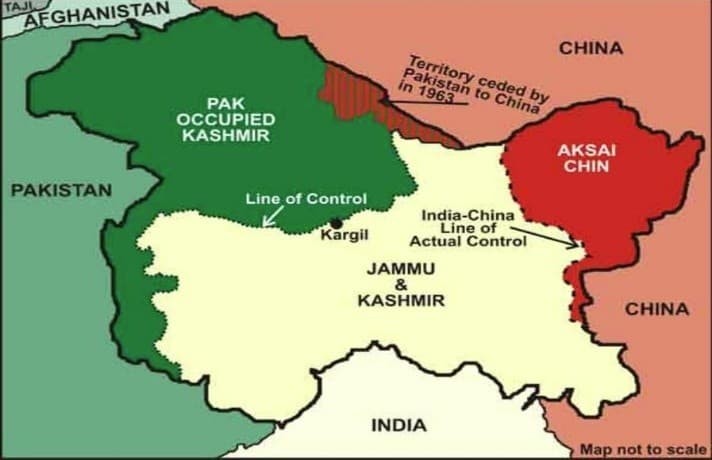
8.India Pakistan Line of Control Overview (India-Pakistan Border)

New Indian Express
Illustration for India Pakistan Line of Control Overview (India-Pakistan Border)

What & Where

De facto military boundary slicing the former princely state of J&K between India and Pakistan.

Began 1949 as UN-mediated Ceasefire Line; redesignated “Line of Control” by 1972 Simla Agreement.

Runs ≈740 km from Jammu to Siachen Glacier; distinct from Sino-Indian Line of Actual Control.

Quick Facts for MCQs

Historical Milestones

  • 1947-48 conflict ended with UN-brokered ceasefire drawing original line.
  • 1949 Karachi Agreement formalised Ceasefire Line under UN Military Observer presence.
  • 1972 Simla Agreement redesignated line as LoC; urged bilateral settlement, trimmed UN role.

Security Dimension

  • Ceasefire violations, infiltration, artillery duels, drone-delivered IEDs mark persistent low-intensity conflict.
  • Frontline for India’s counter-terrorism, narcotics interdiction, arms-trafficking control.
  • Militarisation includes surveillance radars, night vision devices, multilayer patrols, forward observation posts.

Infrastructure & Surveillance

  • India’s double-row, flood-lit fence covers ~550 km of its side.
  • Rugged terrain of Pir Panjal, Kashmir Valley, Siachen foothills demands ropeways, avalanche shelters.

Key Data Points

FeatureData-Point
Legal statusDe facto, not internationally recognised
Original name / yearCeasefire Line, 1949
Renamed by / yearSimla Agreement, 1972
Total length~740 km
Fencing (Indian side)~550 km double-row fence
ExtentJammu to Siachen Glacier

Related UPSC Prelims PYQs

GS1 1996PYQ 1

Consider the map given below:

GS-3Security

9.National Investigation Agency Mandate and Powers (Counter-Terror Agency)

The Hindu

What & Where

Federal counter-terror investigation agency created under the NIA Act, 2008; operational since 2009.

Jurisdiction: all Indian States, cross-state probes without consent, extra-territorial cases with Central approval.

Presents charge-sheets before designated NIA Special Courts nationwide.

Quick Facts for MCQs

Legal & Policy

  • Amendment 2019 expanded powers, adding extra-territorial jurisdiction and removing state-consent requirement.
  • Section 6 allows Centre takeover or State referral of scheduled offences suo-motu.
  • Central sanction mandatory before prosecuting under UAPA 1967.

Investigative Scope

  • Mandate covers terrorism, insurgency, national-security crimes of pan-India impact.
  • Collects, analyses, shares counter-terror intelligence; coordinates with domestic & international agencies.
  • May club connected offences discovered during the same probe.

Performance Metrics

  • 2025 conviction rate exceeded 92 %, signalling stronger internal-security enforcement.
  • Dedicated cell handles Left-Wing Extremism terror-finance cases, aiding convictions.
  • Conducts capacity-building programmes to enhance investigative proficiency across agencies.

Key Data Points

FeatureData-Point
Establishment year2009
Parent legislationNIA Act, 2008
Key amendmentNIA (Amendment) Act, 2019
2025 conviction rate> 92 %
Case-takeover clauseSection 6, NIA Act
Central nod needed forUAPA-1967 prosecutions
Trial forumNIA Special Courts
GS-2Scheme

10.Digital e-Bill System for Fertiliser Subsidies (Fertiliser Subsidy)

HBL

What & Where

Integrated e-Bill System: end-to-end digital platform for fertiliser subsidy claims.

Replaces nationwide manual paper workflow for ~₹2 lakh crore annual subsidy.

Operated by Ministry of Chemicals & Fertilizers, Government of India.

Quick Facts for MCQs

Tech & Schemes

  • End-to-end digitisation eliminates manual vetting delays.
  • Built-in validation auto-checks bills against predefined eligibility criteria.
  • Real-time dashboard provides centralised expenditure monitoring.

Economic Angle

  • Faster clearing lowers working-capital burden on fertiliser firms.
  • Reduced administrative overhead curbs subsidy leakage, improving fiscal efficiency.
  • Predictable payments may stabilise fertiliser retail prices.

Governance & Accountability

  • Continuous e-tracking curtails discretion and back-dated alterations.
  • Complete audit logs strengthen CAG and internal audits.
  • Digital records support evidence in fraud investigations.

Key Data Points

FeatureData-Point
Launch portfolioMinistry of Chemicals & Fertilizers
Annual subsidy handled≈ ₹2 lakh crore
Core goalTimely, transparent, accountable subsidy disbursal
Workflow natureFully digital; no physical bill movement
Claim submissionOnline by fertiliser companies
Processing orderFIFO (First-In-First-Out)
Payment cycleWeekly subsidy release enabled
Audit safeguardTamper-proof, logged trail

Related UPSC Prelims PYQs

CAPF_GAI 2020PYQ 1

PAHAL, an initiative to transfer the subsidy to direct bank account of the beneficiaries, is related to

GS-2Scheme

11.Export Promotion Mission Market Access Guidelines (Export Support)

The Hindu

What & Where

Export Promotion Mission (EPM) – India’s digital umbrella to strengthen export ecosystem for MSMEs & labour-intensive sectors.

Notified by Ministry of Commerce & Industry; first market-access guidelines released January 2026.

Executed nationwide via two sub-schemes: Niryat Protsahan (financial) & Niryat Disha (non-financial).

Quick Facts for MCQs

Tech & Schemes

  • Niryat Protsahan: trade finance, interest subvention, collateral aid, credit enhancement for MSMEs.
  • Niryat Disha: quality compliance, branding, logistics, trade-fair access, district capacity building.
  • Guidelines merge fragmented export schemes into a single digital interface.

Fiscal Support

  • Funding covers participation cost for approved events; aims to lower market-entry expenses.
  • Assistance available for up to three BSMs yearly; MSMEs eligible for four.
  • Incentives target expansion of global footprint for small exporters.

Governance & Policy

  • Coordinated by Dept of Commerce with MSME, Finance, EPCs & states.
  • DGFT provides single-window implementation and monitoring.
  • Mission aligns with Trade Policy 2023-28 objective of USD 2 trn exports.

Key Data Points

FeatureData-Point
Nodal ministryCommerce & Industry
Implementing agencyDGFT
Sub-schemes under EPMNiryat Protsahan, Niryat Disha
Delegate assistance cap2 per firm
Minimum delegation size50 participants
MSME share in delegations≥ 35 %
BSM limit per FYFirms 3; MSMEs 4
Key support eventsTrade fairs, BSMs, Mega RBSMs, trade delegations

Related UPSC Prelims PYQs

CAPF_GAI, ESE_GS 2024PYQ 1

Which of the following is NOT one of the pillars of India’s ‘Foreign Trade Policy-2023’?

CAPF_GAI, ESE_GS 2024PYQ 2

To increase transparency and consumer awareness and handle customer complaints, a 'Centralised Receipt and Processing Centre' and an 'Integrated Ombudsman Scheme' have been set up. These two schemes are related to which one of the following institutions?

GS-2Scheme

12.BEE Standards and Labelling Programme Expansion (Energy Efficiency)

The Hindu

What & Where

Standards & Labelling (S&L): 2006 BEE programme under Energy Conservation Act 2001, rates appliances 1–5 stars for efficiency.

Two label types: Comparative (star-based), Endorsement (meets minimum standards); mandatory or voluntary by notification.

Scope: Household appliances & industrial equipment pan-India; criteria revised periodically to match tech advances.

Quick Facts for MCQs

Legal & Policy

  • Energy Conservation Act mandates minimum performance, audits, star disclosure.
  • S&L, ECBC, PAT notified through BEE regulations; criteria tightened every 3 years.
  • States ranked annually via BEE State Energy Efficiency Index to spur competition.

Tech & Schemes

  • NMEEE pillars: PAT, EEFP, MTEE, FEEED—finance, trade, credit guarantees for efficiency.
  • Street Lighting National Programme retrofits LEDs; Bachat Lamp Yojna swapped CFLs for bulbs.
  • UJALA distributed subsidised LEDs, slashing peak demand and bills.

Environmental Impact

  • Star labels drive lower household load, curb national electricity demand growth.
  • 60 Mt CO₂ annual avoidance strengthens India’s Paris targets & energy security.
  • Efficiency upgrades deliver lifetime bill savings, freeing consumer expenditure.

Institutional Setup

  • BEE certifies Energy Managers/Auditors; prescribes audit periodicity for designated consumers.
  • Defines appliance standards, approves test labs, enforces compliance with penalties.
  • Collaborates with financial institutions via EEFP to mainstream green financing.

Key Data Points

FeatureData-Point
Implementing bodyBureau of Energy Efficiency, Ministry of Power
BEE set-up year2002
Legal anchorEnergy Conservation Act 2001
S&L launch year2006
Star scale1 (least) – 5 (most efficient)
Annual CO₂ cut via S&L≈ 60 million t
Mandatory labels (2026)Expanded to more appliances
NMEEE mission count under NAPCC1 of 8
PAT instrumentTradable Energy Saving Certificates
ECBC notified2017
UJALA focusLED bulbs & fans
State Index bandsFront Runner > 60%; Achiever 50-60%; Contender 30-50%; Aspirant < 30%

Related UPSC Prelims PYQs

GS1 2016PYQ 1

On which of the following can you find the Bureau of Energy Efficiency Star Label?

Ready to practice?

Test your knowledge with our UPSC test series.

Start Free Trial