UPSC Current Affairs

16 topicsGS-1: 3GS-2: 6GS-3: 7
0/16 done
GS-2Polity

1.Chief Justice of India Appointment Process (Judicial Appointment)

Times of India

What & Where

Chief Justice of India: head of Supreme Court & entire Indian judiciary, allocates cases, oversees administration.

Constitutional anchor: Article 124(2) mandates Presidential appointment after requisite judicial consultation.

Geography: Supreme Court, New Delhi; oath administered at Rashtrapati Bhavan by President.

Quick Facts for MCQs

Legal & Policy

  • Article 124(2) requires President consult SC & HC judges “as deemed necessary”.
  • Executive advice: President acts on Council of Ministers’ recommendation, ensuring separation-of-powers balance.
  • Collegium practice, though unwritten, upholds seniority and judicial independence.

Process Flow

  • Sequence: Law Minister seeks name → CJI recommends → PM forwards → President signs warrant → oath ceremony.
  • Integrity check: CJI may confer with senior judges if fitness/suitability doubts arise.
  • Warrant under seal formalises appointment; effective from swearing-in date.

Institutional Conventions

  • Continuity: Seniority rule avoids abrupt administrative vacuum in Supreme Court.
  • Merit overlay: Fitness & integrity can override mere years-served metric.
  • Non-statutory: Whole procedure governed by convention, not explicit legislation.

Key Data Points

FeatureData-Point
Constitutional Article124(2)
Appointing AuthorityPresident of India
Recommending AuthorityOutgoing CJI (senior-most judge tradition)
Initiating MinistryUnion Law & Justice
Consultation Time≥ 1 month before incumbent retires
Oath Administered ByPresident
Seniority NormOldest SC judge “fit for office”
Collegium SizeCJI + 4 senior-most judges (for other judges)

Related UPSC Prelims PYQs

CAPF_GAI, GS1 2012PYQ 1

What is the provision to safeguard the autonomy of the Supreme Court of India?

CAPF_GAI, GS1 2022PYQ 2

Which one of the following is correct in respect of the appointment of District Judges?
GS-3Scheme

2.National Critical Mineral Mission (Critical Minerals)

PIB
Illustration for National Critical Mineral Mission (Critical Minerals)

What & Where

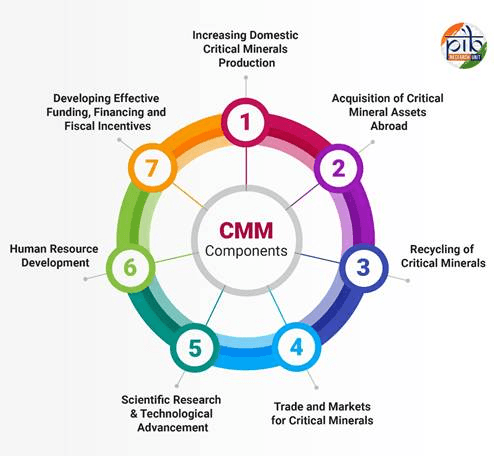
National Critical Mineral Mission (NCMM): 2024-25 Budget scheme ensuring secure supply of strategic minerals across full value chain.

Centres of Excellence: IISc Bengaluru & C-MET Hyderabad added; work on hub-and-spoke model with academia-industry.

Geography: Mission led by Ministry of Mines; offshore polymetallic-nodule zones and domestic deposits targeted.

Quick Facts for MCQs

Legal & Policy

  • Governance: Empowered Committee frames strategy, approves projects, monitors supply-chain risks.
  • Coverage: Mission spans domestic extraction plus overseas tie-ups for assured access.

Technology & R&D

  • Hub-and-Spoke: CoEs coordinate labs, industry pilots, scale-up of mineral processing/recycling tech.
  • Recycling: End-of-life electronics and batteries mined for lithium, cobalt, rare earths.

Strategic Sectors

  • Clean-Energy: Photovoltaics, wind magnets, grid-storage batteries dependent on critical minerals.
  • Mobility: NEMMP targets rely on Li-ion batteries with imported lithium, nickel, cobalt.

Economic Angle

  • Supply-security: Diversification reduces import bill, shields against geopolitical price shocks.
  • Offshore nodules: Potential new revenue stream; exploration authorized in Exclusive Economic Zone.

Key Data Points

FeatureData-Point
Total CoEs recognised9 (7 earlier + 2 new)
Latest CoEsIISc Bengaluru, C-MET Hyderabad
Nodal ministryMines
Oversight bodyEmpowered Committee on Critical Minerals
Budget announcementUnion Budget 2024-25
Value-chain stagesExploration, mining, beneficiation, processing, recycling
Offshore focusPolymetallic nodules rich in cobalt, REEs
Key solar mineralsSilicon, tellurium, indium, gallium
India’s installed solar capacity64 GW
Key wind-turbine REEsNeodymium, dysprosium
EV battery trioLithium, nickel, cobalt

Related UPSC Prelims PYQs

GS1 2025PYQ 1

Consider the following statements:

GS1 2020PYQ 2

Consider the following minerals:

GS-3Economy

3.Reclassifying CPSE Ratna Categories (CPSE Governance)

Economic Times
Illustration for Reclassifying CPSE Ratna Categories (CPSE Governance)

What & Where

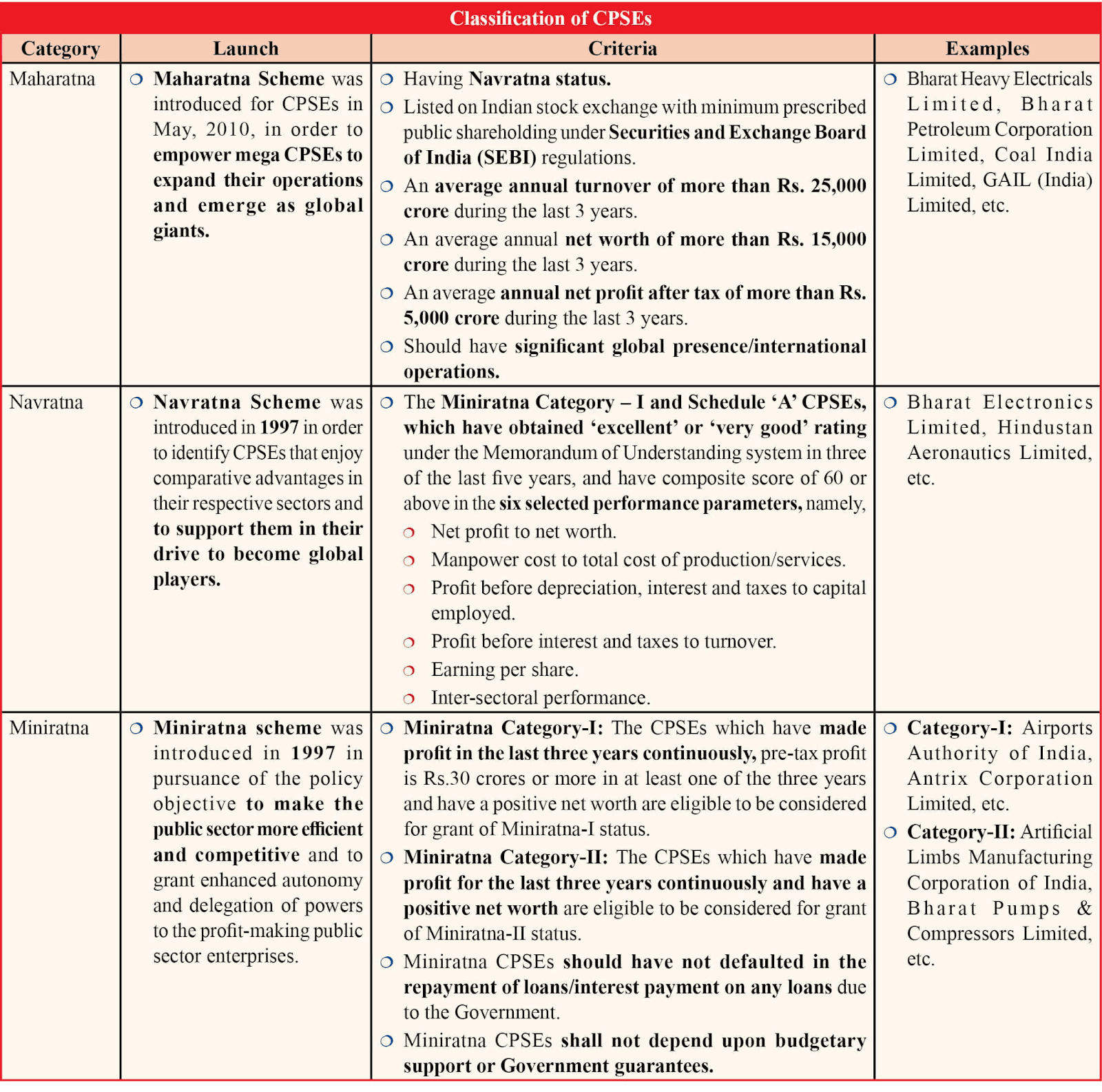
CPSE = company with ≥51 % Central Govt holding (direct/indirect), includes subsidiaries.

India currently uses three Ratna tiers—Maharatna, Navratna, Miniratna; two additional tiers proposed.

10-member panel led by Cabinet Secretary T.V. Somanathan reviewing criteria; report due pre-Budget 2026-27.

Quick Facts for MCQs

Legal & Policy

  • Department grants Ratna status under 2007 guidelines; overhaul aims to modernise framework.
  • CPSEs incorporated via Companies Act 2013 or special parliamentary Acts.
  • Revision seeks alignment with Vision 2047, future economic-security sectors.

Governance Metrics

  • New scorecard stresses corporate governance, board succession, leadership grooming.
  • ESG and dividend record to influence categorisation.
  • Performance-driven accountability replaces size-only benchmarks.

Economic Angle

  • Ratna autonomy enables faster capex, global JVs, strategic acquisitions.
  • Reclassification targets globally competitive, next-gen public enterprises.
  • Focus on efficient capital allocation, sectoral priorities, inclusive growth.

Key Data Points

FeatureData-Point
Ownership threshold for CPSEMinimum 51 % Union shareholding
Present Ratna levelsMaharatna, Navratna, Miniratna
Maharatna firms (2025)14
Navratna firms (2025)26
Miniratna firms (2025)74
Ratna tiers to be added2 (names yet to be notified)
Evaluating ministryDept. of Public Enterprises, Min. of Heavy Industries
Panel headCabinet Secretary T.V. Somanathan
Panel size10 members
Report timelineBefore Union Budget 2026-27
Sample new assessment yardsticksGovernance, succession planning, capex, dividend, ESG, Vision 2047 alignment
Autonomy given by Ratna tagHigher limits for capex, JVs, investments

Related UPSC Prelims PYQs

CAPF_GAI, GS1 2023PYQ 1

‘Rail Vikas Nigam Limited’ is a:

CAPF_GAI, GS1 2007PYQ 2

With reference to the steel industry in India in recent times, consider the following statements:

GS-3Infrastructure

4.India Maritime Week 2025 Vision (Maritime Vision)

PIB
Illustration for India Maritime Week 2025 Vision (Maritime Vision)

What & Where

Event India Maritime Week 2025; five-day global conclave, 85 nations; launched by Union Home & Cooperation Minister

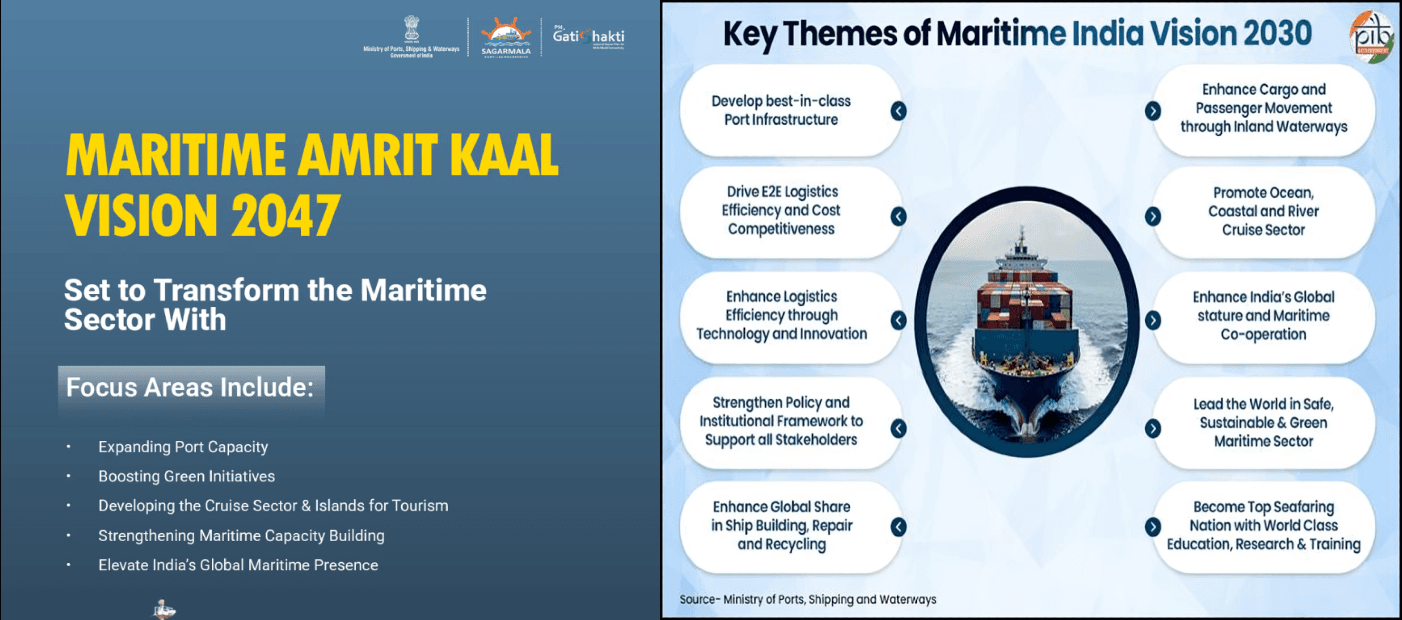
Purpose Showcase Maritime India Vision 2030 and Amrit Kaal Vision 2047, steering India toward maritime leadership by 2047

Geography 11,000 km coastline, 13 coastal states, 23.7 lakh sq km EEZ power natural maritime advantage

Quick Facts for MCQs

Legal & Policy

  • Framework Maritime India Vision 2030 lists 150 + initiatives modernising ports, shipping, waterways
  • Continuum Amrit Kaal Vision 2047 pursues one-third global seaborne trade, Rs 80 lakh crore investment

Economic Angle

  • Capacity Port handling doubled to 2,762 MMTPA; major ports +92 %, non-major +80 % since 2013-14
  • Contribution Maritime sector carries 95 % trade volume, 70 % value; coastal GDP share 60 %

Tech & Sustainability

  • Initiative Green corridors, hydrogen bunkering, methanol-fuelled vessels planned for low-carbon shipping
  • Innovation Seafarer workforce up 200 % to 3.2 lakh through enhanced training and digital systems

Key Data Points

FeatureData-Point
Event ThemeUniting Oceans, One Maritime Vision
Participating Countries85
Indian Coastline11,000 km
Exclusive Economic Zone23.7 lakh sq km
GDP from Coastal States60 %
Trade Volume via Sea95 %
Port Capacity 2013-141,400 MMTPA
Port Capacity 2024-252,762 MMTPA
MIV 2030 Initiatives150 +
MIV 2030 InvestmentRs 3–3.5 lakh crore
Amrit Kaal InvestmentRs 80 lakh crore
Target Global Seaborne Share 2047One-third

Related UPSC Prelims PYQs

ESE_GS, NDA_GAT 2024PYQ 1

Consider the following statements:

ESE_GS, NDA_GAT 2026PYQ 2

What is the name of the national digital framework launched at India Maritime Week 2025 to make Indian ports data-driven and AI-enabled?

GS-1History

5.Ollo Tribe Cultural Profile (Northeast Tribe)

The Print
Illustration for Ollo Tribe Cultural Profile (Northeast Tribe)

What & Where

Ollo (Lazu Naga) = Tibeto-Burman tribe located in Tirap district, Arunachal Pradesh, and contiguous Myanmar Naga zone

Occupy 12–13 villages of Lazu Circle along the Indo-Myanmar frontier, reflecting cross-border ethnic continuity

Assam Rifles’ Khonsa Battalion has begun a women-centric skill programme under Operation Sadbhavana in these villages

Quick Facts for MCQs

Social Structure

  • Patriarchal lineage; inheritance and authority transmitted through male line
  • Clan-based hierarchy with hereditary Lowang chiefs and Ngongpa leaders
  • Land ownership organised by extended kin networks

Cultural Practices

  • Oral tradition includes Voorang folk song and mythic lore
  • Facial tattoos, youth dormitories, ancestral worship remain visible despite Christian influence
  • Woraang festival integrates song, dance, ritual prayers for agrarian prosperity

Economic Angle

  • Shifting cultivation and forest products underpin subsistence livelihood
  • Tailoring, handicraft training now promoted to diversify household income
  • Skill revivals aim to commercialise traditional crafts for market linkages

Security Dimension

  • Operation Sadbhavana leverages civic projects to build goodwill in insurgency-prone border belt
  • Khonsa Battalion’s programme targets Ollo women to reduce recruitment vulnerability
  • Civil-military outreach complements routine counter-insurgency patrols in Tirap

Key Data Points

FeatureData-Point
Alternate nameLazu Naga
Language familyTibeto-Burman
State/DistrictArunachal Pradesh, Tirap
Administrative unitLazu Circle
Villages inhabited12 – 13
2011 Census population≈ 1,500
Traditional chief titleLowang
Historic practiceHeadhunting
Signature festivalWoraang (Voorang)
Primary economySubsistence agriculture, crafts
Recent initiativeSkill empowerment under Operation Sadbhavana
Cultural affiliationTangshang Naga grouping
GS-1History

6.Dogri Language Decline Concern (Scheduled Language)

The Hindu
Illustration for Dogri Language Decline Concern (Scheduled Language)

What & Where

Indo-Aryan tongue; one of 22 scheduled languages; official in Jammu & Kashmir since 2020

Core speech belt: Jammu plains & hills; pockets in Himachal Pradesh, northern Punjab, diaspora, Pakistan

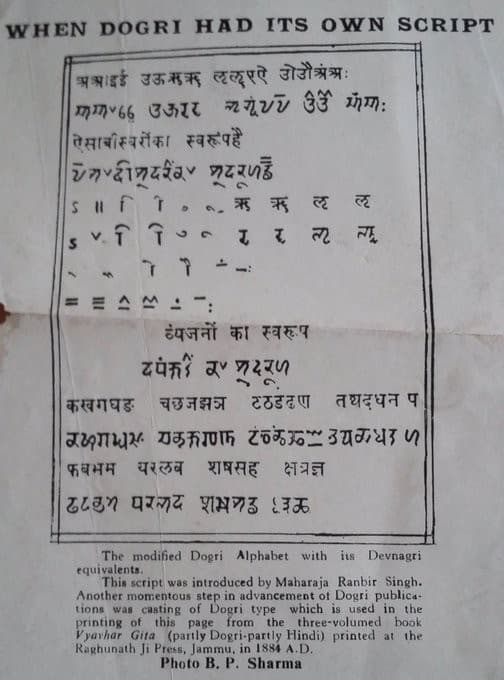
Written today in Devanagari; earlier Dogra Akkhar during Dogra princely state

Quick Facts for MCQs

Historical Evolution

  • Lineage Sanskrit → Old IA (1200–250 BCE) → Middle IA (400 BCE–1100 CE) → Modern Dogri
  • State script institutionalised by Maharaja Ranbir Singh, 1857–85
  • Constitutional inclusion 2003 ended long policy neglect

Script & Phonology

  • Script shift Dogra Akkhar to Devanagari in early 20th century
  • Phonology: 10 vowels, 28 consonants; obligatory lexical tone
  • Processes: nasalization, metathesis, tone-driven minimal pairs

Social Concerns

  • Urban survey: 96 % cannot write Dogri; functional use vanishing from education, admin
  • Youth perceive language as low economic utility; cultural nostalgia persists
  • Government promotion weaker than Urdu/Hindi, accelerating domain loss

Key Data Points

FeatureData-Point
Language familyIndo-Aryan, Sanskritic descent
Earliest literary mention1317 CE, Amir Khusrow’s Nuh Sipihr
Speakers (Census est.)≈ 2.6 million
8th Schedule inclusion2003
J&K Official-language status2020 Act
Historic scriptDogra Akkhar
Current scriptDevanagari
Vowel inventory10
Consonant inventory28
Tone typesLevel, falling, rising
Urban writing literacy (survey)4 %
Youth reading/writing proficiencyNear-zero

Related UPSC Prelims PYQs

CDS_GK 2025PYQ 1

Which among the following is not a language listed in the Eighth Schedule of the Constitution of India?

CDS_GK 2020PYQ 2

Which one of the following is not among the principal languages of Jammu and Kashmir?

GS-3Environment

7.Loktak Lake Ramsar Wetland (Ramsar Wetland)

New Indian Express
Illustration for Loktak Lake Ramsar Wetland (Ramsar Wetland)

What & Where

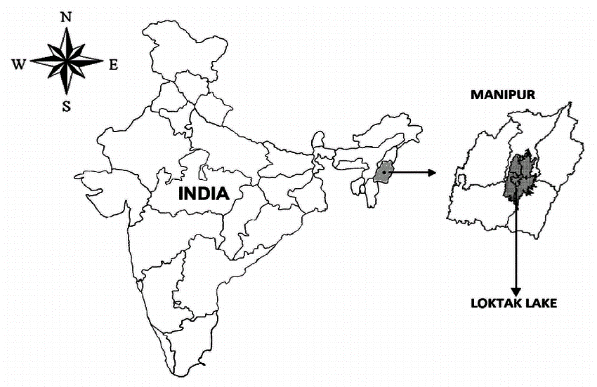
Loktak Lake — largest South Asian freshwater lake with floating phumdis; Ramsar wetland.

Situated at Moirang, Bishnupur District, Manipur; ~48 km south-west of Imphal.

Natural floodplain basin fed by Khuga, Nambul, Imphal, Thoubal & minor streams.

Quick Facts for MCQs

Environmental Impact

  • Degradation drivers : land-use change, agricultural runoff, shifting cultivation noted by Nagaland University study.
  • Pollution plus sedimentation prompting Ramsar Montreux Record tagging.
  • Phumdi thinning threatens lake oxygen balance and Sangai habitat.

Biodiversity

  • Habitat supports migratory waterfowl, freshwater fishes, rare orchids besides Sangai.
  • Keibul Lamjao’s phumdi thickness critical for deer calving and forage.
  • Loss of wetland vegetation risks 428 recorded animal species.

Cultural & Livelihoods

  • Phumsang dwellings built on phumdis enable resident fishers.
  • Sendra & Takmu complexes draw domestic tourists, bolstering local income.
  • Loktak Day events raise awareness, reinforce community stewardship.

Conservation & Policy

  • Loktak Lake (Protection) Act 2006 regulates land use, fishing, tourism.
  • Proposed Athaphum (circle-net) ban to curb eutrophication.
  • Need for integrated catchment management highlighted by recent study.

Key Data Points

FeatureData-Point
Surface area (dry)~250 km²
Surface area (monsoon)~500 km²
Lake typeFloodplain freshwater
Ramsar designation year1990
Montreux RecordIncluded (threat list)
Unique islandsPhumdis (floating mats)
National park presentKeibul Lamjao NP (only floating NP)
Flagship faunaSangai deer (endangered)
Biodiversity428 animal, 132 plant spp.
Annual observanceLoktak Day – 15 Oct
Key livelihoodsFishing, irrigation, hydropower, tourism
Nearest cityImphal (48 km)

Related UPSC Prelims PYQs

GEO_GS, NDA_GAT 2024PYQ 1

Keibul Lamjao National Park is located in which one of the following wetlands?

GEO_GS, NDA_GAT 2019PYQ 2

Loktak lake is situated in the State of

GS-3S&T

8.International Bharat 6G Symposium (6G Technology)

PIB
Illustration for International Bharat 6G Symposium (6G Technology)

What & Where

2nd International Bharat 6G Symposium, part of India Mobile Congress 2025, New Delhi; showcased India’s 6G roadmap & alliances.

“New Delhi Declaration on 6G” by India, EU, USA, others: 6G as global public good with five guiding principles.

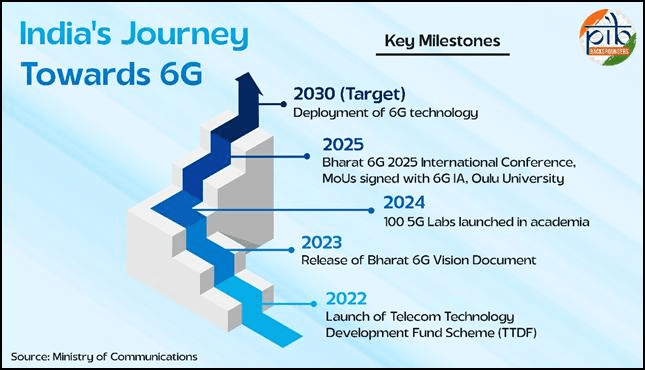
Bharat 6G Vision (2023) targets affordable, sustainable, universally accessible 6G leadership by 2030 under Viksit Bharat 2047.

Quick Facts for MCQs

Legal & Policy

  • Declaration promotes skills, global collaboration, interoperable standards, secure supply chains.
  • MoUs signed with Next G Alliance (USA), 6G-IA (EU), Korea, Finland, Brazil bodies.
  • Government planning National Spectrum Strategy for THz bands.

Economic Angle

  • Vision projects USD 1.2 trn GDP boost, major export potential.
  • Targeting tripled satellite-com market and indigenous stack exports.
  • Patent ambition: top-three globally with 10 % share.

Tech & Schemes

  • Government funded 6G THz & Advanced Optical Testbeds; 100 academic 5G labs.
  • TTDF finances rural-focused 5G/6G R&D; 115 projects cleared.
  • Indigenous 4G core demonstrated for self-reliant upgrade path to 6G.

Challenges

  • Infrastructure gaps in fibre, semiconductors, domestic hardware.
  • Limited high-end R&D talent in AI, photonics, network engineering.
  • Risk of widened digital divide without inclusive rollout policies.

Key Data Points

FeatureData-Point
Declaration principlesTrusted, Resilient, Open, Inclusive, Sustainable (5)
GDP impact targetUSD 1.2 trillion by 2035
Global patent share aim10 % of 6G patents
Satellite comm growth3 × by 2033
Indigenous 4G towers1 lakh deployed
Bharat 6G Vision launch2023
Bharat 6G Alliance members80 + (Jul 2025)
5G labs sanctioned100 in FY 23-24
6G research proposals104 approved
TTDF projects115; Rs 310.6 cr
Core 6G speed promiseUp to 1000 × 5G

Related UPSC Prelims PYQs

ESE_GS 2024PYQ 1

Which Union Ministry announced '5G & Beyond Hackathon 2023' aimed at shortlisting India-focused cutting-edge ideas workable beyond products and solutions?

GS-3S&TQuick Bite

9.Rashtriya Vigyan Puraskar 2025 Awards (Science Awards)

PIB

What & Where

National award; Ministry of Science & Technology, GoI; honours outstanding science, technology & innovation contributions

Four-tier structure: Vigyan Ratna, Vigyan Shri, Vigyan Yuva–SSB, Vigyan Team

Scope spans 13 disciplines incl. Physics, Chemistry, Engineering, Agriculture, Space, Environment, Atomic Energy

Quick Facts for MCQs

Award Categories

  • Vigyan Ratna; highest tier; lifetime oeuvre recognised
  • Vigyan Shri; notable distinguished contributions across covered fields
  • Vigyan Yuva–SSB; under-45 scientists; named after Shanti Swarup Bhatnagar

Notable Personalities

  • Jayant V. Narlikar; astrophysicist; co-developed Hoyle–Narlikar gravity alternative to Einsteinian relativity
  • Work supports steady-state cosmology opposing Big Bang consensus

Tech & Schemes

  • Coverage embraces strategic domains like Atomic Energy & Space, aligning with Make-in-India & Atmanirbhar tech goals

Policy Angle

  • Award expected to bolster R&D ecosystem, complementing National Research Foundation & STI Policy-2020 proposals

Key Data Points

FeatureData-Point
Official nameRashtriya Vigyan Puraskar (RVP)
Award statusHighest Indian S&T recognition
Parent ministryScience & Technology
Total categories4
Category for lifetime workVigyan Ratna (VR)
Young scientist age cap45 yrs (VY–SSB)
Collaborative honourVigyan Team (VT)
Distinguished service tagVigyan Shri (VS)
Discipline count13
Prominent 2025 awardeeProf. Jayant V. Narlikar (posthumous VR)
Key Narlikar theoryHoyle–Narlikar gravity; steady-state universe
Core aimInspire excellence & innovation for national development

Related UPSC Prelims PYQs

CAPF_GAI, GS1 2025PYQ 1

'Rashtriya Vigyan Puraskar, 2024' under the category of 'Vigyan Ratna Award' was given to

CAPF_GAI, GS1 1998PYQ 2

Bharat Ratna was awarded in 1997 to

GS-2Editorial

10.EU–India New Strategic Agenda 2025 (EU–India Partnership)

The Hindu

What & Where

Agreement – EU–India New Strategic Agenda 2025, a joint long-term cooperation blueprint

Provision – links India’s Carbon Credit Trading Scheme with EU Carbon Border Adjustment Mechanism

Geography – applies across 27-nation EU market and all Indian covered emitters/exporters

Quick Facts for MCQs

Climate & Carbon

  • Linkage enables EU border levy deduction equal to Indian carbon price
  • Harmonisation aligns CCTS monitoring with EU ETS verification standards
  • Precedent showcases climate-justice model for Global South participation

Trade & Economy

  • Relief shields steel, cement, aluminium exports from double carbon taxation
  • Wide price gap may trigger EU non-recognition unless floor price negotiated
  • CBAM oversight raises sovereignty and WTO-compliance concerns for India

Institutional & Capacity

  • India needs independent carbon regulator plus compliance-grade caps
  • Robust MRV and third-party audits essential for EU acceptance
  • EU committed to capacity-building and technical sharing for linkage success

Key Data Points

FeatureData-Point
Adoption monthOctober 2023
SignatoriesEuropean Union & India
Pillar count5 key pillars
Landmark clauseMutual carbon-market linkage (ICM–CBAM)
Current Indian carbon price€5–10 / tCO₂e
Current EU ETS price€60–80 / tCO₂e
Indian CCTS statusNo legally binding emission caps
Global firstNorth–South carbon market interconnection

Related UPSC Prelims PYQs

CAPF_GAI, ESE_GS 2026PYQ 1

What is the name of the initiative launched by India and Denmark in November 2025 to enhance bilateral ties?

CAPF_GAI, ESE_GS 2024PYQ 2

CBAM (कार्बन बॉर्डर एडजस्टमेंट मेकेनिज़्म) के संबंध में निम्नलिखित में से कौन-सा/कौन-से कथन सही है/हैं?

GS-2Editorial

11.India–ASEAN Summit 2025 Outcomes (ASEAN Relations)

Indian Express
Illustration for India–ASEAN Summit 2025 Outcomes (ASEAN Relations)

What & Where

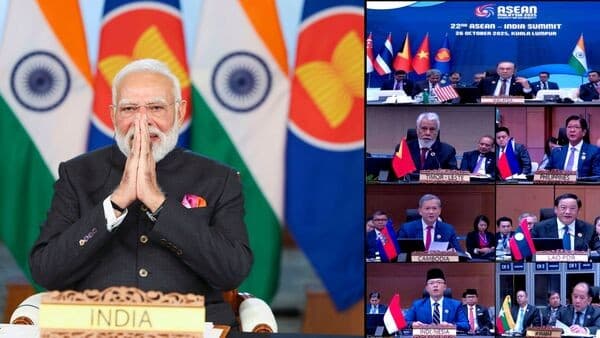
India–ASEAN Summit: annual leaders’ meet between India & 10-nation ASEAN to review strategic, economic, cultural ties.

22nd Summit (2025) virtually from Kuala Lumpur; India a summit partner since 2002.

Geography: Indo-Pacific arc from Myanmar to Philippines; critical sea-lanes linking Indian & Pacific Oceans.

Quick Facts for MCQs

Policy Evolution

  • Look East Policy 1991 upgraded to Act East 2014; broader security & economic objectives.
  • Plan of Action 2026-30 targets trade, education, innovation, food security.
  • ASEAN centrality vs India’s Quad tilt demands calibrated diplomacy.

Economic Angle

  • Bilateral trade 2022-23 ≈ US$131 bn; deficit tilted against India.
  • Ongoing AITIGA review seeks NTB removal, services access, digital trade chapter.
  • ASEAN’s heavy China linkage restrains rapid market diversification toward India.

Security Dimension

  • Indo-Pacific alignment enables joint patrols, MDA info-sharing, HADR drills.
  • 2026 Maritime Year earmarked for blue economy projects & naval exercises.
  • ASEAN’s neutrality tempers formal endorsement of Quad-led security constructs.

Connectivity Projects

  • India–Myanmar–Thailand Highway ≈ 1,360 km; land acquisition & insurgency delays.
  • Kaladan Multi-Modal Corridor links Kolkata–Sittwe–Mizoram; cost overruns persist.
  • Proposed power grids & digital corridors aim to integrate India’s Northeast with Southeast Asia.

Key Data Points

FeatureData-Point
Sectoral Dialogue Partner year1992
Full Dialogue Partner year1996
First India–ASEAN Summit2002 (Phnom Penh)
Goods FTA (AITIGA) signed2009
Services & Investment pacts2015
Comprehensive Strategic Partnership2022
ASEAN share in India’s trade~11 %
India–ASEAN Fund corpus₹500 crore
2026 declared asASEAN–India Year of Maritime Cooperation
Plan of Action timeline2026–2030

Related UPSC Prelims PYQs

CAPF_GAI, GEO_GS 2026PYQ 1

The 22nd India-ASEAN Summit was held in October 2025 in

CAPF_GAI, GEO_GS 2022PYQ 2

Which of the following statements is/are correct?

GS-3Security

12.Exercise Trishul Tri-Services Drill (Military Exercise)

FP

What & Where

Definition: Exercise Trishul – large-scale tri-services drill validating joint land, air, sea, cyber, space operations

Core process: integrated combat scenarios including desert warfare, amphibious landings, air strikes, electronic-warfare, counter-drone

Geography: Rajasthan deserts, Sir Creek & Rann of Kutch wetlands, Saurashtra coast in Gujarat

Quick Facts for MCQs

Security Dimension

  • Deterrence: showcases readiness for multi-front or hybrid threats along India–Pakistan border
  • Validation: tests rapid mobilisation, joint command, real-war conditions across five operational domains
  • NOTAM trigger: Pakistan restricted airspace anticipating heightened Indian activity

Tech & Schemes

  • Indigenous: deployment of home-grown drones, AI-driven command networks, ISR platforms
  • Systems: electronic-warfare suite Trinetra drills counter-drone, spectrum dominance tactics
  • Policy link: aligns with Atmanirbhar Bharat goal of self-reliant defence capability

Geography & Terrain

  • Sir Creek: marshy estuary, disputed India–Pakistan boundary, critical for amphibious practice
  • Rann of Kutch: salt desert enabling large armoured manoeuvres and integrated air-ground firepower
  • Saurashtra coast: secures offshore installations like Jamnagar refinery during naval phases

Operational Integration

  • Jointness: seamless Army armour, Navy landing craft, Air Force fighters under unified theatre-style command
  • Scale: concurrent multi-domain scenarios from cyber intrusion to surface-to-air missile defence
  • Realism: live munitions, night ops, logistics stress tests mirroring potential conflict timelines

Key Data Points

FeatureData-Point
Launched byMinistry of Defence, India
Services involvedArmy, Navy, Air Force
Approx troops20,000+
Key fighter jetsRafale, Sukhoi-30MKI
Air-defence systemS-400
Major sub-exercisesTrinetra (EW, anti-drone), Mahagujraj (integrated air ops)
Naval assetsFrigates, destroyers, amphibious craft
Terrain zonesDesert, creek, maritime
Deterrence focusWestern front against Pakistan
Indigenous pushDrones, ISR, AI targeting under Atmanirbhar Bharat

Related UPSC Prelims PYQs

CDS_GK, NDA_GAT 2023PYQ 1

The 16th edition of Indo-Nepal annual joint training exercise in jungle warfare and counter-terrorism operations was held in December 2022 at Nepal Army Battle School, Saljhandi. What is the name of this exercise?

CDS_GK, NDA_GAT 2021PYQ 2

Which one of the following statements is most appropriate about ‘Exercise Kavach’?

GS-2Scheme

13.PM SHRI Model Schools Scheme (School Upgradation)

DH

What & Where

Centrally Sponsored Scheme upgrading 14,500 existing schools into NEP-2020 model “lighthouse” institutions across India

Launched September 2022; executed by MoE-Department of School Education & Literacy with States/UTs, KVS, NVS

Operates under Samagra Shiksha umbrella; Kerala now signing MoU to unlock pending SSA funds

Quick Facts for MCQs

Funding Pattern

  • Differential sharing; higher Central aid for NE, Himalayan states, J&K, UTs without legislature
  • Funds routed through Samagra Shiksha; pending ₹1,500 cr for Kerala contingent on MoU
  • Five-year budget ceiling fixed, avoiding open-ended liabilities

Infrastructure & Tech

  • Smart classrooms, computer & integrated science labs, Atal Tinkering & skill labs mandated
  • Digital resources to support blended and personalised learning
  • Upgrades aim to serve as demonstration hubs for surrounding schools

Pedagogy & Assessment

  • Shift toward inquiry-driven, experiential, competency-based teaching aligned with NEP 2020
  • Continuous holistic assessment replaces exam-centric grading
  • Teacher capacity-building modules on digital pedagogy, skill education

Inclusivity & Sustainability

  • Barrier-free access, gender-sensitive facilities, multilingual resources ensured
  • Emphasis on solar energy, water harvesting, solid-waste management for green campuses
  • Scheme aspires to integrate SDG-4 (quality education) and SDG-13 (climate action) targets

Key Data Points

FeatureData-Point
Full namePM Schools for Rising India (PM SHRI)
Total schools targeted14,500
Launch month-yearSeptember 2022
Scheme period2022-27
Total outlay₹27,360 crore
Centre:State share60:40 normal; 90:10 NE/Himalayan, J&K; 100 % UTs w/o legislature
Implementing ministryEducation (DoSE&L)
Selection modeCompetitive challenge via UDISE+ data, field verification
Key pedagogy focusExperiential, competency-based learning
Core green featuresSolar power, rainwater harvesting, waste management

Related UPSC Prelims PYQs

CDS_GK, NDA_GAT 2022PYQ 1

भारत सरकार द्वारा हाल ही में आरम्भ की गई ‘SHRESHTA’ योजना के बारे में निम्नलिखित में से कौन-सा/कौन-से कथन सही है/हैं?

CDS_GK, NDA_GAT 2025PYQ 2

NEP 2020 के दिशा-निर्देश के अनुसार, 'पोषण और पढ़ाई पूर्व' (PPBP), निम्नलिखित में से किस कार्यक्रम के अंतर्गत प्रारंभ की गई है?

GS-2Scheme

14.Mission Aatmanirbharta in Pulses (Pulse Self-Reliance)

Indian Express
Illustration for Mission Aatmanirbharta in Pulses (Pulse Self-Reliance)

What & Where

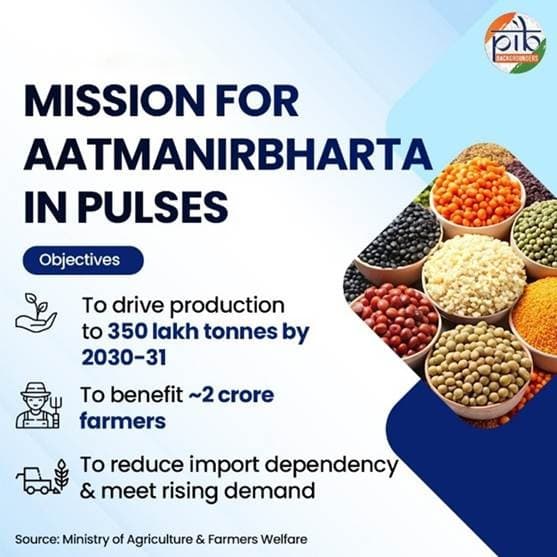
Mission-for-Aatmanirbharta-in-Pulses: six-year national drive to lift domestic pulse output, farmer income, price stability

Key processes: cluster-based production support, 100 % assured procurement, climate-resilient seed adoption

Core geography: traditional pulse belts plus NE, rain-fed, rice-fallow zones across India

Quick Facts for MCQs

Tech & Schemes

  • Climate-resilient seed research, protein enrichment, post-harvest storage prioritized
  • Aadhaar-based e-registration ensures transparent procurement and benefit delivery
  • Integration with PM Dhan-Dhaanya Krishi Yojana and Aspirational Districts for tech diffusion

Economic Angle

  • Targeted 45 % production rise aims to cut imports from Myanmar, Canada, others
  • 100 % assured MSP procurement cushions prices, boosts farmer profitability
  • ₹11,440 crore allocation expected to expand pulse area by 13 %

Implementation Approach

  • Cluster strategy enables focused input supply, demonstrations, market linkages
  • Front Line Demonstrations funded at ₹10,000 ha showcase high-yield tech to nearby farmers
  • NAFED-NCCF act as centralised buyers, stabilising market demand

Key Data Points

FeatureData-Point
Formal launch11 Oct 2025 by PM
Mission span2025-26 → 2030-31
Budget outlay₹11,440 crore
Production target350 lakh MT by 2030-31
Base production (23-24)242 lakh MT
Focus cropsTur, Urad, Masoor
Implementation ministryAgriculture & Farmers’ Welfare
Key agenciesNAFED, NCCF, State govts
Cluster size≥10 ha plain, ≥2 ha hills
Farmer FLD aid₹10,000 per ha
Procurement schemePM-AASHA
Digital checkAadhaar biometric/facial verification

Related UPSC Prelims PYQs

GS1 2010PYQ 1

An objective of the National Food Security Mission is to increase the production of certain crops through area expansion and productivity enhancement in a sustainable manner in the identified districts of the country. What are those crops?

GS-2Scheme

15.Electronics Components Manufacturing Scheme (Electronics Manufacturing)

PIB
Illustration for Electronics Components Manufacturing Scheme (Electronics Manufacturing)

What & Where

Flagship MeitY scheme boosting domestic electronic-component manufacturing, import-substitution

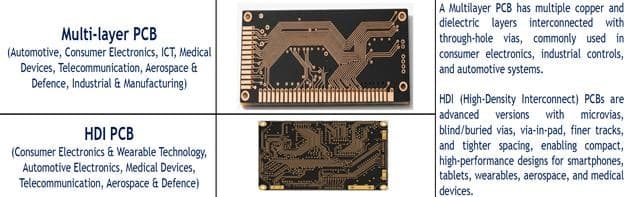
Incentivises PCBs, camera modules, copper-clad laminates, polypropylene films, capital equipment

Pan-India rollout; complements existing PLI and India Semiconductor Mission

Quick Facts for MCQs

Incentive Design

  • Differentiated support offsets India-specific disability costs
  • Turnover incentive paid annually on incremental sales
  • Hybrid option blends capex reimbursement with turnover subsidy

Target Segments

  • Focus segments include PCBs, camera modules, copper-clad laminates, polypropylene films
  • Capital equipment for electronics fabrication also eligible

Economic Angle

  • ₹1 public outlay aims to trigger ~₹6.6 in production value
  • Scheme seeks deeper integration of Indian firms into global value chains

Employment & R&D

  • 91,600 direct jobs projected across design, process engineering, QA
  • Mandates local R&D spending to foster indigenous tech capabilities

Key Data Points

FeatureData-Point
Approval bodyUnion Cabinet, 2024
First batch size7 projects
First batch investment₹5,532 cr
Projected production₹36,559 cr
Scheme tenureTurnover incentive 6 yrs (+1 gest), Capex incentive 5 yrs
Incentive modesTurnover-linked, Capex, Hybrid
Expected direct jobs91,600
Target DVA raiseSub-assemblies, bare components, capital equipment
Domestic demand goal100 % CCL, 20 % PCBs, 15 % camera modules
Supervising ministryMeitY
GS-1Editorial

16.Internationalising Indian Higher Education (Higher Education)

Indian Express

What & Where

UGC 2023 Regulations permit Foreign Higher Educational Institutions (FHEIs) to run full campuses within India.

Eligibility limited to QS Top-500 universities; 17 UK/Australia institutes already green-lit.

Measure operationalises NEP 2020 goal of positioning India as a global education hub.

Quick Facts for MCQs

Legal & Policy

  • NEP 2020; embeds Access, Equity, Quality, Affordability, Accountability; welcomes top global institutions.
  • UGC-2023; grants curriculum, staffing, profit-repatriation autonomy; insists on parent-campus academic parity.
  • Proposed fast-track single-window, clear taxation to sustain policy credibility.

Demand Drivers

  • Demographics; vast youth cohort, rising middle-class incomes, English fluency spur domestic higher-ed demand.
  • Western universities eye India to offset stagnant enrolments, shrinking public funding at home.
  • Visa curbs abroad reduce outbound Indians, enhancing attractiveness of local foreign campuses.

Benefits

  • Brain-drain curb; international degrees attainable at roughly half overseas expense.
  • Quality infusion; global pedagogy, research funding raise standards of Indian counterparts.
  • Skill supply; programs in AI, data science, finance bolster Make in India & Digital India workforce.

Implementation Challenges

  • Autonomy; uncertainty on fee, curriculum approvals could deter investors.
  • Financial; high setup and faculty costs challenge affordability, break-even timelines.
  • Infrastructure; land, labour, tax compliance need predictable, investor-friendly frameworks.

Key Data Points

FeatureData-Point
FHEIs approved (Oct 2025)17
Main source nationsUnited Kingdom, Australia
Governing ruleUGC “Setting up & Operation of FHEI Campuses” Regulations 2023
Eligibility cut-offQS World University Rankings Top 500
Indian Higher-Ed GER<30 %
Population under 30 yrs>50 %
Fee-cap statusExempt from domestic ceilings
Example fee (Southampton UG India, 2026)₹13.86–23.10 lakh (~50 % UK cost)

Related UPSC Prelims PYQs

CDS_GK, ESE_GS 2021PYQ 1

Which one of the following statements is NOT correct regarding the National Education Policy 2020 in India ?

CDS_GK, ESE_GS 2023PYQ 2

Consider the following statements concerning the National Education Policy, 2020:

Ready to practice?

Test your knowledge with our UPSC test series.

Start Free Trial