UPSC Current Affairs

15 topicsGS-1: 3GS-2: 4GS-3: 8
0/15 done
GS-3Economy

1.RBI Credit Market Reforms (RBI Credit Reforms)

Indian Express

What & Where

Definition: RBI Oct 2025 credit-reform package to deepen Indian financial markets and internationalise the rupee

Processes: bank funding for M&A, cross-border rupee lending, higher capital-market limits, wider SRVA investment scope

Geography: India nationwide; external focus on Nepal, Bhutan, Sri Lanka for rupee loans

Quick Facts for MCQs

Banking Reforms

  • Lending banks allowed M&A financing, shifting domain from NBFCs and private funds
  • Lower risk weights for MSME and housing loans under revised Basel III ease capital strain
  • Need for strengthened credit appraisal to mitigate promoter risk and concentration

Capital Market Moves

  • Limit against shares lifted to ₹1 crore, boosting collateral based funding
  • IPO financing cap raised to ₹25 lakh, expected to energise primary issues
  • SRVA balances now investable in corporate bonds, widening investor base

Rupee Internationalisation

  • Rupee loans to Nepal Bhutan Sri Lanka reduce dollar dependence in regional trade
  • FBIL to add more partner currency benchmarks, enabling direct forex quotes without USD
  • Measures complement BRICS discussions on non-dollar settlement alternatives

Key Data Points

FeatureData-Point
Bank takeover financingPermitted to scheduled commercial banks for first time
Loan against shares cap₹1 crore (raised from ₹20 lakh)
IPO financing cap₹25 lakh (raised from ₹10 lakh)
Revised Basel III startApril 2027
Neighbours eligible for rupee loansNepal, Bhutan, Sri Lanka
SRVA investable instrumentsCorporate bonds & Commercial paper, besides G-secs
FBIL benchmark currenciesExpanding beyond USD, Euro, Pound, Yen

Related UPSC Prelims PYQs

GS1 2021PYQ 1

भारत के संदर्भ में, निम्नलिखित कथनों पर विचार कीजिए :

GS1 1995PYQ 2

The Narasimham Committee for Financial Sector Reforms has suggested reduction in
GS-1Editorial

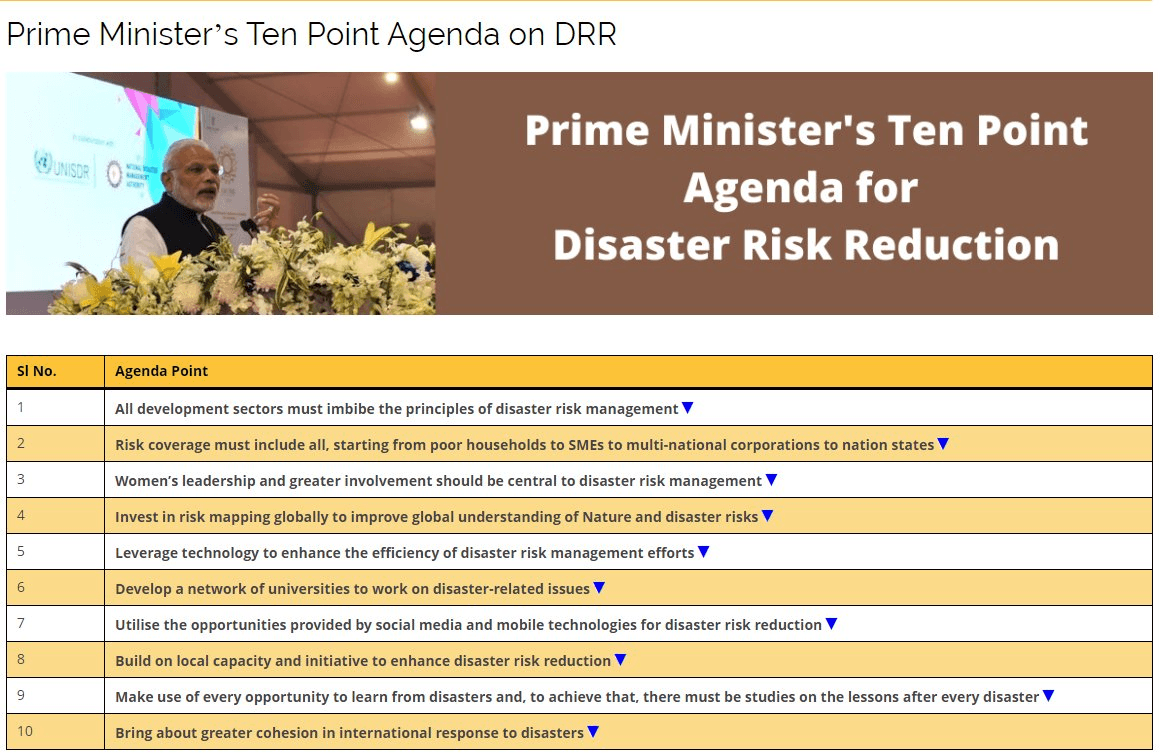
3.India’s Disaster Resilience Strategy (Disaster Risk Reduction)

The Hindu
Illustration for India’s Disaster Resilience Strategy (Disaster Risk Reduction)

What & Where

Disaster Risk Reduction (DRR): systematic approach to identify, assess, and lower hazard impacts via prevention–mitigation–preparedness–response–recovery.

Key processes: multi-hazard planning, early warning, resilient reconstruction, nature-based buffering (wetlands, mangroves, bio-engineering).

Core geography: 59 % quake-prone belt, Himalayan-NE landslide–GLOF zone, 7,500 km cyclone-exposed coastline, urban flood-prone plains.

Quick Facts for MCQs

Legal & Policy

  • Constitution: disaster on State List but DM Act 2005 enables NDMA central guidance.
  • NDMA issues thematic guidelines; districts craft DRR plans under Home Ministry oversight.
  • Coalition for Disaster Resilient Infrastructure positions India as global policy influencer.

Financial Angle

  • Finance-linked model reduces dependence on multilateral loans, funds already released to 5 hill & flood states.
  • Proposal: expand disaster insurance, create dedicated resilience funds with penalty-linked contributions.
  • Reconstruction packages cleared: ₹5,000 cr to Uttarakhand, Himachal, Assam, Sikkim, Kerala.

Tech & Schemes

  • Remote-sensing, AWS, glacial-lake monitoring feed hazard mapping & Common Alerting Protocol.
  • Apps FloodWatch, Mausam, Meghdoot, Damini deliver real-time citizen alerts.
  • Geo-spatial training labs plus hyper-local IoT sensors proposed for river, slope, soil tracking.

Capacity Building

  • NIDM now offers 36 disaster streams; panchayat & school drills mainstream preparedness.
  • Target: 1 million ‘Aapda Sakhi’ women responders; trauma-care centres for Psychological First Aid.
  • District Disaster Management Authorities sought legal autonomy and faster fund flow.

Challenges

  • Fragile ecosystems face cascading cloudburst-landslide-flash flood chains, exemplified by 2023 Himachal & Sikkim GLOF.
  • Urban mismanagement blocks drainage; lax building-code enforcement despite seismic risk.
  • Only quarter of flood districts get timely forecasts, widening socio-economic vulnerability.

Key Data Points

FeatureData-Point
15th Finance Commission DRR outlay₹2.28 lakh cr (2021-26)
Spending split (Prep-Mit-Resp-Recons)10 %-20 %-40 %-30 %
PM’s 10-Point Agenda launch2016
National Guidelines for Landslides2023
Urban Flood Management Framework2024
Cyclone Mitigation Programme phase2011-22; 700 shelters in 8 states
Volunteer schemes (Apda Mitra + Yuva)2.5 lakh trainees
People in high-risk districts>80 % of Indians
Quake-prone area share59 % of land
Functional flood-forecast districts~25 % only

Related UPSC Prelims PYQs

CDS_GK 2025PYQ 1

राष्ट्रीय आपदा प्रबंधन संस्थान (NIDM) के संदर्भ में निम्नलिखित में से कौन-सा/कौन-से कथन सही है/हैं?

CDS_GK 2021PYQ 2

National Disaster Management Authority is headed by

GS-1Mapping

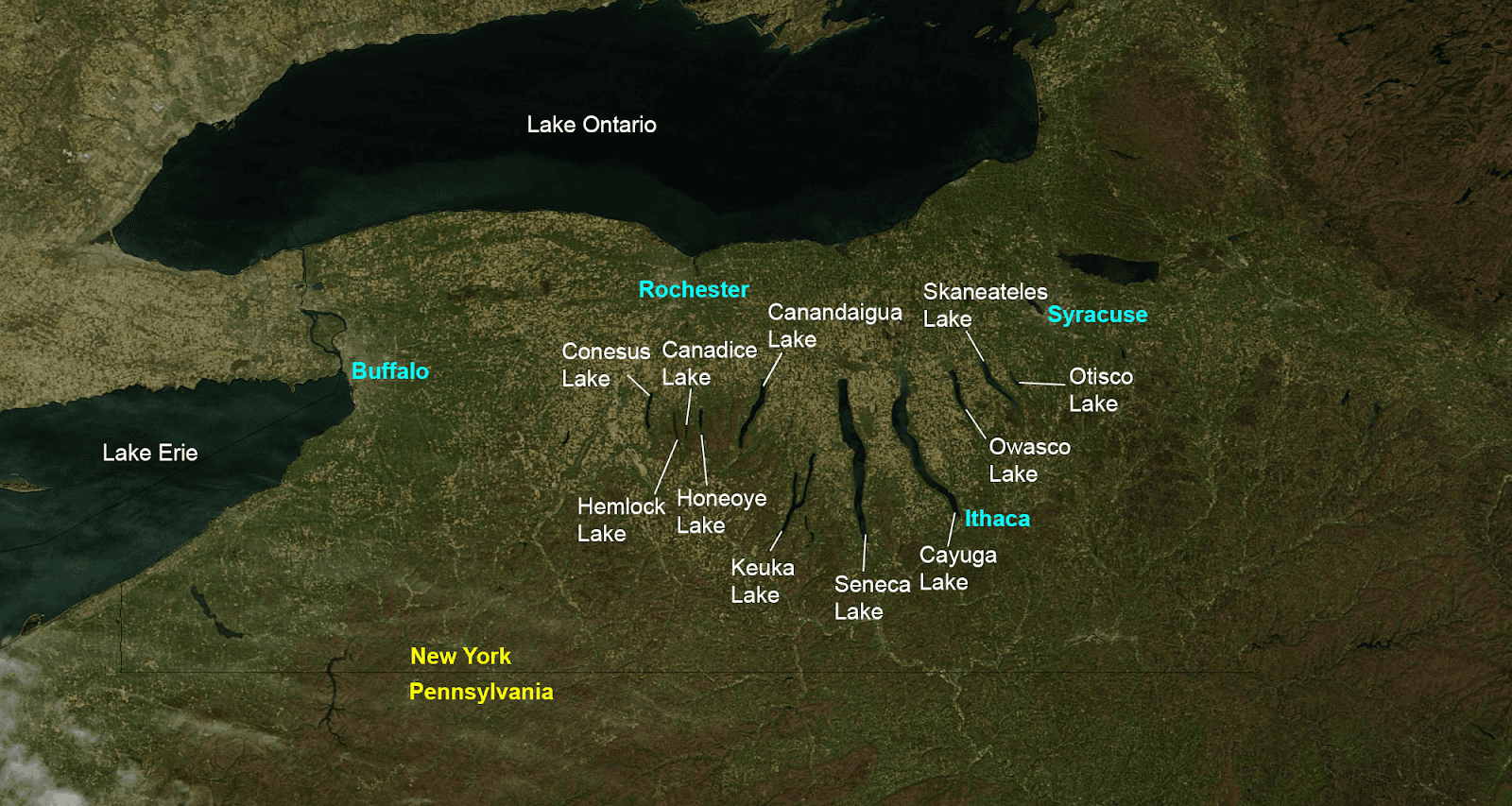
4.New York Finger Lakes Geology (Glacial Finger Lakes)

Indian Express
Illustration for New York Finger Lakes Geology (Glacial Finger Lakes)

What & Where

Finger Lakes: 11 long, narrow, parallel, north-south oriented glacial lakes in central New York, USA.

Seneca & Cayuga: largest, among North America’s deepest; Seneca now shows seafloor-like craters.

Scientists probing Seneca Lake craters for methane escape linked to mysterious “Seneca Guns” booms.

Quick Facts for MCQs

Geomorphology

  • Glacial scouring deepened valleys into broad, deep U-shaped troughs.
  • Southern moraines formed natural dams, impounding water to create lakes.
  • Drumlins north of lakes map subglacial sediment flow direction.

Potential Gas Emissions

  • Lake-floor craters sampled for methane, CO₂ and other trapped gases.
  • Sudden gas bursts posited as trigger for Seneca Guns booms.
  • Results may recalibrate regional greenhouse and limnology data.

Acoustic Mystery

  • Seneca Guns: sporadic cannon-like booms without observable thunder or quake.
  • Phenomenon recorded since 19th century, still unexplained.
  • Current study couples geophysics, acoustics and limnology to locate source.

Key Data Points

FeatureData-Point
Total lakes11
Largest lakesSeneca, Cayuga
Lake orientationLong, narrow, N-S, parallel
Geological originPleistocene glacial scouring
Valley changeV-shaped river → U-shaped trough
Depositional marksTerminal & recessional moraines; drumlin belts
Climate driverMilankovitch orbital cycles
GS-3Environment

5.International Solar Alliance Assembly 2025 (International Solar Alliance)

The Hindu

What & Where

International Solar Alliance – intergovernmental platform accelerating global solar energy access, security, climate resilience

Launched 2015 as India-France initiative at COP21; first treaty-body headquartered Gurugram, India

8th ISA Assembly scheduled 27–30 Oct 2025 at Bharat Mandapam, New Delhi

Quick Facts for MCQs

Legal & Policy

  • 2020 framework amendment expanded eligibility to every UN member state
  • Ease-of-Doing-Solar analytics guides tariffs, permitting, grid codes for member governments
  • Annual Solar Investment Report supplies comparative data shaping national regulations

Financing Tools

  • Africa Solar Facility offers risk guarantees catalysing mini-grids and solar pumps in LDCs, SIDS
  • ASF aims USD 200 m guarantees to unlock USD 2–4 bn investments by 2026
  • ISA overall seeks mobilisation of USD 1 trillion solar finance by 2030

Tech & Schemes

  • Replicates PM-KUSUM pumps and PM Surya Ghar rooftops in Africa, island nations
  • Programmes cover solar in agriculture, health clinics, e-mobility, distributed energy
  • STAR-Cs train engineers, entrepreneurs, officials on PV design, installation, O&M

Key Data Points

FeatureData-Point
Launch year2015
Founding partnersIndia & France
Headquarters cityGurugram, India
Signatory countries (2025)124
Full members>90
Membership open to all UN states2020 amendment
Global solar capacity target1000 GW by 2030
Investment mobilisation targetUSD 1 trillion by 2030
Clean energy access target1 billion people
8th Assembly dates27–30 Oct 2025
8th Assembly venueBharat Mandapam, New Delhi
Africa Solar Facility baseAhmedabad
ASF leverage goalUSD 200 m → USD 2–4 bn by 2026
Capacity-building centresSTAR-C network

Related UPSC Prelims PYQs

GEO_GS, GS1 2016PYQ 1

Consider the following statements:

GEO_GS, GS1 2026PYQ 2

India's installed solar capacity in 2025 is close to

GS-3S&T

6.AI Roadmap for Inclusive Development (AI Roadmap)

NITI Aayog

What & Where

Definition: NITI Aayog “Roadmap on AI for Inclusive Societal Development” guiding AI use to uplift informal workers.

Key processes: AI-based skilling, financial inclusion, social-security convergence through Digital Public Infrastructure.

Geography: Pan-India focus on ~490 million informal workers in agriculture, construction, retail, gig sectors.

Quick Facts for MCQs

Informal Workforce Stats

  • Dominance: Agriculture, construction, retail, handicrafts host most informal jobs.
  • Gender skew: Women concentrated in home-based work, farm labour, lacking social protection.
  • Urban trend: Gig economy expanding “new informal class” without labour safeguards.

Technology & DPI

  • Aadhaar-UPI-eShram trio enables verifiable identities, wage transparency.
  • AI credit scoring (SBI YONO, Setu.ai) unlocks collateral-free micro-loans.
  • Blockchain pilots ensure wage traceability, curb middlemen exploitation.

Policy Recommendations

  • Digital ShramSetu Mission: unified AI platform for skilling, security, livelihood links.
  • Voice-first, vernacular AI interfaces to bypass literacy barriers.
  • Responsible-AI Charter to guarantee transparency, privacy, inclusion.

Urgency Drivers

  • Automation risk widens post-pandemic inequality among informal earners.
  • Demographic dividend window closing within a decade; productivity gains essential.
  • Climate stress: heat-exposed construction and displaced farm labour heighten vulnerability.

Key Data Points

FeatureData-Point
Informal workforce size≈490 million persons
Share of total workforce≈90 %
GDP contribution~50 % of India’s GDP
Rural informal without contracts>80 %
Women’s share in informality>55 %
Productivity ratio (informal/formal)1 : 4
Platform (gig) workers~7.5 million
Earn <₹10,000/month>75 % informal workers
Direct digital market access12 % producers/artisans
Lacking basic digital literacy~70 % workers
Registered under e-Shram/PM-SYM~33 % eligible workers
AI-driven GDP boost by 2035$957 billion (PwC)
Population below 35 yrs65 %

Related UPSC Prelims PYQs

GS1 2025PYQ 1

विश्व बैंक ने यह चेतावनी दी है कि भारत वह पहला देश बन सकता है जहाँ आर्टिफ़िशियल इंटेलिजेंस-आधारित ऑटोमेशन (डेटा-ड्रिवन ऑटोमेशन) के कारण 35% से अधिक नौकरियाँ प्रभावित होंगी। निम्नलिखित कथनों पर विचार कीजिए:

GS-3S&TQuick Bite

7.Nobel Prize 2025 MOFs Discovery (Metal-Organic Frameworks)

The Hindu
Illustration for Nobel Prize 2025 MOFs Discovery (Metal-Organic Frameworks)

What & Where

Definition: Metal–Organic Frameworks (MOFs) are crystalline 3-D networks of metal ions and organic linkers with ultrahigh, tunable porosity.

Process: Reticular chemistry assembles MOFs; “breathing” pores expand or contract when exposed to specific gases or chemicals.

Geography: 2025 Chemistry Nobel shared by scientists from Japan, Australia, USA; MOF water-harvesters proven in arid deserts.

Quick Facts for MCQs

Pioneers & Contributions

  • Robson: Built first 3-D coordination lattices, proving permanent porosity feasible.
  • Kitagawa: Demonstrated “breathing” MOFs; stability with guest-dependent pore sizing.
  • Yaghi: Systematised reticular chemistry, producing thousands of tailor-made MOFs.

Environmental Applications

  • Carbon capture: MOFs selectively adsorb CO₂ over N₂, aiding industrial flue-gas cleanup.
  • Water harvesting: Zirconium-based MOFs condense potable water from ≤20 % relative humidity air.
  • Toxic gas sequestration: Ag/Cu-MOFs immobilise ammonia, sulfur-mustard for safe storage.

Indian Context

  • Reference: Only Indian-born Chemistry Nobelist since 1930 is V. Ramakrishnan (ribosome studies, 2009).
  • Relevance: Nano Mission funds MOF synthesis at IISc, IITs for CO₂ binding and storage.
  • Potential: Indigenous MOFs can support carbon neutrality targets and Jal Jeevan Mission water goals.

Key Data Points

FeatureData-Point
Year of award2025
Nobel categoryChemistry
LaureatesSusumu Kitagawa, Richard Robson, Omar Yaghi
Coined term “MOF”Omar Yaghi
Enabling methodologyReticular chemistry
Core structureMetal nodes + organic linkers
Key propertyPermanent, adjustable nanometre-scale pores
Flagship usesCO₂ capture, desert air water extraction
Indian Chemistry NobelV. Ramakrishnan, 2009
GS-2Economy

8.India-Qatar Economic Cooperation (India-Qatar CEPA)

Business Standard

What & Where

What: India-Qatar Joint Commission on Economic & Commercial Cooperation, apex forum guiding bilateral trade, energy and investment agenda

Where: Co-chaired in Doha, covers India and State of Qatar across West Asian maritime arc

Process: Biennial minister-level review; outcomes feed into proposed India-Qatar Comprehensive Economic Partnership Agreement (CEPA)

Quick Facts for MCQs

Trade & Investment

  • Focus-sectors: Pharmaceuticals, textiles, gems-jewellery, electronics, autos, processed foods, IT, solar
  • UPI launch: Enables instant rupee-riyal payments for residents and tourists
  • QIA investments: Infrastructure, tech, real estate backing National Infrastructure Pipeline

Energy Security

  • LNG supply: Long-term contracts grant price predictability aiding India’s gas-based economy shift
  • Qatar role: Global price-setter; synergy with India’s planned strategic gas reserve
  • Hydrocarbon trade dominance ensures India remains top three export destination for Doha

Defence & Security

  • Defence Cooperation Agreement 2008, extended 2018 covers training, ship visits, DIMDEX participation
  • Joint naval exercise Za’ir-Al-Bahr enhances Gulf maritime domain awareness
  • Qatar’s Al-Udeid US airbase gives India indirect strategic depth in West Asia

Diaspora & Culture

  • Remittances: Multibillion-dollar yearly inflow stabilises Indian forex
  • Cultural milestones: 2019 Year of Culture, ‘Passage to India’ festival 2024 under 2012 pact
  • Indian workforce core to Qatar EPC, healthcare, hospitality, aviation sectors

Key Data Points

FeatureData-Point
FY 25 bilateral tradeUSD 14.15 bn
India’s trade deficitUSD 10.78 bn
Doubling trade target year2030
LNG contracted volume7.5 mtpa from 2028 (25 yrs)
Qatar share in India LPG imports26 %
Hydrocarbons in total trade78.7 %
Indian companies in Qatar20,000 +
Qatar FDI stock in India≈ USD 1.5 bn
Indian diaspora size830,000 +
Bilateral naval drillZa’ir-Al-Bahr

Related UPSC Prelims PYQs

CAPF_GAI, NDA_GAT 2024PYQ 1

Which of the following statements with regard to the outcomes of the talks between the Prime Minister of India and the President of UAE held in February, 2024 is/are correct?

CAPF_GAI, NDA_GAT 2025PYQ 2

S1. Liberalisation and globalisation freed India's economy from the low GDP trap that had impeded India's progress

GS-2Mapping

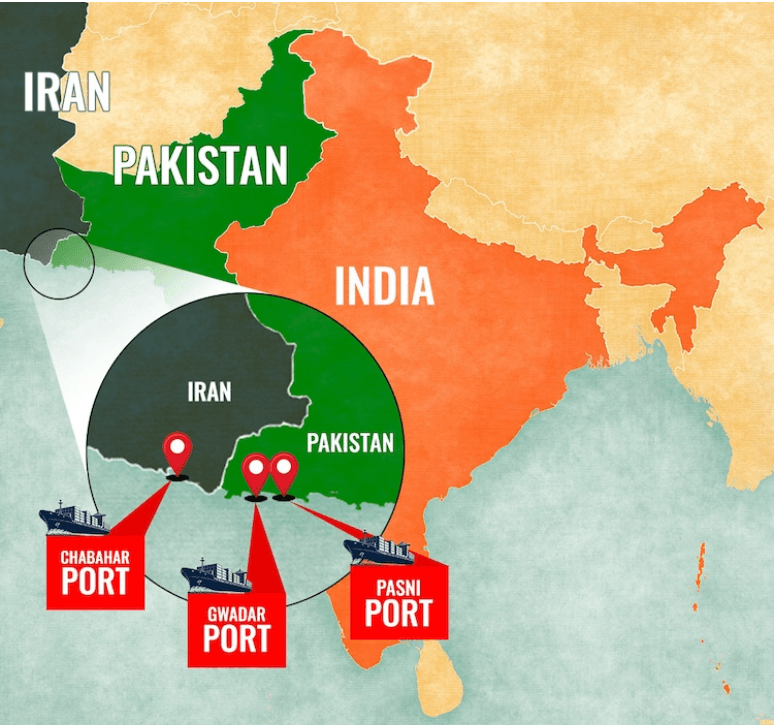
9.Strategic Port of Pasni (Pasni Port)

Economic Times
Illustration for Strategic Port of Pasni (Pasni Port)

What & Where

Pasni Port proposal: Pakistan offering US a small deep-water harbour in Gwadar district, Balochistan on Arabian Sea

Sits near Iran–Pakistan border, east of China-run Gwadar and ~200 km from India-linked Chabahar

Forms Pasni–Gwadar–Chabahar strategic triangle influencing Gulf of Oman sea-lanes

Quick Facts for MCQs

Security Dimension

  • Proximity places US naval presence beside China’s CPEC node, heightening superpower face-off
  • Triangle controls chokepoints near Strait of Hormuz, vital for energy shipping lanes
  • PMSA base enables maritime domain awareness in Western Arabian Sea

Economic Angle

  • Port envisaged to export Balochistan rare-earths, copper and critical minerals to global markets
  • US investment aims to diversify Pakistan’s foreign funding away from debt-heavy Chinese loans
  • Potentially undercuts India’s trade corridor to Afghanistan via Chabahar

Geopolitical Dynamics

  • Move repositions Pakistan from China-centric to more multi-aligned foreign policy calculus
  • US foothold near Iran may pressure Tehran and influence Gulf security architecture
  • India’s regional outreach weakened after loss of US sanctions waiver on Chabahar

Key Data Points

FeatureData-Point
ProposerPakistan
Intended PartnerUnited States
CoastlineArabian Sea, Balochistan
Distance from Gwadar≈ 40–50 km east
Nearby Indian projectChabahar Port, Iran
Existing facilityPakistan Maritime Security Agency base
Key motiveCut China BRI dependence; tap US funds
Resource interestRare-earth & other critical minerals
Strategic triangleChabahar–Gwadar–Pasni
Impacted waiverUS Chabahar sanctions waiver withdrawn 2023
GS-3Security

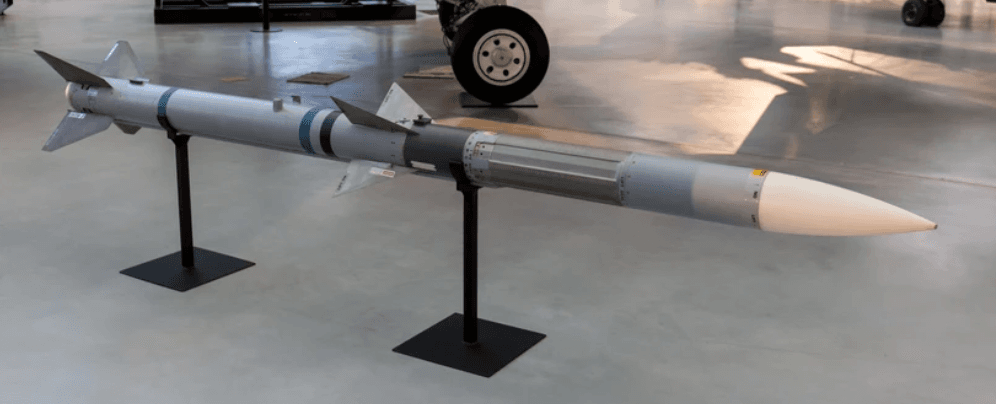
10.AIM-120 AMRAAM Missile Deal (Air-to-Air Missile)

Business Standard
Illustration for AIM-120 AMRAAM Missile Deal (Air-to-Air Missile)

What & Where

AIM-120 AMRAAM = US-made beyond-visual-range, radar-guided air-to-air missile, 1980s origin

Contract route: modified US-Raytheon FMS deal now covering Pakistan Air Force

Core deployment theatres: fighters of US, NATO allies, Japan, Australia, Pakistan etc.

Quick Facts for MCQs

Security Dimension

  • Inclusion of Pakistan revives US support despite previous supply freezes
  • AMRAAM equips Pakistan F-16 fleet, altering South Asia air-combat calculus
  • Missile resists electronic counter-measures, complicating adversary interception

Tech & Schemes

  • Features: multi-target, all-weather, launch-and-leave engagement
  • Variants C8/D3 boast improved rocket motor and seeker sensitivity
  • ASTRA programme under Make-in-India reduces import dependence

International Examples

  • Operational users include US, UK, Germany, Japan, Australia, NATO partners
  • Over 14,000 AMRAAMs produced; combat proven in Gulf War, Syria strikes
  • Export via Foreign Military Sales; Raytheon is prime contractor

Key Data Points

FeatureData-Point
Full formAdvanced Medium-Range Air-to-Air Missile
TypeBVR, active-radar, fire-and-forget
Max range (C8/D3)≈ 160 km
Top speedUp to Mach 4
Guidance comboInertial nav + active radar homing
Latest variantsC8 and D3
Compatible jetsF-15, F-16, F-35, Typhoon, Gripen
Indian analogueDRDO ASTRA Mk-1/2
ASTRA range80–110 km
ASTRA speed> Mach 4

Related UPSC Prelims PYQs

CDS_GK, GS1 2025PYQ 1

भारत के सैन्य आयुध (military arsenal) के बारे में निम्नलिखित में से कौन-सा/कौन-से कथन सही है/हैं?

CDS_GK, GS1 2003PYQ 2

With reference to Indian defence, which one of the following statements is correct?

GS-3Security

11.IAF Inducts Tejas Mk1A (Tejas Mk1A)

The Hindu

What & Where

Tejas Mk1A; upgraded Light Combat Aircraft variant; built by HAL, flown by Indian Air Force

Part of indigenous LCA programme initiated 1984 to replace MiG-21 fleet

Core geography India; design by ADA Bengaluru, production HAL Bengaluru & Nashik

Quick Facts for MCQs

Technological Upgrades

  • AESA radar adds multi-target tracking and longer detection range
  • Digital Flight Control Computer Mk1A improves agility and stability
  • Planned CIT, SDR, ODL integration enhances network-centric warfare

Variants

  • Trainer two-seat used for operational conversion
  • Navy versions feature strengthened landing gear for carrier operations
  • Mk1A employs higher-thrust engine compared to baseline Mk1

Security Dimension

  • Indigenous fighter reduces dependence on foreign suppliers
  • Replaces ageing Soviet-era MiG-21 enhancing fleet safety
  • Supports Atmanirbhar Bharat defence manufacturing push

Key Data Points

FeatureData-Point
DeveloperHindustan Aeronautics Ltd
Programme managerAeronautical Development Agency
First Mk1A induction2025 (IAF)
Radar typeAESA
EW suiteRadar-warning + self-protection jamming
Max speedMach 1.8
Ferry range3,000 km
Payload capacity4,000 kg
Missile fitBVR, AAM, AGM, ASRAAM
Key variantsTrainer, Navy, Navy Mk2, Mk1A

Related UPSC Prelims PYQs

CAPF_GAI, GS1 2024PYQ 1

Consider the following aircraft:

CAPF_GAI, GS1 2022PYQ 2

निम्नलिखित कथनों पर विचार कीजिए :

GS-3Security

12.INS Sutlej Hydrographic Mission (Hydrographic Vessel)

PIB

What & Where

INS Sutlej – Indian Navy hydrographic survey vessel, Goa Shipyard build, commissioned 1993.

Currently Kochi-based; in Port Louis for 18th India–Mauritius Joint Hydrographic Survey.

Mission scope: seabed charting, oceanography, electronic navigational chart (ENC) production.

Quick Facts for MCQs

Technical Specs

  • Multi-beam & side-scan sonar enable high-precision seabed mapping.
  • Differential GPS plus motion sensors ensure centimetric positional accuracy.
  • ISO 9002 compliance guarantees survey data fit for ENC generation.

Operational Role

  • Conducts hydrographic surveys, oceanographic research, geophysical data collection.
  • Chetak helicopter & motorboats extend reconnaissance, sampling and beach profiling reach.
  • Outputs charts vital for shipping safety and maritime domain awareness.

International Cooperation

  • 18th joint survey reinforces India–Mauritius maritime partnership.
  • Data aids Mauritius in updating nautical charts & coastal management.
  • Showcases India’s SAGAR doctrine: “Security and Growth for All in the Region”.

Build & Maintenance

  • Indigenous construction by Goa Shipyard supports Atmanirbhar Bharat.
  • Continuous upgrades keep sensor suite contemporary.
  • Southern Naval Command oversees deployment, training, and refits.

Key Data Points

FeatureData-Point
Vessel classSpecialized hydrographic survey ship
Commissioning year1993
BuilderGoa Shipyard Ltd
Present commandSouthern Naval Command, Kochi
Current deployment18th Joint Hydrographic Survey, Mauritius
Helicopter carried1 × Chetak
Survey craft4 × motorboats
Key sensorsMulti-beam echo sounder, side-scan sonar
Navigation aidsDifferential GPS, motion sensors
Geophysical gearSea gravimeter, magnetometer
Data handlingAutomated real-time logging system
Quality standardISO 9002 digital survey accuracy
Chart outputElectronic Navigational Charts (ENCs)

Related UPSC Prelims PYQs

CDS_GK 2024PYQ 1

Which one of the following statements about 'INS Tarmugli' is not correct?

CDS_GK 2021PYQ 2

Which one of the following ships was involved in ‘Mission Sagar – II’?

GS-2Scheme

13.e-NAM Commodity Expansion (e-NAM Portal)

PIB

What & Where

National Agriculture Market (e-NAM); pan-India electronic trading portal unifying APMC mandis into one market

Operational since 14 Apr 2016; conducts online auctions with quality assaying and digital payments

Covers entire country; links farmers, traders, processors, exporters, mandis via web and mobile apps

Quick Facts for MCQs

Tech & Schemes

  • Digital marketplace integrates real-time auctions, online payments, warehouse-based sales, mobile data access
  • Quality assaying module enables value-based bidding, reducing information asymmetry
  • Single interface links APMCs and private markets across states

Economic Angle

  • Expansion to 247 items widens trade basket, expected to boost rural incomes
  • Inclusion of premium oils, teas, medicinal roots diversifies revenue sources for farmers
  • Transparent pricing curtails intermediary margins, enhancing farmer bargaining power

Market Processes

  • Warehouse sale option lets farmers trade without physically bringing produce to mandi
  • Nationwide buyer–seller connectivity facilitates inter-state movement of agricultural goods
  • Mandis, traders, exporters operate under one digital licence easing compliance

Key Data Points

FeatureData-Point
Launch date14 April 2016
Total tradable commodities247
Recent addition count9 commodities
New commodities listGreen Tea, Tea, Aswagandha Dry Roots, Mustard Oil, Lavender Oil, Mentha Oil, Virgin Olive Oil, Lavender Dried Flower, Broken Rice
Core aimUniform national market & transparent price discovery
Main stakeholdersFarmers, traders, processors, exporters, mandis

Related UPSC Prelims PYQs

ESE_GS, GS1 2025PYQ 1

Which one of the following is an effort to get to the next stage of creating a pan-India electronic portal, which networks the existing APMC mandis by creating a national market for agricultural commodities?

ESE_GS, GS1 2017PYQ 2

‘राष्ट्रीय कृषि बाजार (National Agricultural Market)’ योजना को क्रियान्वित करने का क्या लाभ है ?

GS-2Scheme

14.Shram Shakti Niti 2025 Draft (Labour Policy)

LiveMint

What & Where

Draft Shram Shakti Niti 2025: first integrated National Labour & Employment Policy

Issued by Ministry of Labour & Employment, Government of India

Public consultation phase; targets implementation beginning 2025

Quick Facts for MCQs

Legal & Policy

  • Unified vision replaces fragmented labour codes with integrated policy architecture
  • Tripartite dialogue ensures participation of Centre, States, employers, workers
  • Ease-of-Compliance portal reduces paperwork, encourages formalisation

Tech & Schemes

  • Employment DPI offers AI-driven job matching, credential verification, career guidance
  • Labour & Employment Stack links worker IDs, enterprise data, entitlements for paperless governance
  • AI-enabled workplace safety systems and digital upskilling promoted

Social Concerns

  • Universal Social Security Account promises portable, lifelong protection for all workers
  • Women empowerment via flexible work, childcare, entrepreneurship, vocational pathways
  • Green jobs prioritised to align labour market with climate commitments

Key Data Points

FeatureData-Point
Policy natureDraft, integrated labour & employment policy
Guiding visionDignity, safety, opportunity for every worker
Core objectivesSeven: social security, OSH, gender, youth, future-readiness, green jobs, etc.
Female workforce target35 % participation by 2030
Social Security AccountIntegrates EPFO, ESIC, PM-JAY, e-Shram
Employment DPINational Career Service upgraded with AI job-matching
Compliance toolSingle-window digital portal with risk-based self-certification
Evaluation metricLabour & Employment Policy Evaluation Index (LEPEI)
Institutional tiersNational, State, District Labour Missions
Implementation phasesI (2025-27), II (2027-30), III (>2030)

Related UPSC Prelims PYQs

CDS_GK, ESE_GS 2025PYQ 1

Which of the following features regarding ‘Shram Suvidha Portal’ are correct?

CDS_GK, ESE_GS 2022PYQ 2

भारत सरकार द्वारा अधिसूचित निम्नलिखित श्रम संहिताओं में से किसमें केंद्रीय श्रम अधिनियमों, यथा कारखाना अधिनियम, 1948 और खदान श्रम अधिनियम, 1951 के विशेष उपबंध को शामिल किया गया है?

GS-1Editorial

15.Gender-Affirming Care Framework (Transgender Rights)

The Hindu

What & Where

Definition GAC = medical, psychological, social steps aligning self-identified gender with body & social recognition.

Key forms Correct names/pronouns, counselling, hormone therapy, surgeries, legal documentation support.

India focus Article flags urgent need; WHO treats GAC as medically necessary worldwide.

Quick Facts for MCQs

Health Burden

  • Risk Trans persons 4–6 × likelier to attempt suicide without GAC.
  • Benefit Access to GAC lowers depression, suicidal ideation (JAMA Network Open 2023).
  • Isolation Lack of care fuels poverty, homelessness via school/job exclusion.

Barriers

  • Infrastructure Few trained endocrinologists; no uniform national protocols.
  • Finance High GAHT/surgery costs; Ayushman Bharat TG Plus poorly implemented.
  • Safety Self-medication with unsupervised hormones causing renal, cardiovascular damage.

Policy & Schemes

  • Mandate Article 21 right to dignity grounds demand for publicly funded GAC.
  • Models Tamil Nadu gender clinics, Kerala Transgender Cell show integrated delivery.
  • Roadmap National GAC guidelines, insurance cover, medical-curriculum sensitisation urged.

Key Data Points

FeatureData-Point
Suicide attempts among trans persons31 % (India Mental Health Survey 2024)
Half of attempts occur before age20 yrs
GAHT annual cost₹50,000–70,000
Gender-affirming surgery cost₹2–8 lakh
Healthcare rejection (TISS 2023)65 % of trans youth
Trans Persons Act enactment2019

Related UPSC Prelims PYQs

CDS_GK 2024PYQ 1

India's first dedicated OPD for the Transgenders was opened at which one among the following hospitals?

Ready to practice?

Test your knowledge with our UPSC test series.

Start Free Trial