UPSC Current Affairs

14 topicsGS-1: 2GS-2: 5GS-3: 7
0/14 done
GS-2Polity

1.130th Amendment Minister Removal (130th Amendment Bill)

Indian Express

What & Where

Amendment Bill 130th Constitution 2025 enables temporary ouster of detained Union, State and Delhi Ministers

Scope inserts new clauses into Articles 75, 164, 239AA governing Councils of Ministers

Trigger custody of 30 consecutive days on serious charges forces resignation or automatic cessation next day

Quick Facts for MCQs

Legal & Policy

  • Provision automatic removal on day 31 if advice absent or if PM / CM detained
  • Reversibility release from custody ends disqualification restoring office
  • Objective uphold constitutional morality and public trust

Judicial Benchmarks

  • Supreme Court Manoj Narula 2014 urged Cabinets avoid individuals facing heinous charges
  • Public Interest Foundation 2018 held only Parliament can expand disqualifications, urged stricter law
  • Senthil Balaji 2025 and Kejriwal 2024 cases highlighted court unease with detained ministers

Criminalisation Data

  • ADR 2025 report 45 % MLAs declared criminal cases, 29 % involve serious offences
  • RPA 1951 Section 8 disqualifies only after conviction allowing long tenure under trial
  • Ministers command executive power risking probe interference amid lengthy judicial process

Reform Proposals

  • Law Commission 170th 1999 advised disqualification once charges framed for offences punishable by ≥5-year jail
  • Law Commission 244th 2014 and EC 2004 reiterated charge-frame disqualification recommendation
  • Additional suggestions ministerial code of conduct, parliamentary ethics oversight, party due diligence in selections

Key Data Points

FeatureData-Point
Bill number & year130th Constitution Amendment Bill 2025
Articles amended75, 164, 239AA
Custody threshold30 consecutive days
Removal authorityPresident or Governor on PM/CM advice
ReinstatementAutomatic on release from custody

Related UPSC Prelims PYQs

GS1 2009PYQ 1

Which one of the following Constitutional Amendments states that the total number of Ministers, including the Prime Minister, in the Council of Ministers shall not exceed fifteen percent of the total number of members of the House of the People ?

GS1 2006PYQ 2

What does the 104th Constitution Amendment Bill relate to?
GS-2Polity

2.Election Commission Process Reforms (Electoral Reforms)

PIB

What & Where

Election Commission of India (ECI): constitutional authority managing all Indian elections, headquartered New Delhi

Current focus: cleaning rolls, tech-enabled monitoring, booth-level rationalisation across all states & UTs

ECINET platform: national single window integrating voter, party, and official services

Quick Facts for MCQs

Tech & Schemes

  • ECINET offers digital index cards, constituency reports, grievance redress on one portal
  • Webcasting plus standard photo IDs for BLOs enhance live surveillance and field transparency
  • Mandatory VVPAT slip count triggered by Form 17C – EVM mismatch or uncleared mock-poll data

Governance Challenges

  • Expenditure gap widens; shadow financing fuels corruption and black money
  • Criminalisation persists; muscle-money nexus enables candidates with pending cases to win
  • Urban apathy, migrant barriers, duplicate names cause turnout and inclusivity concerns

Reform Agenda

  • Partial state funding with real-time online disclosure and stringent CAG/ECI audits proposed
  • Inner-party democracy push: compulsory internal elections, transparent ticketing, audited constitutions
  • Nationwide totalizer machines, shorter campaign windows, uniform rolls to deter booth mapping and violence

Key Data Points

FeatureData-Point
Inactive RUPPs flagged476 parties for delisting
Apps linked under ECINET40+
Polling-station webcasting100 % coverage
Voters per polling booth cap1,200
MPs with criminal cases (LS 2024)251 / 543 ≈ 46 %
Special summary revision4 states; first in 20 yrs

Related UPSC Prelims PYQs

GEO_GS, GS1 2021PYQ 1

Which one of the following statements about the Election Commission of India is NOT correct?

GEO_GS, GS1 2004PYQ 2

Consider the following tasks:

GS-3Economy

3.Monetary Policy Committee Overview (Monetary Policy)

LiveMint
Illustration for Monetary Policy Committee Overview (Monetary Policy)

What & Where

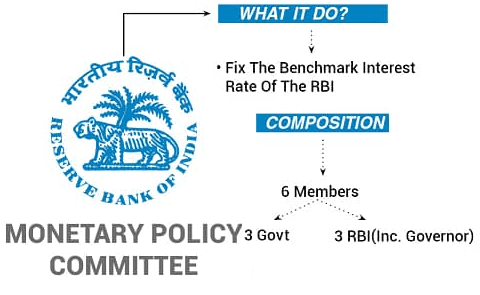
MPC: statutory body under RBI Act (1934, amended 2016) to set India’s policy (repo) rate

Embedded in RBI; meetings held at RBI HQ, Mumbai; covers whole Indian monetary jurisdiction

Operates bi-monthly, steering inflation targeting framework (4 % ± 2 %)

Quick Facts for MCQs

Structure & Membership

  • Composition ensures 1:1 ratio RBI insiders vs independent externals
  • Latest RBI nominee: Executive Director Indranil Bhattacharyya replaces outgoing ex-officio member
  • External members chosen by Centre, vetted for economics, banking, finance expertise

Powers & Instruments

  • Authority to alter repo, reverse repo; influences CRR, SLR indirectly
  • Decisions statutorily binding; RBI must implement without modification
  • Enables price stability while supporting growth mandate

Process & Transparency

  • Publishes minutes, individual votes, rationale 14 days post-meeting
  • Enhances market credibility, anchors expectations, guides financial pricing
  • Inflation failure report required if target missed for three consecutive quarters

Policy Objective

  • Primary mandate: maintain medium-term CPI at 4 % within 2–6 % band
  • Balances growth-inflation trade-off via calibrated rate adjustments
  • Supports investor confidence, macro-financial stability

Key Data Points

FeatureData-Point
Year formed2016
Legal basisSec 45ZB-ZL, RBI Act 1934
Total members6
RBI sideGovernor, Dy Governor (Mon Policy), 1 Executive Director
Govt-nominated side3 external experts
ChairpersonRBI Governor (ex-officio)
External term4 years, no re-appointment
Voting ruleSimple majority; Governor casting vote on tie
Meeting frequencySix times a year (every two months)
Current inflation target4 % ± 2 % CPI
Decision binding onReserve Bank of India

Related UPSC Prelims PYQs

GS1 2017PYQ 1

मौद्रिक नीति समिति (Monetary Policy Committee/MPC) के सम्बन्ध में निम्नलिखित कथनों में से कौन-सा/से सही है/हैं ?

GS1 2022PYQ 2

In India, which one of the following is responsible for maintaining price stability by controlling inflation?

GS-3Economy

4.NITI Aayog Homestay Policy Report (Homestay Policy)

PIB
Illustration for NITI Aayog Homestay Policy Report (Homestay Policy)

What & Where

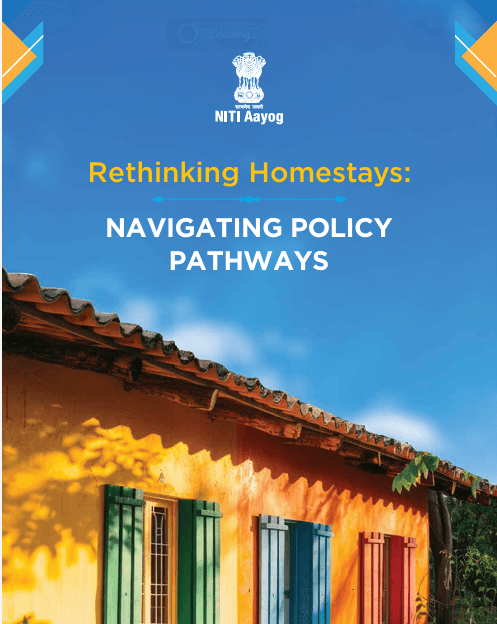
Report “Rethinking Homestays: Navigating Policy Pathways” released 22 Aug 2025, New Delhi, by NITI Aayog with IAMAI

Scope - strategic roadmap to strengthen India’s homestay & Bed-and-Breakfast ecosystem nationwide

Crafted through consultations with policymakers, hosts, aggregators; maps opportunities, challenges, policy gaps

Quick Facts for MCQs

Legal & Policy

  • Emphasises cooperative federalism for uniform yet flexible homestay regulations across states
  • Suggests streamlined licensing, safety, taxation norms to formalise informal stays
  • Recommends single-window digital portal for host compliance tracking

Institutional Structure

  • NITI composition covers full-time, part-time experts, ex-officio Union Ministers for cross-sector insights
  • Governing Council enables vertical Centre-State coordination on tourism reforms
  • Advisory status allows policy nudging without legislative mandate

Economic Angle

  • Homestays seen as low-capital driver for rural employment, heritage preservation, local supply chains
  • Report flags demand-supply mismatch, quality assurance, marketing gaps limiting sectoral GDP share
  • Advocates incentive packages, credit access for micro-entrepreneurs

Tech & Schemes

  • Calls for integration with Atal Innovation Mission startups offering booking, IoT safety, vernacular apps
  • Proposes data dashboards mirroring Aspirational District metrics to monitor homestay growth
  • Encourages SDG-aligned green certifications leveraging digital audits

Key Data Points

FeatureData-Point
Release date22 August 2025
Prepared byNITI Aayog + IAMAI
Sector focusHomestay & BnB tourism
NITI Aayog inception1 January 2015
Replaced bodyPlanning Commission
NITI ChairpersonPrime Minister of India
Governing CouncilCMs of states + LGs of UTs
Vice-Chairperson selectionAppointed by PM
Key missions handledAspirational Districts, Atal Innovation, SDG localisation
Nature of powersAdvisory yet highly influential

Related UPSC Prelims PYQs

ESE_GS, NDA_GAT 2025PYQ 1

निम्नलिखित में से कौन-सी एजेंसी ‘SAFE आवास : वित्तीय विकास के लिए श्रमिक आवास सुविधाएँ’ पर रिपोर्ट जारी करती है?

ESE_GS, NDA_GAT 2026PYQ 2

Which institution released the report titled “India’s Blue Economy: Strategy for Harnessing Deep-Sea and Offshore Fisheries”?

GS-3Infrastructure

5.Great Nicobar Mega Project (Island Infrastructure)

The Hindu
Illustration for Great Nicobar Mega Project (Island Infrastructure)

What & Where

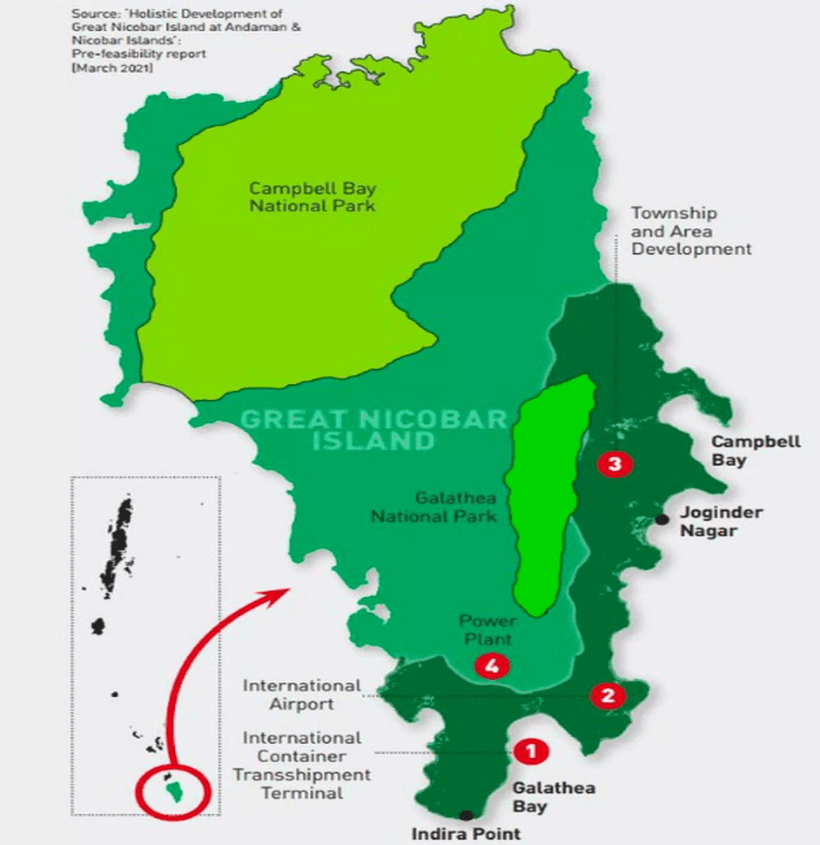
Great Nicobar Project: ₹72,000-crore multi-sector infrastructure plan on Great Nicobar Island, Andaman & Nicobar UT

Location: Galathea Bay and surrounding southern blocks of the island in the Bay of Bengal

Implementers: NITI Aayog & A&N Administration with strategic backing of Government of India

Quick Facts for MCQs

Legal & Policy

  • Conflict: PAT 1956 override powers clash with FRA 2006 consent requirement
  • Obligation: Forest rights (individual & community) must be recorded before non-forest diversion under FRA
  • Status: Tribal Council alleges rights settlement and Gram Sabha process bypassed

Security Dimension

  • Maritime: Port and airfield intended as forward logistics hub for Bay of Bengal & Malacca Straits
  • Dual-use: International airport planned for civil flights and military assets
  • Regional: Project aligns with Indo-Pacific strategic posture against expanding rival navies

Economic Angle

  • Transshipment: Target to capture global cargo currently moving via Colombo and Singapore
  • Employment: Township, port and ancillary services projected to create local jobs
  • Connectivity: Enhanced shipping lanes expected to integrate Indian coastline with Southeast Asian trade routes

Social Concerns

  • Displacement: 13,000 ha diversion risks impacting traditional livelihoods of hunting, fishing, horticulture
  • Representation: Tribal Council of Great Nicobar claims inadequate consultation and documentation of customary rights
  • Protection: FRA envisages community role in forest governance yet process reportedly sidelined

Environmental Impact

  • Biodiversity: Large-scale forest clearance in a globally recognised tropical rainforest hotspot
  • Carbon: Loss of dense canopy threatens island carbon sink and climate resilience
  • Habitat: Potential disturbance to endemic species and nesting leatherback turtles at Galathea Bay

Key Data Points

FeatureData-Point
Concept year2015
Statutory clearances year2022
Estimated cost₹72,000 crore
Forest diversion sought13,000 + ha
Core componentsTransshipment port, dual-use airport, gas power plant, integrated township
Key tribes affectedNicobarese, Shompen
Main governing lawsFRA 2006, PAT 1956
FRA consent neededGram Sabha approval post rights settlement
PAT authorityAdministrator can divert land in notified tribal areas
Strategic objectiveStrengthen India’s Indo-Pacific maritime security

Related UPSC Prelims PYQs

CDS_GK 2020PYQ 1

Recently islands of Andaman and Nicobar were connected with mainland by Submarine Optical Fibre Cable. Which one of the following islands was not connected initially?

GS-1EnvironmentQuick Bite

6.Ecuador-Peru Amazon Oil Opposition (Amazon Rainforest)

Down to Earth
Illustration for Ecuador-Peru Amazon Oil Opposition (Amazon Rainforest)

What & Where

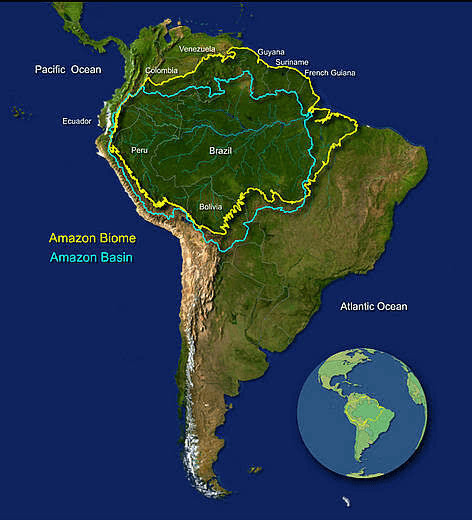
Amazon Rainforest – world’s largest tropical rainforest (~6.7 million sq km) across Amazon Basin, N-central South America.

Spreads over 9 nations; ~60 % in Brazil; bounded by Guiana Highlands, Andes, Brazilian Plateau, Atlantic.

Indigenous groups in Ecuador & Peru resist new oil deal citing deforestation, river pollution, biodiversity loss.

Quick Facts for MCQs

Environmental Impact

  • Deforestation risk intensified by proposed oil extraction in Ecuador-Peru Amazon blocks.
  • Potential river contamination threatens aquatic biodiversity and indigenous water sources.
  • Loss of carbon sink capacity undermines regional climate regulation.

Biodiversity Highlights

  • Habitat for Amazon river dolphins, myriad bird species, endemic flora.
  • Critical refuge for jaguars; population density highest globally.
  • High endemism makes ecosystem recovery slow after disturbance.

Regional Geography

  • Andes spine bisects Ecuador & Peru, feeding tributaries of Amazon River.
  • Humboldt Current influences Peru’s coastal climate; El Niño periodically disrupts rainfall.
  • Nazca Lines and Atacama edge illustrate Peru’s desert-rainforest contrast.

Key Data Points

FeatureData-Point
Amazon area≈ 6.7 million sq km
Rainforest share of global volume> 50 %
Earth surface covered≈ 1 %
Global wildlife supported≈ 10 %
Jaguars hosted here> 70 % world total
Amazon countriesBrazil, Bolivia, Colombia, Ecuador, Guyana, Peru, Suriname, Venezuela, French Guiana
Ecuador capitalQuito
Highest active volcano (Ecuador)Cotopaxi
Peru capitalLima
Lake TiticacaWorld’s highest navigable lake; Peru-Bolivia
Peru’s Amazon forest cover≈ 60 % national area
Atacama Desert locationSouthern Peru (extends into Chile)

Related UPSC Prelims PYQs

GS1 2024PYQ 1

One of the following regions has the world’s largest tropical peatland, which holds about three years worth of global carbon emissions from fossil fuels; and the possible destruction of which can exert detrimental effect on the global climate. Which one of the following denotes that region?

GS1 1999PYQ 2

The physical regions marked as 1, 2, 3 and 4 on the given map are respectively

GS-1Mapping

7.Algeria Physical Geography (North Africa Geography)

The Hindu

What & Where

Algeria; largest African nation; spans Mediterranean littoral to deep Sahara.

Maghreb location; borders Tunisia, Libya, Niger, Mali, Mauritania, Western Sahara, Morocco.

Landscape mixes Tell & Saharan Atlas ranges, Mitidja plain, and ~80 % Sahara desert.

Quick Facts for MCQs

Mountains & Highlands

  • Tell Atlas parallels coast, moderates climate, supports agriculture.
  • Saharan Atlas marks climatic divide, feeding seasonal wadis northward.
  • Ahaggar Mountains host volcanic massifs, include national summit Mount Tahat.

Deserts & Oases

  • Sahara terrain shows hammadas, ergs, scattered oases sustaining caravan routes.
  • M’zab Valley showcases fortified Ibadi settlements, UNESCO-listed.
  • Groundwater aquifers crucial for date-palm agriculture in desert belts.

Climate Variation

  • Mediterranean coast enjoys wet winters, dry summers favouring cereals, olives, citrus.
  • High plateau steppe features sharp diurnal swings, sparse rainfall, pastoral use.
  • Central Sahara faces extreme aridity; annual precipitation often below 50 mm.

Key Data Points

FeatureData-Point
CapitalAlgiers
CoastlineMediterranean Sea (north)
Africa area rank1st (largest)
Highest peakMount Tahat – 3,003 m
Main mountain beltsTell Atlas; Saharan Atlas
Desert coverage≈80 % (Sahara)
Fertile plainMitidja Plain
Longest wadi/riverChelif
UNESCO siteM’zab Valley
Permanent riversNone
Climate zonesMediterranean; Steppe; Arid Sahara
GS-3Editorial

8.Workplace Heat Stress Risks (Heat Stress Impact)

Down to Earth

What & Where

Heat stress – occupational physiological strain when environmental heat and metabolic load push core temperature beyond safe limit

Process – rising Wet Bulb Globe Temperature; every +1 °C above 20 °C slashes labour productivity 2–3 %

Geography – South Asia, Middle East, Sub-Saharan Africa worst; 40–50 °C peaks now seen even in Europe

Quick Facts for MCQs

Health Impact

  • Morbidity – heat stroke, kidney disease, cardiovascular collapse documented in brick-kiln, construction, farm sectors
  • Breach – one-third workers already exceed 38 °C core temperature during shifts
  • Mortality – fatalities reported in Europe 2023 heatwaves despite temperate latitude

Economic Angle

  • GDP drag – developing economies face measurable shrinkage from labour hour losses
  • Productivity – each lost workday undermines crop cycles, factory output, wages
  • Job displacement – automation and mechanisation touted to offset human exposure

Legal & Policy

  • Regulation – heat-index based work-hour caps, paid rest, hydration mandated in Qatar, US OSHA guidance
  • Compensation gap – surge in occupational claims risks overwhelming labour courts
  • Integration – experts urge inclusion of heat stress in ILO conventions, COP adaptation finance

Technology & Infrastructure

  • Cooling – ventilated shelters, low-cost fans piloted in Bangladesh garments cut fatigue markers
  • Shade – temporary canopies and reflective roofing reduce radiant load on outdoor crews
  • Hydration – “Water-Rest-Shade” protocols institutionalise fixed drinking intervals

Climate Justice

  • Inequity – low-emitter nations like Bangladesh bear disproportionate health and income losses
  • Migrant risk – Gulf construction deaths highlight safeguard gaps for temporary labour
  • Gendered burden – women in informal agriculture face compounded heat and caregiving responsibilities

Key Data Points

FeatureData-Point
ReportWHO–WMO Climate Change & Workplace Heat Stress 2025
2024 mean temperature1.45 °C above pre-industrial
Population under heat stress30 % of world
Workers exposed>4 billion
Productivity loss per +1 °C WBGT >20 °C2–3 %
Extra penalty from direct sun+2–3 °C WBGT equivalent
Annual heat-linked injuries22.85 million
Annual worker deaths18 970
DALYs lost each year2.09 million
India jobs at risk by 203034 million (agri + construction)
WHO 1969 core-temp limit≤38 °C during 8-hr shift
Typical peak temperatures40–50 °C daytime
GS-3Environment

9.Expanded Sundarbans Tiger Reserve (Mangrove Tiger Habitat)

Down to Earth
Illustration for Expanded Sundarbans Tiger Reserve (Mangrove Tiger Habitat)

What & Where

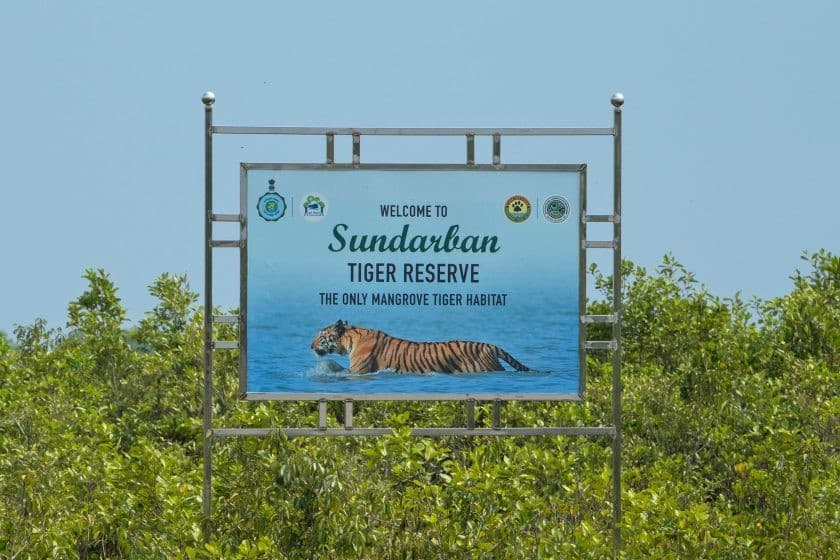
Sundarbans Tiger Reserve: UNESCO World Heritage mangrove–tiger landscape in South 24 Parganas, West Bengal

Expanded 2024 to 3,629.57 sq km, now India’s second-largest tiger reserve

Forms Indian part of transboundary Sundarbans adjoining Bangladesh

Quick Facts for MCQs

Legal & Policy

  • NBWL approval elevated reserve from 7th to 2nd largest nationally
  • Falls under Project Tiger network; administered by West Bengal Forest Dept
  • Multiple international tags: UNESCO World Heritage, Biosphere, Ramsar augment legal protection

Biodiversity Highlights

  • Mangrove‐adapted species include estuarine crocodile, fishing cat, water monitor lizard, olive ridley turtle
  • Rich ichthyofauna; Hilsa vital for regional fisheries
  • Pneumatophore‐bearing mangroves enable saline, tidal resilience

Geophysical Importance

  • Dense mangroves dissipate storm surges, reducing cyclone Amphan-type damages
  • Estuarine deltaic setting fosters unique saline-brackish nutrient cycles
  • Human interface: traditional honey collectors and fisherfolk depend on ecosystem services

Key Data Points

FeatureData-Point
Latest notified addition1,044.68 sq km approved by NBWL
Total area post-expansion3,629.57 sq km
National size rank2nd largest tiger reserve
Tiger-reserve declaration1973 (Project Tiger Phase-I)
Biosphere Reserve year1989
UNESCO Biosphere tag2001
Ramsar designation2019
Dominant floraSundari, Gewa, Golpata mangroves
Iconic faunaSwimming Royal Bengal Tiger
Unique habitat claimWorld’s only mangrove tiger habitat
Cyclone protection roleNatural barrier for coastal West Bengal
Transboundary partnerBangladesh Sundarbans Reserve Forest

Related UPSC Prelims PYQs

GS1 2012PYQ 1

Consider the following protected areas:

GS1 2020PYQ 2

Among the following Tiger Reserves, which one has the largest area under “Critical Tiger Habitat”?

GS-3Species

10.Saltwater Crocodile Population Rise (Saltwater Crocodile)

The Hindu

What & Where

Saltwater crocodile: hypercarnivorous apex predator inhabiting estuarine creeks of Sundarban Biosphere Reserve (SBR).

Sundarbans: largest mangrove delta of Ganga-Brahmaputra-Meghna, straddling Bay of Bengal; 40 % area in India.

Ecotone: freshwater swamps, intertidal mangroves, saline forests recognised by UNESCO (1987) and Ramsar (2019).

Quick Facts for MCQs

Biodiversity Role

  • Apex predator scavenges carcasses, curbing disease spread and recycling nutrients.
  • Population increase signals healthier food web dynamics.

Habitat Traits

  • Mangrove creeks provide cover, brackish water, abundant prey.
  • Seasonal salinity flux dictates nesting and juvenile survival.

Global Recognition

  • UNESCO World Heritage tags: India 1987, Bangladesh 1997.
  • Ramsar wetland status awarded 2019, enhancing international conservation funding.

Key Data Points

FeatureData-Point
Estimated population (2025)220 – 242 individuals
Preferred creek width< 180 m at high tide
Diet share from animals> 70 % (hypercarnivore)
Salinity toleranceBroad in winter; rising salinity threatens
Indian share of Sundarbans≈ 40 % of total area

Related UPSC Prelims PYQs

GS1 2008PYQ 1

Consider the following statements:

GS1 2003PYQ 2

Consider the following animals of India:

GS-3Editorial

11.Deep-Tech Governance Reforms (Deep-Tech Ecosystem)

Indian Express

What & Where

Deep-tech ambition: Indian push for self-reliant semiconductors, AI, quantum, aerospace under Viksit Bharat 2047 vision.

Governance locus: Colonial-era bureaucracy, regulations, judiciary cited as nationwide innovation constraints.

Core clusters: Bengaluru-Hyderabad-Pune R&D hubs; Gujarat, UP, Bengaluru–Chennai corridor targeted for fabs & corridors.

Quick Facts for MCQs

Tech Achievements

  • UPI, IndiaStack exported to Singapore, UAE, France indicating digital public good diplomacy.
  • Nvidia, IBM, Microsoft operate large Indian R&D centres validating talent depth.
  • Drone Rules 2021 partially liberalised unmanned aviation licensing.

Governance Bottlenecks

  • Bureaucracy retains Westminster generalist cadre; limited lateral entry despite ARC recommendation.
  • Compliance overload: Deregulation Commission yet to prune 39k obligations hindering start-ups.
  • Judicial backlog and weak IP enforcement deter venture capital, prolong contract disputes.

Reform Pathways

  • Civil-service overhaul: domain-based UPSC, enforceable Public Service Code, wider lateral hiring.
  • Risk-based regulation: expand fintech-style sandboxes to AI, biotech; create single-window deep-tech approvals.
  • Federal incentives: states offered fiscal support exemplified by Gujarat Micron fab, UP semiconductor policy.

Key Data Points

FeatureData-Point
Monthly UPI volume14 billion transactions (NPCI 2025)
Smartphone users800 million+
Average mobile data cost≈ ₹10 per GB
Semiconductor import bill₹1.2 lakh crore in 2023-24
India share in global AI patents< 5 % (WIPO 2024)
Compliances across sectors39,000 + (DPIIT)
Pending court cases5 crore + (SC e-Committee 2025)
Contract enforcement time1,445 days (World Bank 2020)
Annual STEM student outflow2 lakh + (MEA)
Start-up ecosystem rank3rd globally; 100 + unicorns

Related UPSC Prelims PYQs

CDS_GK, ESE_GS 2026PYQ 1

Which Ministry released the India AI Governance Guidelines in 2025?

CDS_GK, ESE_GS 2025PYQ 2

भारत में नवाचार तथा अनुसंधान और विकास के बारे में निम्नलिखित कथनों पर विचार कीजिए :

GS-2Misc

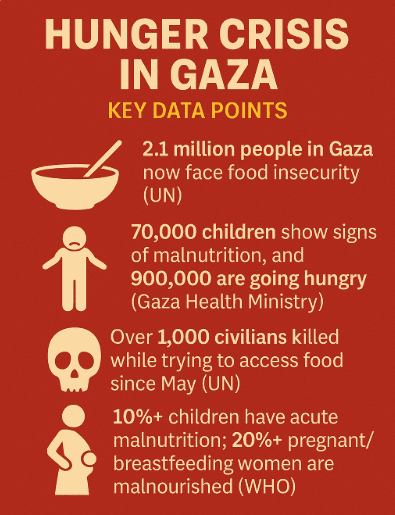
12.UN Gaza Famine Declaration (UN Famine Declaration)

BBC
Illustration for UN Gaza Famine Declaration (UN Famine Declaration)

What & Where

Famine declaration: IPC Phase-5 classification signalling catastrophic food insecurity.

Triggered when ≥20 % households extreme shortage, >30 % children acute malnutrition, mortality >2/10,000/day.

Latest famine in Gaza Strip (2025); earlier Somalia, South Sudan, Tigray-Ethiopia, Sudan; Yemen at sustained risk.

Quick Facts for MCQs

Declaration Process

  • Data-collection: agencies gather food security, nutrition, mortality evidence on ground
  • Technical-review: IPC Global Support Unit scrutinises datasets for phase scoring
  • Validation: FAO, WFP, UNICEF, OCHA endorse; UN-IPC jointly announce

Significance

  • Mobilisation: declaration unlocks emergency funding, galvanises donors and media attention
  • Legal-pressure: strengthens calls for ceasefires, humanitarian corridors under IHL obligations
  • Accountability: heightens scrutiny on obstructing state/non-state actors

International Examples

  • Somalia: 2011 & 2022 drought-conflict famines
  • South Sudan: 2017 civil war displacement triggered famine
  • Gaza: 2025 famine driven by aid obstruction amid conflict with Israel

Key Data Points

FeatureData-Point
Framework usedIntegrated Food Security Phase Classification (IPC)
Phase for faminePhase 5
Household shortage threshold≥20 %
Child acute malnutrition>30 %
Mortality threshold>2 deaths/10,000/day
UN validation agenciesFAO, WFP, UNICEF, OCHA

Related UPSC Prelims PYQs

GEO_GS 2022PYQ 1

The United Nations has recently warned that 'famine-like conditions have been created by climate change' in which one of the following countries?

GS-2Scheme

13.Nasha Mukt Bharat Abhiyaan Review (Nasha Mukt Abhiyaan)

PIB
Illustration for Nasha Mukt Bharat Abhiyaan Review (Nasha Mukt Abhiyaan)

What & Where

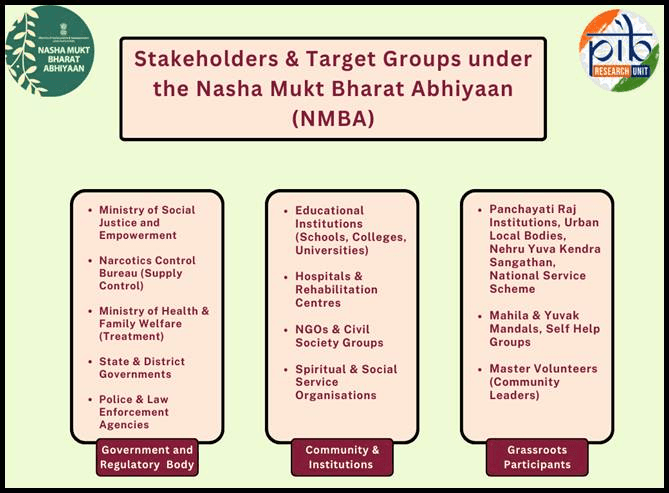
Nasha Mukt Bharat Abhiyaan: 2020 nationwide Social Justice campaign for substance-use awareness, counselling, treatment

Three-pronged model: supply control, demand reduction, medical treatment

Coverage: launched in 272 vulnerable districts, now spans all Indian districts

Quick Facts for MCQs

Legal & Policy

  • Legislation: NDPS 1985 and PITNDPS 1988 enforcement needs stronger interdiction, resources, inter-agency coordination
  • States: Uttar Pradesh, Maharashtra, Punjab topped NDPS FIRs during 2019-21 period
  • Plan: National Action Plan for Drug Demand Reduction guides prevention and rehabilitation activities

Tech & Schemes

  • Digital: Abhiyaan uses website, app, social media, geo-tagging for real-time monitoring and outreach
  • Surveillance: Proposed AI, drones, big-data analytics for border control and supply chain interception
  • MoUs: Collaborations with Art of Living, Brahma Kumaris, ISKCON, others for community campaigns

Social Concerns

  • Prevalence: 10 crore narcotics-affected; 16 crore alcohol users; 3.1 crore cannabis consumers aged 10-75
  • Stigma: Social exclusion hampers rehabilitation demand, particularly among rural youth
  • Volunteers: 20,000 master volunteers drive campus pledges, rallies, door-to-door counselling

Security Dimension

  • Geography: Golden Crescent impacts northwest borders; Golden Triangle routes enter via Northeast
  • Method: Darknet and crypto payments enabling new psychoactive substance circulation
  • Countermeasure: Border policing, alternative livelihood schemes for illicit poppy farmers, e.g., Jharkhand program

Key Data Points

FeatureData-Point
Launch date15 Aug 2020
Nodal ministrySocial Justice & Empowerment
Initial district focus272
Present coverageAll districts
People sensitised18.10 crore+
Institutions reached4.85 lakh+
Students mobilised1.67 crore+
Master volunteers20,000+
Key survey year2019 National Substance Use
Two drug regionsGolden Crescent, Golden Triangle
GS-2Scheme

14.Kerala Achieves Full Digital Literacy (Digi Keralam Project)

Indian Express

What & Where

Digital literacy: capability to access, understand, create, communicate via digital tools in daily life.

Kerala, via Digi Keralam, declared India’s first fully digitally literate state (Aug 2025).

Core processes: youth–led household training, K-SMART platform, follow-up to 2002 Akshaya project.

Quick Facts for MCQs

State Initiative

  • Digi Keralam used 3-tier local bodies to map and train every household.
  • Volunteers equipped with tablets, delivered 2-hour modules and service-access demos.
  • Post-training assessment uploaded to K-SMART for certification.

National Schemes

  • NDLM & DISHA closed after exceeding targets; merged learnings into PMGDISHA.
  • PMGDISHA reimburses CSCs ₹500 per certified rural trainee.
  • BharatNet backhauls connectivity for PMGDISHA centres.

Statistical Snapshot

  • Rural-urban digital literacy gap: 36 percentage points.
  • Kerala literacy baseline pre-Digi Keralam: 87 % households with at least one net-user.
  • Each Akshaya centre expected to serve 1,000 families.

Socio-Demographic Focus

  • Priority groups: elderly, women homemakers, fisherfolk, SC/ST hamlets.
  • Female participation in Digi Keralam training exceeded 60 %.
  • Sign-language modules piloted for persons with hearing impairment.

Tech Platform

  • K-SMART integrates e-district, welfare pensions, utility payments in single sign-on.
  • Real-time dashboard tracks trainee count, geography, gender.
  • AI chatbot in Malayalam offers 24×7 digital helpdesk.

Key Data Points

FeatureData-Point
Declaration year2025
First fully digital-literate stateKerala
Digi Keralam launch focusSeniors, homemakers, digitally excluded
K-SMART full formKerala Solutions for Managing Administrative Reformation & Transformation
India household digital literacy38 % overall; 61 % urban; 25 % rural
NDLM & DISHA combined target52.50 lakh persons
NDLM & DISHA trained53.67 lakh (42 % rural)
PMGDISHA training till Mar 20246.39 crore individuals
Akshaya project launch2002 by President A.P.J. Abdul Kalam

Related UPSC Prelims PYQs

GS1 1999PYQ 1

The population growth rate in Kerala is the lowest among major Indian states. Which one of the following is the most widely accepted reason for this?

GS1 2006PYQ 2

Consider the following statements :

Ready to practice?

Test your knowledge with our UPSC test series.

Start Free Trial