Editorial
1.Pre-1950 constitutional draft visions (Pre-1950 Drafts)
The Hindu1895 Bill · M.N. Roy 1944 draft · popular sovereignty
What & Where
Pre-1950 Indian constitutional drafts proposing alternate post-colonial governance models
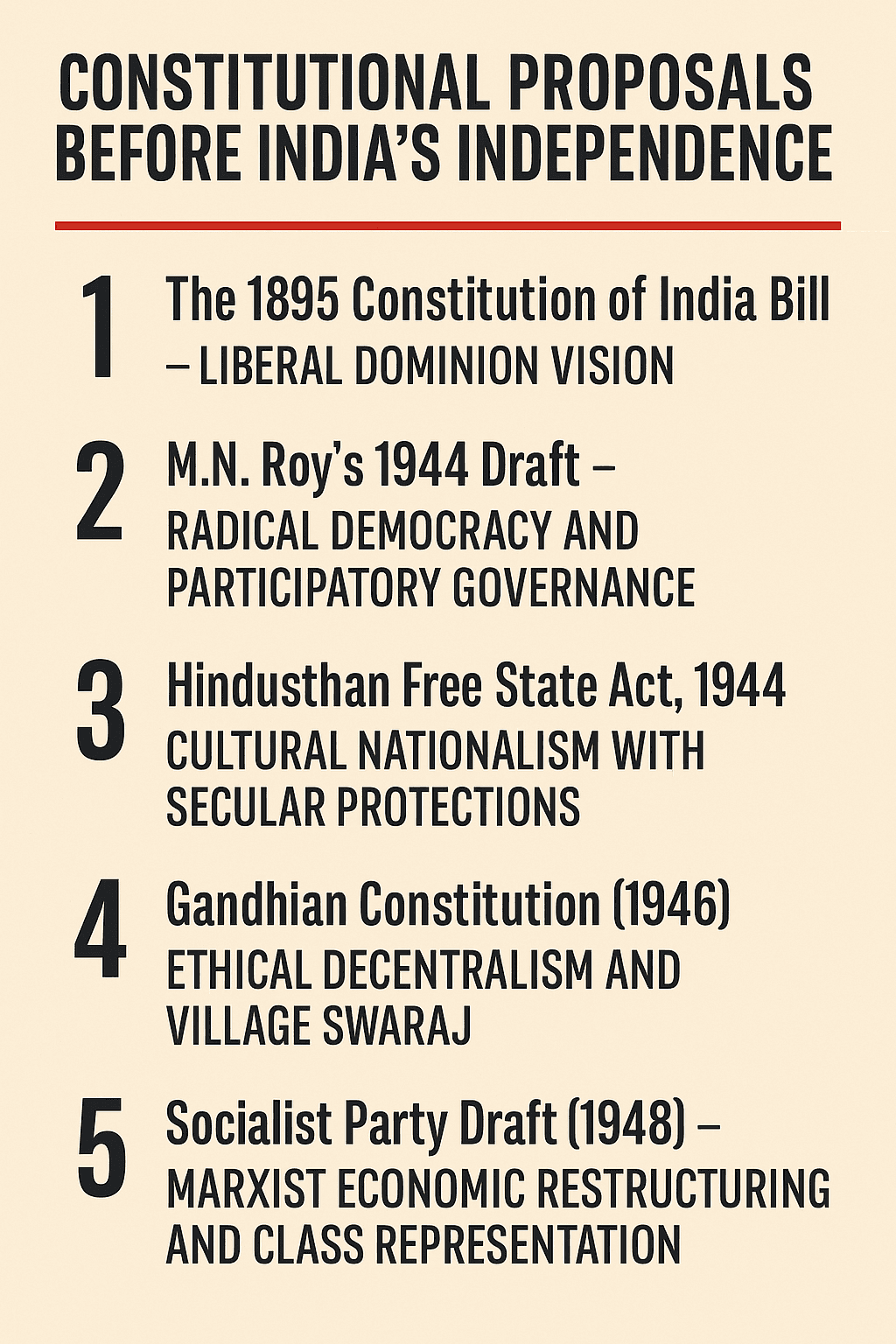
Five key texts: 1895 Constitution Bill, 1944 Roy Draft, 1944 Hindusthan Free State Act, 1946 Gandhian Constitution, 1948 Socialist Party Draft
All India centric; visions span Dominion liberalism, participatory radicalism, cultural nationalism, village swaraj, Marxist socialism
Quick Facts for MCQs
Ideological Spectrum
- Liberal-legal to Marxist; five drafts cover widest ideological arc in nationalist debate
- Each linked to specific party: early Congress, Radical Democratic Party, Hindu Mahasabha, Gandhians, Socialist Party
- Showcased constitutional imagination before Constituent Assembly
Sovereignty Placement
- Legislature centric: 1895, Socialist Party drafts emphasised parliamentary supremacy
- People centric: Roy Draft empowered citizens committees, right to revolt
- Moral-community centric: Gandhian text derived authority from village ethics
Rights Architecture
- Civil-liberty heavy: 1895, Roy; latter added justiciable socio-economic rights
- Class-justice lens: Socialist Draft prioritised material equity over procedure
- Duty first: Gandhian model stressed communal obligations, spiritual values
Economic Vision
- Minimalist agrarian: Gandhian trusteeship, khadi, anti-industrial stance
- Democratic socialism: Roy backed public control with enforceable welfare rights
- Marxist planning: Socialist Draft sought worker-peasant control, land redistribution
Influence on 1950 Constitution
- 1895 informed parliamentary form, rule of law
- Roy inspired Fundamental Rights, Directive Principles, linguistic federal hints
- Gandhian ideals echoed in Panchayati Raj and ethical state discourse
Key Data Points
| Feature | Data-Point |
|---|---|
| Earliest draft | Constitution of India Bill 1895 |
| Articles in 1895 Bill | 110 |
| Roy Draft ideology | Radical humanism, participatory democracy |
| Hindusthan Free State model | Unitary structure; provinces could secede |
| Gandhian core unit | Self-reliant village republic |
| Socialist Draft economy | Nationalisation of land & industry |
| Common legacy | Rights chapter, DPSP, Panchayati Raj ideas |
Related UPSC Prelims PYQs
GS1 1996PYQ 1
Which one of the following first mooted the idea of a constituent assembly to frame a constitution for India?
GS1 2012PYQ 2
The distribution of powers between the Centre and the States in the Indian Constitution is based on the scheme provided in the: