UPSC Current Affairs

13 topicsGS-1: 2GS-2: 3GS-3: 8
0/13 done
GS-2Polity

1.Kolhapuri Chappal GI Controversy (Geographical Indications)

The Hindu
Illustration for Kolhapuri Chappal GI Controversy (Geographical Indications)

What & Where

Geographical Indication (GI): IP tag linking product qualities/reputation to a specific origin

India’s regime: Geographical Indications of Goods (Registration & Protection) Act 1999, operational 2003 under TRIPS

Showcase row: Kolhapuri chappal (Maharashtra–Karnataka) GI 2019; Prada displayed look-alike footwear, Milan, June 2025

Quick Facts for MCQs

Legal & Policy

  • Provision: Act bars unauthorised use; civil, criminal remedies including fines, imprisonment
  • Alignment: Complies with TRIPS Article 22–24 on geographical indications
  • Limitation: Absence of multilateral GI treaty enables foreign mimicry without penalty

Economic Angle

  • Premium: Authentic GI goods fetch higher prices, boosting rural artisan/farmer incomes
  • Spill-overs: GI branding drives tourism; examples Darjeeling Tea estates, Mysore silk markets
  • Self-reliance: Supports Aatmanirbhar Bharat by valorising indigenous supply chains

International Examples

  • Basmati: Ricetec US patent attempt defeated via prior-art evidence, 1997
  • Turmeric & Neem: CSIR, Ayurveda data revoked US/EU patents in 1995 & 2000
  • Fashion: Prada Kolhapuri look-alike spotlights cultural appropriation in luxury sector

Gaps & Challenges

  • Database: No global searchable GI registry complicates brand due-diligence
  • Cost: Foreign GI filing lengthy, expensive for small producer groups
  • Awareness: Many artisans unaware of enforcement pathways, weakening deterrence

Key Data Points

FeatureData-Point
Governing lawGI Act 1999 (in force 2003)
Registry locationChennai, under CGPDTM
Protection term10 years, unlimited renewals
Ownership modelCommunity/public property, non-transferable
International reachTerritorial only; no automatic overseas cover
Prada incidentSpring/Summer 2026 line, shown June 2025
Misappropriation precedentsBasmati 1997, Turmeric 1995, Neem 2000

Related UPSC Prelims PYQs

GS1 2010PYQ 1

In order to comply with TRIPS Agreement, India enacted the Geographical Indications of Goods (Registration & Protection) Act, 1999. The difference/differences between a “Trade Mark” and a Geographical Indication is/are
GS-3Economy

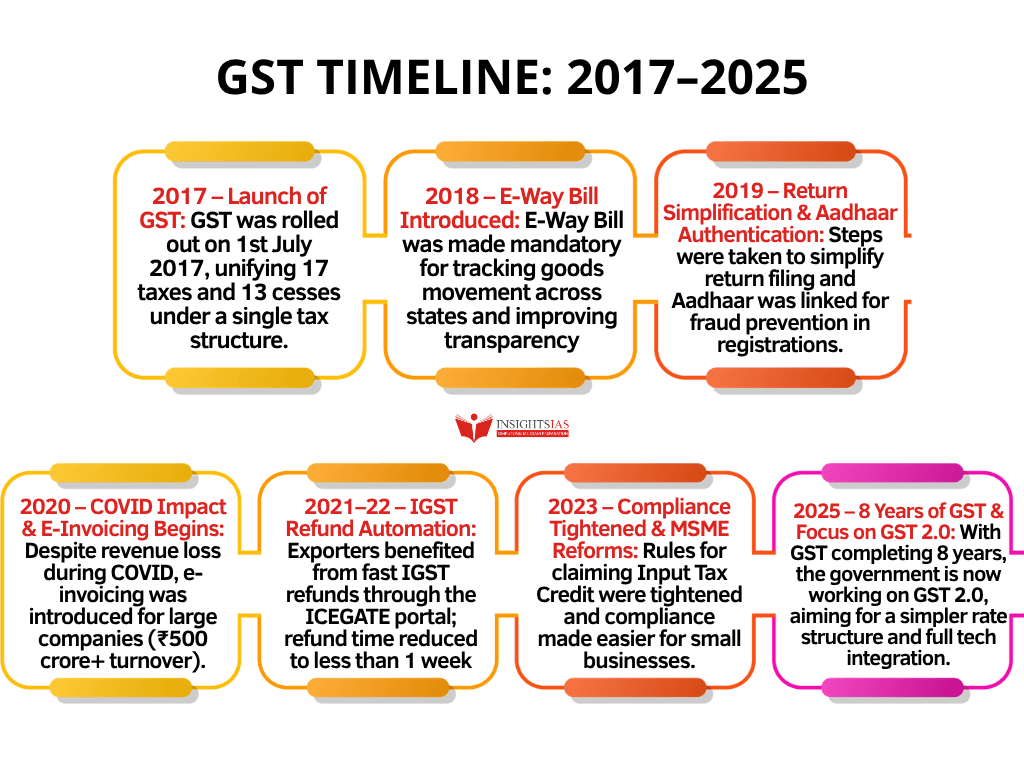
2.Eight Years of GST (GST Implementation)

Business Standard
Illustration for Eight Years of GST (GST Implementation)

What & Where

GST: comprehensive, multi-stage, destination-based indirect tax replacing excise, VAT, service tax in India

Key processes: Dual levy CGST+SGST; seamless input-tax credit; zero-rated exports via refund or LUT

Nationwide coverage: rolled out 1 July 2017 under Constitution 101st Amendment Act 2016

Quick Facts for MCQs

Economic Angle

  • Revenue: average ₹1.65 lakh crore monthly FY25; record ₹2.10 lakh crore April 2025
  • Taxbase: registrations widened to >1.45 crore taxpayers by 2025
  • Logistics: unified GST reduced inter-state barriers and cascading taxes

Tech & Schemes

  • GSTN: digital portal for registration, return filing, credit matching
  • ICEGATE: customs automation clears IGST export refunds within one week; ₹1.18 lakh crore FY25
  • Integration plan: real-time data sharing between GSTN and Customs proposed

Challenges

  • Refunds: GST-portal claims may linger 90 days, straining exporter liquidity
  • Systems: mismatch between Customs and GST databases delays cross-verification
  • Compliance: frequent notifications, portal glitches, complex reconciliations burden MSMEs

Reform Path

  • Automation: extend quick workflows to all refund categories, not only IGST
  • MSME relief: graded reporting and single-page returns recommended
  • GST 2.0: rationalise rates, broaden base to fuel/alcohol, bolster appellate capacity

Key Data Points

FeatureData-Point
GST launch date1 July 2017
Constitutional base101st Amendment Act 2016
Active taxpayers>1.45 crore by 2025
Avg monthly collection FY25₹1.65 lakh crore
Record monthly collection₹2.10 lakh crore in Apr 2025
IGST refund time (automated)≤7 days
IGST refunds issued FY25₹1.18 lakh crore
Officer-handled refund time≤90 days

Related UPSC Prelims PYQs

CDS_GK, GS1 2017PYQ 1

वस्तु एवं सेवा कर (Goods and Services Tax/GST) के क्रियान्वयन हेतु निम्नलिखित संभावित लाभ क्या है/हैं ?

CDS_GK, GS1 2021PYQ 2

Following the Constitution (One Hundred and First Amendment) Act, 2016, the Parliament of India enacted quite a few GST Acts in the year 2017. Which one of the following does not fall in this category?

GS-3EconomyQuick Bite

3.National Turmeric Board Launch (Turmeric Value Chain)

The Hindu

What & Where

National Turmeric Board: new statutory body under Commerce & Industry to integrate turmeric value chain from farm to export.

Key functions: packaging, branding, marketing, GI-promotion, farmer training, middlemen reduction.

Geography: inaugurated at Nizamabad (Telangana); crop grown in 20+ Indian states, core belts Maharashtra-Telangana-Karnataka-Tamil Nadu.

Quick Facts for MCQs

Legal & Policy

  • Board launched 2025 by Union Home Minister; statutory backing via Commerce Ministry.
  • Mandate covers entire value chain, organic & GI promotion, capacity building.
  • Turmeric oversight shifted from multi-spice Spices Board to exclusive board.

Economic Angle

  • India dominates with 75 % production and 62 % exports globally.
  • Export earnings USD 207 mn (2022-23); roadmap targets USD 1 bn by 2030.
  • Principal markets: Bangladesh, UAE, USA, Malaysia driving demand.

Agro-Climate

  • Crop thrives at 20-30 °C, >1500 mm rainfall, porous loam soils.
  • Cultivation spans 20+ states; Western & Southern belts lead output.
  • GI varieties Lakadong, Kandhamal, Erode valued for high curcumin content.

Key Data Points

FeatureData-Point
Plant part usedUnderground rhizome
Botanical familyZingiberaceae
Active compoundCurcumin
Major producersMH, TS, KA, TN
Varieties grown30 +
Cultivating states20 +
Optimal temperature20-30 °C
Required rainfall> 1500 mm/yr
Preferred soilWell-drained sandy/clay loam
India’s 2022-23 production share75 % of world
India’s 2022-23 export share62 % of world
FY 23 export valueUSD 207.45 million
2030 export targetUSD 1 billion
Top importersBangladesh, UAE, USA, Malaysia
GI-tagged typesLakadong, Kandhamal, Erode
Parent ministry of BoardCommerce & Industry
Previous nodal bodySpices Board

Related UPSC Prelims PYQs

GS1 2025PYQ 1

Consider the following statements about turmeric during the year 2022-23:

GS-1HistoryQuick Bite

4.Hul Diwas Commemoration (Santhal Uprising)

PIB

What & Where

Santhal Hul: 1855 revolt; Rajmahal Hills, Damin-i-Koh; first organised tribal war vs British

Revolt process: Sidhu-Kanhu rallied 32 communities against land grab, bonded labour, zamindari exploitation

Geography spread: Present Santhal Pargana, Jharkhand; echoes across Bengal, Bihar, Odisha tribal belts

Quick Facts for MCQs

Historical Timeline

  • 1770 famine pushed Santhal migration from Birbhum-Manbhum to Damin-i-Koh
  • 1855 Hul preceded 1857 Revolt, inspiring future anti-colonial mass actions

Legal & Policy

  • 1876 SPT Act blocks Adivasi land alienation to outsiders within Santhal Parganas
  • 1908 CNT Act limits Adivasi, Dalit land sale; intra-caste transfers need Collector nod

Tribal Culture

  • Festivals: Sohrai, Baha, Karam celebrate cattle, flowers, crops; reflect agro-based livelihood
  • Language: Santhali in Eighth Schedule; written in indigenous Ol Chiki script

Key Data Points

FeatureData-Point
Date of launch30 Jun 1855
Settlement trigger1832 Damin-i-Koh
Core areaRajmahal Hills, Jharkhand
Lead siblingsSidhu, Kanhu Murmu
Support leadersChand, Bhairav, Phulo, Jhano
United communities32 castes/ethnic groups
Outcome ActSanthal Parganas Tenancy Act 1876
Santhal tribe rank3rd largest Scheduled Tribe

Related UPSC Prelims PYQs

GEO_GS, GS1 2020PYQ 1

Which one of the following groups of movements/revolts/rebellions/riots is in chronological order (starting from the earliest)?

GEO_GS, GS1 2018PYQ 2

After the Santhal Uprising subsided, what was/were the measure/measures taken by the colonial government?

GS-1Mapping

5.Ghana Geographic Profile (West Africa Mapping)

DD News

What & Where

Ghana: West-African nation on Gulf of Guinea; capital Accra; borders Côte d’Ivoire, Burkina Faso, Togo, Atlantic Ocean.

Terrain: dissected Precambrian peneplains; uplands include Akwapim-Togo Ranges, Kwahu Plateau, Gambaga Scarp; peak — Mt Afadjato 885 m.

Hydrology: Volta River system plus Lake Volta (8,500 sq km, Akosombo Dam) dominates drainage and inland navigation.

Quick Facts for MCQs

Physical Geography

  • Precambrian peneplains rarely exceed 900 m, giving generally low-relief landscapes.
  • Akwapim-Togo Ranges run north-south along eastern border, sheltering coastal plains.
  • Kwahu Plateau acts as climatic divide between forest south and savanna north.

Hydrology

  • Lake Volta ranks among world’s largest artificial lakes, crucial for power, transport, irrigation.
  • Black, White Volta merge near Yeji before flowing to Akosombo reservoir.
  • Secondary rivers Pra, Ankobra, Tano drain southwestern forest belt.

Soil Profile

  • Lateritic soils widespread in humid forest and derived savanna; moderate fertility.
  • Ochrosols: well-drained, support cocoa, oil-palm along forested south-central belt.
  • Akuse clays enable irrigated rice schemes near lower Volta; Vleisols dominate drier coastal savanna.

Diplomatic Context

  • Upcoming visit: first Indian PM state visit to Ghana in over 30 years.
  • Engagement expected to bolster energy, mining, digital, and development cooperation agendas.

Key Data Points

FeatureData-Point
CapitalAccra
Regional settingGulf of Guinea, West Africa
NeighboursCôte d’Ivoire, Burkina Faso, Togo
Highest peakMount Afadjato – 885 m
Key uplandKwahu Plateau
Major escarpmentGambaga Scarp
Largest lakeLake Volta – 8,500 sq km
Main damAkosombo Dam
Core river systemVolta with Black, White Volta & Oti
Dominant soilsLateritic, Ochrosols, Akuse Clays, Vleisols
GS-3Species

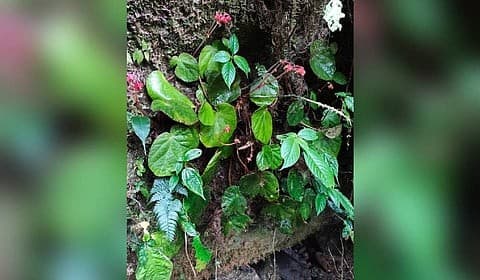
6.Begonia nyishiorum Discovery (Endemic Begonia)

New Indian Express
Illustration for Begonia nyishiorum Discovery (Endemic Begonia)

What & Where

Begonia nyishiorum – new Begoniaceae species, named after Nyishi tribe, described from Eastern Himalaya

Endemic to two high-altitude forest patches, East Kameng district, Arunachal Pradesh

Grows on moist, shaded mountain slopes at 1 500–3 000 m, often under early-winter snow cover

Quick Facts for MCQs

Morphology

  • Petiole: light-green stalk densely fringed with crimson, unprecedented in Asian begonias
  • Indumentum: thick hair layer aiding cold tolerance
  • Growth form: succulent herb adapted to steep, rocky slopes

Habitat & Range

  • Micro-sites: pristine, community-protected mixed forests, minimal human disturbance
  • Climate: sub-zero winters, high rainfall monsoon, prolonged moisture retention
  • Distribution: only two known contiguous patches, making population extremely localized

Conservation Significance

  • Indicator: underscores Eastern Himalaya as biodiversity hotspot, plant speciation cradle
  • Priority: limited range heightens vulnerability to logging, road projects, climate shifts
  • Recognition: adds to India’s tally of newly described taxa, boosting global botanical profile

Key Data Points

FeatureData-Point
Taxonomic familyBegoniaceae
EndemismExclusive to Arunachal Pradesh
Elevational range1 500 m – 3 000 m
District locatedEast Kameng
Unique traitCrimson-fringed petioles
Indumentum statusDensest hair cover among > 2 150 global begonias
Naming honourNyishi tribe
GS-3S&T

7.Kombucha Gut Benefits (Probiotic Beverage)

The Hindu

What & Where

Kombucha = fermented, lightly effervescent drink from sweetened black/green tea using SCOBY (symbiotic bacteria-yeast).

Classified functional food; consumed for probiotic, metabolic and immune support.

Marketed globally, incl. India’s health-beverage segment.

Quick Facts for MCQs

Composition & Fermentation

  • SCOBY metabolises sucrose → organic acids, CO₂, small ethanol; develops tangy flavour.
  • Polyphenol retention higher with green-tea base versus black-tea base.
  • Shelf stability varies; refrigeration slows continued fermentation.

Gut Microbiome Effects

  • Microbiota shift linked to improved insulin sensitivity, lower inflammation markers.
  • Reduced fungal dysbiosis complements bacterial rebalancing.
  • Phenolic-driven mucus layer strengthens intestinal barrier integrity.

Indian Context

  • Sold in urban retail & cafés as ready-to-drink functional beverage.
  • Labels emphasise probiotic count; FSSAI yet to frame kombucha-specific standards.
  • Adaptation of SCOBY to local microbes may alter flavour and health impact.

Key Data Points

FeatureData-Point
Fermenting cultureSCOBY (Symbiotic Culture of Bacteria & Yeast)
Core ingredientsSweetened black or green tea
Key bioactivesProbiotics, polyphenols, organic acids, vitamins, antioxidants
Carbonation natureNaturally effervescent
Alcohol presenceTrace amounts from fermentation
Beneficial bacteria ↑Akkermansiaceae, Prevotellaceae
Harmful bacteria ↓Ruminococcus gnavus, Dorea
Fungi reducedRhodotorula, Exophiala
Gut barrier aidPhenolics stimulate mucus secretion
Study sourceThe Journal of Nutrition, obesity cohort

Related UPSC Prelims PYQs

GS1 2022PYQ 1

Consider the following statements in respect of probiotics :

GS-3S&T

8.GOSAT-GW Climate Satellite (Climate Satellite)

WION
Illustration for GOSAT-GW Climate Satellite (Climate Satellite)

What & Where

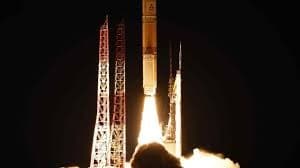
GOSAT-GW: third Japanese satellite monitoring global greenhouse gases and water-cycle variables

Launched by H-2A liquid-fuel rocket from Tanegashima Space Centre, Kagoshima Prefecture, Japan

Operated by JAXA with Mitsubishi Heavy Industries; positioned in low Earth orbit for worldwide climate observation

Quick Facts for MCQs

Tech & Schemes

  • Dual-sensor design captures greenhouse gas and hydrological data concurrently
  • High-resolution optics enhance spatial and temporal climate mapping accuracy
  • Planned shift to cost-efficient H3 launcher for future missions

Environmental Impact

  • Continuous CO₂ and CH₄ mapping pinpoints emission hotspots for mitigation
  • Sea-surface temperature and cloud data refine predictive climate models
  • Outputs aid Paris Agreement global stock-take evaluations

International Cooperation

  • Open-access policy boosts transparency under UNFCCC frameworks
  • Real-time streams scheduled for NOAA and other partners
  • Mission strengthens multilateral climate science collaboration

Space Industry

  • 50 successful H-2A launches highlight Japanese launch reliability
  • Retirement of H-2A pivots market toward newer H3 variant
  • Demonstrated capability reinforces Japan’s autonomous environmental surveillance

Key Data Points

FeatureData-Point
Acronym expansionGlobal Observing Satellite for Greenhouse Gases and Water Cycle
Series positionThird in GOSAT lineup
DeveloperJapan Aerospace Exploration Agency (JAXA)
Launch vehicleH-2A rocket (liquid + solid boosters)
Launch siteTanegashima Space Centre, Japan
H-2A mission count50th & final flight
Core measurementsCO₂, CH₄, sea-surface temp, clouds, precipitation
Data availabilityWithin one year post-deployment
Data access modelOpen to global users
Key stakeholderNOAA, United States
GS-3S&T

9.Chromium Antimonide Altermagnet (Altermagnetism)

PIB
Illustration for Chromium Antimonide Altermagnet (Altermagnetism)

What & Where

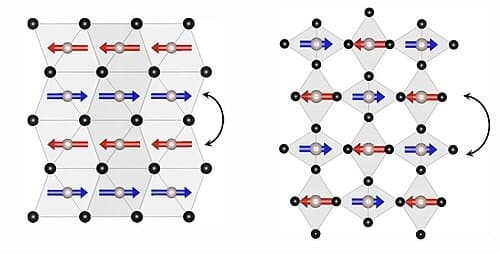
Altermagnets = magnetic materials with antiferro spin ordering, ferromagnet-like utility, zero external magnetism

Chromium Antimonide (CrSb) shows Direction-Dependent Conduction Polarity: n-type in-plane, p-type cross-plane within one crystal

Phenomenon experimentally confirmed at S N Bose National Centre for Basic Sciences, Kolkata, India

Quick Facts for MCQs

Material Properties

  • Zero-field magnetism removes stray interference in circuits
  • High spin splitting ensures strong, temperature-robust spin signals
  • Thermal stability twice room temperature supports standard industrial conditions

Industrial Applications

  • Spintronics enables ultrafast, low-power memory and logic
  • Single material offering both polarities simplifies semiconductor fabrication, cuts doping steps
  • Thermoelectric devices gain bidirectional charge flow, improving conversion efficiency

Research Context

  • Discovery funded and supervised by Department of Science and Technology India
  • High-quality single crystals permitted direct measurement of anisotropic transport
  • Breakthrough positions India as early leader in altermagnet device exploration

Key Data Points

FeatureData-Point
MaterialChromium Antimonide (CrSb)
Magnetic classAltermagnet
Net external magnetismZero
Spin splitting≈ 30 × room-temperature energy
Magnetic ordering temperature≈ 2 × room temperature
Conduction polarityn-type along layers; p-type across layers
Research instituteS N Bose NCBS, DST
ToxicityNon-toxic, earth-abundant
GS-3S&TQuick Bite

10.Digital Fossil-Mining Squid Evolution (Squid Evolution)

The Hindu

What & Where

Digital fossil-mining: non-destructive 3D scans, CT, AI, GIS applied to 110–70 Mya Cretaceous concretions in Japan

Key squid groups: Oegopsida (deep-sea) & Myopsida (coastal) traced back at least 100 Mya

Finding shifts squid marine dominance 30 million years earlier than prior estimates

Quick Facts for MCQs

Tech & Methods

  • Digital fossil-mining enables virtual extraction, preserves fragile concretions
  • CT & AI rapidly reconstruct soft-tissue outlines invisible to naked eye

Biodiversity & Evolution

  • Presence of both pelagic Oegopsids and near-shore Myopsids indicates early ecological radiation
  • Revised timeline pushes deep-sea squid lineage back by additional 30 Myr

Behaviour & Adaptations

  • Chromatophores allow dynamic camouflage, signalling, predator evasion
  • Ink-spray, arm-tip autotomy and cooperative hunting (e.g., Humboldt squid) enhance survival

Habitat & Size Range

  • Distribution spans shallow coasts to ≈ 3 miles depth; body sizes from pygmy centimetres to giant 15 m+

Key Data Points

FeatureData-Point
Fossil age range110–70 million years (Late Cretaceous)
Species digitally identified≈ 40
Modern groups presentOegopsida, Myopsida
Discovery locationJapanese Cretaceous concretions
Research tools3D scanning, CT imaging, AI, GIS
ClassCephalopoda
Hearts per squidThree
Arms : tentacles8 : 2
Max recorded glide≈ 164 ft (“flying” squids)
Largest eye sizeVolleyball-sized (giant squid)
GS-2Security

11.QUAD Maritime Observer Mission (QUAD Maritime Mission)

PIB
Illustration for QUAD Maritime Observer Mission (QUAD Maritime Mission)

What & Where

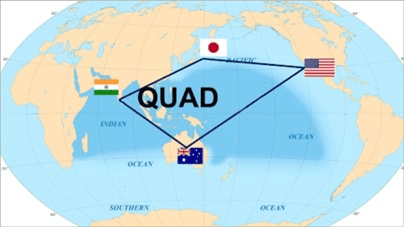
QUAD At Sea Ship Observer Mission: first cross-embarkation Coast-Guard programme of India, USA, Japan, Australia.

Area: Indo-Pacific transit; inaugural leg on USCGC Stratton sailing Hawaii-Guam-Pacific isles.

Rooted in Wilmington Declaration 2024, advancing rules-based maritime order under India’s SAGAR/MAHASAGAR visions.

Quick Facts for MCQs

Security Dimension

  • Interoperability: common SOP drills, coordinated patrols, joint SAR enhancing quick multilateral response.
  • MDA: live data exchange via MAITRI, QUIN deters grey-zone activities.
  • Deterrence: collective Coast-Guard presence signals resolve against unilateral Indo-Pacific coercion.

Infrastructure & Connectivity

  • Logistics: Quad Logistics Network integrates refuel, repair nodes across partner ports.
  • Ports: Ports of the Future Partnership pushes smart, green upgrades for regional harbours.
  • Fellowship: 2,200+ specialists funded for infrastructure capacity-building.

Tech & Climate

  • Semiconductors: joint R&D, supply-chain mapping for chip security.
  • Cybersecurity: QUIN enables rapid cross-national cyber-threat intelligence.
  • Climate: Q-CHAMP finances adaptation, uses Earth-Observation satellites for disaster response.

Key Data Points

FeatureData-Point
Launch year2025
Core membersIndia, Japan, USA, Australia
Parent summit6th QUAD Leaders’ Summit, Delaware (2024)
Guiding documentWilmington Declaration
First platformUSCGC Stratton (US Coast Guard)
Key aimsInteroperability, Maritime Domain Awareness, SAR
Linked doctrinesSAGAR, IPOI, MAHASAGAR
Gender aspectWomen officers in cross-embarkation teams
Associated missionMAITRI maritime info-sharing
Expansion talkQUAD-Plus: ROK, NZ, Vietnam joined dialogues

Related UPSC Prelims PYQs

CAPF_GAI 2024PYQ 1

Which one among the following statements with regard to India’s maritime initiative, SAGAR, is correct?

CAPF_GAI 2023PYQ 2

क्वाड (Quad) के बारे में निम्नलिखित में से कौन-सा/कौन-से कथन सही है/हैं?

GS-3Security

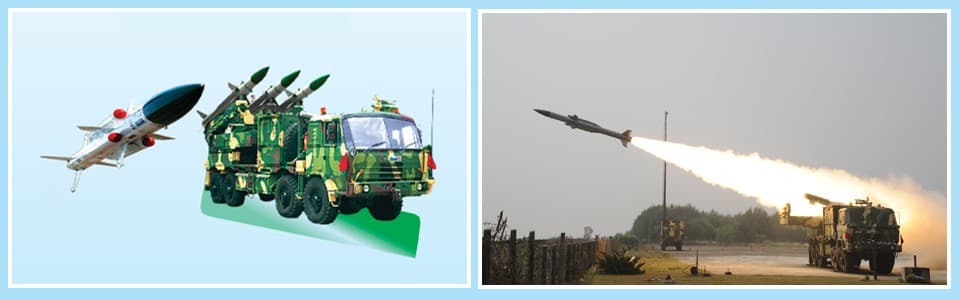
12.Akash Air Defence System (Akash Missile)

ANI
Illustration for Akash Air Defence System (Akash Missile)

What & Where

Akash: indigenous mobile medium-range surface-to-air missile system for point/area defence against aircraft, UAVs, cruise missiles.

Developed under DRDO-BDL-BEL collaboration; deployed by Indian Air Force & Army, success shown in Operation Sindoor.

Export interest from Brazil ahead of 17th BRICS underscores India–South America defence linkage.

Quick Facts for MCQs

Tech & Schemes

  • Architecture: single-stage solid-fuel missile, Rajendra radar, encrypted datalink, electro-thermal battery ignition.
  • Make-in-India: >85 % indigenous content, supports Atmanirbhar Bharat and Defence Production Policy 2020 targets.
  • Deployment: Group-mode allows simultaneous multi-target engagement through networked batteries.

Security Dimension

  • Gap-filler: complements S-400 long-range and VSHORAD short-range layers in Indian integrated air defence.
  • Versatility: protects airbases, coastal assets, mobile armored formations, strategic infrastructure.
  • Reaction time: launch readiness <30 seconds; reload time ~15 minutes enhances sustained defence.

International Angle

  • Brazil request: first potential Latin American buyer, may open $2-3 billion market for SAM exports.
  • BRICS synergy: technology transfer, joint training, possible licensed assembly eyed to deepen strategic ties.
  • Previous interest: Vietnam, Philippines, UAE explored Akash variants, boosting India’s credibility as net security provider.

Key Data Points

FeatureData-Point
Engagement range4.5 km – 25 km
Altitude envelope100 m – 20 km
SpeedMach 1.8 – 2.5
GuidanceCommand guidance via integrated radar
Platform mobilityRoad & rail mobile launchers
Fire controlFully automatic, quick-reaction
ECCM capabilityIn-built, high jamming immunity
IFF provisionYes, Mk-XII compatible
Lead developerDRDO; production by BDL & BEL
Recent combat testOperation Sindoor interception, 100 % kill probability claimed

Related UPSC Prelims PYQs

CDS_GK, GS1 2003PYQ 1

With reference to Indian defence, which one of the following statements is correct?

CDS_GK, GS1 2022PYQ 2

The term ‘Terminal High Altitude Area Defense’, sometimes mentioned in news, refers to

GS-2Scheme

13.Decade of Digital India (Digital India)

PIB

What & Where

Digital India: 1 Jul 2015 mission to build a digitally-empowered, knowledge-based Indian economy

Nine pillars: broadband, universal mobile, public internet, e-Governance, e-Kranti, info-for-all, electronics mfg, IT-for-jobs, early-harvest

Core geography: pan-India, rural thrust via BharatNet reaching 2.18 lakh Gram Panchayats

Quick Facts for MCQs

Digital Infrastructure

  • Connectivity: broadband users +1,452 %, internet users +285 % during 2014-25
  • Coverage: 5G in 99.6 % districts; 4G touches 6.15 lakh villages
  • Semiconductors: 6 fabs okayed worth ₹1.55 lakh cr with 50 % capital aid

Digital Finance

  • Payments: UPI processed 1,867.7 cr txns worth ₹24.77 lakh cr in Apr 2025
  • Commerce: ONDC adds lakhs of sellers; GeM hosts 22.5 lakh sellers, 1.6 lakh buyers
  • Inclusion: DBT purge removed 5.87 cr fake ration cards, 4.23 cr duplicate LPG accounts

Social Concerns

  • Divide: Rural internet penetration only 37 % (2023); digital literacy uneven
  • Security: 8 lakh cyber-security manpower gap, 13.91 lakh incidents (2022)
  • Privacy: 61 % firms breach consent despite DPDP Act 2023

Environmental Impact

  • E-waste: +74 % rise from 1.01 MT (2019-20) to 1.751 MT (2023-24)
  • Energy: data-centre load escalating, needs green standards
  • Policy: link Swachh Bharat with e-waste collection, extend PLI to eco-tech

Key Data Points

FeatureData-Point
10-year celebration1 Jul 2025
Phone connections93.3 cr (2014) → 120 cr (2025)
5G towers4.74 lakh in 22 months
Data price₹308 / GB (2014) → ₹9.34 / GB (2022)
BharatNet fibre6.92 lakh km
UPI world share49 % of real-time txns (2023)
Aadhaar issued142 cr (Apr 2025)
DBT value₹44 lakh cr till Apr 2025
Cyber incidents13.91 lakh (2022)
E-waste volume1.751 MT (2023-24)

Related UPSC Prelims PYQs

ESE_GS, GS1 2018PYQ 1

निम्नलिखित में से कौन-सा/से भारत सरकार की ‘Digital India’ योजना का/के उद्देश्य है/हैं?

ESE_GS, GS1 2020PYQ 2

Which one of the following is not the vision area of Digital India as a program to transform India into a digitally empowered society and knowledge economy?

Ready to practice?

Test your knowledge with our UPSC test series.

Start Free Trial