UPSC Current Affairs

17 topicsGS-1: 2GS-2: 3GS-3: 12
0/17 done
GS-3Economy

1.National Investment and Infrastructure Fund Operations (Infrastructure Fund)

Business Standard
Illustration for National Investment and Infrastructure Fund Operations (Infrastructure Fund)

What & Where

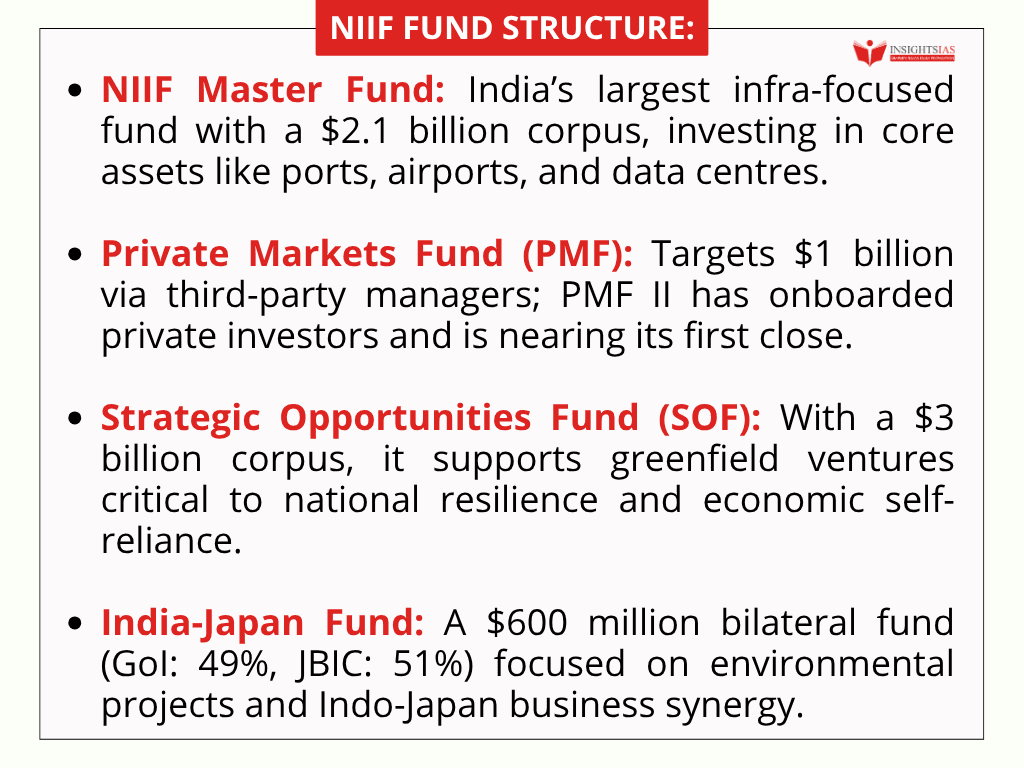
Government-anchored platform raising long-term capital for Indian infrastructure & strategic sectors.

SEBI-registered Category II Alternative Investment Fund, headquartered Mumbai; operational since 2015.

Functions as sovereign-wealth-linked asset manager with independent investment decisions across India.

Quick Facts for MCQs

Governance Setup

  • Governing Council advises on strategy, governance, mobilisation, deployment; chaired by Finance Minister.
  • 6th meeting held 2024; cadence shifted to annual reviews.
  • NIIF board retains independent, commercial investment authority.

Fund Structure

  • Public-private mix: 49 % Govt, 51 % global institutional investors.
  • Category II AIF offers tax pass-through, no preset leverage cap.

Capital & Partnerships

  • AUM ₹30k cr leverages ~4×, attracting ₹1.17 lakh cr total capital.
  • Partners: sovereign wealth (ADIA), pension funds (CPPIB), multilaterals (ADB, AIIB, NDB).
  • Priority sectors: Make in India manufacturing, renewable/green energy, digital infrastructure.

Key Data Points

FeatureData-Point
Full nameNational Investment & Infrastructure Fund (NIIF)
Established2015-16 Union Budget
HeadquartersMumbai, Maharashtra
Nodal ministryDept. of Economic Affairs, MoF
Govt equity share49 %
Foreign anchor investorsADIA, Temasek, CPPIB
SEBI statusCategory II AIF (Dec 2015)
Assets under management> ₹30,000 cr (~US$4.9 bn)
Capital catalysed~₹1.17 lakh crore
CEO & MDSanjiv Aggarwal (Feb 2024)
Governing Council chairUnion Finance Minister
Latest council meeting6th, New Delhi, 2024

Related UPSC Prelims PYQs

CDS_GK, GS1 2024PYQ 1

Which one of the following is not a fund managed by NIIFL (National Investment and Infrastructure Fund Limited)?

CDS_GK, GS1 2017PYQ 2

With reference to 'National Investment and Infrastructure Fund', which of the following statements is/are correct?
GS-3Economy

3.Special Economic Zones Reforms for Semiconductor Manufacturing (Special Economic Zones)

PIB

What & Where

SEZ: duty-free enclave deemed foreign territory for trade; established under SEZ Act 2005 & Rules 2006.

Types: EPZ, Free Trade/Ports, Industrial Estates, Urban Enterprise Zones; 276 operational units as of 2023-24.

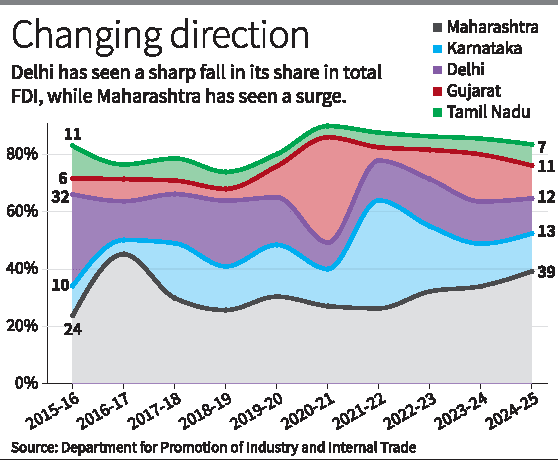
New hubs: Micron semiconductor SEZ (Sanand, Gujarat); Aequs electronics component SEZ (Dharwad, Karnataka).

Quick Facts for MCQs

Legal & Policy

  • Amendment trims land norm to 10 ha, easing high-tech entry barriers.
  • DESH Bill aims to morph SEZs into flexible Development Hubs, diluting export-only mandate.
  • Baba Kalyani panel 2018 proposed rebranding as 3Es—Employment & Economic Enclaves.

Economic Angle

  • Semiconductor & electronics sectors capital-intensive, import-dependent, long gestation; domestic sales permission boosts viability.
  • SEZ exports topped USD 163.69 bn in 2023-24, IT still ~70 % share.
  • Rising input, logistics costs erode cost edge versus China, Vietnam.

Implementation Challenges

  • 40 % gap approved vs. notified SEZs; >60 % gap notified vs. operational.
  • WTO scrutiny on export-linked subsidies; OECD tax may dilute incentives.
  • Infrastructure shortfalls: land cost, power reliability, last-mile port connectivity.

Key Data Points

FeatureData-Point
Minimum land (old → new)50 ha → 10 ha for semiconductor/electronics SEZ
Net Foreign ExchangeFree-of-cost goods now count in NFE calculus
Domestic sales ruleAllowed to DTA on duty payment
Land encumbranceBoard of Approval may relax if mortgaged/leased to govt
Board of Approval headSecretary, Dept. of Commerce
Operational SEZs276 (FY 24)
SEZ exports FY 24USD 163.69 billion
ECB ceiling for unitsUSD 500 million per year, no maturity bar
Upcoming replacement lawDESH Bill 2022
OECD global tax rate15 % minimum corporate tax

Related UPSC Prelims PYQs

GEO_GS, GS1 2026PYQ 1

Dholera and Sanand in Gujarat are in news for setting up

GEO_GS, GS1 2010PYQ 2

The SEZ Act, 2005 which came into effect in February 2006 has certain objectives. In this context, consider the following :

GS-3EconomyQuick Bite

4.World Accreditation Day 2025 and QCI Initiatives (Accreditation Standards)

PIB
Illustration for World Accreditation Day 2025 and QCI Initiatives (Accreditation Standards)

What & Where

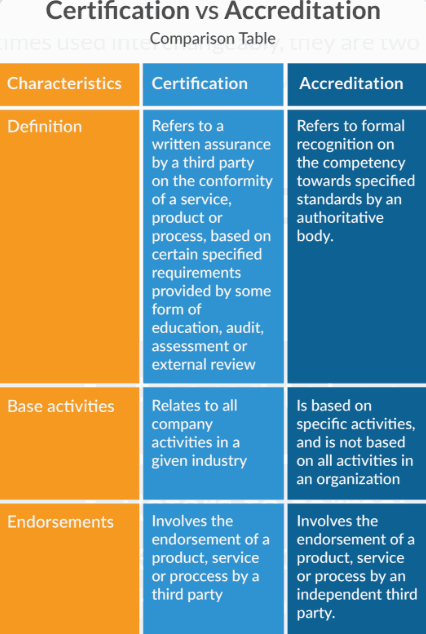
Accreditation: formal verification that institutions meet prescribed quality standards in testing, inspection, certification

Quality Council of India: autonomous under DPIIT; drives National Accreditation Structure via NABCB & NABL

World Accreditation Day 2025: observed 9 June; focus on empowering SMEs; India events led by QCI

Quick Facts for MCQs

Government Policies

  • Autonomy: QCI established 1997 to insulate accreditation from direct state control yet aid regulators
  • NAS mandate: ensures robust, trustworthy conformity data for decision making, compliance, standard setting
  • WAD spotlight: annual observance mainstreams quality culture across sectors

Tech & Schemes

  • NABL Portal: single-window digital accreditation access; tailored for cost-sensitive MSMEs
  • Gunvatta Samarpan: online pledge drive inviting public and industry commitment to quality
  • Integration: NABL & NABCB databases unified for regulators, exporters, consumers

Economic Angle

  • Cost reduction: accreditation lowers transaction costs; eases global market entry for SMEs
  • Collaboration: industry bodies ASSOCHAM CII FICCI partner with government to speed trade facilitation
  • Investor confidence: reliable conformity assessment data enhances market trust and GDP contribution

Key Data Points

FeatureData-Point
WAD 2025 date9 June 2025
WAD theme“Accreditation: Empowering Small and Medium Enterprises (SMEs)”
QCI set-up year1997
Parent ministryDPIIT, Commerce & Industry
Chairperson selectionAppointed by PM on industry recommendation
Accreditation boardsNABCB & NABL
Fresh digital toolRevamped NABL Portal
Quality pledge driveGunvatta Samarpan Initiative
Industry membersASSOCHAM, CII, FICCI
Core mandateDevelop & manage National Accreditation Structure

Related UPSC Prelims PYQs

GS1 2017PYQ 1

With reference to ‘Quality Council of India (QCI)’, consider the following statements:

GS-3InfrastructureQuick Bite

5.Rail Connectivity Reaches Aizawl via Bairabi-Sairang Line (Northeast Railway Connectivity)

Indian Express
Illustration for Rail Connectivity Reaches Aizawl via Bairabi-Sairang Line (Northeast Railway Connectivity)

What & Where

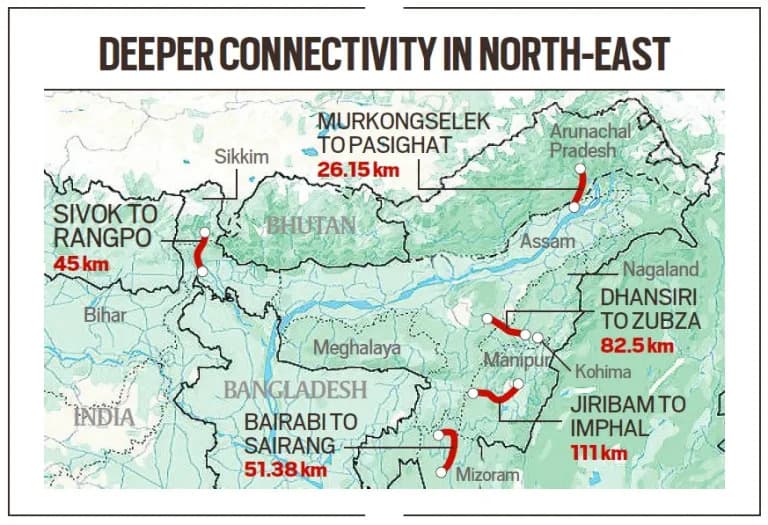
Bairabi–Sairang rail line links Aizawl, integrating Mizoram with the national broad-gauge network.

Aizawl becomes 4th Northeastern capital on rail map after Dispur, Agartala, Itanagar.

Indian Railways: 4th-largest global network, first ran 21 mi Bombay–Thane, 1853.

Quick Facts for MCQs

Regional Connectivity

  • Expansion boosts Northeast integration, easing movement of goods, troops, tourists.
  • Remaining non-connected NE capitals: Shillong, Imphal, Kohima, Gangtok.

Economic Angle

  • Freight dominance underpins financial health; passenger cross-subsidised.
  • Rail connectivity expected to spur Mizoram trade, lower logistics cost.

Policy & Planning

  • National Rail Plan 2030 targets capacity, technology, sustainability upgrades.
  • Focus corridors: high-density & port linkage lines for freight speed enhancement.

Social Concerns

  • Khasi organisations fear demographic change, demand inner-line safeguards before Shillong link proceeds.

Key Data Points

FeatureData-Point
New lineBairabi–Sairang
State capital connectedAizawl, Mizoram
NE capitals with rail4 (Assam, Tripura, Arunachal Pr., Mizoram)
Year first Indian train1853
First journey length21 miles
Global network rank4th (after US, China, Russia)
Freight share 2022-2369 % of revenue
Passenger share 2022-2324 % of revenue
Other revenue 2022-237 %
GDP contribution FY24~1.5 %
National Rail Plan horizon2030
Projected 2050 global share~40 % of rail activity
Shillong rail statusOpposed by Khasi groups

Related UPSC Prelims PYQs

CAPF_GAI, NDA_GAT 2022PYQ 1

Which one of the following States/UTs was connected with the Indian Railways network in the year 2021?

CAPF_GAI, NDA_GAT 2022PYQ 2

As part of the Look/Act East Policy, which one of the following capitals of North-East Indian States is proposed to be connected with Bangladesh via rail route?

GS-3InfrastructureQuick Bite

6.Chenab and Anji Khad Railway Bridges Inauguration (Railway Bridges J&K)

Hindustan Times
Illustration for Chenab and Anji Khad Railway Bridges Inauguration (Railway Bridges J&K)

What & Where

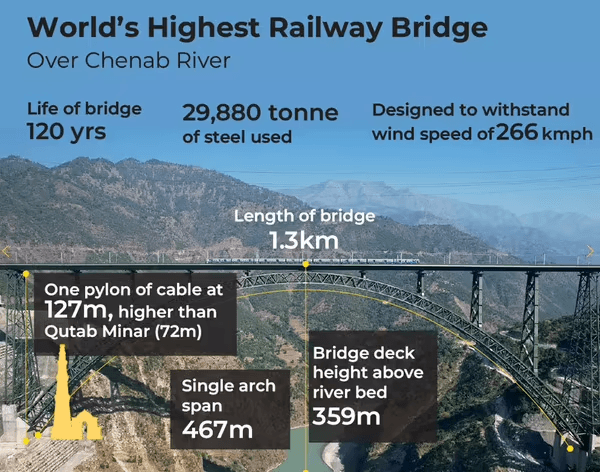
Chenab Rail Bridge – 359 m steel arch spanning Chenab River, Reasi district, Jammu & Kashmir

Anji Khad Bridge – India’s first cable-stayed rail bridge over Anji River, a Chenab tributary

Both bridges anchor the Udhampur-Srinagar-Baramulla Rail Link, giving Kashmir year-round rail access

Quick Facts for MCQs

Engineering & Design

  • Steel-arch geometry optimised for Himalayan winds and 1:8 slope approaches
  • Foundation by IISc; seismic analytics by IIT Delhi & IIT Roorkee
  • DRDO certification ensured blast-proofing standards

Durability & Safety

  • Structure endures magnitude-8 quakes, 266 km/h winds, −20 °C temperatures
  • 40-tonne TNT blast survivability enhances critical-asset security
  • Redundant pier system allows limited-speed operations after single-pier failure

Connectivity & Strategic

  • USBRL completion shortens Jammu–Srinagar travel to roughly three hours
  • Year-round rail boosts troop mobility and disaster response in Kashmir valley
  • Improved market access expected to spur tourism and horticulture exports

Key Data Points

FeatureData-Point
Highest railway bridgeChenab Rail Bridge – 359 m
Taller than EiffelBy 35 m
Second-highest bridgeAnji Khad Bridge
Bridge typeChenab – steel arch; Anji – cable-stayed
DistrictReasi, J&K
Main riverChenab
Tributary crossedAnji River
Rail projectUSBRL
Executing agencyKonkan Railway Corporation
Seismic toleranceMagnitude 8
Wind design speed266 km/h
Blast resistance40 t TNT
Temperature tolerance−20 °C
RedundancyRuns even if 1 of 8 piers fails
Chenab originChandra+Bhaga at Tandi, HP
GS-1History

7.Bhagwan Birsa Munda Tribal Freedom Legacy (Tribal Freedom Fighter)

FPJ
Illustration for Bhagwan Birsa Munda Tribal Freedom Legacy (Tribal Freedom Fighter)

What & Where

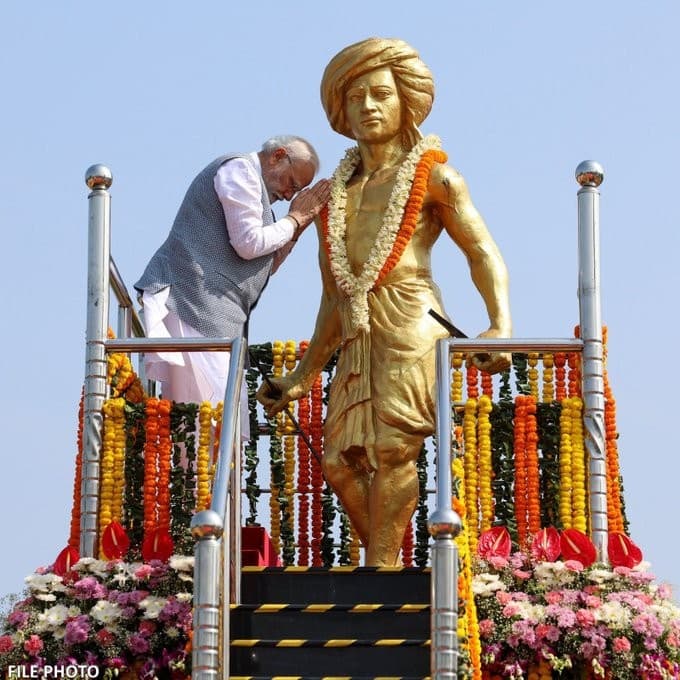
Tribal icon Bhagwan Birsa Munda; freedom-fighter, reformer; born 15 Nov 1875, Ulihatu, Chotanagpur Plateau (present Jharkhand).

Spearheaded Ulgulan (Great Tumult) 1895-1900 across Jharkhand-Odisha-Bengal against British zamindari, forced labour, forest curbs.

Created Birsait sect merging Vaishnavism with Munda ethos; spiritual plank for political mobilisation.

Quick Facts for MCQs

Freedom Struggle

  • Leadership: Unified tribes through drums, flags, traditional attire; stressed self-rule over Crown control.
  • Strategy: Employed swift guerrilla raids disrupting revenue, missionary networks.
  • Geographic-reach: Actions radiated from Tamar-Khunti belt to Odisha’s Mayurbhanj fringe.

Social Reform

  • Campaign: Denounced alcoholism, black magic; promoted agrarian ethics, collective worship.
  • Consciousness: Urged pride in indigenous identity, rejection of Diku (outsider) dominance.

Legal & Policy

  • Precedent: Ulgulan pressure catalysed Chotanagpur Tenancy Act 1908, restricting land transfer to non-tribals.
  • Legacy: Framework later echoed in Fifth Schedule, PESA 1996 safeguards.

Recognition & Memory

  • Commemoration: Statues, stamps, films; 2021 Azadi ka Amrit Mahotsav highlighted contributions.
  • Government-push: Ongoing schemes under “Mission Janjatiya Vikas” cite his vision for inclusive development.

Key Data Points

FeatureData-Point
Birth15 Nov 1875, Ulihatu
TribeMunda
AliasDharti Aaba (Father of the Earth)
Key RebellionUlgulan, 1895-1900
Guerrilla TargetsPolice stations, churches, outposts
Rallying Slogan“Abua Raj setar jana, Maharani Raj tundu jana”
Sect FoundedBirsait
Arrest1895, Jamkopai forest
Death9 June 1900, Ranchi Jail
Legislative ImpactChotanagpur Tenancy Act 1908 securing tribal land
National Day15 Nov as Janjatiya Gaurav Diwas (since 2021)
Honorific“Bhagwan” Birsa Munda
Key Tribes MobilisedMunda, Oraon, Kharia
Institutions NamedBirsa Agricultural University, Birsa Institute of Technology
Core DemandRestoration of Khuntkatti communal land tenure

Related UPSC Prelims PYQs

GS1 2020PYQ 1

With reference to the history of India, "Ulgulan" or the Great Tumult is the description of which of the following events?

GS-1Misc

8.ICC Cricket Hall of Fame Induction 2025 (Sports Personalities)

LiveMint

What & Where

ICC Cricket Hall of Fame — global platform honouring players’ historic contributions across eras, formats and countries

Launched 2 Jan 2009 by International Cricket Council (ICC) with Federation of International Cricketers’ Associations (FICA)

Annual inductions; coverage spans all Test-playing nations, announced around flagship ICC events

Quick Facts for MCQs

Eligibility & Criteria

  • Waiting-period five years post last international appearance
  • Assessment impact, records, consistency, leadership, overall influence
  • Gender-neutral selection covering Tests, ODIs, T20Is

Indian Representation

  • Dhoni becomes 11th Indian, joins Kapil, Gavaskar, Dravid, Tendulkar, Sehwag, Kumble, Bedi, Mankad
  • Women honourees Diana Edulji & Neetu David inducted 2023
  • Indian inclusions span teams from 1950s through 2020s

Institutional Features

  • Recognition covers pre- & post-World War cricket eras ensuring continuity
  • Inclusive scope celebrates all Test nations plus emerging women cricketers
  • Inductees receive ceremonial cap during yearly announcement

Key Data Points

FeatureData-Point
Launch year2009
Founding bodiesICC + FICA
Initial FICA inductees absorbed55
New names added in 20095
Eligibility gap after retirement5 years
Induction frequencyAnnual
Commemorative itemHall of Fame cap
Total Indian inductees (till 2025)11
Latest Indian inducteeMS Dhoni (2025)
Indian women honourees2 (Diana Edulji, Neetu David)

Related UPSC Prelims PYQs

NDA_GAT 2021PYQ 1

Who among the following is the lone Indian Cricketer included in the ICC Hall of Fame special inductions to mark the inaugural ICC World Test Championship Final?

GS-3Environment

9.Gangotri National Park Ecology Overview (National Park)

Hindustan Times
Illustration for Gangotri National Park Ecology Overview (National Park)

What & Where

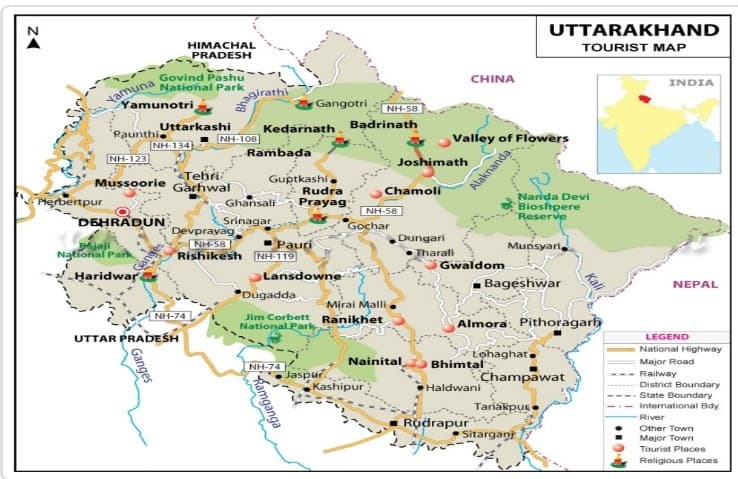
Gangotri NP — 2,390 sq km high-altitude protected area conserving Gangotri Glacier source of Ganga

Lies in Garhwal Himalayas, upper Bhagirathi catchment, Uttarkashi district, Uttarakhand, bordering Tibet (China)

Adjoins Kedarnath WLS and Govind NP, hosts peaks Chaukhamba I–III, Satopanth, Kedarnath Main

Quick Facts for MCQs

Conservation Significance

  • Glacier-safeguard; park ensures perennial flow of Ganga headwaters
  • Corridor; links multiple PAs enabling genetic exchange for large mammals
  • Eco-Sensitive Zone; additional regulatory buffer against high-impact projects

Flora Zones

  • Subalpine conifers; fir, spruce, oak, deodar dominate lower slopes
  • Rhododendron scrub and alpine meadows occupy mid-altitudes below glacier snouts
  • Alpine shrublands, grasslands above 3,500 m sustain cold-adapted herbs

Faunal Highlights

  • Apex predator; snow leopard regulates bharal populations
  • Keystone herbivores; musk deer and Himalayan tahr support predator guild
  • Avifauna; Himalayan monal and migratory birds frequent high-altitude meadows

Current Issue

  • Illegal waste incinerator inside park polluting Bhagirathi Eco-Sensitive Zone
  • Residents allege violations of Wildlife (Protection) Act and pollution norms
  • Demands; immediate shutdown and stricter enforcement against unapproved facilities

Key Data Points

FeatureData-Point
StateUttarakhand
DistrictUttarkashi
Legal statusNational Park (2000)
Area2,390 sq km
Altitude span~1,800 m – >7,000 m
Main riverUpper Bhagirathi
Glacier protectedGangotri
Neighbour PAsKedarnath WLS; Govind NP
International boundaryTibet (China)
Dominant forest typeWestern Himalayan subalpine conifer
Alpine vegetation limit~3,500 m
Flagship carnivoreSnow leopard
Key ungulatesMusk deer; Himalayan tahr; Blue sheep
Sensitive zoneBhagirathi Eco-Sensitive Zone

Related UPSC Prelims PYQs

GEO_GS 2025PYQ 1

The Govind Ballabh Pant National Institute of Himalayan Environment (GBPNIHE) has its Headquarters at

GS-3Environment

10.Delhi E-Waste Recycling Eco Park (E-Waste Management)

NDTV

What & Where

Facility: Dedicated park for scientific collection, dismantling, recycling and metal recovery from e-waste.

Location: 11.4-acre site at Holambi Kalan, North Delhi; India’s first E-Waste Recycling Eco Park.

Model: DBFOT public-private partnership; showcases circular-economy infrastructure for replication nationwide.

Quick Facts for MCQs

Tech & Schemes

  • Infrastructure: Collection sheds, dismantling lines, refurbishment labs, metal-recovery plant integrated on campus.
  • Coverage: Handles 106 categories including mobiles, laptops, industrial and solar equipment.
  • Training: On-site centres will skill informal recyclers in safe techniques and formal compliance.

Economic Angle

  • Investment: ₹150 crore expected from concessionaire for park development and operation.
  • Revenue: Model projects ₹350 crore turnover across 15-year concession.
  • Employment: Thousands of green jobs anticipated in collection, logistics, processing and refurbishing.

Environmental Impact

  • Hazard reduction: Eliminates landfill dumping, open acid baths and backyard burning.
  • Resource security: Enables recovery of precious metals, plastics, rare earths for secondary markets.
  • Circularity: Demonstrates urban closed-loop model supporting national circular economy targets.

Legal & Policy

  • Compliance: Conforms to E-Waste Management Rules 2022 extended producer and recycler responsibilities.
  • Governance: Delhi Environment Department supervises; DSIIDC procures concessionaire via global tender.
  • Replicability: Planned as template for similar parks in other states.

Key Data Points

FeatureData-Point
State / CityDelhi / Holambi Kalan
Area11.4 acres
Processing capacity51,000 t e-waste per year
Categories handled106 (E-Waste Rules 2022)
Implementation agencyDSIIDC (global RFQ-RFP)
Operating modelDBFOT-PPP
Concession period15 years
Completion target18 months
Estimated investment₹150 crore
Projected revenue₹350 crore

Related UPSC Prelims PYQs

GS1 2019PYQ 1

In India, ‘extended producer responsibility’ was introduced as an important feature in which of the following?

GS-3Species

11.Asafoetida Cultivation and Domestication in India (Medicinal Plant)

The Hindu
Illustration for Asafoetida Cultivation and Domestication in India (Medicinal Plant)

What & Where

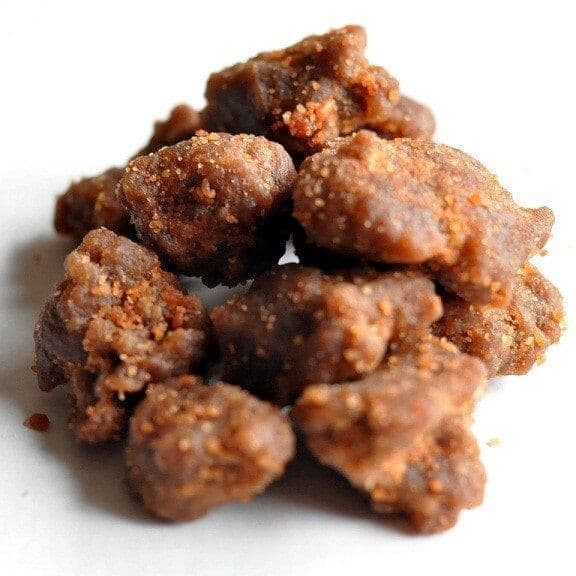
Asafoetida / heeng: oleo-gum resin from taproot of perennial herb Ferula assa-foetida.

First Indian flowering + seed set achieved at CSIR-IHBT, Palampur (Himachal Pradesh, 1 300 m).

Native belts: cold-arid Iran, Afghanistan, Central Asia; now adaptable to Himalayan high-altitude valleys.

Quick Facts for MCQs

Botanical Traits

  • Long-taproot stores oleoresin; fleshy root main tapping site
  • Winter dormancy ensures drought and cold survival
  • Umbelliferous inflorescence appears only in year five

Agro-Climatic Needs

  • Prefers cold deserts with low humidity and bright sunshine
  • Performs in Himalayan valleys if drainage and temperature range ensured
  • Sensitive to waterlogging; excess moisture rots root system

Medicinal & Cultural Uses

  • Ayurveda cites carminative, anti-flatulent, metabolism-stimulating actions
  • Referenced in Charaka Samhita, Mahabharata, Panini’s grammar works
  • Staple tempering spice in vegetarian Indian cuisines, especially Jain and Kashmiri

Self-Reliance Push

  • Domestic cultivation targets import bill of ~Rs 900 crore annually
  • Successful Palampur acclimatisation broadens cultivation beyond cold deserts
  • Tissue-culture labs and germplasm bank enable rapid farmer dissemination

Key Data Points

FeatureData-Point
Botanical nameFerula assa-foetida
Plant habitPerennial, herbaceous
Resin share in dried gum40 – 64 %
Maturation before tapping≈5 years
Rainfall need< 300 mm annually
Temp. tolerance–4 °C to 40 °C
Soil preferenceSandy, well-drained
Palampur trial altitude1 300 m
Indigenous ideal zonesLahaul-Spiti, Kinnaur, Uttarkashi
Import dependency (historic)100 %
Germplasm Centre setup2022, IHBT
Dormancy phaseExtreme winters
GS-3S&T

12.Tardigrade Experiment on Axiom-4 ISS Mission (Space Biology)

Indian Express
Illustration for Tardigrade Experiment on Axiom-4 ISS Mission (Space Biology)

What & Where

Axiom Mission-4: 4th private crewed flight to ISS by Axiom Space aboard SpaceX Crew Dragon, launch 2025.

Crew: Peggy Whitson (USA, commander) and Shubhanshu Shukla (India, pilot) plus members from Poland, Hungary.

Venue: 14-day stay on International Space Station; Indian payload includes tardigrades, moong-dal seeds, cyanobacteria.

Quick Facts for MCQs

Mission Profile

  • Experiments: screen-use cognition, tardigrade resilience, seed germination, cyanobacteria photosynthesis.
  • Goal: validate tech for first commercial space station, lessen ISS reliance.
  • International crew fosters multilateral space cooperation.

Indian Significance

  • Gaganyaan synergy: microgravity data, crew training experience, astrobiology inputs.
  • Strengthens ISRO–NASA cooperation in human spaceflight.
  • Enhances India’s role in upcoming commercial orbital platforms.

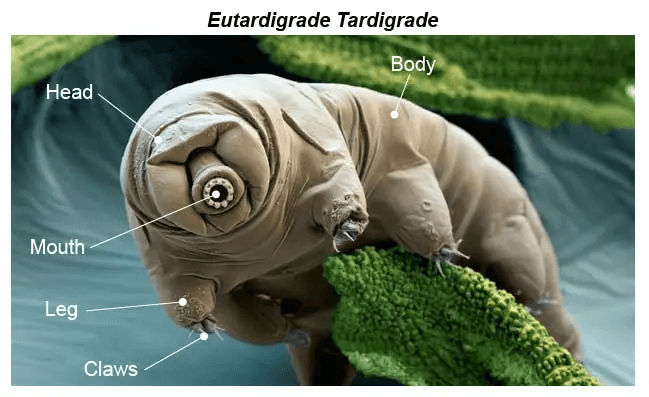
Tardigrade Biology

  • Survival range: −273 °C to 150 °C, vacuum, 40 000 kPa pressure.
  • Mechanisms: cryptobiosis, anhydrobiosis, CAHS protein gel shielding cells.
  • Spin-offs: climate-resilient crops, UV-proof sunscreens, organ-preservation tech.

Key Data Points

FeatureData-Point
Launch window2025
Mission length14 days on ISS
OperatorAxiom Space (US)
SpacecraftSpaceX Crew Dragon
Indian milestone1st Indian to set foot on ISS
Zero-G indicatorSwan plushie “Joy”
Key biology payloadTardigrades (water bears)
Crop study6 varieties, focus on moong dal
Cyanobacteria testGrowth, biochemistry in microgravity
CommanderPeggy Whitson, USA
PilotShubhanshu Shukla, India
Future linkData feed into ISRO Gaganyaan 2027

Related UPSC Prelims PYQs

CDS_GK, GS1 2025PYQ 1

निम्नलिखित अंतरिक्ष मिशनों पर विचार कीजिए :

CDS_GK, GS1 2022PYQ 2

India's maiden human space mission will be launched in 2023. What is its name?

GS-3S&TQuick Bite

13.Saturn-Sized Exoplanet Orbiting Red Dwarf Discovery (Exoplanet Discovery)

Times of India
Illustration for Saturn-Sized Exoplanet Orbiting Red Dwarf Discovery (Exoplanet Discovery)

What & Where

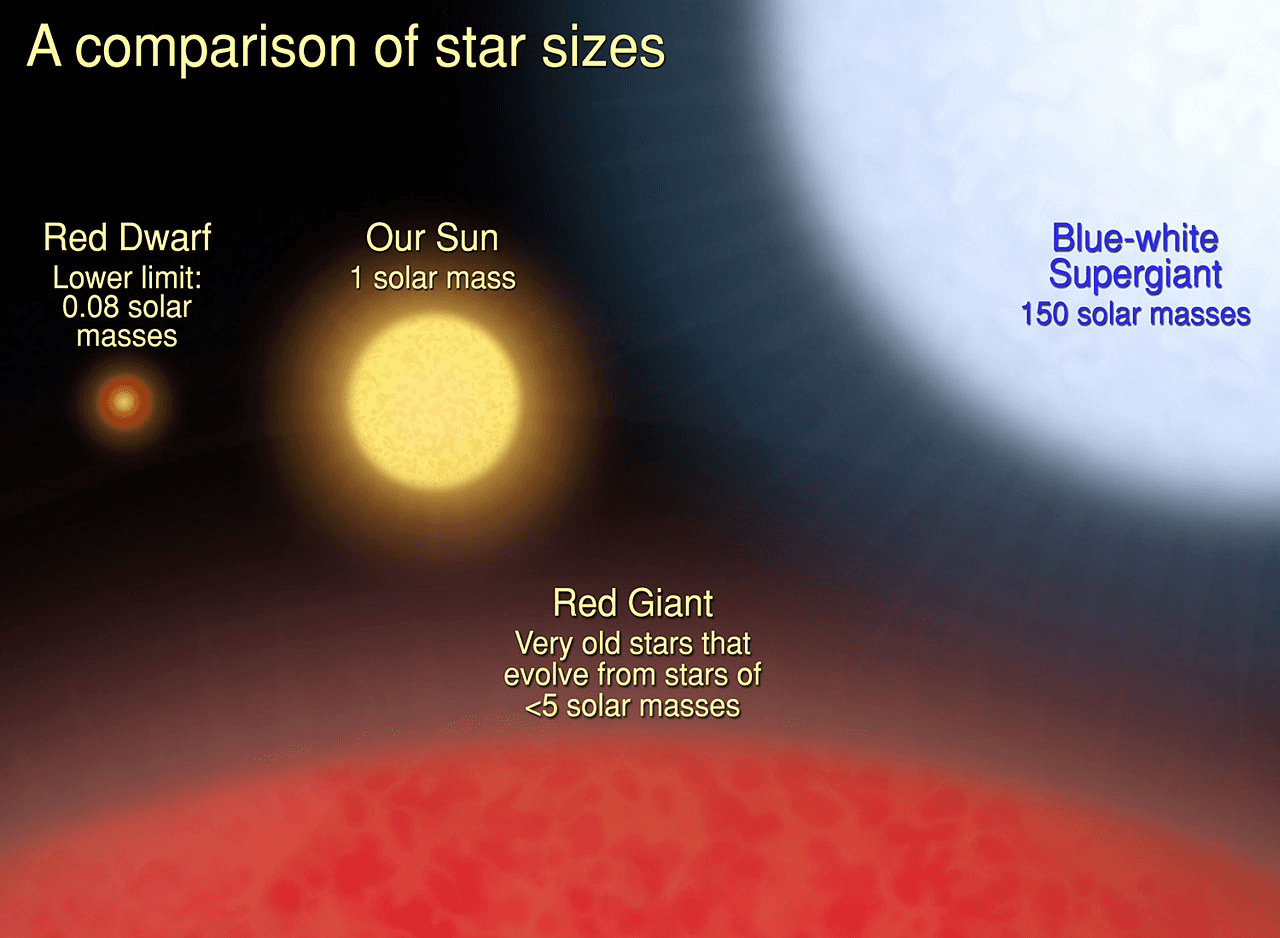
Exoplanet TOI-6894 b: Saturn-sized gas giant orbiting red-dwarf star TOI-6894 in Leo constellation, outside Solar System

Host star: only 21 % Sun’s mass—smallest known to carry such a massive planet, defying prevailing formation theories

Detection: NASA TESS transit data, confirmed by radial-velocity measurements on ESO’s Very Large Telescope, Chile

Quick Facts for MCQs

Planetary Formation Challenge

  • Anomaly; gas giant around low-mass star contradicts core-accretion models expecting only rocky planets
  • Result; compels revision of star-disk mass threshold assumptions in planet-formation theory

Stellar Demographics

  • Red dwarfs dominate Milky Way population, increasing chances of similar unexpected gas-giant systems
  • Longevity trillions years offers prolonged, potentially stable habitable zones around such stars

Observation & Instruments

  • TESS employs transit photometry, detecting brightness dips to estimate planet radius and orbital period
  • VLT radial-velocity data quantifies planetary mass, rules out stellar companions, confirming exoplanet nature

Key Data Points

FeatureData-Point
Planet nameTOI-6894 b
Planet typeGas giant
Planet size~Saturn
Orbited starTOI-6894
Star categoryRed dwarf
Star mass21 % Sun
Record statusSmallest star hosting Saturn-class planet
ConstellationLeo
Discovery surveyNASA TESS
Follow-up facilityESO Very Large Telescope
Red-dwarf mass band7.5 %–50 % Sun
Red-dwarf luminosity0.01 %–10 % Sun
Red-dwarf lifespanTrillions of years
Nearest red dwarfProxima Centauri
GS-2Editorial

14.Evolution of India’s Foreign Policy Doctrine (Foreign Policy Doctrine)

DH
Illustration for Evolution of India’s Foreign Policy Doctrine (Foreign Policy Doctrine)

What & Where

Definition: India’s foreign policy path from Nehruvian idealism to post-2025 pre-emptive counterterror stance.

Key processes: Non-alignment, Realpolitik, Nuclear deterrence, Counterterrorism retaliation, Strike-first doctrine.

Core geography: Sub-continent (Pakistan), Himalayas (China LAC), multilateral arenas (UN, Quad, BRICS).

Quick Facts for MCQs

Doctrinal Phases

  • Idealism: anti-colonial leadership, UN faith, moral diplomacy.
  • Realpolitik: hard-power prioritised, border defence upgraded, defence institutions boosted.
  • Assertiveness: nuclear deterrence, calibrated retaliation, codified strike-first post-2025.

Security Dimension

  • Pakistan proxy war: “bleeding India” strategy using non-state actors; Pahalgam 2025 latest case.
  • China challenge: post-Galwan LAC violations demand sustained deterrence and diplomacy.
  • Public signalling: visible military ops to warn adversaries and reassure domestic opinion.

Policy Prescriptions

  • Autonomy: realistic non-alignment with flexible partnerships (US, France, Japan, West Asia).
  • Indigenous defence: expand DRDO output to cut import bills.
  • Proactive deterrence: proportional retaliation doctrine to pre-empt cross-border terror.

Key Data Points

FeatureData-Point
Non-Alignment phase1947–1962
Panchsheel signing1954, with China
Trigger for Realpolitik1962 Sino-Indian war
First nuclear test1974, Pokhran-I
CTBT/NPT stanceRejected to keep autonomy
Counterterror doctrine span2000s–2019
Uri terror attack2016, proxy war example
Operation Sindoor2025, pre-emptive strike
Core sloganZero-tolerance to terror
Atmanirbhar defence toolsBrahMos, Agni, INS Arihant

Related UPSC Prelims PYQs

ESE_GS, GS1 2025PYQ 1

Which one of the following is not the principle of India’s Foreign Policy for Panchsheel?

ESE_GS, GS1 1997PYQ 2

Which one of the following is NOT a principle of “Panchsheel”?

GS-3Security

15.Combat Drones Transforming Modern Warfare (Unmanned Aerial Vehicles)

The Hindu

What & Where

Definition – UAV/drone: pilot-less aircraft remotely or autonomously flown; roles span ISR, strike, logistics.

Key Types – Surveillance, UCAV, Loitering munitions, Swarm, Nano; exemplars Heron, Reaper, Harpy, Nagastra-1, Black Hornet.

India – Used in Operation Sindoor (Pahalgam), Ladakh standoff; development led by DRDO, startups, tri-service commands.

Quick Facts for MCQs

Tech & Schemes

  • Stealth – Aura adopts flying-wing design plus AI target recognition.
  • Sensors – EO/IR packages beam live feeds via encrypted data-links to IACCS nodes.
  • Swarm R&D – MoD funding AI-coordinated 20-plus drone systems for saturation strikes.

Security Dimension

  • Precision – Reaper killed General Soleimani without troop deployment, zero collateral.
  • Asymmetry – Low-cost drones threaten high-value AD assets, altering cost-benefit of war.
  • Psychological – Persistent overhead ISR deters movement, demoralises adversaries.

Challenges & Gaps

  • Vulnerability – High attrition when facing layered electromagnetic and kinetic defences.
  • Regulation – Fragmented civil-military rules slow seamless UAV deployment over India.
  • Production – Inconsistent orders deter scaling, despite 3D-printing modular potential.

Key Data Points

FeatureData-Point
Longest endurance mentioned52 hours (select HALE platforms)
Max range cited>7,000 km for strategic UAVs
Indian armed importsHeron TP, MQ-9 Reaper (lease)
Indigenous stealth projectDRDO Aura/“Ghatak” UCAV
Cost asymmetry example$2,000 quadcopter disabling Russian S-300
2020 swarm successAzerbaijan over Armenian Nagorno-Karabakh defences
Loitering munition roleSelf-destructs on radar/missile units (Harpy, Nagastra-1)
Civil-military regulation gapNo seamless airspace coordination in current Indian rules
Counter-drone methodsJamming, spoofing, radar-guided interceptors
Key domestic startupsIdea Forge, Solar Industries

Related UPSC Prelims PYQs

GS1 2025PYQ 1

मानव-रहित वायु वाहन (UAV) के संदर्भ में, निम्नलिखित कथनों पर विचार कीजिए :

GS1 2025PYQ 2

भारत की रक्षा के संदर्भ में, निम्नलिखित युग्मों पर विचार कीजिए :

GS-2Scheme

16.Pradhan Mantri Surakshit Matritva Abhiyan Milestones (Maternal Health)

DD News
Illustration for Pradhan Mantri Surakshit Matritva Abhiyan Milestones (Maternal Health)

What & Where

Scheme: Pradhan Mantri Surakshit Matritva Abhiyan provides free quality antenatal care on every 9th day across all government facilities

Geography: Nationwide coverage; extended surveillance through e-PMSMA for high-risk pregnancies till 45 days post-delivery

Governance: Ministry of Health & Family Welfare with volunteer OB-GYN, radiologists, physicians from private sector

Quick Facts for MCQs

Objectives

  • Coverage: ensure at least one specialist ANC in later trimesters
  • Detection: early identification and management of high-risk pregnancies
  • Tracking: name-based digital monitoring for continuous follow-up

Service Package

  • Single-window: ultrasound, labs, IFA, calcium, counselling delivered same visit
  • Tagging: coloured stickers on MCP card classify risk for quick referral
  • Specialists: OB-GYN led team supplements public workforce with private volunteers

Digital & Incentives

  • Alerts: automated SMS remind scheduled check-ups under e-PMSMA
  • Incentives: cash paid when three additional ANC visits completed
  • Monitoring: real-time portal publishes coverage and outcome dashboards

Key Data Points

FeatureData-Point
Parent ministryMoHFW
PMSMA launchJune 2016
e-PMSMA launchJan 2022
Fixed ANC day9th of every month
Minimum specialist ANC≥ 1 in 2nd/3rd trimester
Risk tag coloursGreen = no risk; Red = HRP
HRP follow-upUp to 45 days postpartum
Digital toolsNational portal + mobile app
SMS alerts sent toPregnant woman & ASHA
Extra incentivised ANC visits3 beyond standard
Cash incentive beneficiariesWoman + ASHA
Max monthly sessions in vulnerable areas4

Related UPSC Prelims PYQs

GS1 2024PYQ 1

With reference to the ‘Pradhan Mantri Surakshit Matritva Abhiyan’, consider the following statements:

GS1 2023PYQ 2

जननी सुरक्षा योजना के संबंध में, निम्नलिखित कथनों पर विचार कीजिए :

GS-2Scheme

17.Goa Achieves Full Functional Literacy Under ULLAS (Adult Literacy Program)

PIB
Illustration for Goa Achieves Full Functional Literacy Under ULLAS (Adult Literacy Program)

What & Where

Functional literacy – ability to use reading-writing-numeracy for daily, civic and economic tasks

ULLAS / New India Literacy Programme – 2022-27 centrally sponsored adult-literacy scheme for 15 + non-scholars

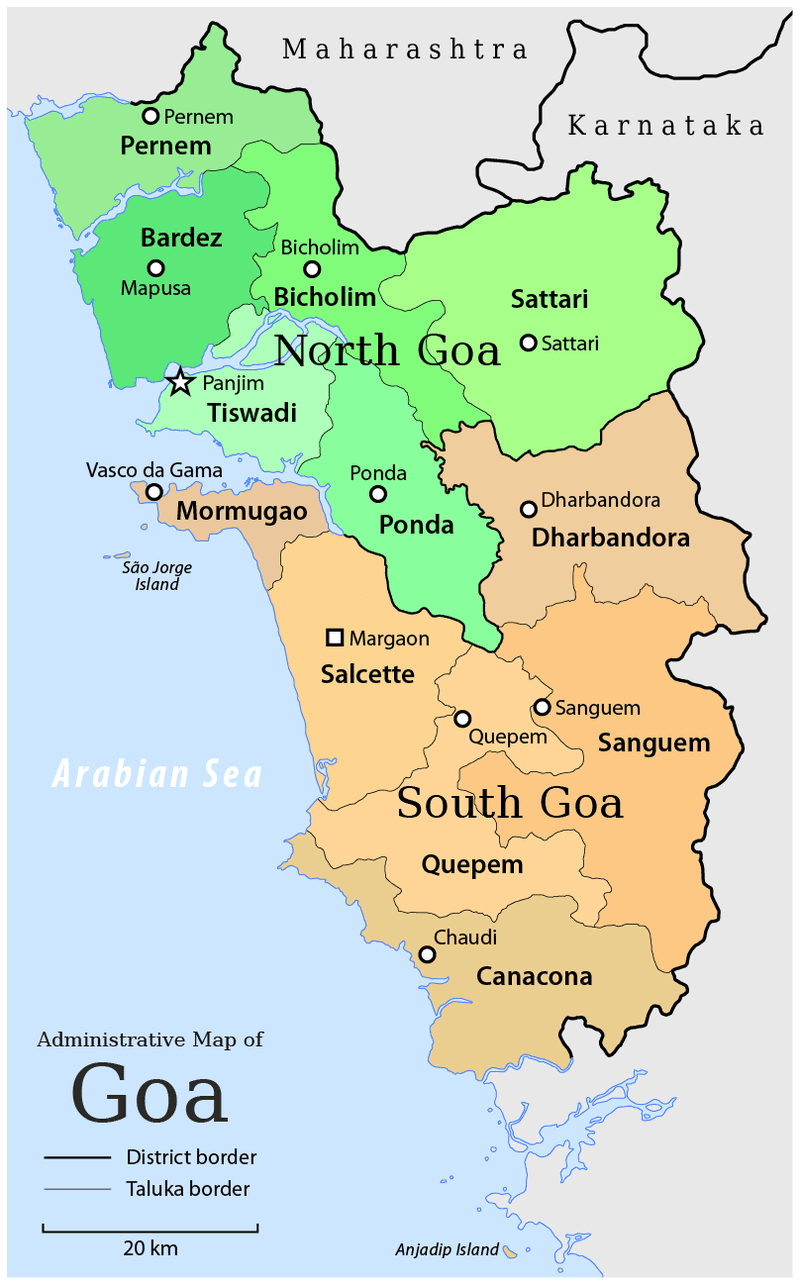
Goa – Konkan coastal state, west of Western Ghats; capital Panaji

Quick Facts for MCQs

Tech & Schemes

  • Digital-access; DIKSHA provides multilingual e-content, quizzes, certification
  • Volunteerism focus; promotes Kartavya Bodh and community ownership
  • Hybrid delivery; offline teaching aids supplemented by QR-linked resources

Geography & History

  • Liberation; Operation Vijay freed Goa, Daman, Diu in Dec 1961
  • Statehood; Goa became India’s 25th state on 30 May 1987
  • Commemorations; 19 Dec Goa Liberation Day, 30 May Statehood Day

Targets & Benchmarks

  • FLNAT certification mandatory for recognising functional literacy
  • 95 % threshold aligns with UNESCO functional literacy standards
  • Outcome monitoring via periodic ULLAS surveys and PLFS cross-verification

Key Data Points

FeatureData-Point
Goa functional literacy statusDeclared Full-Functionally-Literate Jun 2025
Literacy benchmark used≥ 95 % functionally literate
PLFS 2023-24 Goa literacy93.60 %
First full-functional literate stateMizoram
First UT achieving sameLadakh
Scheme full nameULLAS-Nav Bharat Saaksharta Karyakram
Earlier nameAdult Education Programme
Scheme spanFY 2022-27
Target learners5 crore (1 crore/year)
Age eligibility15 years +
Five componentsFLN, Critical Life Skills, Basic Education, Vocational Skills, Continuing Education
Implementation styleVolunteer-based hybrid (online + offline)
Digital platformsDIKSHA & ULLAS portal/app
Language support22 Indian languages
AssessmentFLNAT in local schools, twice a year

Ready to practice?

Test your knowledge with our UPSC test series.

Start Free Trial