UPSC Current Affairs

16 topicsGS-1: 4GS-2: 5GS-3: 7
0/16 done
GS-2Editorial

1.Strengthening Parliamentary Oversight Mechanisms (Parliamentary Oversight)

THE HINDU

What & Where

Parliamentary oversight – continuous legislative scrutiny ensuring executive accountability in Indian parliamentary democracy.

Key tools – Question Hour, Zero Hour, motions, debates, Department-related Standing Committees (DRSCs).

Jurisdiction – Lok Sabha, Rajya Sabha; analogous mechanisms encouraged in state legislatures.

Quick Facts for MCQs

Oversight Tools

  • Question Hour disruptions: Pegasus row, frequent adjournments curb ministerial replies.
  • Zero Hour and adjournment motions diluted by protests and walkouts.
  • No-confidence or censure motions rarely employed in 17th Lok Sabha.

Committee Mechanism

  • DRSC reports seldom reach floor debate; Delhi pollution (2021) and Data Protection (2022) examples.
  • Annual member shuffle weakens domain continuity; technical support staff minimal.
  • India lacks non-partisan research wing akin to US Congressional Research Service.

Reform Proposals

  • Institutionalise Post-Legislative Scrutiny via DRSC sub-panels, mirroring UK 3–5 year review cycle.
  • Provide multilingual summaries, infographics, dedicated analysts to amplify committee outputs.
  • Launch Parliamentary Modernisation Scheme using AI dashboards to flag budget or scheme anomalies.

Key Data Points

FeatureData-Point
Constitutional anchorArticle 75(3) collective responsibility
Question Hour productivity (17th LS)60 % sittings functional
Question Hour productivity (17th RS)52 % sittings functional
No. of DRSCs24 (subject-wise)
Membership rotationEvery 1 year, reducing expertise
Post-legislative scrutiny in IndiaNo formal system
UK PLS timelineDept. review after 3–5 years
Example ignored report2022 IT panel on Data Protection Bill

Related UPSC Prelims PYQs

GS1 2001PYQ 1

In what way does the Indian Parliament exercise control over the administration?

GS1 2017PYQ 2

The Parliament of India exercises control over the functions of the Council of Ministers through
GS-2Editorial

2.Judicial Activism and Constitutional Balance (Judicial Activism)

The Hindu
Illustration for Judicial Activism and Constitutional Balance (Judicial Activism)

What & Where

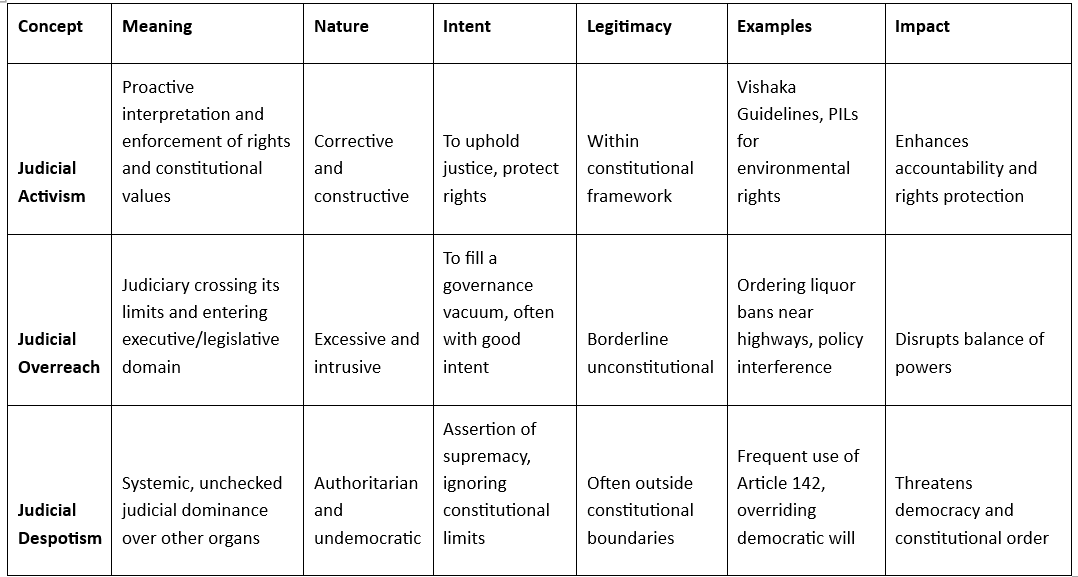
Judicial despotism: higher courts wield excessive power, eclipsing legislature–executive balance in India.

Key levers: judicial review (Arts 13, 32, 226), extraordinary authority under Art 142, public-interest suo-motu actions.

Jurisdiction: Supreme Court nationwide; 25 High Courts over respective states/UTs.

Quick Facts for MCQs

Constitutional Tools

  • Article 142; residuary, discretionary, non-appealable, fills legislative voids.
  • Judicial review declared basic structure in Kesavananda 1973; insulated from amendments.
  • Art 137 allows SC to revisit own judgments, reinforcing self-check mechanism.

Activism Cases

  • Vishaka 1997; court framed workplace sexual-harassment code before Parliament law.
  • Tehri liquor-shops 2017; order relocated vendors 500 m from national highways.
  • Women officers 2024; permanent commissions mandated in Army despite statutory silence.

Restraint Cases

  • Demonetisation, Rafale, NRC Assam, UAPA-bail upheld; minimal interference in executive policy.
  • Same-sex marriage plea 2023; court left recognition to Parliament, citing separation of powers.
  • Pending hearings: CAA 2019, EVM, Pegasus; selective passivity flagged by scholars.

Key Data Points

FeatureData-Point
Article empowering “complete justice”Art 142
Articles implying judicial review13, 32, 226, 131-136, 137
Kesavananda Bharati verdict year1973
Minerva Mills verdict year1980
Example of SC policy directive500 m liquor-shop buffer from NHs
First sexual-harassment guidelines caseVishaka 1997
Key activism compensation caseBhopal Gas Tragedy 1989
Recent restraint: same-sex marriagePetition dismissed 2023
NJAC struck down2015 Fourth Judges Case
SC power to issue mandamus to President/GovernorAsserted 2024

Related UPSC Prelims PYQs

GS1 2019PYQ 1

With reference to the Constitution of India, prohibitions or limitations or provisions contained in ordinary laws cannot act as prohibitions or limitations on the constitutional powers under Article 142. It could mean which one of the following?

GS1 2017PYQ 2

In India, ‘judicial review’ implies

GS-2Polity

3.National Human Rights Commission Mandate (Statutory Body)

Business Standard

What & Where

NHRC India – statutory, autonomous watchdog safeguarding rights to life, liberty, equality, dignity.

Created 12 Oct 1993 by Protection of Human Rights Act, 1993; HQ New Delhi.

Operates through inquiries, jail visits, advisories, awareness drives nationwide.

Quick Facts for MCQs

Legal & Policy

  • Statute-basis 1993 Act lays mandate; 2019 Amendment added NHRC Secretary-General as CEO, trimmed member tenures.
  • Power-under CPC 1908 enables summon, witness examination, document requisition.
  • Advisory-scope covers Constitution safeguards & UN human-rights treaties.

Institutional Structure

  • Chairperson-post filled only by retired CJI, ensuring judicial independence.
  • Membership-mix blends judiciary and domain experts, promoting multidisciplinary oversight.
  • Ex-officio-link with national Commissions fosters integrated rights redressal chain.

Social Concerns

  • Kerala-jails flagged for poor infrastructure, staff shortage impairing inmate education access.
  • NHRC-initiated suo-motu probe leveraging jail-visit mandate for conditions assessment.
  • Recommendation-path may include compensation, infrastructure upgrades though enforcement depends on governments.

Key Data Points

FeatureData-Point
Legal foundationProtection of Human Rights Act, 1993
Latest amendment2019 Act broadened eligibility, tenure changes
StatusStatutory, non-constitutional, autonomous
Establishment date12 Oct 1993
HeadquartersNew Delhi
Chairperson eligibilityRetired Chief Justice of India
Voting members4 (1 SC judge, 1 HC CJ, 2 experts)
Ex-officio membersChairpersons: SC, ST, Women, Minorities Commissions etc.
Investigatory triggerPetition or suo-motu cognizance
Judicial powerCivil-court powers under CPC 1908
Recommendation natureAdvisory, not legally binding

Related UPSC Prelims PYQs

CAPF_GAI, CDS_GK 2023PYQ 1

राष्ट्रीय मानव अधिकार आयोग का गठन किस कानून के अधीन किया गया था ?

CAPF_GAI, CDS_GK 2024PYQ 2

निम्नलिखित में से कौन-सा, मानव अधिकार संरक्षण अधिनियम, 1993 की अधिकारिता में नहीं है?

GS-3Economy

5.World Audio Visual Entertainment Summit (Media Summit)

Indian Express

What & Where

WAVES = World Audio Visual Entertainment Summit, annual platform linking creators with global investors and buyers

Initiated by Ministry of Information & Broadcasting, Government of India

2025 edition hosted in Mumbai, positioning India as strategic content-commerce hub

Quick Facts for MCQs

Economic Angle

  • ₹250 crore media-entertainment deals sealed within 36 hours of summit opening
  • Structured B2B transactions framework accelerates deal closure and investment matchmaking
  • Summit aims to brand India as lucrative global media market

International Collaboration

  • Platform hosts investors, buyers, collaborators from multiple countries for cross-border content partnerships
  • Landmark international co-production announcements highlighted during 2025 edition
  • Objective to position India as preferred global hub for content commerce

Tech & Schemes

  • Focus on high-growth verticals viz film, OTT platforms, VFX, animation, music
  • Provides launchpad for emerging Indian creators to pitch directly to worldwide studios
  • Government-backed initiative complements Make in India creative economy push

Key Data Points

FeatureData-Point
Full formWorld Audio Visual Entertainment Summit
Nodal ministryInformation & Broadcasting
Host city (2025)Mumbai
Deals mobilised≈ ₹250 crore in first 1.5 days
Core focus sectorsFilm, OTT, VFX, Animation, Music
Primary objectiveFacilitate cross-border media collaboration
GS-3Economy

6.MSME Competitiveness Report Findings (MSME Competitiveness)

DD news
Illustration for MSME Competitiveness Report Findings (MSME Competitiveness)

What & Where

Blueprint report “Enhancing MSMEs Competitiveness in India” by NITI Aayog & Institute for Competitiveness, 2024.

Targets financing, skilling, innovation, market linkages for 6.3 crore Indian MSMEs.

Flags extra policy push for Northeast & Eastern India.

Quick Facts for MCQs

Finance Gap

  • Credit-access rise still leaves 81 % unmet demand, necessitating deeper formal lending channels.
  • Recommends interest subvention, collateral-free instruments and fintech risk assessment to shrink ₹80 lakh crore gap.
  • Suggests integrating GST, Udyam and banking datasets for dynamic MSME credit scoring.

Skill & Technology

  • Identifies minimal workforce with formal vocational training; urges massive skilling aligned to Industry 4.0 needs.
  • Calls for higher R&D spend, cluster-based tech upgrades, plus hand-holding on digital marketing and branding.
  • Promotes common facility centres for shared prototyping, testing and quality certification.

Governance & Outreach

  • Finds poor scheme awareness; advises multilingual portals, local helplines and B2B matchmaking events.
  • Proposes state-level MSME competitiveness dashboards for real-time monitoring and feedback loops.
  • Emphasises logistics tie-ups, targeted incentives for Northeast and East regional clusters.

Key Data Points

FeatureData-Point
Releasing bodiesNITI Aayog + Institute for Competitiveness
Release year2024
Micro/Small formal credit access 202014 %
Micro/Small formal credit access 202420 %
Medium enterprise credit access 20204 %
Medium enterprise credit access 20249 %
MSME credit demand met19 %
Estimated credit gap₹80 lakh crore
NITI Aayog set-up1 Jan 2015
NITI Aayog chairpersonPrime Minister of India

Related UPSC Prelims PYQs

ESE_GS, GEO_GS 2021PYQ 1

Micro, Small & Medium Enterprises (MSMEs) contribute significantly in the economic and social development of the country. Which of the following measures is / are taken by the Government with respect to MSMEs?

ESE_GS, GEO_GS 2026PYQ 2

Which institution released the report titled “India’s Blue Economy: Strategy for Harnessing Deep-Sea and Offshore Fisheries”?

GS-3Infrastructure

7.Vizhinjam Deep-Water Transshipment Port (Port Infrastructure)

Economic Times
Illustration for Vizhinjam Deep-Water Transshipment Port (Port Infrastructure)

What & Where

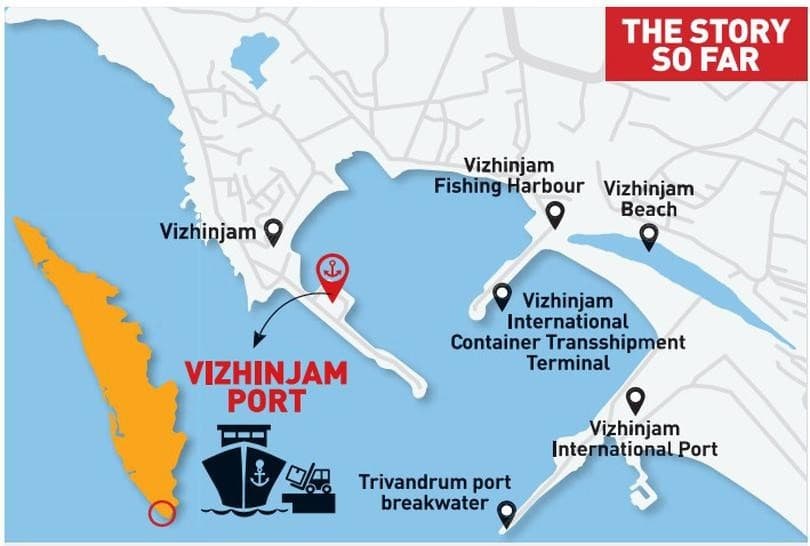
Vizhinjam International Seaport — India’s first deep-water, all-weather, fully automated trans­shipment port.

Sited at Vizhinjam, 16 km south of Thiruvananthapuram; merely 10 NM off Suez–Far-East sea-lane.

Operates on landlord model: Kerala Govt owner; Adani Ports & SEZ 40-yr concessionaire.

Quick Facts for MCQs

Strategic Significance

  • Direct competition to Colombo, Singapore, Jebel Ali; positions India as South-Asia transshipment hub.
  • Cuts double-handling, voyage detours; boosts Make in India export reliability.
  • Proximity to international sea-lane strengthens maritime domain awareness & naval logistics.

Tech & Infrastructure

  • Automation; AI-driven VTMS enables high-density vessel traffic with reduced turnaround.
  • Natural 24 m draft eliminates costly, eco-risky dredging.
  • Integrated cruise berth, on-dock rail, long tunnel enhance multimodal evacuation.

Economic Angle

  • Potential to process half of national transshipment, retaining value within domestic ports.
  • Supports containerised export of electronics, textiles, seafood, perishables from both coasts.
  • Lower handling costs expected to attract global carriers, spurring coastal job creation.

Key Data Points

FeatureData-Point
Natural depth24 m (no capital dredging)
Max vessel size24,000 + TEU ULCVs
Breakwater depth28 m – India’s deepest
Shipping-lane offset10 nautical miles
Ownership modelKerala Govt; Adani 40-yr O&M
Port categoryDeep-water, all-weather, automated
Cargo share aim50 % of India’s transshipment
Forex saving> $200 million/yr
Traffic managementAI-based VTMS + radar
Tallest STS craneRecord for India
Planned rail tunnel3rd longest nationally

Related UPSC Prelims PYQs

GS1 2009PYQ 1

In which one of the following States has India's largest private sector sea port been commissioned recently?

GS1 2023PYQ 2

Consider the following pairs:

GS-1History

8.Sacred Relics of Buddha (Buddhist Relics)

PIB

What & Where

Sacred Relics = physical remains or personal objects of Gautama Buddha, focal to global Buddhist devotion.

Now displayed in Ho Chi Minh City, Vietnam, for UN Vesak Day 2025 celebrations.

Custody with National Museum, New Delhi; outreach backed by Ministry of Culture & International Buddhist Confederation.

Quick Facts for MCQs

Relic Categories

  • Saririka: bones, teeth, ashes of Buddha
  • Paribhogika: personal utilities such as robe, bowl, staff
  • Uddesika: representational items—stupas, sculptures, images

Major Relic Sites

  • Bodh Gaya: enlightenment under Bodhi tree; UNESCO World Heritage
  • Piprahwa (UP): Kapilavastu relics tied to Shakya clan
  • Kandy (Sri Lanka): Temple of Sacred Tooth; high ritual status

Cultural Diplomacy

  • Outreach: relic tours to Mongolia (2022), Thailand (2023), Vietnam (2024-25)
  • Goal: deepen Buddhist heritage bonds, project India’s soft power
  • Message: promotes regional harmony through shared spiritual legacy

Key Data Points

FeatureData-Point
Relic natureSaririka, Paribhogika, Uddesika
Current foreign venueHo Chi Minh City, Vietnam
Core custodianNational Museum of India
Supporting bodiesMoC + International Buddhist Confederation
Past overseas showcasesMongolia, Thailand, now Vietnam
Symbolic teachingsPeace, Non-violence, Enlightenment
Enlightenment siteMahabodhi Temple, Bodh Gaya
First sermon siteSarnath, Dhammacakkappavattana
Tooth Relic locationKandy, Sri Lanka
Kapilavastu relic findPiprahwa, Uttar Pradesh

Related UPSC Prelims PYQs

NDA_GAT 2022PYQ 1

Early Buddhist sculptors did not show Buddha in human form. Through which of the following symbols was Buddha's presence shown by the early sculptors?

GS-1History

9.Archaeological Survey of India Overview (ASI Functions)

New Indian Express

What & Where

Agency: ASI is India’s apex body for archaeological research, protection and conservation.

Domains: Terrestrial excavations plus revived Underwater Archaeology Wing (UAW) for submerged sites.

Geography: HQ 24 Tilak Marg, New Delhi; new UAW surveys planned off Maharashtra coast.

Quick Facts for MCQs

Organisational Setup

  • Headquarters: New Delhi; functions through regional circles & branches.
  • Leadership: Director-General heads; UAW now receiving staff expansion.
  • Collaboration: Works with state archaeology wings, IITs, Indian Navy, foreign institutes.

Core Functions

  • Survey: Systematic exploration, mapping and documentation of cultural remains.
  • Conservation: Structural repairs, chemical preservation, site management of notified monuments.
  • Publication: Issues excavation reports, conservation manuals, annual Indian Archaeology review.

Underwater Focus

  • Revival: UAW re-energised to chart offshore sites, shipwrecks, drowned settlements.
  • Tech use: Side-scan sonar, sub-bottom profilers, diving archaeology protocols.
  • Priority zone: Konkan coast, including Maharashtra’s submerged ports & forts.

Historical Milestones

  • 1861 origin under Lord Canning statute; pioneering surveys launched.
  • 1871 departmental status granted; systematic documentation begun.
  • Post-1958 Act: Mandate widened to legal protection of national monuments.

Key Data Points

FeatureData-Point
Establishment year1861
Founder & 1st DGAlexander Cunningham
Revival as dept.1871
Parent ministryMinistry of Culture
Statutory logo motifSanchi Stupa
Monuments under care3,600 +
Key ActAncient Monuments & Archaeological Sites and Remains Act 1958
Flagship journalIndian Archaeology – A Review

Related UPSC Prelims PYQs

CDS_GK, GS1 2004PYQ 1

The Archaeological Survey of India is an attached office of the Department/Ministry of

CDS_GK, GS1 2021PYQ 2

The location of the ancient city of Taxila (Takshshila), mentioned in ancient Indian texts, was identified by

GS-1HistoryQuick Bite

10.Jagannath Digha Kalinga-Style Temple (Kalinga Architecture)

Indian Express
Illustration for Jagannath Digha Kalinga-Style Temple (Kalinga Architecture)

What & Where

Jagannath Dham Temple, Digha (Purba Medinipur, West Bengal); inaugurated Apr 2024, modelled on 12th-c Puri shrine

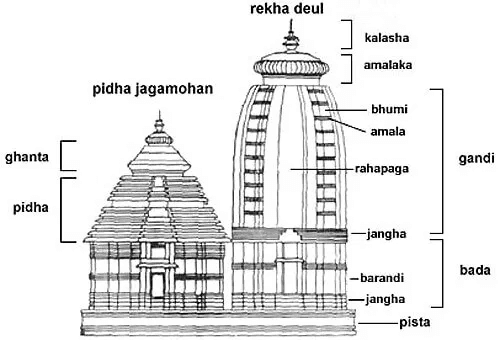
Exhibits Kalinga temple layout: Vimana, Jagamohan, Nat Mandir, Bhog Mandap around Ratnabedi platform

Houses stone idols of Jagannath, Balabhadra, Subhadra; contrasts with Puri’s neem-wood Darubrahma deities

Quick Facts for MCQs

Architecture

  • Layout mirrors Rekha Deula tower with adjacent Jagamohan and subsidiary halls typical of Kalinga idiom
  • Shikhara crowned by Sudarsana-style chakra, echoing Puri visual silhouette
  • Stone carvings replicate Odisha iconography yet adopt Bengal coastal motifs

Materials

  • Sandstone sourced from Rajasthan’s Bansi Paharpur quarry, noted for longevity and pink hue
  • Absence of metal reinforcing; traditional interlocking stone technique employed
  • Stone idols allow permanent darshan, eliminating Nabakalebara-type replacements

Rituals & Symbolism

  • Triad worship aligns with Vaishnavite pan-Indian circuit linking Puri, yet local festivals adapted to Bengal calendar
  • Ratnabedi placement signifies cosmic seat concept; mirrors Jagannath cosmology
  • Flag orientation in Puri cited to illustrate temple’s mystique, boosting pilgrimage appeal

Key Data Points

FeatureData-Point
State & townDigha, West Bengal
Inauguration month-yearApril 2024
Architectural styleKalinga (Odisha sub-style)
Core materialBansi Paharpur pink sandstone
Number of main structures4 (Vimana, Jagamohan, Nat Mandir, Bhog Mandap)
Deity triadJagannath – Balabhadra – Subhadra
Idol material (Digha)Stone
Idol dais nameRatnabedi
Parent inspirationJagannath Temple, Puri
Puri builderKing Anantavarman Chodaganga Deva, Eastern Ganga dynasty
Puri idol materialNeem-wood logs
Nabakalebara interval12–19 years
Char Dham status (Puri)One of four; others Badrinath, Dwarka, Rameswaram
Optical quirks (Puri)Flag flies against wind; Sudarsana Chakra appears identical from all directions

Related UPSC Prelims PYQs

GS1 1996PYQ 1

Which one of the following temples figured in the news regarding the institution of the Devadasis?

GS1 2015PYQ 2

With reference to the art and archaeological history of India, which one among the following was made earliest?

GS-1Environment

11.Western Disturbances Impact on India (Western Disturbances)

Indian Express
Illustration for Western Disturbances Impact on India (Western Disturbances)

What & Where

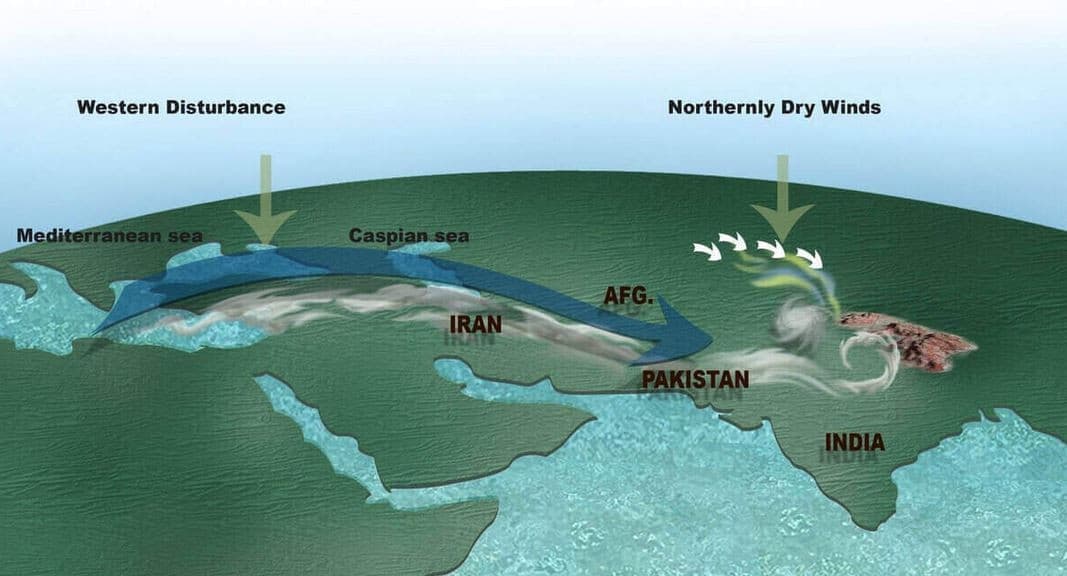
Definition: Eastward-moving extra-tropical cyclones originating over Mediterranean-Caspian-Black Seas, termed Western Disturbances (WDs).

Formation: Polar–tropical air interaction rides subtropical westerly jet, creates embedded low-pressure waves crossing Hindu Kush–Himalaya.

Impact belt: Iran–Afghanistan–Pakistan corridor to North, Central, occasionally South India, giving winter rain, snow, storms.

Quick Facts for MCQs

Climatic Impact

  • Winter-rain driver, supplies up to 30 % annual precipitation northwest India
  • Heatwave moderation, frequent WDs cap pre-monsoon max temps
  • Monsoon interaction, overlapping systems intensify June–July downpours

Climate-Change Trends

  • Frequency spike, more post-Jan 2025 events noted by IMD
  • Jet intensification, stronger meridional swings widen WD reach into central peninsula
  • Moisture surge, warmer Arabian Sea loads systems causing flash floods

Agriculture & Economy

  • Yield booster, timely Jan–Feb showers vital for grain filling
  • Loss amplifier, hailstorms damage orchards Vidarbha, Bihar, Himachal
  • Insurance need, variable WD timing pushes demand for weather-indexed cover

Disaster & Infrastructure

  • Urban flooding, Delhi airport closures and metro waterlogging during intense spells
  • Landslide risk, saturated slopes in J&K, Himachal, Uttarakhand
  • Transport disruption, snowbound highways and flight diversions across North India

Key Data Points

FeatureData-Point
Trough typeExtra-tropical cyclone
Jet streamSubtropical westerly (≈30° N)
Usual peak monthsDecember–March
New active monthsMay–July (post-2000s)
Origin basinsMediterranean, Caspian, Black
Arabian Sea SST rise+1.2–1.4 °C
Key crop supportedRabi wheat in Punjab–Haryana–wUP
Journal citing 70-yr shiftWeather and Climate Dynamics 2024
Typical trajectory height5–7 km above mean sea level
Recent extreme year2025: floods Delhi, Telangana

Related UPSC Prelims PYQs

GS1 2001PYQ 1

Assertion (A): Anti-cyclonic conditions are formed in winter season when atmospheric pressure is high and air temperatures are low.

GS1 2010PYQ 2

If there were no Himalayan ranges, what would have been the most likely geographical impact on India?

GS-3Environment

12.Climate Impact on Caspian Sea (Caspian Sea Shrinkage)

Nature

What & Where

Tectonic lake; world’s largest enclosed inland water body; endorheic basin.

Bordered by Russia, Azerbaijan, Iran, Turkmenistan, Kazakhstan along Euro-Asian frontier.

Fed chiefly by Volga, Ural, Terek rivers; evaporation is principal water-loss process.

Quick Facts for MCQs

Biodiversity Impact

  • Caspian seal: only marine mammal in basin, IUCN Endangered, habitat shrinking with waterline retreat
  • Beluga sturgeon: critically endangered, spawning grounds desiccating, jeopardising caviar exports

Economic Angle

  • Ports: Baku, Anzali, Aktau, Turkmenbashi, Lagan risk becoming inland, crippling trade
  • Hydrocarbon fields: Kashagan, Filanovsky may turn landlocked, raising extraction costs
  • Volga navigation: Lower levels threaten sole maritime corridor linking Caspian to global seas

Public Health & Stability

  • Desiccated seabed dust: pollutant-laden salt aerosols could mirror Aral Sea respiratory crises
  • Livelihoods: fisheries, shipping, oil revenues imperilled across five littoral states
  • Regional stability: resource stress may inflame interstate disputes over navigation, hydrocarbon access

Key Data Points

FeatureData-Point
Projected level drop (< 2 °C warming)5–10 m by 2100
Projected level drop (higher warming)Up to 21 m by 2100
Flagship endemic mammalCaspian seal – IUCN Endangered
Flagship fish speciesBeluga sturgeon – Critically Endangered
At-risk portsBaku, Anzali, Aktau, Turkmenbashi, Lagan
Sole maritime outletVolga River
Oil–gas fields threatenedKashagan (Kazakhstan), Filanovsky (Russia)
Basin typeEndorheic tectonic lake

Related UPSC Prelims PYQs

GEO_GS 2022PYQ 1

Volga River drains into which one of the following seas?

GS-3SpeciesQuick Bite

13.Hyena Ecology and Conservation (Hyena Species)

Down to Earth

What & Where

Hyenas = carnivorous mammals of family Hyaenidae; closest ecological analogue to canids.

Four extant species: spotted, striped, brown hyenas and aardwolf (termite-eater).

Natural range spans most African biomes plus West to South-west Asia out to India.

Quick Facts for MCQs

Behaviour & Social

  • Spotted hyenas form complex matriarchal clans, demonstrating advanced cognition and cooperative hunting.
  • Striped hyenas largely solitary; brown hyenas form small mixed-sex clans with wandering males.
  • Aardwolves are monogamous, typically living alone or in pairs.

Feeding Ecology

  • Spotted hyenas both active predators and talented scavengers; frequently steal kills from lions, leopards.
  • Brown hyenas mainly scavenge but augment diet with fruits, small vertebrates.
  • Aardwolves specialise on harvester termites, showing dentition adapted for insectivory.

Conservation Awareness

  • International Hyena Day counters negative folklore, highlights species’ indispensable sanitation role.
  • Public vilification hampers support for hyena protection despite crucial ecosystem functions.
  • Awareness drives stress coexistence benefits in rangelands across Africa-Asia interface.

Key Data Points

FeatureData-Point
International Hyena Day27 April (observed 2025)
Total extant species4 (spotted, striped, brown, aardwolf)
Dominant social unit (spotted)Female-led clan
Aardwolf dietAlmost exclusively termites
Brown hyena habitScavenger; nomadic males, small clans
Striped hyena activityNocturnal, mainly solitary
Key ecological servicesCarrion cleanup, disease control, nutrient recycling
Usual mislabel“Villain of African Savanna” stereotype
Behavioural kleptoparasitismCommon in spotted hyenas
GS-3S&T

14.Non-Contact Health Monitoring Wearable (Wearable Sensors)

The Hindu
Illustration for Non-Contact Health Monitoring Wearable (Wearable Sensors)

What & Where

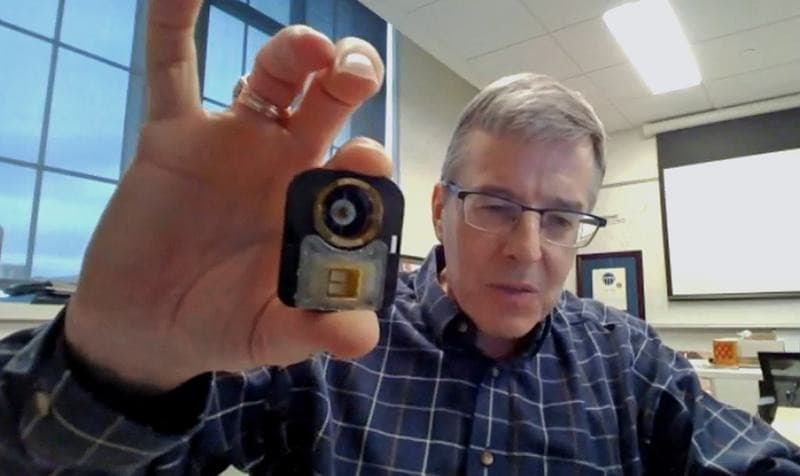
Non-contact wearable tracks bidirectional molecular flux (water vapour, CO₂, VOCs) through skin without physical touch.

Built at Northwestern University, USA, by team led by Prof John A Rogers alongside South-Korean partners.

Smartphone-sized device houses sealed microclimate chamber positioned millimetres above skin surface.

Quick Facts for MCQs

Tech & Design

  • Microclimate chamber traps emitted molecules enabling precise flux quantification.
  • Remote valve modulates airflow, providing baseline and dynamic measurements.
  • Wireless data relay allows continuous, untethered patient monitoring.

Medical Applications

  • Wound-healing assessment in diabetics and chronic ulcers via moisture and CO₂ outputs.
  • Barrier-function, hydration diagnostics for dermatological conditions like eczema, psoriasis.
  • Post-COVID telemedicine integration for home-based vital monitoring.

Industrial & Commercial Uses

  • Hazardous-chemical exposure surveillance for factory and field workers.
  • VOC tracking interests perfume, cosmetics R&D for skin–product interaction insights.
  • Low-cost production envisaged for rural, resource-limited healthcare deployments.

Key Data Points

FeatureData-Point
Measurement targetsWater vapour, Carbon dioxide, Volatile organic compounds
Skin contactZero; operates through adjacent air gap
Core componentSealed chamber with remote-controlled valve
Key electronicsWireless module + miniature chemical sensors
Comparative readingsValve toggles closed vs open states
Potential new metricSkin-flux as additional “vital sign”
Main advantagesNon-invasive, dual-flux tracking, low-cost scalability
Device sizeApprox. smartphone dimensions
GS-3S&T

15.Natural Geologic Hydrogen Potential (Natural Hydrogen)

The Hindu
Illustration for Natural Geologic Hydrogen Potential (Natural Hydrogen)

What & Where

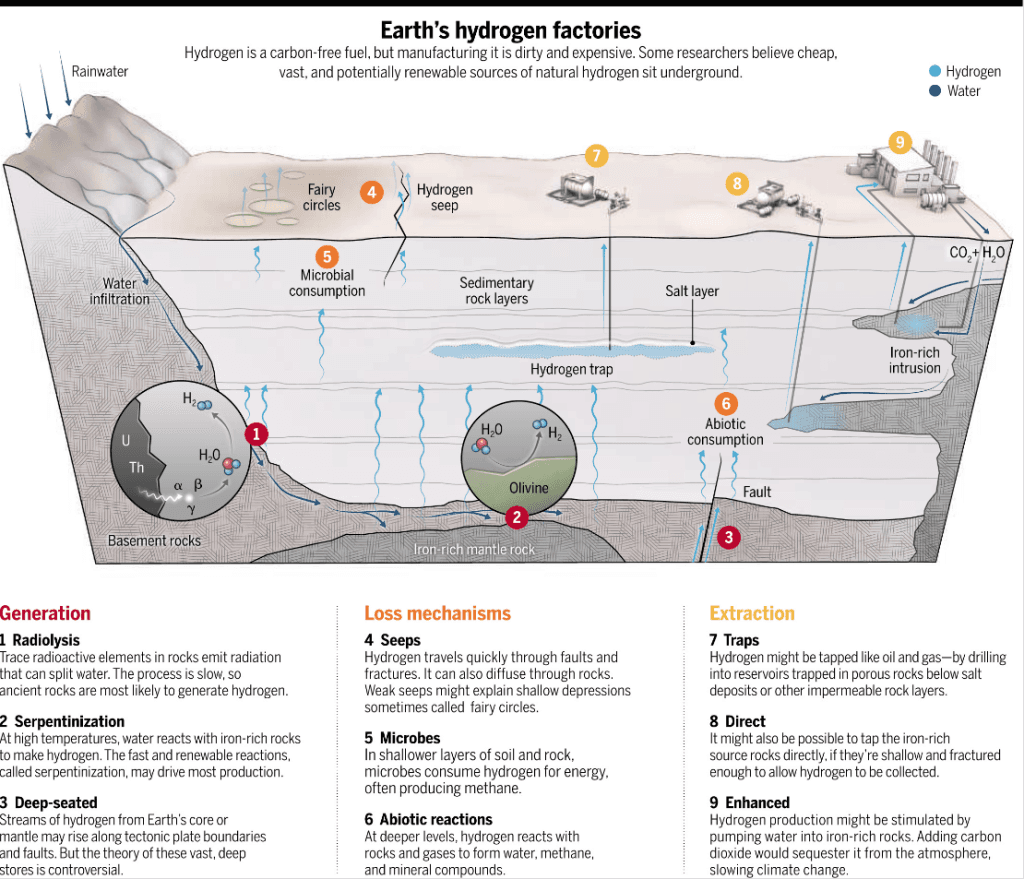
Definition: naturally occurring H₂, aka geologic/white hydrogen, generated in Earth’s crust without anthropogenic input

Processes: serpentinisation of ultramafic rocks, radiolysis by radioactive minerals, deep organic decomposition

Geography: seeps mapped on six continents; Indian targets include ophiolite belts, Vindhyan–Cuddapah–Gondwana basins, hot-spring zones

Quick Facts for MCQs

Geological Formation

  • Serpentinisation: water reacts with iron-rich olivine, liberates H₂ continuously
  • Radiolysis: natural radioactivity splits subsurface water molecules, adding to hydrogen stock
  • Organic burial: deep thermochemical breakdown of kerogen releases H₂ over geologic time

International Discoveries

  • Mali: Bourakébougou well commercialised, supplies village power since 2012
  • France: Lorraine & Moselle core logging suggests half current world production in situ
  • Mapping: Australia, USA, Canada, Spain, South Korea report active hydrogen seeps

Indian Prospects

  • Lithology: ultramafic complexes of Sukinda, Naga-Arakan, Andaman ideal for serpentinisation
  • Basins: Vindhyan, Cuddapah, Gondwana, Chhattisgarh flagged for possible radiolytic H₂ pockets
  • Indicators: active hydrothermal springs and volcanic gases hint at ongoing hydrogen generation

Economic Angle

  • Cost: natural H₂ extraction projected cheaper than both green and grey alternatives
  • Investment: “hydrogen rush” sees quadrupled exploration firms between 2020-23

Key Data Points

FeatureData-Point
Alternate nameWhite / geologic hydrogen
First Mali borehole flare1987
Purity at Bourakébougou≈ 98 % H₂
French Lorraine–Moselle find≈ 92 million tonnes
Countries with documented seeps> 10
Recoverable share to double NG energyOnly 2 % geological H₂
Global demand coverage≈ 200 years (at 2 % recovery)
Production cost estimate≤ USD 1 per kg
Explorers 2020 vs 202310 → 40 companies
Atmospheric concentration0.5–1.0 ppm
Share in Earth’s crust (weight)0.75 %
GS-2Mapping

16.Sandy Cay Reef Sovereignty Dispute (South China Sea)

The Hindu
Illustration for Sandy Cay Reef Sovereignty Dispute (South China Sea)

What & Where

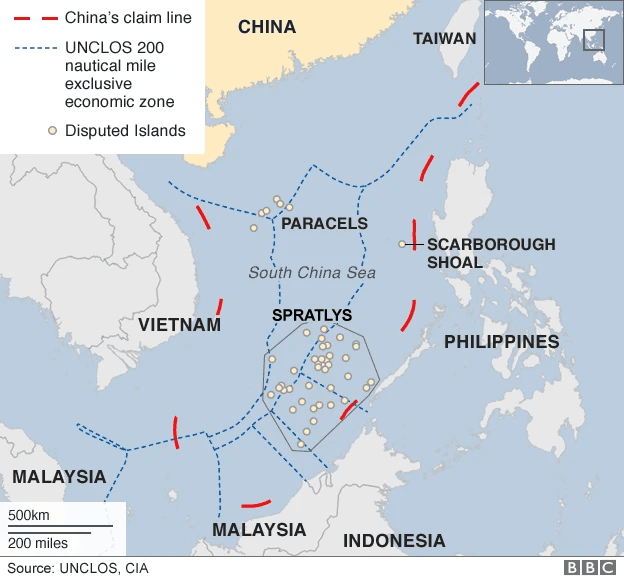
Sandy Cay (Reef) = small sandbar–reef cluster, incl. Tiexian Reef, 2 km west of Pag-asa Island (Thitu), Spratly Islands, SCS

Hotspot in South China Sea sovereignty dispute; claimed by China, Philippines, Taiwan, Vietnam

Lies within China’s asserted Nine-Dash Line; close to key Philippine-held airstrip and village on Pag-asa

Quick Facts for MCQs

Security Dimension

  • Balikatan 2025 involved 11,000+ troops, missile-firing near Reed Bank
  • China intensifying coast-guard, militia patrols around Sandy Cay
  • Reef’s proximity to Philippine airstrip raises rapid-deployment stakes

Legal & Policy

  • Permanent Court of Arbitration ruling under UNCLOS dismissed Nine-Dash Line historic rights
  • China rejects award, maintains island-building and patrols
  • ASEAN Code-of-Conduct talks stalled; incident adds pressure

Claimants & Geography

  • Philippines administers Pag-asa with civilian community, airstrip since 1970s
  • Vietnam nearest base = Southwest Cay, ~22 km south
  • Taiwan holds Itu Aba, largest natural Spratly feature, ~200 km north

Key Data Points

FeatureData-Point
Nearest Philippine outpostPag-asa Island (Thitu)
Alternate Chinese nameTiexian Reef
Island groupSpratly Islands
Main claimantsChina, Philippines, Taiwan, Vietnam
Nine-Dash Line coverage≈ 90 % of South China Sea
2016 PCA verdictChina’s historic-rights claim invalid
Recent drill nearbyBalikatan 2025, US–Philippines
US view on drills“Deterrence”; China calls “provocative”

Related UPSC Prelims PYQs

GS1 2022PYQ 1

Which one of the following statements best reflects the issue with Senkaku Islands, sometimes mentioned in the news?

Ready to practice?

Test your knowledge with our UPSC test series.

Start Free Trial