UPSC Current Affairs

14 topicsGS-1: 2GS-2: 5GS-3: 7
0/14 done
GS-2Polity

1.Chief Justice of India Appointment Process (Judiciary)

News on Air

What & Where

Chief Justice of India: apex judicial post, appointed per Article 124(2), heads Supreme Court & higher judiciary.

52nd CJI: Justice Bhushan R. Gavai; will take oath 14 May 2025, after Justice Sanjiv Khanna.

Acting CJI: senior-most available judge discharges duties under Article 126 during vacancy/absence.

Quick Facts for MCQs

Constitutional Basis

  • Article 124(2) empowers appointment; Article 126 enables temporary charge.
  • Constitution sets no fixed term, only age cap of 65 years.

Appointment Procedure

  • Seniority convention guides outgoing CJI’s recommendation to Law Ministry.
  • Law Ministry forwards to PM; President issues warrant after fitness clearance.
  • Gazette publication finalises assumption of office.

Eligibility & Tenure

  • Candidate must be Indian citizen plus one of three prescribed legal experiences.
  • Holds office till 65 years or resignation/removal under Constitution.

Key Data Points

FeatureData-Point
Constitutional article (appointment)Article 124(2)
Constitutional article (acting)Article 126
Appointing authorityPresident of India
Executive advice routePrime Minister after consulting outgoing CJI
Upper age limit65 years
Traditional normSenior-most SC judge recommended
Minimum HC judge service5 years
Minimum HC advocate practice10 years
Alternate eligibility“Distinguished jurist” at President’s discretion
Official appointment mediumGazette of India notification

Related UPSC Prelims PYQs

CAPF_GAI 2021PYQ 1

उच्चतम न्यायालय के न्यायाधीश के रूप में किसे नियुक्त किया जा सकता है?

CAPF_GAI 2022PYQ 2

Which one of the following is correct in respect of the appointment of District Judges?
GS-2Polity

2.Arbitration Reform in India (Alternative Dispute Resolution)

The Hindu

What & Where

Arbitration – voluntary ADR; neutral arbitrator issues binding award under Arbitration & Conciliation Act 1996

Main variants – domestic, international commercial, institutional (e.g., India International Arbitration Centre)

Hub – IIAC, New Delhi, created 2019 to brand India a global arbitration venue

Quick Facts for MCQs

Legal & Policy

  • Amendments 2015, 2019, 2021 mandate timelines, institutional push, minimal court meddling
  • Draft A&C Amendment Bill 2024 seeks stronger institutionalisation and faster awards
  • CPC 1908 Sec 89 empowers courts to shift disputes to ADR, incl. arbitration

Institutional Framework

  • IIAC offers low-cost, globally aligned arbitral facilities
  • ACI chaired by ex-SC/HC judge or eminent expert; grades institutions, arbitrators
  • Proposed National Accreditation Board to certify multidisciplinary arbitrators

Challenges

  • Retired-judge dominance breeds court-like, time-heavy, high-cost proceedings
  • Thin pool of engineers, economists, technologists limits handling of technical disputes
  • Indian arbitrators under-represented in cases lacking Indian parties

Reform Proposals

  • Arbitration Awareness Mission via Startup India, MSME Sambandh, Skill India for Tier 2/3 reach
  • Commercial courts staffed with arbitration specialists to uphold minimal judicial intervention
  • Tie-ups with SIAC, ICC; host global summits to raise India’s arbitral visibility

Key Data Points

FeatureData-Point
Case backlog >10 yrs≈ 50 lakh
Judges per million21
FDI inflow 2024USD 1 trillion
Award deadline post-201912 mths + 6 mth extension
First statuteIndian Arbitration Act 1899
Current umbrella lawA&C Act 1996
Model adoptedUNCITRAL 1985
Autonomous regulatorArbitration Council of India 2019
National centreIIAC 2019
Key SC rulingBALCO v Kaiser 2012

Related UPSC Prelims PYQs

ESE_GS 2025PYQ 1

Which one of the following is correct with respect to the Industrial Relations Bill?

GS-1History

3.Raghuji Bhosale Dynasty Founder (Maratha History)

Times of India

What & Where

Ceremonial Firangi sword of Maratha general Raghuji Bhosale I repatriated by Maharashtra from a London auction house.

Key sword types mentioned: indigenous Khanda; hybrid Firangi with European blade, Indian hilt.

Core geography: Nagpur-based Bhosale dynasty, control over Vidarbha, Chhattisgarh, Odisha, Bengal; sword seized/gifted post-1817 Battle of Sitabuldi.

Quick Facts for MCQs

Historical Figure

  • Raghuji Bhosale I founded Nagpur Bhosale line; loyal to Chhatrapati Shahu Maharaj.
  • Expanded Maratha hold over Chhattisgarh, Sambalpur, parts of Odisha & Bengal.
  • Encouraged local weapon artisanship blending imported blades with indigenous hilts.

Weaponry

  • Khanda: straight, double-edged, 9th–10th c., Rajput-Sikh-Maratha favourite, all-Indian steel.
  • Firangi: European single-edge blade + Indian basket hilt; suited for cavalry thrusts & prestige.
  • Reclaimed sword typifies Firangi; decorative, purpose likely ceremonial not battlefield.

Repatriation Effort

  • Maharashtra invoked cultural heritage grounds to bid successfully at London auction.
  • Adds to India’s ongoing drive to retrieve artefacts removed during colonial era.
  • Highlights state-level initiative complementing Union cultural diplomacy.

Regional Influence

  • Bhosale control secured mineral-rich Vidarbha, boosting Maratha war economy.
  • Military wins in Bengal, Deccan checked Nawab ambitions, extending Maratha taxation rights.

Security Dimension

  • Post-Sitabuldi British possession of Maratha arms symbolised power shift after Third Anglo-Maratha War.

Key Data Points

FeatureData-Point
Purchase cost (incl. all charges)₹47.15 lakh
Likely blade originSolingen, Germany
Hilt styleLocal Mulheri, gold inlay
Grip wrap colourGreen (ceremonial)
Sword inscription“Shrimant Raghoji Bhosale Senasaheb Subha Firang”
Raghuji Bhosale I eraEarly 18th century
Title from Shahu MaharajSenasaheb Subha
Major battles ledBengal 1745, 1755; Kurnool & Cuddapah victories
Dynasty’s mineral zoneVidarbha—rich in iron, copper
Possible British acquisitionWar loot or gift after Sitabuldi 1817
GS-1S&T

4.India Monsoon Forecasting Evolution (Monsoon Forecasting)

Indian Express

What & Where

Monsoon forecasting – scientific estimation of seasonal rainfall over India via observations and numerical models

Forecast horizons – nowcasting 0–6 h; short-range 1-3 d; medium 4-10 d; long-range 10 d-2 yr

Long Period Average (LPA) – 1971-2020 mean SW monsoon ≈ 87 cm; 96-104 % tagged normal

Quick Facts for MCQs

Historical Timeline

  • 1882 Blanford correlated Himalayan snow cover with monsoon strength
  • 1904 Walker introduced 28 global predictors creating first large statistical model
  • 1988 Gowariker power-regression replaced colonial Walker model in IMD operations

Tech & Schemes

  • MMCFS couples ocean–land–atmosphere enhancing seasonal dynamical skill
  • MME integrates multiple global climate models delivering probabilistic guidance
  • Doppler radars, AWS and ocean buoys expand real-time data capture network

Limitations

  • Systematic model biases yield regional rainfall errors and miss extremes
  • ENSO and IOD teleconnections weakening post-2000, lowering forecast skill
  • District-level accuracy remains low, limiting local advisories

Future Roadmap

  • AI-ML planned for bias correction and pattern recognition
  • High-resolution dynamic grids aimed for sub-district agriculture services
  • Wider global data sharing to strengthen ensemble prediction power

Key Data Points

FeatureData-Point
IMD establishment1875
2025 SW monsoon outlook105 % of LPA (above normal)
Current LPA base1971-2020 (87 cm)
Gowariker model predictors16 variables
SEFS parameters5 (Apr) + 6 (Jun)
MMCFS launch year2012
MME adoption2021
Nowcasting time window0–6 hours

Related UPSC Prelims PYQs

GS1 2002PYQ 1

For short-term climate prediction, which one of the following events, detected in the last decade, is associated with occasional weak monsoon rains in the Indian sub-continent?

GS-3Editorial

5.India Waste Management Challenges (Plastic Pollution)

The Hindu
Illustration for India Waste Management Challenges (Plastic Pollution)

What & Where

Waste management: collection, segregation, treatment, disposal of solid, liquid, plastic waste to curb environmental degradation.

India: world’s highest plastic polluter, 9.3 million t/yr; rural areas & informal sector largely unrecorded.

Supreme Court: Vellore tanneries case applies continuing mandamus nationwide for time-bound waste remediation.

Quick Facts for MCQs

Legal & Policy

  • Rules: segregation at source, single-use bans, EPR targets, decentralized responsibility to Panchayats.
  • Jute Packaging Act mandates eco-friendly jute for select foodgrains, sugar.
  • SC stresses State liability for compensation, ecological restoration costs.

Data Gaps

  • Statistics exclude rural waste, open burning, informal recycling, causing severe underreporting.
  • No uniform audit methodology or third-party verification across local bodies.
  • SC calls for real-time public dashboards and mandatory audits.

Infrastructure

  • Majority cities rely on unlined dumps; sanitary landfills scarce.
  • Absent geotagging links between ULBs, MRFs, recyclers, EPR kiosks hamper traceability.
  • Rural areas outside formal collection, widening urban-rural waste divide.

Judicial Oversight

  • Continuing mandamus enables periodic compliance reviews, contempt threat ensures execution.
  • Vellore template may guide nationwide waste cases for swift remediation.
  • Courts can direct polluter cost recovery and monitor restoration timelines.

Technology & Schemes

  • Proposed AI, GIS tracking, geotagged waste maps for live monitoring.
  • Local EPR kiosks to be manned by PIBOs, easing citizen deposit.
  • Infrastructure mapping mandated for every ULB & Gram Panchayat below 1 Ha landfill threshold.

Key Data Points

FeatureData-Point
India’s annual plastic emission9.3 million tonnes (Nature, 2025)
Per-capita plastic waste (Nature)0.54 kg/day
Per-capita official estimate0.12 kg/day
Dumpsite : sanitary landfill ratio10 : 1
Plastic Waste Management Rules2016; amended 2018, 2021, 2022, 2024
Mandatory Jute Packaging Act2010
EPR liable entitiesProducers, Importers, Brand Owners (PIBOs)
Rural governance bodyGram Panchayat
Judicial tool highlightedContinuing mandamus
Key SC principlePolluter Pays & State pays/take back

Related UPSC Prelims PYQs

GS1 2019PYQ 1

In India, ‘extended producer responsibility’ was introduced as an important feature in which of the following?

GS1 2019PYQ 2

As per the Solid Waste Management Rules, 2016 in India, which one of the following statements is correct?

GS-3Environment

6.Bandhavgarh Tiger Reserve (Tiger Reserve)

Hindustan Times
Illustration for Bandhavgarh Tiger Reserve (Tiger Reserve)

What & Where

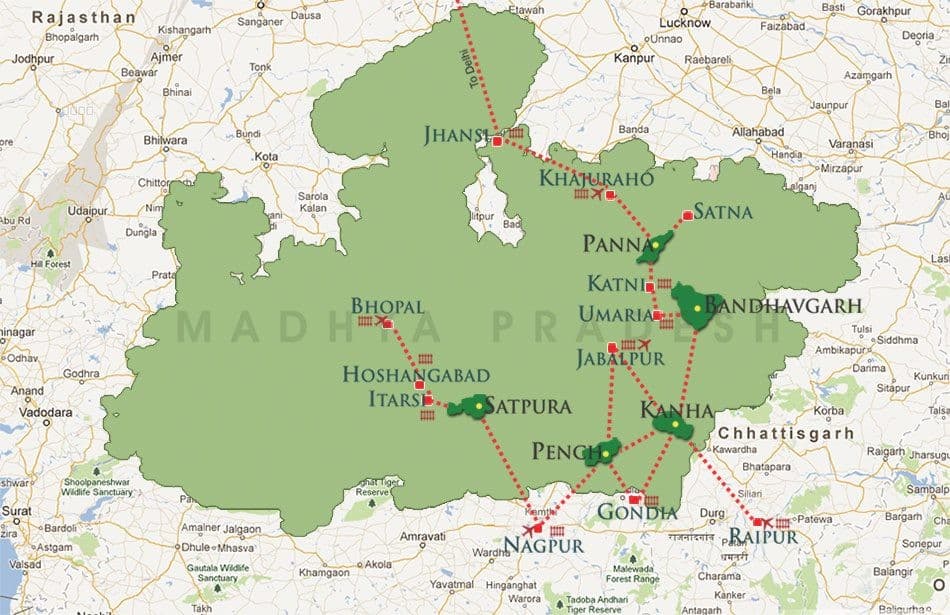
Tiger Reserve & National Park in Umaria district, Madhya Pradesh, on the Vindhya ranges.

Notified National Park 1968; upgraded 1993 under Project Tiger.

Integral to central-Indian highland corridor, holding world’s densest Royal Bengal Tiger population.

Quick Facts for MCQs

Legal & Policy

  • SupremeCourt dismissed illegal-mining plea; labelled frivolous abuse.
  • ₹1 lakh cost imposed on petitioner, deterring baseless environmental litigation.
  • Tiger Reserve notified 1993 under Project Tiger, ensuring stronger protection.

Biodiversity

  • Hosts world’s densest Royal Bengal Tigers; predators include leopard, wild dog, wolf, jackal.
  • Major prey: chital, sambhar, barking deer, nilgai, chinkara, wild pig, chowsingha.
  • Vegetation: Sal forests with bamboo, tendu, saj, dhaora, arjun, amla, palas.

Historical Heritage

  • Bandhavgarh Fort linked to Treta Yuga and Ramayana legends.
  • Inscriptions cite Vakataka, Sengar, Kalchuri, Baghel dynastic periods.
  • Area once royal Rewa hunting grounds; numerous archaeological remains.

Physical Geography

  • Part of central Indian highland corridor facilitating tiger gene flow.
  • No perennial river; seasonal streams sustain water-dependent biodiversity.
  • Valley-ridge topography within Vindhya range shapes habitat diversity.

Key Data Points

FeatureData-Point
StateMadhya Pradesh
DistrictUmaria
Hill rangeVindhya
National Park year1968
Tiger Reserve year1993
Forest typeDry deciduous Sal-dominated
Iconic predatorRoyal Bengal Tiger
Historic monumentBandhavgarh Fort
HydrologySeasonal streams, no major river
SC penalty (2024)₹1 lakh

Related UPSC Prelims PYQs

GS1 2007PYQ 1

Which of the following is located in the Bastar region?

GS1 2012PYQ 2

Consider the following protected areas:

GS-3Environment

7.Urban Heat Island Effect Impacts (Urban Climate)

The Hindu
Illustration for Urban Heat Island Effect Impacts (Urban Climate)

What & Where

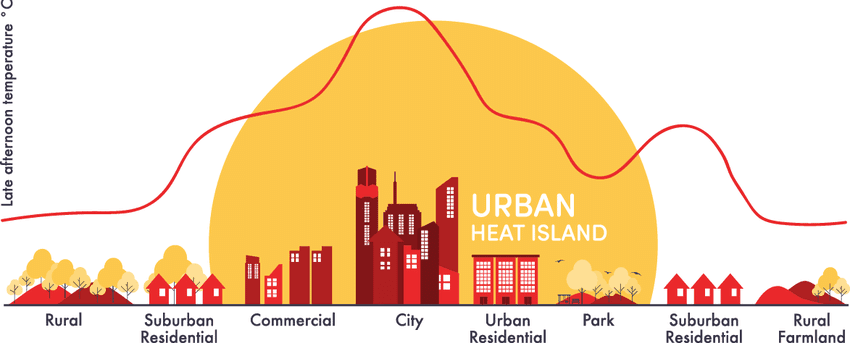
Urban Heat Island (UHI) = metropolitan zone measurably warmer than adjoining rural belt due to heat-absorbing built surfaces.

Greatest intensity in dense megacities: New Delhi, New York, Paris, London, Moscow.

2018 study: cooling effect (fewer cold deaths) outweighed heating effect (extra heat deaths) by 4.4 × globally.

Quick Facts for MCQs

Causes

  • Impervious surfaces store daytime heat and emit it nocturnally, sustaining higher temperatures.
  • Vegetation deficit curtails evapotranspiration, removing natural cooling.
  • Anthropogenic heat from traffic, industry, air-conditioning amplifies ambient warmth.

Impacts

  • Energy demand spikes for cooling, burdening power grids and emissions targets.
  • Air quality worsens through enhanced ground-level ozone formation and smog.
  • Health risks rise: heatstroke, dehydration, cardiovascular strain, especially among elderly and urban poor.

Mitigation & Examples

  • Cool roofs employ high solar reflectance and thermal emittance to deflect absorbed heat.
  • District cooling circulates centrally chilled water, slashing urban electricity use.
  • Cool Streets Paris converts car lanes to tree-lined pedestrian corridors, adding urban green cover.

Key Data Points

FeatureData-Point
2018 cold : heat mortality changeDecline 4.4 × larger than rise
Key heat-absorbing surfacesAsphalt, concrete, steel with low albedo
Peak UHI cities citedNew Delhi, New York, Paris, London, Moscow
Los Angeles Cool Roof ruleReflective roofing compulsory for all new builds & major renovations
Dubai district coolingDelivers 30–50 % more energy efficiency than standalone AC
GS-3Species

8.Red-Crowned Roofed Turtle Reintroduction (Critically Endangered)

PIB

What & Where

Species; Critically Endangered red-crowned roofed turtle (Batagur kachuga) native to northern Indian sub-continental rivers

Geography; Historical Ganga-Brahmaputra system, current viable wild population only in Chambal; 2024 reintroduction into Ganga

Context; 20 juveniles released after 30 yr under Namami Gange Mission biodiversity action

Quick Facts for MCQs

Legal & Policy

  • Protection; Highest under WPA Schedule I enabling strict penalties
  • Trade ban; CITES Appendix I prohibits international commercial exchange
  • Global priority; IUCN listing drives funding and bilateral conservation support

Biology & Ecology

  • Morphology; Hard ridged carapace aids current navigation, pointed snout enables surface breathing
  • Reproduction; Nests on dry sandbars away from waterline requiring intact riparian geomorphology
  • Feeding; Exclusive herbivory limits competition with carnivorous river fauna

Threats

  • Habitat loss; Pollution, dams, excessive water abstraction alter depth and flow
  • Nest destruction; Sand mining, riverbank cultivation erase nesting beaches
  • Poaching; Demand for meat delicacy and ornamental shell despite legal bans

Tech & Schemes

  • Captive breeding; Hatchlings raised at Turtle Conservation Centre, Sarnath since 2007
  • Release protocol; GPS tagging and post-release monitoring planned for survivorship data
  • Mission synergy; Namami Gange couples pollution abatement with flagship species recovery

Key Data Points

FeatureData-Point
Scientific nameBatagur kachuga
FamilyGeoemydidae
IUCN statusCritically Endangered
WPA statusSchedule I
CITES listingAppendix I
Female lengthUp to 56 cm
Female weight≈ 25 kg
Male size~50 % of female
Breeding monthsMarch–April
Clutch size11–30 eggs
Incubation60–70 days
DietStrict herbivore; aquatic plants, algae
Core habitatDeep, fast-flowing rivers with sandbars
Present wild strongholdChambal River
Reintroduction siteGanga River, Uttar Pradesh
Colour changeBreeding males turn red-yellow-blue on neck
Key schemeNamami Gange Mission

Related UPSC Prelims PYQs

GS1 2017PYQ 1

In India, if a species of tortoise is declared protected under Schedule I of the Wild Life (Protection) Act, 1972, what does it imply?

GS1 2013PYQ 2

Consider the following fauna of India:

GS-3S&T

9.Amazon Project Kuiper Satellite Broadband (Satellite Internet)

LiveMint
Illustration for Amazon Project Kuiper Satellite Broadband (Satellite Internet)

What & Where

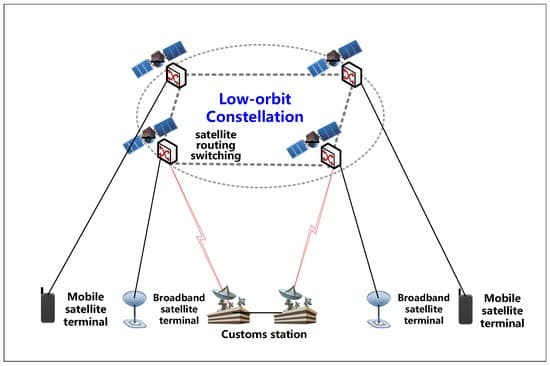
Project Kuiper: Amazon satellite-internet constellation delivering broadband globally via 3,232 Low Earth Orbit (LEO) satellites

Orbit: 630 km altitude; first 27 satellites lifted by Atlas V from Cape Canaveral, USA

Service: Target speeds 100 Mbps–1 Gbps, latency 20–40 ms for homes, institutions, governments

Quick Facts for MCQs

Tech Features

  • Constellation: Hundreds of small satellites share load, hand-off users seamlessly
  • Interlinks: Laser/radio links plus AI routing choose fastest data path
  • ACM: Adaptive Coding & Modulation maintains link quality during weather changes

International Examples

  • Starlink: SpaceX aiming 40,000+ satellites, already >6,000 operational
  • OneWeb: UK–India venture targeting 648 satellites for global coverage
  • Guowang: China planning 13,000+ satellite broadband network

Environmental Impact

  • Space-debris: Mega-constellations heighten collision probability and orbital junk
  • Astronomy: Bright tracks and radio noise hinder telescopic observations

Challenges

  • Cost: Launch, satellite build, user terminals exceed terrestrial broadband expenses
  • Weather-fade: Heavy rain notably weakens Ka and V-band links
  • Congestion: Growing LEO fleets intensify spectrum, orbital slot competition

Key Data Points

FeatureData-Point
Total satellites planned3,232
Initial batch launched27 units
Launch vehicle / siteAtlas V / Cape Canaveral
Orbit altitude≈630 km LEO
Speed tiers100 Mbps, 400 Mbps, 1 Gbps
Typical latency20–40 ms
Frequency bandsKa, Ku, C, V (exp)
Competitor Starlink fleet>6,000 satellites
GS-3S&T

10.AI Growth and Clean Energy Balance (Artificial Intelligence)

The Hindu
Illustration for AI Growth and Clean Energy Balance (Artificial Intelligence)

What & Where

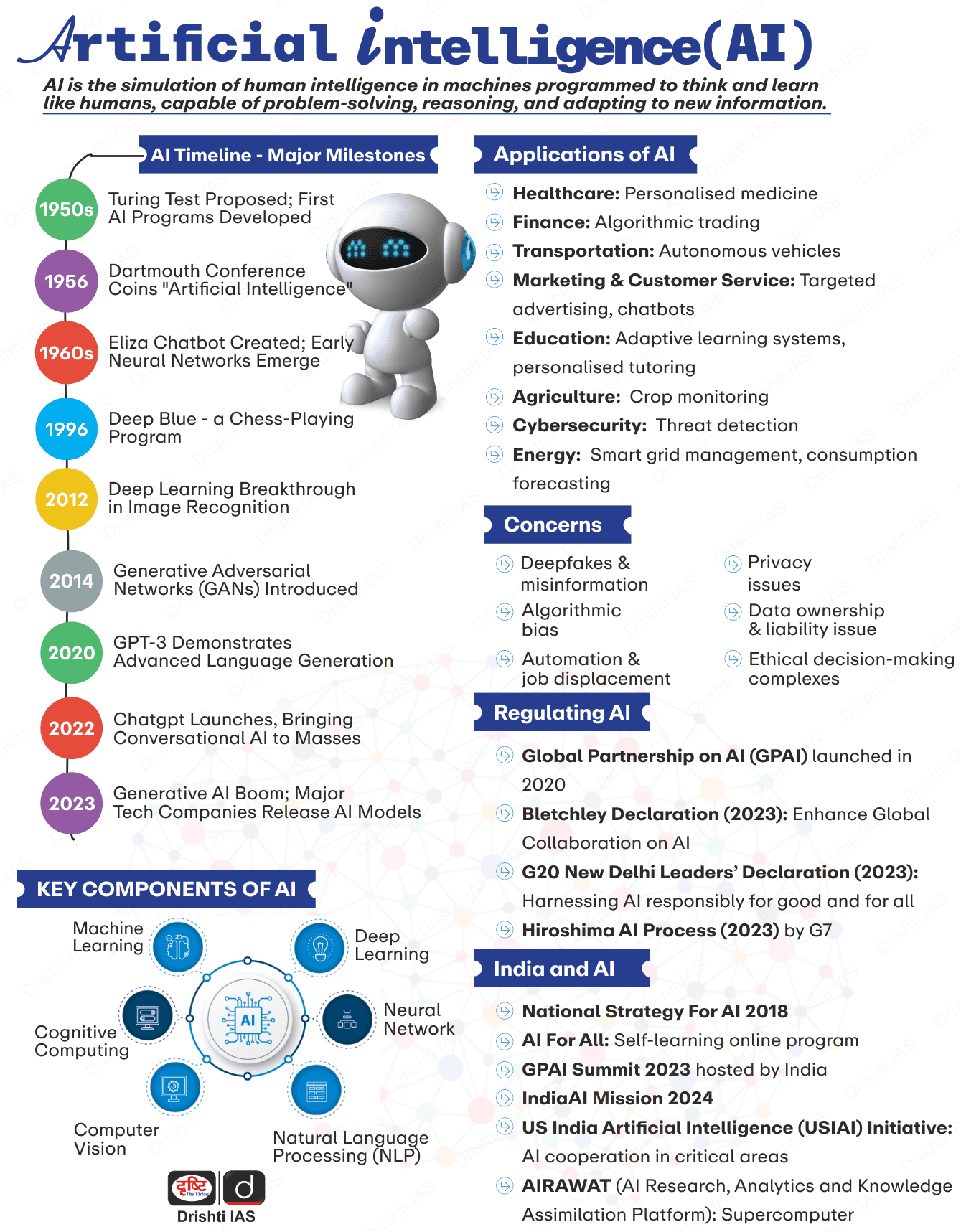
Artificial Intelligence (AI): data-driven algorithms executing cognition-like tasks; now core to India’s digital economy push.

Renewable-AI coupling: siting energy-hungry data-centres near solar, wind, green-hydrogen or small modular reactor sources.

Indian clusters: Hyderabad & Pune (Google/Microsoft), plus Green Energy Corridors linking high-irradiation western & southern belts.

Quick Facts for MCQs

Economic Angle

  • Productivity: Farm Vibes boosts yields 40 %, cuts water 50 %, fertiliser 25 %.
  • Manufacturing: Tata Steel uses predictive maintenance, aligning with “Make in India”.
  • Financial inclusion: AI-led onboarding expands UPI reach among unbanked.

Environmental Impact

  • Power demand: AI data growth could double electricity use by 2030.
  • Emissions & e-waste: servers already 1 % GHG; toxic lead/mercury risk.
  • Water stress: cooling & model training rival consumption of 6 × Denmark.

Policy & Schemes

  • IndiaAI Mission & NITI Strategy link AI rollout with renewables.
  • National Solar Mission, Green Hydrogen Mission enable green back-up for data-centres.
  • Paris AI Action Summit: India pressed for renewable alignment.

Tech & Schemes

  • Smart grids: AI forecasts load, allocates solar/wind in real time.
  • Energy-efficient hardware: low-power chips, liquid cooling promoted.
  • Pilot 100 % renewable data-centres incentivised by Central govt.

Challenges & Solutions

  • Grid limits & storage cost hinder intermittent renewables; answer: AI-optimised batteries, hydrogen cells.
  • High capex, uncertain ROI; remedy: targeted incentives, blended-finance models.
  • Mineral, water footprint; push circular e-waste rules, domestic recycling hubs.

Key Data Points

FeatureData-Point
AI value add to India (2030)₹33.8 lakh crore
Share of GDP via digital economy 202820 % (USD 1 trn goal)
Data-centre power use 2024415 TWh ≈ 1.5 % global
Projected power use 2030945 TWh; > Japan today
Energy per AI query vs Google search10 × higher
GPT-3 training water need~7 lakh litres
AI hardware GHG share 20231 %; may double by 2026
Non-fossil share India installed capacity44.72 %
Raw material for 2 kg computer800 kg mined inputs
IMF estimate: US power tariff rise from AIup to 9 %

Related UPSC Prelims PYQs

GS1 2020PYQ 1

विकास की वर्तमान स्थिति में, कृत्रिम बुद्धिमत्ता (Artificial Intelligence), निम्नलिखित में से किस कार्य को प्रभावी रूप से कर सकती है?

GS1 2025PYQ 2

ग्रैण्ड पैलै (Grand Palais) पेरिस में नवम्बर 2025 में आयोजित होने वाले AI शिखर सम्मेलन के सन्दर्भ में, निम्नलिखित कथनों पर विचार कीजिए :

GS-3S&TQuick Bite

11.GM Alfalfa Seed Import Curbs (GM Crops)

BL

What & Where

Alfalfa (Medicago sativa): leguminous fodder crop, Arabic root al-fasfasa meaning “best forage”.

GM alfalfa seed entry into India regulated under Environment (Protection) Act 1986.

United States is the world’s largest producer; cultivation largely rain-fed.

Quick Facts for MCQs

Legal & Policy

  • Restriction: Centre planning curb on GM alfalfa seed imports.
  • Empowerment: Environment (Protection) Act 1986 grants power to regulate GM organisms.
  • Diplomatic push: US urging India to lower import duties on alfalfa.

Agronomic Traits

  • Nutrition: High vitamin, mineral, protein and antioxidant content, boosts livestock productivity.
  • Soil benefit: Legume root nodules fix nitrogen, enhancing soil fertility.
  • Usage: Predominantly animal feed; also consumed by humans in salads, supplements.

International Scenario

  • Production: US leads global output, cultivating mostly under rain-fed conditions.
  • Trade angle: US producers eye Indian market amid duty and biosafety hurdles.

Key Data Points

FeatureData-Point
Botanical nameMedicago sativa
Arabic etymologyal-fasfasa = “best forage”
Crop categoryLeguminous fodder/forage
Nitrogen fixationYes, atmospheric N₂ to soil
Key nutrientsVitamins A,C,K,B; Ca, Mg, K; proteins, antioxidants
Top global producerUnited States
Indian GM regulatorEnvironment (Protection) Act 1986

Related UPSC Prelims PYQs

GS1 2018PYQ 1

भारत में विकसित आनुवंशिकतः संशोधित सरसों (जेनेटिकली मॉडिफाइड सरसों / GM सरसों) के सन्दर्भ में, निम्नलिखित कथनों पर विचार कीजिए:

GS-2Economy

12.US Special 301 IP Watchlist (IPR Watchlist)

The Hindu
Illustration for US Special 301 IP Watchlist (IPR Watchlist)

What & Where

Special 301 Report – annual USTR review of global intellectual-property protection; first issued 1989, Washington D.C.

Mandated under Section 182, U.S. Trade Act 1974; classifies partners into Watch/Priority Watch lists.

Guides U.S. trade actions, negotiations, tariffs toward listed economies.

Quick Facts for MCQs

Legal & Policy

  • Mandate identifies IPR regimes harming U.S. commerce, presses for legislative or enforcement reforms.
  • Priority Watch listing may trigger bilateral consultations, retaliatory tariffs under Trade Act sections 301/306.
  • Report references Indian Patents Act flexibilities like Section 3(d) as potential TRIPS-plus concern for pharma.

Economic Angle

  • Listing can influence FDI flows, technology licensing and drug-pricing negotiations with U.S. firms.
  • High customs duties on IPR-heavy goods viewed as non-tariff barrier, discouraging advanced tech imports.

India-Specific Concerns

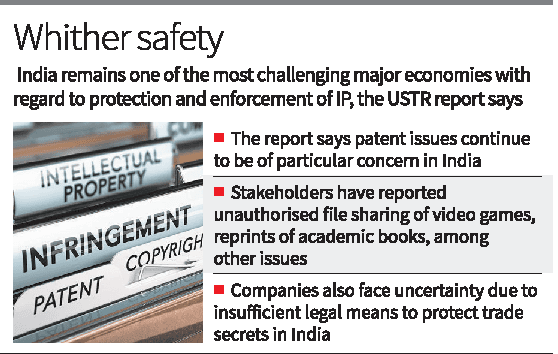
  • Enforcement gaps on digital piracy and counterfeit goods, especially in metros and online platforms.
  • Persistent signal theft affecting U.S. broadcasters; widespread photocopying of academic texts flagged.

Institutional Setup

  • USTR coordinates with USPTO, DHS, DOJ, industry coalitions during report drafting.
  • Engages Congress, WTO forums, and affected countries through out-of-cycle reviews for progress tracking.

Key Data Points

FeatureData-Point
Issuing agencyOffice of the U.S. Trade Representative (USTR)
Legal basisSection 182, U.S. Trade Act 1974
First release1989
Latest cycle considered2025 Report
India’s 2025 statusPriority Watch List (re-added)
Other PW-listed economies 2025China, Indonesia, Russia, Argentina
Key India critique 1Vague interpretation of Indian Patents Act
Key India critique 2Weak anti-piracy, anti-counterfeiting enforcement
Key India critique 3Absence of dedicated trade-secret law
Tariff concernHigh duties on ICT, solar, pharma imports
Extra issues flaggedSignal theft, academic reprint piracy, tech-protection circumvention
USTR HQWashington D.C., USA
USTR staff strength~200 trade professionals
Other USTR reportsNational Trade Estimate, Notorious Markets List

Related UPSC Prelims PYQs

ESE_GS, GS1 2026PYQ 1

Consider the following regarding intellectual property rights:

ESE_GS, GS1 2017PYQ 2

‘राष्ट्रीय बौद्धिक सम्पदा अधिकार नीति (National Intellectual Property Rights Policy)’ के सन्दर्भ में, निम्नलिखित कथनों पर विचार कीजिए :

GS-2MappingQuick Bite

13.Shahid Rajaee Port Explosion Iran (INSTC Port)

LiveMint

What & Where

Shahid Rajaee Port — Iran’s largest commercial port, operational since 1985 Iran-Iraq War

Located at Bandar Abbas, Hormozgan; abuts Strait of Hormuz chokepoint

Critical node on International North-South Transport Corridor linking Indian Ocean to Caspian, Russia, N Europe

Quick Facts for MCQs

Strategic Significance

  • Chokepoint location allows monitoring of Gulf oil traffic, heightening regional leverage
  • INSTC connectivity positions port as southern gateway for Russia-Europe trade diversification
  • Expansion plans indicate intent to retain dominance amid sanctions pressures

Trade & Infrastructure

  • Container, oil and general cargo terminals integrated, maximizing 85 % national container throughput
  • Ongoing development suggests capacity boost beyond present 4,800 ha footprint
  • Handles bulk, liquid, and containerised cargo, underpinning Iran’s maritime revenue

Security Dimension

  • Blast underscores vulnerability of dual-use facilities handling missile propellants near civilian shipping lanes
  • Incident heightens Middle East tensions amid existing Strait security patrols
  • Control of port aids Iran’s deterrence through rapid missile deployment logistics

Chemical Angle

  • Sodium perchlorate serves as oxidizer in solid-fuel rockets and missiles
  • Storage hazards include rapid deflagration when contaminated or heated
  • Incident may prompt stricter hazardous-material protocols at Gulf ports

Key Data Points

FeatureData-Point
CountryIran
Province/CityHormozgan / Bandar Abbas
Nearby straitStrait of Hormuz
World oil passing this strait≈26 %
Iran container cargo handled≈85 %
Iran oil trade handled≈52 %
Share of Iran total maritime cargo>50 %
Total port area4,800 ha
Area still under development≈50 %
Year first opened1985
Transport corridorINSTC
Chemical igniting blastSodium perchlorate
Primary chemical useBallistic-missile propellant

Related UPSC Prelims PYQs

GEO_GS 2022PYQ 1

Chabahar Port is located in which one of the following countries?

GS-2Scheme

14.Green Hydrogen Certification Scheme India (Green Hydrogen)

New Indian Express

What & Where

Definition: GHCI certifies hydrogen produced exclusively from renewable energy as “green” in India

Process focus: electrolysis and biomass conversion up to purification stage

Geography: nationwide scheme under MNRE; Bureau of Energy Efficiency acts as nodal agency

Quick Facts for MCQs

Legal & Policy

  • Compliance: annual third-party verification logged on Green Hydrogen Portal
  • Scope limit: excludes transport and storage activities from certification
  • Exemption: units producing solely for export can skip domestic certification

Tech & Schemes

  • Monitoring: digital data capture ensures traceability and transparency
  • Metric: emission intensity assigns green tag, strengthening market credibility
  • Flexibility: new production pathways can be approved by BEE fast-track

Economic Angle

  • Investment: clear standards expected to attract global capital into hydrogen projects
  • Carbon trading: verified output eligible for forthcoming domestic credit market
  • Export credibility: certification supports premium pricing in international contracts

International Examples

  • Japan & Singapore: first large-scale buyers under GHCI framework, securing 4.12 lakh t supply
  • Positioning: scheme aligns India with EU and ISO moves on hydrogen guarantees of origin

Key Data Points

FeatureData-Point
Launch ministryMNRE
Nodal agencyBureau of Energy Efficiency
Supporting missionNational Green Hydrogen Mission
Certification bodyAccredited Carbon Verification Agencies
Operational cycleEach financial year
Core metrickg CO₂-equiv per kg H₂
Guarantee instrumentGuarantee of Origin (GO)
Mandatory coverageAll domestic producers; export-only units exempt
Eligible pathwaysElectrolysis, biomass conversion; others via BEE nod
Integration targetCarbon Credit Trading Scheme 2026
National production goal5 MMT green hydrogen by 2030
Recent export MoUs4.12 lakh t derivatives to Japan & Singapore

Related UPSC Prelims PYQs

CAPF_GAI, ESE_GS 2025PYQ 1

Which of the statements given below is/are correct?

CAPF_GAI, ESE_GS 2022PYQ 2

US-based Ohmium International has started India's first green hydrogen electrolyzer manufacturing unit at

Ready to practice?

Test your knowledge with our UPSC test series.

Start Free Trial