UPSC Current Affairs

13 topicsGS-1: 1GS-3: 12
0/13 done
GS-3Economy

1.ASEAN-India Goods Trade Agreement (Free Trade Agreement)

News on Air

What & Where

Agreement ASEAN-India Trade in Goods Agreement (AITIGA) is an FTA limited to physical goods

Parties India + 10 ASEAN members; operational across Indo-Pacific economies

Scope Eliminates/reduces tariffs, moderates non-tariff barriers, uses Rules of Origin

Quick Facts for MCQs

Origin & Timeline

  • Milestone 7th ASEAN-India Economic Ministers’ meet birthed pact in 2009
  • Service and investment chapters added later via 2014 agreement
  • Review mandate issued 2022, target conclusion 2025

Tariff Framework

  • Provision Gradual duty cuts; deeper for normal track, slower for sensitive lists
  • Rule Rules of Origin minimum 35 % regional value content to claim preference
  • Safeguard Clause allows temporary duty hikes on surge-hit items

Trade Statistics

  • Surge Bilateral goods trade jumped from USD 39 bn (2009) to 121 bn (2023-24)
  • Direction ASEAN now India’s 2nd-largest trading bloc after EU
  • Deficit India’s merchandise deficit with ASEAN hovers ~USD 43 bn (2023-24)

Current Review

  • Objective Simplify customs procedures, update product schedules, add e-commerce provisions
  • Stakeholder Push Indian industry seeks shorter negative list, stricter origin checks
  • Timeline Joint Committee to submit modernised text by 2025 ministerial

Key Data Points

FeatureData-Point
Signing year2009, Bangkok
Entry into force2010
Separate services pact2014
ASEAN members coveredBrunei, Cambodia, Indonesia, Laos, Malaysia, Myanmar, Philippines, Singapore, Thailand, Vietnam
Tariff liberalisation target>75 % of tariff lines
Bilateral goods trade FY 2023-24USD 121 billion
ASEAN share in India trade11 %
Sensitive/exclusion listsAgriculture, auto parts etc.
Latest Joint Committee meet8th, New Delhi 2024
Ongoing exerciseComprehensive review to modernise AITIGA

Related UPSC Prelims PYQs

CDS_GK 2024PYQ 1

If India enters into Free Trade Agreements (FTAs) with other nations, then the growth of exports of India would depend upon which of the following?
GS-3Economy

2.Punjab Ban on Hybrid Paddy Seeds (Hybrid Rice)

Indian Express

What & Where

Hybrid paddy = crossbred non-Basmati rice aiming at higher yield, early maturity, water saving.

Core geography: majorly sown in Punjab’s Kharif belt; common hybrids Sava 127, Sava 134, Sava 7501, 27P22, VNR 203.

Punjab govt bans hybrid paddy seed sale for Kharif 2025 after rice millers’ rejection.

Quick Facts for MCQs

Legal & Policy

  • Ban order under Punjab Seed Act powers, targets sale/marketing of listed hybrid seeds.
  • Objective: align procurement with FCI norms, avoid milling losses.

Economic Angle

  • Low OTR and broken grains raise milling wastage, erode profitability.
  • Farmers face price deductions as hybrid rice fails Fair Average Quality.

Environmental Impact

  • Shorter growth cycle conserves groundwater in Punjab’s over-extracted aquifers.
  • Reduced stubble volume potentially curbs post-harvest burning episodes.

Key Data Points

FeatureData-Point
Typical yield35–40 quintals/acre (≈5–6 q higher)
Crop duration125–130 days
Out Turn Ratio (OTR) reported60–63 %
FCI minimum OTR norm67 %
Main quality issueHigh broken grain share
Water outcomeEarlier harvest cuts irrigation need
Stubble volumeLower than traditional paddy
Ban effective seasonKharif 2025
Affected seed categoryNon-Basmati hybrid paddy
Key stakeholdersFarmers, rice millers, FCI, Punjab Dept. of Agriculture
GS-3Economy

3.India Automotive Industry Global Roadmap (Automotive Sector)

PIB
Illustration for India Automotive Industry Global Roadmap (Automotive Sector)

What & Where

Report “Automotive Industry: Powering India’s Participation in GVCs” by NITI Aayog-CRISIL, 2024.

Purpose: roadmap to position India as global auto-component manufacturing & export hub by 2030.

Geography: Indian auto clusters (TN, MH, Gurugram belt) with focus on EU, UK, ASEAN, US markets.

Quick Facts for MCQs

Economic Angle

  • Contribution: 7.1 % GDP, 49 % manufacturing GDP; potential 2–2.5 mn new jobs by 2030.
  • Exports: aim 3 %→8 % global share; component output target $145 bn by 2030.
  • Middle-class demand plus EV shift sustaining robust domestic sales growth.

Key Challenges

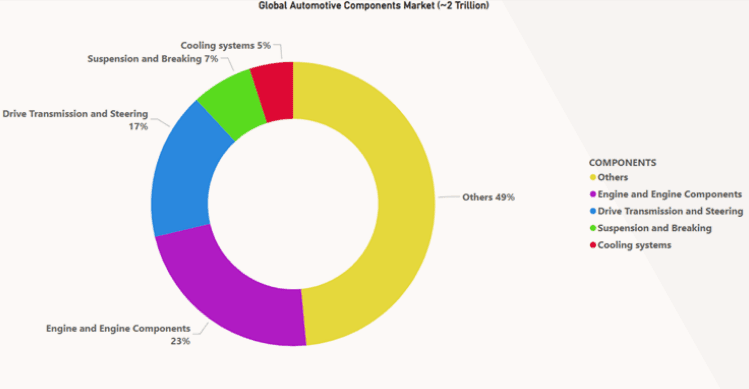
  • Cost-disability: higher capital, material, freight raising costs ≈10 % over China.
  • Precision-tech gap: weak in engines, transmissions, ADAS, steering—60 % of global trade basket.
  • Import reliance: high-end parts mainly from China, S Korea, Germany undermine self-reliance.

Policy & Schemes

  • Incentives: PLI, FAME-II, PM E-Drive, ACC Battery Storage spurring localisation, EV ecosystem.
  • Trade pacts: proposed India-EU, India-UK FTAs to ease component market access.
  • Skill drive: proposed “GVC Skilling India” for battery tech, mechatronics, software-defined vehicles.

Infrastructure & R&D

  • Smart hubs: logistics parks, plug-and-play clusters in TN, Maharashtra, Gujarat to cut freight time.
  • R&D thrust: fiscal breaks, CoEs, test labs, IP cells to boost design & innovation capacity.
  • Semiconductor pull: auto now second-largest chip consumer after electronics, driving fab interest.

Key Data Points

FeatureData-Point
Global production rank4th (28 mn vehicles, 2023-24)
Export value FY24$20 bn auto components
2030 export target$60 bn
Trade ratio (import:export)0.99
GDP share7.1 % of overall; 49 % of manufacturing
Direct jobs today~3 million
Steel usage15 % of India’s steel output
Cost disability vs China≈10 %
Precision component share2–4 % of global engine/transmission trade
Imports from China FY24$2.8 bn
GS-3Economy

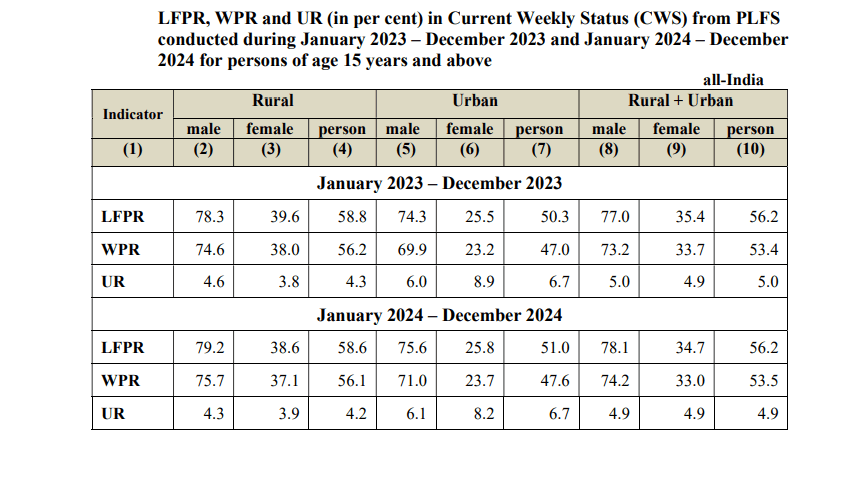
4.Periodic Labour Force Survey 2024 Findings (Labour Force Data)

PIB
Illustration for Periodic Labour Force Survey 2024 Findings (Labour Force Data)

What & Where

Definition – Periodic Labour Force Survey: annual household survey by MoSPI measuring employment, unemployment, labour participation

Key statuses – Current Weekly Status (CWS) and Principal + Subsidiary Status (PS + SS) used for indicators

Geography – Covers rural and urban India; latest round PLFS 2024, reference period July 2023-June 2024

Quick Facts for MCQs

Labour Indicators

  • Stability All-India LFPR, marginal fall 0.2 pp in PS+SS round
  • Urban WPR uptick 0.6 pp; rural unemployment eased to 4.2 %
  • All-India UR slight dip 0.1 pp in CWS, rise 0.1 pp in PS+SS

Gender & Youth Gaps

  • Female LFPR urban only 25.8 %; urban female UR 8.2 %
  • Educated women over 25 with advanced degrees merely 3 % of employed females
  • Youth share dominant among unemployed despite higher education attainment

Productivity & Informality

  • Workweek second longest globally yet GDP per hour ranks 133rd, signalling low productivity
  • Half workforce exceeds 49-hour week, many in informal low-skill roles
  • Rural labour still concentrated in low-productivity subsistence activities

Government Schemes

  • Key skilling/employment: PM-DAKSH, PMKVY, SMILE, Rozgar Mela
  • Income support: MGNREGA rural, Ayyankali & IG-Urban EGS urban models
  • Entrepreneurship push: Start-up India, PM Vishwakarma, Udyam Portal

Policy Recommendations

  • Bridge skill-industry gap via NSDC, Future Skills Prime, Industry 4.0 curricula
  • Formalisation boost through e-Shram, one-nation one-registration, micro-credit for MSMEs
  • Green transition, gendered reforms, employment-linked tax incentives to widen inclusive job creation

Key Data Points

FeatureData-Point
Urban LFPR 2024 (CWS)51.0 %
All-India LFPR (CWS)56.2 %
Urban Unemployment Rate6.7 %
All-India Unemployment Rate4.9 %
All-India WPR (CWS)53.5 %
LFPR (PS+SS)59.6 %
Youth Unemployment 2023-2410.2 %
Avg Indian workweek46.7 hours
GDP per working hourUSD 8
Global youth unemployment 202313.3 %

Related UPSC Prelims PYQs

CAPF_GAI, CDS_GK 2025PYQ 1

Consider the following statements regarding Annual Periodic Labour Force Survey (PLFS) report 2023–24 by the National Statistical Organization (NSO):

CAPF_GAI, CDS_GK 2020PYQ 2

Which of the following statements about employment situation in India according to Periodic Labour Force Survey 2017-18 is/are correct?

GS-3Infrastructure

5.New Pamban Vertical Lift Bridge (Vertical Lift Bridge)

Hindustan Times
Illustration for New Pamban Vertical Lift Bridge (Vertical Lift Bridge)

What & Where

New Pamban Bridge; India’s first vertical-lift railway sea bridge across Palk Strait, Tamil Nadu.

Connects Rameswaram island with Mandapam on mainland; replaces 1914 cantilever Pamban Bridge.

Enables uninterrupted rail–maritime movement via 72.5 m span lifting 17 m vertically.

Quick Facts for MCQs

Technology & Design

  • Vertical-lift mechanism ensures faster opening than Scherzer rolling-lift, reducing rail-marine coordination time.
  • Double-track steel superstructure allows higher axle loads aligning with future freight corridors.
  • Corrosion-resistant materials and deep foundations chosen for saline, high-current conditions.

Disaster Resilience

  • Engineering benchmarks include lessons from 1964 cyclone-tsunami that swept train off old bridge.
  • Wind, wave and seismic modelling integrated to survive Bay of Bengal cyclones.
  • Monitoring systems planned for real-time structural health data.

International Examples

  • Clubbed with iconic lift bridges: Golden Gate (USA), Tower Bridge (UK), Øresund link (Denmark–Sweden).
  • Positions India among few nations operating long sea-span vertical-lift rail bridges.

Key Data Points

FeatureData-Point
Total length2.07 km
Water bodyPalk Strait
StateTamil Nadu
Designer / AgencyRail Vikas Nigam Ltd., Ministry of Railways
Bridge typeVertical-lift steel bridge
Lift span length72.5 m
Lift clearance17 m above sea level
Track provisionDouble line
Design life100+ years
Replaced structure1914 Scherzer rolling-lift cantilever
Old bridge claimIndia’s first sea bridge
InaugurationApril 2025 by Prime Minister
Built to bearHeavier, faster trains
Resilience focusCyclones, turbulent waters, seismic activity
GS-1Environment

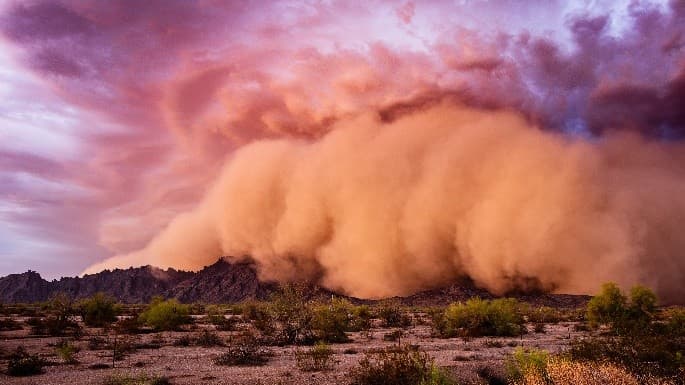
6.Dust Storm Phenomenon and Hazards (Dust Storms)

NDTV
Illustration for Dust Storm Phenomenon and Hazards (Dust Storms)

What & Where

Definition: Strong, turbulent winds lift loose sand/dust into air, slashing visibility and degrading air quality.

Core belt: Pre-monsoon Rajasthan, Haryana, Delhi, Gujarat, western Uttar Pradesh most storm-prone.

Current event: Delhi-NCR clocked 80 kmph gusts; IMD flashed red alert.

Quick Facts for MCQs

Health Impact

  • Respiratory; PM2.5/PM10 surge heightens asthma, bronchitis risk, especially children and elderly.
  • Injury; flying debris, wall collapse killed 67-year-old Delhi resident, injured three.
  • Livestock; dust inhalation and eye irritation reported across storm-prone Rajasthan belts.

Infrastructure & Services

  • Aviation; visibility, wind shear forced diversion of 15 flights, delaying passenger movement.
  • Power; North-West Delhi outages, uprooted trees blocking arterial roads, slowing emergency response.
  • Communication; overhead lines vulnerable, prompting push for underground cabling in NCR plans.

Environmental Consequences

  • Erosion; dust removal strips fertile topsoil, accelerating desertification along Thar fringe.
  • Pathogens; airborne microbes hitchhike on dust, contaminating surface waters and crops.
  • Wildlife; low visibility disrupts migratory bird routes and orientation cues.

Mitigation Measures

  • Early-warning; IMD satellites, Doppler radar, AI models enable real-time alerts to agencies.
  • Land management; afforestation, contour bunding, no-till farming curb soil loosening.
  • Urban planning; green belts, wind-resistant structures, debris-secure roofing mandated in bye-laws.

Key Data Points

FeatureData-Point
Max wind speed (Delhi event)80 km h⁻¹
IMD warning levelRed alert
Flights diverted (IGI)15
Casualties reported1 dead, 3 injured
Delhi AQI during storm164 (Moderate)
Peak Indian seasonPre-monsoon (Mar–Jun)
Dominant pollutant sizesPM2.5, PM10
Global dust emission (UNCCD)2000 million t yr⁻¹

Related UPSC Prelims PYQs

CDS_GK, GS1 2022PYQ 1

WHO के वायु गुणवत्ता दिशानिर्देशों के संदर्भ में, निम्नलिखित कथनों पर विचार कीजिए :

CDS_GK, GS1 2022PYQ 2

निम्नलिखित में से कौन-सा एक, अम्लीय वर्षा का प्रमुख कारण है ?

GS-3Environment

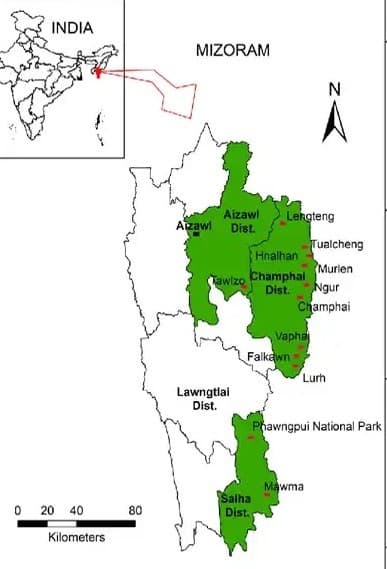
7.Phawngpui National Park Biodiversity (National Park)

Hindustan Times
Illustration for Phawngpui National Park Biodiversity (National Park)

What & Where

National park centred on Blue Mountain, highest peak in Mizoram at 2 ,157 m

Location southeastern Mizoram, Saiha district, adjoining Myanmar border in Indo-Myanmar biodiversity hotspot

March 2025 forest fire from jhum cultivation scorched nearly one-ninth of its 50 sq km area

Quick Facts for MCQs

Biodiversity

  • Avifauna hosts Dark-rumped Swift, Blyth’s Tragopan, Peregrine Falcon, endemic Mount Victoria Babax
  • Mammals include Slow Loris, Capped Langur, Tiger, Leopard, Asiatic Black Bear within compact mountainous terrain
  • Vegetation mosaic of oak, rhododendron, rare bamboos supports high montane species richness

Conservation Threats

  • Recurring fires from shifting cultivation degrade forest structure and disrupt wildlife breeding cycles
  • Steep cliffs and wind patterns hinder firefighting, prolonging burn duration and ecological scars
  • Dry-season intensification under climate change likely to escalate ignition frequency

Eco-tourism

  • Far Pak glade popular for trekking and panoramic ridge walks attracting domestic and foreign visitors
  • Unregulated visitor influx risks trampling, littering, noise during sensitive nesting periods
  • Revenue potential prompts need for strict carrying-capacity norms and local guide involvement

Trans-boundary Aspect

  • Blue Mountain range continues into Myanmar, sharing species with Mount Victoria landscape
  • Cross-border coordination vital to curb wildlife trafficking and manage contiguous fire outbreaks

Key Data Points

FeatureData-Point
DesignationPhawngpui National Park
StateMizoram
Altitude (peak)2,157 m
Total area≈ 50 sq km
Ridge length≈ 10 km
Dominant biomeMontane subtropical oak–rhododendron forest
Signature gladeFar Pak
State bird housedMrs. Hume’s Pheasant
Only Indian site forMount Victoria Babax
Notable carnivoresTiger, Leopard, Asiatic Black Bear
Key primatesSlow Loris, Capped Langur
Rare raptorsPeregrine Falcon, Dark-rumped Swift
Fire damage Mar 2025~11 % area
Fire triggerJhum (shifting) cultivation
Border proximityMyanmar
GS-3Environment

8.Elephant Poaching Threat in Tamil Nadu (Elephant Conservation)

The Hindu

What & Where

National Heritage animal; keystone, ecosystem-engineer mammal shaping forests and water access.

Two living species: Asian (Elephas maximus; Indian subspecies 60 % of global Asian total) & African (savannah, forest).

Core Indian range: Western Ghats-Nilgiris, North-East, central-east corridors; Tamil Nadu poaching hotspot flagged.

Quick Facts for MCQs

Legal & Policy

  • Protection: WPA Schedule I provides highest domestic safeguard; CMS Appendix I mandates strict international conservation.
  • Elephant Reserves lack standalone legal backing unless overlapping reserve forests/PAs.
  • Ivory trade banned; trans-state trafficking monitored under CITES & WPA provisions.

Schemes & Programmes

  • Project Elephant 1992: habitat conservation, vet care, mitigation of conflict.
  • Project RE-HAB: bee-fence installations to deter crop-raiding herds.
  • MIKE programme: site-level recording of illegal killings across Asia-Africa.

Threats

  • Poaching for ivory resurging; recent Tamil Nadu case highlights enforcement gaps.
  • Human-elephant conflict escalating near fragmented corridors, triggering retaliatory killings.
  • Illegal interstate / transnational wildlife trafficking undermines population recovery.

Population & Distribution

  • India shelters ~60 % of global Asian elephants; Western Ghats anchor largest contiguous population.
  • Census shows rebound in Tamil Nadu after 2017 dip, indicating success of anti-poaching drives.
  • Fragmented habitats outside reserves elevate conflict zones, especially Eastern and Southern landscapes.

Key Data Points

FeatureData-Point
India elephant census 201729,964 individuals
Highest state populationKarnataka, followed by Assam, Kerala
Tamil Nadu trend4,000 (2012) → <2,800 (2017) → 3,000+ (2024)
Protected Area with most elephantsSathyamangalam forest division
Elephant Reserves (India)33 notified
Identified elephant corridors150
IUCN statusAsian : Endangered; Afr. savannah : Endangered; Afr. forest : Critically Endangered
CMS listingAppendix I
Wildlife (Protection) Act, 1972Schedule I
World Elephant Day12 August

Related UPSC Prelims PYQs

GS1 1999PYQ 1

"India has the largest population of the Asian X. Today, there are just about 20,000 to 25,000 X in their natural habitat spreading across the evergreen forests, dry thorn forests, swamps and grasslands. Their prime habitats are, however, the moist deciduous forests. The X population in India ranges from Northwest India where they are found in the forest divisions of Dehradun, Bijnor and Nainital districts of UP to the Western Ghats in the states of Karnataka and Kerala and in Tamil Nadu. In Cen

GS1 2003PYQ 2

Consider the following animals of India:

GS-3Species

9.Golden Tiger Variant in Kaziranga (Rare Tiger Variant)

Times of India
Illustration for Golden Tiger Variant in Kaziranga (Rare Tiger Variant)

What & Where

Golden tiger = rare colour morph of Bengal tiger (Panthera tigris tigris), not a new subspecies.

Wild presence: only four individuals, all inside Kaziranga National Park, Assam.

Cause: recessive wideband gene mutation prolonging pheomelanin production, yielding reddish-gold coat.

Quick Facts for MCQs

Genetics

  • Wideband mutation extends reddish pigment bands, suppresses black striping intensity.
  • Both-carrier mating probability low, explaining rarity.
  • Inbreeding amplification possible, risking ancillary genetic issues.

Conservation Status

  • Kaziranga Tiger Reserve management targets habitat integrity and anti-poaching.
  • Extreme rarity of golden morph highlights need for population genetic monitoring.
  • Colour variant itself harmless; conservation focus remains overall tiger viability.

Biodiversity Significance

  • Park harbours world’s largest Indian rhinoceros population, flagship for megafauna conservation.
  • Elephant grass, rhododendron, cotton tree enrich diverse eco-niches.
  • BirdLife IBA status indicates critical migratory and resident avifauna habitat.

Key Data Points

FeatureData-Point
Known wild golden tigers4
Affected geneWideband
Pigment involvedPheomelanin
Parent geneticsBoth must carry mutant allele
Park districtsGolaghat & Nagaon, Assam
Main river nourishing parkBrahmaputra
One-horned rhino count2,200 + (≈ ⅔ global)
UNESCO World Heritage since1985
Tiger Reserve notification2006
Important Bird Area tagBirdLife International

Related UPSC Prelims PYQs

CAPF_GAI, GS1 2024PYQ 1

‘कृष्ण-बाघ (Black Tiger)’ के संदर्भ में, निम्नलिखित में से कौन-सा/कौन-से कथन सही है/हैं?

CAPF_GAI, GS1 1999PYQ 2

"India has the largest population of the Asian X. Today, there are just about 20,000 to 25,000 X in their natural habitat spreading across the evergreen forests, dry thorn forests, swamps and grasslands. Their prime habitats are, however, the moist deciduous forests. The X population in India ranges from Northwest India where they are found in the forest divisions of Dehradun, Bijnor and Nainital districts of UP to the Western Ghats in the states of Karnataka and Kerala and in Tamil Nadu. In Cen

GS-3Species

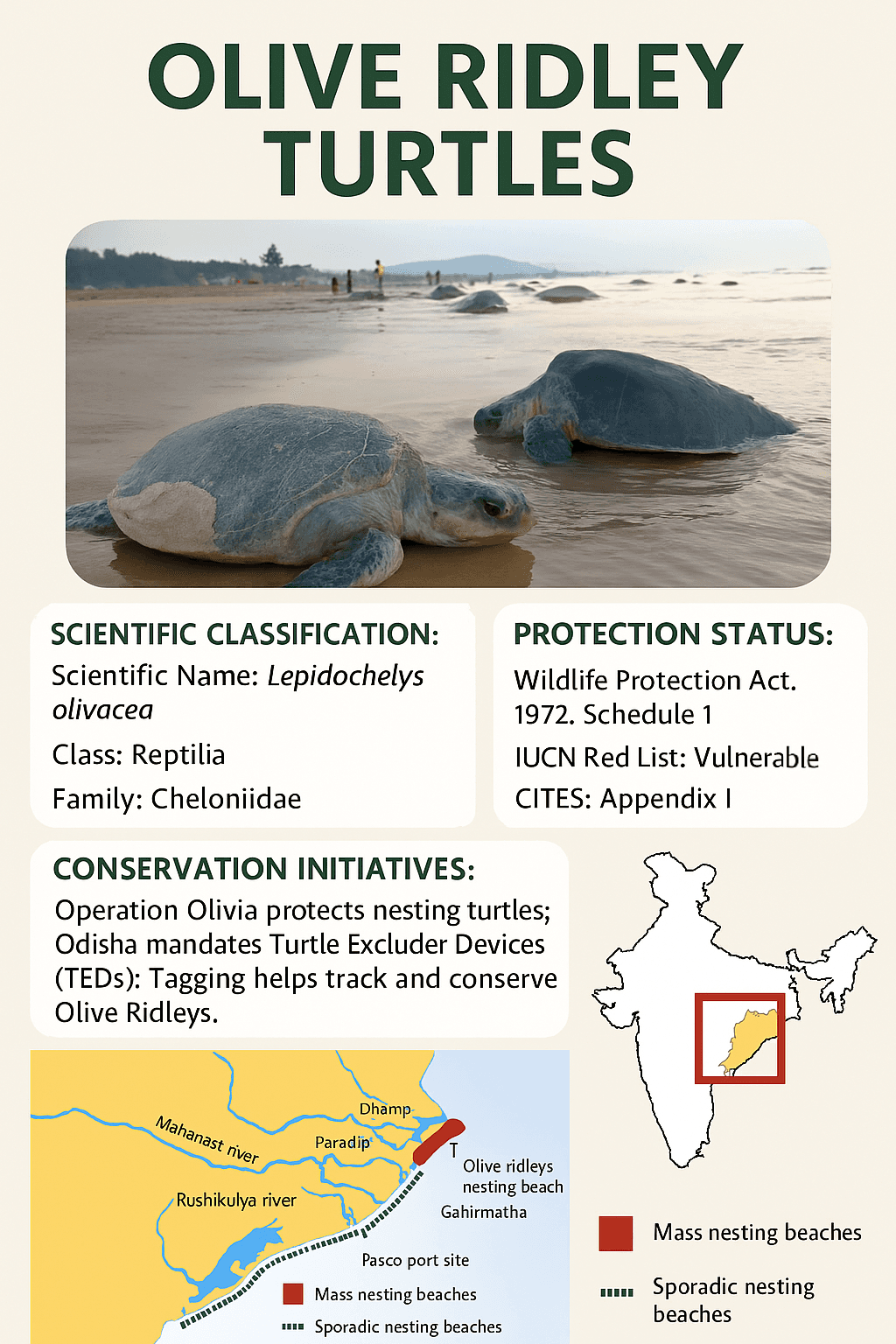
10.Olive Ridley Turtle Lineage Study (Olive Ridley Turtle)

Hindustan Times
Illustration for Olive Ridley Turtle Lineage Study (Olive Ridley Turtle)

What & Where

Olive Ridley (Lepidochelys olivacea); smallest sea turtle, olive-green heart-shaped carapace; Class Reptilia, Family Cheloniidae

Indian-Ocean lineage now tagged oldest; Atlantic & Pacific stocks diverged ≈ 3–4 lakh yrs ago

Key Indian rookeries: Gahirmatha & Rushikulya (1.3 mn nests 2024), plus Devi mouth, Andamans; mass arribada Dec-Mar

Quick Facts for MCQs

Evolutionary Insight

  • Study2025 shows Indian-Ocean stock ancestral; myth of Central-American oldest debunked
  • Divergence estimated 3–4 lakh yrs between Indian and Atlantic-Pacific groups
  • Isthmus-Panama no longer sole driver of global population split

Behaviour & Ecology

  • Arribada synchronised nesting; thousands females, ~100 eggs each
  • Migration long-haul ~9 000 km connecting Pacific feeding and Indian breeding grounds
  • Diet inclusive; algae, crustaceans, fish eggs, jellyfish

Threats

  • Bycatch in trawl, gill nets major mortality factor
  • Poaching, coastal development, plastic debris degrade nesting beaches
  • ClimateChange raises sand temperature, skews sex ratio, submerges rookeries

Legal & Policy

  • WPA 1972 Schedule I confers highest domestic protection India
  • CITES Appendix I prohibits commercial international trade
  • IUCN Vulnerable status drives global conservation collaborations

Key Data Points

FeatureData-Point
Lineage age300 000–400 000 yrs divergence
IUCN StatusVulnerable
WPA ScheduleSchedule I
CITES ListingAppendix I
DietOmnivore
Migration distance≈ 9 000 km (Pacific→Indian)
Arribada seasonDec–Mar; 1–3 nests/female
Eggs per clutch~100
2024 Odisha nesting1.3 mn females
Prime rookeriesGahirmatha, Rushikulya
Taxonomic familyCheloniidae

Related UPSC Prelims PYQs

NDA_GAT 2021PYQ 1

Operation Olivia, an initiative to protect Olive Ridley turtles, is undertaken by

GS-3S&T

11.Thorium Small Modular Reactor Initiative (Small Modular Reactor)

Business Standard
Illustration for Thorium Small Modular Reactor Initiative (Small Modular Reactor)

What & Where

Thorium-based Small Modular Reactor: compact nuclear unit breeding fissile U-233 from Th-232 for flexible, low-waste power.

MoU signed by MAHAGENCO and Russia’s ROSATOM for pilot deployment in Maharashtra.

India owns ≈25 % global thorium, concentrated along Kerala & Tamil Nadu coasts.

Quick Facts for MCQs

Tech & Design

  • Modular fabrication allows factory build, fast on-site assembly.
  • Passive safety; coolant and control rely on natural forces, no pumps.
  • Compact footprint fits remote grids or brownfield power stations.

Economic Angle

  • Lower incremental capital than gigawatt reactors, easing financing.
  • High R&D and fuel-cycle costs until supply chain matures.
  • Domestic component manufacture plugs into ‘Make in India’.

Legal & Policy

  • Reactor licensing needs DAE & AERB clearances; state alone insufficient.
  • No global regulatory precedent for thorium SMRs; standards evolving.
  • International tie-ups subject to nuclear export-control regimes.

Environmental Impact

  • Produces less long-lived waste versus uranium cycle reactors.
  • Cuts imported uranium demand, aiding carbon-free energy security.
  • Public acceptance challenged by historic nuclear accident memories.

Key Data Points

FeatureData-Point
Reactor categorySmall Modular Reactor (SMR)
Primary fertile isotopeThorium-232
Bred fissile fuelUranium-233
Indian state first to ink SMR MoUMaharashtra
Indian utility involvedMAHAGENCO
Foreign partnerROSATOM, Russia
India’s thorium share~25 % of world total
Operational thorium SMRs worldwideZero
Core safety designPassive auto-shutdown systems
Constitutional control of nuclear energyUnion List (Centre)

Related UPSC Prelims PYQs

GS1 2012PYQ 1

To meet its rapidly growing energy demand, some opine that India should pursue research and development on thorium as the future fuel of nuclear energy. In this context, what advantage does thorium hold over uranium?

GS1 2016PYQ 2

India is an important member of the ‘International Thermonuclear Experimental Reactor’. If this experiment succeeds, what is the immediate advantage for India?

GS-3S&T

12.Need for Local Data Centres (Data Centers)

Business Standard
Illustration for Need for Local Data Centres (Data Centers)

What & Where

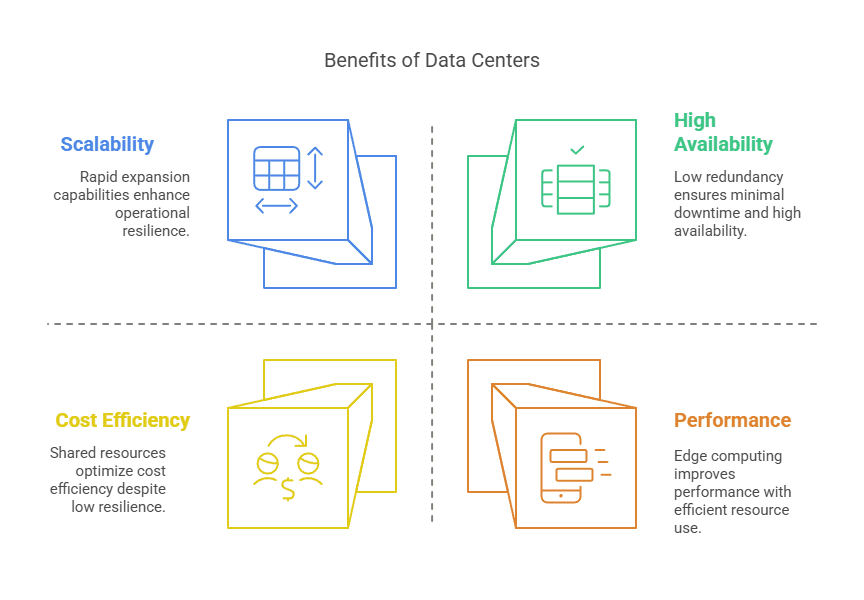
Data centre = secure building hosting servers, storage, network hardware for mission-critical digital workloads.

Key types: Enterprise (on-prem), Hyperscale cloud, Colocation, Edge (near-user, low-latency).

India produces 20 % of global data yet has < 2 % of data-centre capacity.

Quick Facts for MCQs

Economic Angle

  • 40 GW rollout could unlock USD 400 bn, aiding USD 5 trn economy goal.
  • Spurs 800 mn sq ft construction; lifts real estate, renewables, telecom demand.
  • Jobs: 1–2 mn direct, ≤ 6 mn indirect across build, logistics, IT services.

Legal & Policy

  • DPDP 2023 mandates domestic storage of sensitive data; boosts sovereignty.
  • Hard localisation may trigger WTO disputes, mirror barriers against Indian IT exports.
  • Recommended: incentives—tax breaks, low-tariff power, green standards—over compulsion.

Infrastructure & Tech Challenges

  • Frequent outages and hot climate inflate backup and cooling costs.
  • 10–15 yr payback dampens private appetite despite rising demand.
  • International traffic depends on largely foreign-owned undersea cables.

Environmental Impact

  • DCs may reach 3 % global electricity use by 2030; coal-heavy grid worsens emissions.
  • Significant water for cooling competes with agriculture in drought-prone zones.
  • Green push: liquid cooling, renewables purchase, ultra-low industrial tariffs.

Key Data Points

FeatureData-Point
India’s share of world data20 %
India’s share of DC capacity< 2 %
2030 capacity target40 GW IT load
Investment neededUSD 400 bn
Direct jobs forecast1–2 mn
Indirect jobs multiplier3 × (≤ 6 mn)
Build-up space required800 mn sq ft
Key Act driving localisationDPDP Act 2023
DC power draw 20241.5 % global electricity
Projected draw 20303 % global electricity
Big entrantsAWS, Google, Microsoft

Related UPSC Prelims PYQs

ESE_GS, GS1 2020PYQ 1

Infrastructure aspects provided by the Government of India in formation of National e-Governance Plan for storage of data and hosting applications, network connectivity and capacity building respectively are

ESE_GS, GS1 2019PYQ 2

Consider the following statements:

GS-3Security

13.Gaurav Long-Range Glide Bomb (Indigenous Glide Bomb)

New Indian Express
Illustration for Gaurav Long-Range Glide Bomb (Indigenous Glide Bomb)

What & Where

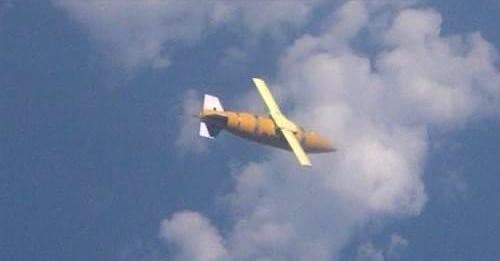
Gaurav: indigenously designed precision-guided, winged glide bomb for land targets.

Fired from IAF Su-30 MKI, striking 30–150 km beyond enemy air-defence.

Jointly developed by DRDO, ARDE, RCI, Integrated Test Range (Odisha).

Quick Facts for MCQs

Technical Features

  • Wing kit adds lift, extending glide without engine.
  • Digital autopilot sustains course amid jamming or GPS loss.
  • Modular 1-ton warhead effective against fortified targets.

Operational Advantage

  • Stand-off launch keeps aircraft outside SAM envelopes.
  • High accuracy enables surgical strikes, limiting collateral damage.
  • Complements BrahMos-A and Spice-2000 in IAF arsenal.

Indigenisation Push

  • Aligns with Atmanirbhar Bharat, reducing import dependence.
  • Builds domestic smart-munition ecosystem and export potential.

Key Data Points

FeatureData-Point
Bomb typeLong-range glide (winged)
VariantsGaurav – 1,000 kg; Gautham – 550 kg
Demonstrated range~100 km (design 30–150 km)
GuidanceINS + satellite, digital control
Launch platformSukhoi-30 MKI
DeveloperDRDO, ARDE, RCI, ITR
RoleStand-off precision strike

Related UPSC Prelims PYQs

CDS_GK 2024PYQ 1

भारत का ‘मिशन शक्ति’ (DRDO) निम्नलिखित में से किससे संबंधित है?

CDS_GK 2022PYQ 2

P-75 I (या P-75 भारत) परियोजना किनके निर्माण से संबंधित है?

Ready to practice?

Test your knowledge with our UPSC test series.

Start Free Trial