UPSC Current Affairs

14 topicsGS-1: 3GS-2: 3GS-3: 8
0/14 done
GS-2Editorial

1.High Court Judge Transfer Process (Judicial Transfers)

The Hindu

What & Where

Article 222; President may transfer any High Court judge on CJI recommendation; judge consent unnecessary

In-house inquiry; 1999 SC-devised process to examine misconduct below impeachment bar within judiciary

Case spot; Justice Yashwant Varma moved Delhi HC → Allahabad HC after alleged sacks-of-burnt-currency episode

Quick Facts for MCQs

Legal & Policy

  • TransferWorkflow; CJI initiates, Law Minister forwards, PM advises, President signs, Gazette notifies
  • CollegiumConsultation; for ordinary judge CJI seeks views of both affected High Courts and familiar SC judges
  • PersonalFactors; health, family convenience and courtroom workload weigh in decision

Transparency & Accountability

  • InHouseCommittee; ensures natural justice, lets judge respond, reports substantiation to CJI
  • OutcomeRange; warning, advice, request to resign or retire, else impeachment recommendation
  • ConfidentialNature; findings kept internal to uphold judicial dignity unlike public parliamentary removal

Separation of Powers

  • ImpeachmentRoute; needs 100 LS or 50 RS MPs notice and two-thirds support in both Houses
  • JudiciarySelf-discipline; in-house mechanism excludes legislature, preserves independence yet enforces ethics
  • ExecutiveTouchpoint; President acts post PM advice, providing constitutional check on collegium decisions

Key Data Points

FeatureData-Point
Constitutional article for transferArticle 222
Consent of judge neededNo
Collegium for Chief Justice transferCJI + 4 senior-most SC judges
Inquiry panel composition2 Chief Justices + 1 HC judge
Year in-house procedure adopted1999
Final transfer order issuerPresident of India

Related UPSC Prelims PYQs

GS1 1996PYQ 1

When the Chief Justice of a High Court acts in an administrative capacity, he is subject to

GS1 2012PYQ 2

What is the provision to safeguard the autonomy of the Supreme Court of India?
GS-2Polity

2.National e-Vidhan Application Expansion (e-Vidhan Application)

News on Air

What & Where

National e-Vidhan Application (NeVA) – pan-India digital platform for paperless legislative work.

Covers state/UT legislatures; Delhi joined as 28th member via MoU with MoPA & GNCTD.

Hosted on Government cloud MeghRaj 2.0; accessible on multiple devices anywhere.

Quick Facts for MCQs

Tech & Schemes

  • Device-neutral design enables seamless sync across personal and in-house hardware.
  • Real-time repository holds multilingual bills, questions, committee reports.
  • Continuous updates delivered via mNeVA; manuals, videos aid quick onboarding.

Environmental Impact

  • Paperless workflow drastically lowers stationery demand, landfill load.
  • Supports Swachh Bharat mission, sustainable public procurement.
  • Digital signatures replace hard-copy circulation during sessions.

Governance & Transparency

  • Instant public portal release boosts citizen oversight of legislative business.
  • Uniform application standardises procedures across houses, easing inter-house data sharing.
  • Audit trails ensure accountability for edits, submissions, votes.

Key Data Points

FeatureData-Point
Implementing ministryMinistry of Parliamentary Affairs
Guiding visionOne Nation, One Application
Cloud hostMeghRaj 2.0 (NIC)
Latest entrant (May 2024)Delhi Legislative Assembly
Total legislatures onboard28
Key functionReal-time access to bills, agendas, reports
Device supportSmartphone, tablet, laptop, desktop
Green objectiveCuts paper use; aligns with Swachh Bharat & SDG12
Security layerEnd-to-end encryption, NIC infrastructure
Mobile versionmNeVA app on Android & iOS
GS-3Economy

3.Equalisation Levy Abolition Proposal (Digital Taxation)

Business Standard

What & Where

Equalisation Levy: India-specific direct tax on non-resident digital services lacking a permanent establishment.

Covers online advertisement payments (since 1 Jun 2016) & e-commerce supply/services (since 1 Apr 2020).

Finance Bill 2025 proposes abolishing the 6 % ad levy from 1 Apr 2025.

Quick Facts for MCQs

Legal & Policy

  • Origin: Finance Act 2016 (ads); Finance Act 2020 inserted Sec 165A for e-commerce.
  • Abolition move aligns with OECD Pillar-I digital tax consensus discussions.
  • Amendments routed via forthcoming Finance Bill 2025.

Compliance & Penalties

  • Quarterly Form-1 statement; delay invites ₹1,000/day up to levy amount.
  • Appeal chain: CIT(A) via Form-3 → ITAT via Form-4.
  • Interest clock starts next day after due date till actual payment.

Exemptions & Carve-outs

  • Services attributable to Indian permanent establishment kept outside levy.
  • Personal consumption payments by Indian users excluded.
  • Threshold breaches judged financial year-wise, not transaction-wise.

Key Data Points

FeatureData-Point
Levy rate – Online ads6 %
Levy rate – E-commerce2 %
Threshold – Ads₹1 lakh per payer per year
Threshold – E-commerce₹2 crore gross turnover
Geography triggerIndian resident or Indian IP address targeted
Compliance – AdsIndian payer/PE deducts & deposits
Compliance – E-commerceNon-resident operator pays directly
Penalty100 % of unpaid levy + 1 % p.m. interest
Income-tax treatmentExempt under Sec 10(50) IT Act
Proposed abolition date1 Apr 2025 (only 6 % category)

Related UPSC Prelims PYQs

GS1 2018PYQ 1

अवासी इकाइयों द्वारा दी जा रही ऑनलाइन विज्ञापन सेवाओं पर भारत द्वारा 6% ‘समतुल्य कर’ (Equalisation Levy) लगाए जाने के निर्णय के सन्दर्भ में निम्नलिखित कथनों पर विचार कीजिए:

GS-3Economy

4.BAANKNET NPA E-Auction Portal (NPA E-Auctions)

PIB

What & Where

BAANKNET Portal – integrated e-auction system for PSBs/financial institutions to sell NPA-backed properties across India.

e-BKray Platform – centralized digital marketplace for PSU-bank recovery auctions.

Both under Ministry of Finance, Department of Financial Services, Government of India.

Quick Facts for MCQs

Tech & Schemes

  • Integration – BAANKNET revamp embeds smart auctions, real-time updates, verified titles.
  • Digitisation – e-BKray offers single window tracking of recovery auctions.
  • Security – Built-in KYC plus payment gateways minimise fraud.

Economic Angle

  • Value-Maximisation – Competitive bidding targets higher realisation from stressed assets.
  • NPA-Recovery – Faster disposal aids bank balance-sheet clean-up.
  • Cost-Saving – Standardised platform lowers administrative overheads for PSBs.

Governance & Transparency

  • Verification – Bank-certified titles build bidder confidence.
  • Monitoring – Real-time auction data enables oversight by regulators.
  • Adoption – Mandatory use by all PSBs ensures uniform transparency norms.

Key Data Points

FeatureData-Point
BAANKNET launch bodyMinistry of Finance (DFS)
e-BKray launch date28 Feb 2019
CoverageAll 12 Public Sector Banks + IBBI
Core aimTransparent, efficient NPA asset value realisation
Key toolAutomated KYC with secure payment gateways
Auction reachAll-India property listings
Bidding styleReal-time, intelligent, competitive
Administrative impactStandardised procedures, reduced bank workload
GS-1HistoryQuick Bite

5.Lapis Lazuli Historical Significance (Lapis Lazuli)

The Hindu
Illustration for Lapis Lazuli Historical Significance (Lapis Lazuli)

What & Where

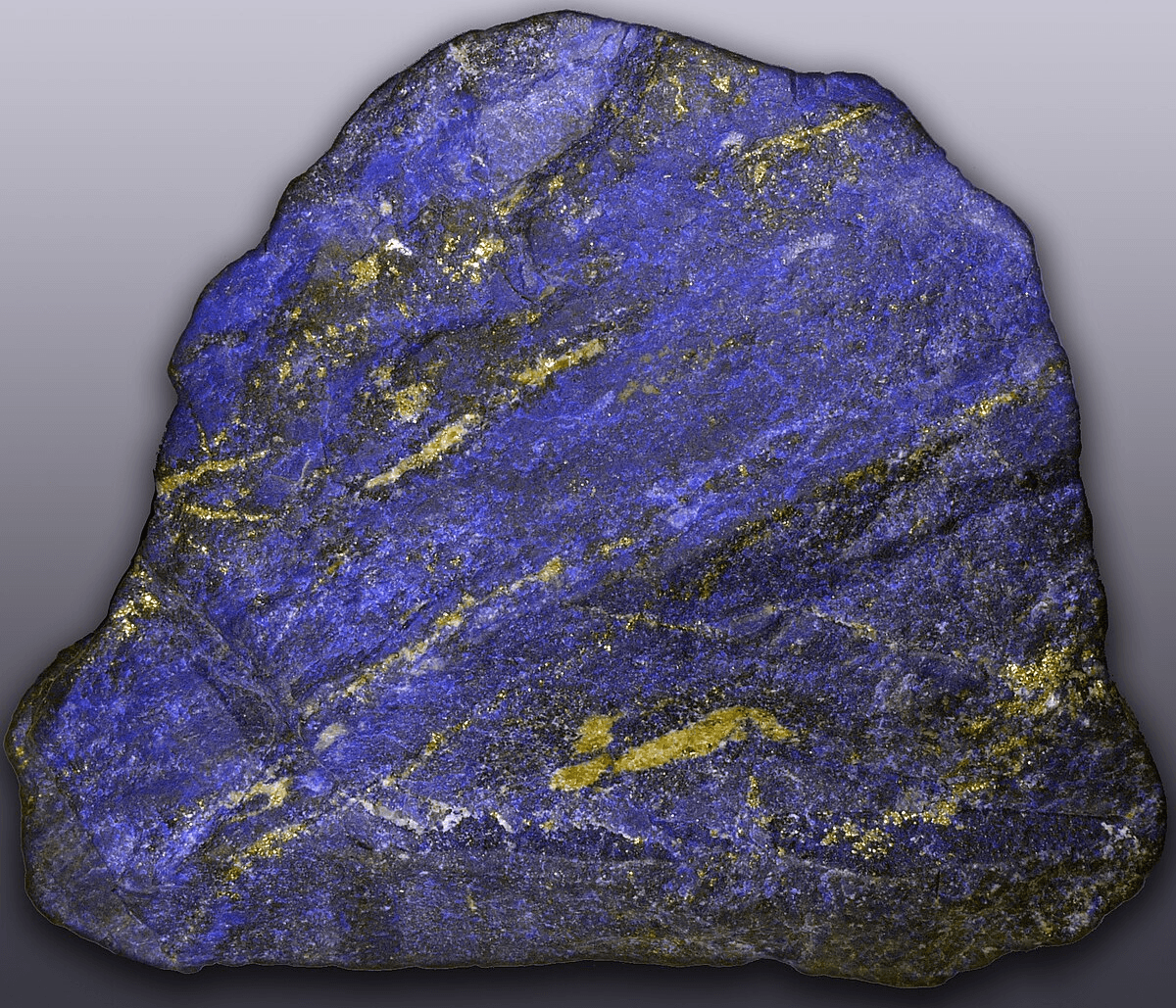
Metamorphic gemstone; intense deep-blue; named from Latin lapis (stone) + Persian lazuli (blue)

Core geography; finest grade from Badakhshan province, Afghanistan; also Chile, Russia, USA deposits

Key minerals; lazurite 25-40 %, calcite whitens, pyrite gives golden flecks

Quick Facts for MCQs

Geological Composition

  • Lazurite proportion 25-40 % decides blueness
  • Increased calcite dilutes colour; pyrite inclusions produce metallic lustre

Historical Trade

  • Indus Valley traders imported Afghan lapis by 1000 BC
  • Gem symbolised wealth, power across Mesopotamian, Egyptian, Greco-Roman cultures

Global Artistic Usage

  • Egyptian artisans carved amulets, inlaid coffins with lapis
  • Renaissance painters valued ultramarine made from powdered lapis for premium artworks

Key Data Points

FeatureData-Point
Rock typeMetamorphic, semi-precious
Colour agentSulphur-rich lazurite
Golden shimmer mineralPyrite
Main historic mineSar-e-Sang, Badakhshan, Afghanistan
Mining antiquity≥6,000 years
Indian import start~1000 BC
IVC artefact sitesMohenjo-daro, Harappa
Renaissance useGround into ultramarine pigment
Egyptian useJewellery, cosmetics
Name originLatin + Persian blend

Related UPSC Prelims PYQs

NDA_GAT 2025PYQ 1

हड़प्पाई मुहरों (Seals) के निर्माण में, निम्नलिखित में से किस सामग्री का उपयोग किया गया था?

GS-1Mapping

6.Türkiye Physical Geography (Turkey Mapping)

The Hindu

What & Where

Türkiye: trans-continental republic straddling southeastern Europe & western Asia, capital Ankara, largest city Istanbul.

Lies between Black, Aegean, Mediterranean seas; dominated by Pontic & Taurus ranges flanking central Anatolian Plateau.

Mount Ararat (5,165 m) highest; Euphrates-Tigris rise in east before flowing to Syria-Iraq.

Quick Facts for MCQs

Physical Geography

  • Pontic range parallels Black Sea, Kaçkar section tops 3,900 m.
  • Taurus range aligns Mediterranean coast, peaks above 11,000 ft.
  • Anatolian Plateau gently tilted, peppered with extinct volcanoes.

Hydrology

  • Euphrates & Tigris headwaters originate in eastern Türkiye, crucial for West Asia irrigation.
  • Sakarya, Kızıl, Yeşil drain to Black/Aegean seas, support northern agriculture.
  • Rivers enable multipurpose GAP dams on Upper Euphrates-Tigris.

Political Unrest

  • 1,100+ detainees after arrest of opposition figure, Istanbul Mayor.
  • Demonstrations span 55 of 81 provinces, reflecting nationwide discontent.
  • Security sweep underscores tense pre-election climate.

Key Data Points

FeatureData-Point
CapitalAnkara
Largest city/portIstanbul
Continents spannedEurope & Asia
Highest peakMt Ararat – 5,165 m
Key mountain beltsPontic (N), Taurus (S)
Central plateauAnatolian Plateau
Notable volcanic peakMt Erciyes – 3,916 m
Major river systemEuphrates & Tigris
Other riversSakarya, Kızıl, Yeşil
Coastline seasBlack, Aegean, Mediterranean
Provinces with recent protests55
Immediate neighboursGreece, Bulgaria, Georgia, Armenia, Azerbaijan (Nakhchivan), Iran, Iraq, Syria
GS-3Environment

7.FAO Commission on Genetic Resources (FAO CGRFA)

Down to Earth
Illustration for FAO Commission on Genetic Resources (FAO CGRFA)

What & Where

CGRFA; Rome-based FAO body conserving genetic resources vital to food and agriculture.

Covers plants, animals, forests, aquatic, micro-organisms since 1995 expansion.

Holds biennial global meetings; 20th session underway in Rome, 2024.

Quick Facts for MCQs

Legal & Policy

  • Global-policy: formulates strategies guiding national laws on agrobiodiversity conservation.
  • Treaties: facilitated negotiation, adoption, monitoring of Plant Genetic Resources Treaty.
  • Benefit-sharing: promotes equity aligned with Convention on Biological Diversity principles.

Institutional Setup

  • Monitoring: reviews state-of-world reports, tracks member implementation progress.
  • Data systems: supports global databases for seeds, animal breeds, forest germplasm.
  • Coordination: acts as focal forum linking FAO, CBD, other UN bodies.

Functions & Tools

  • Assessment: commissions periodic global status reports on sector-wise genetic resources.
  • Guidance: issues voluntary codes, genebank standards, action plans to members.
  • Capacity-building: channels technical assistance, North-South cooperation projects.

Key Data Points

FeatureData-Point
Establishment year1983 (as Commission on Plant Genetic Resources)
Scope expansion1995 to all food-agriculture genetic resources
HeadquartersRome, Italy
Parent organisationUN-FAO
Meeting frequencyBiennial; special sessions ad-hoc
Flagship treaties steeredInternational Treaty on Plant Genetic Resources for Food & Agriculture
Key deliverables 2024Global reports on plant & forest genetic resources
Core aimsSustainable use, conservation, equitable benefit sharing
Current sessionCGRFA-20
GS-3Environment

8.Species-Specific Global Conservation Success (Species Conservation)

Down to Earth

What & Where

Targeted conservation = species‐specific actions (breeding, reintroduction, predator control) to avert extinctions.

Global study (PLOS Biology 2025) links 99.3 % IUCN status improvements since 1980 to such actions.

India’s umbrella is Integrated Development of Wildlife Habitats (IDWH 2008; FC-XV cycle 2021-26) covering 22 priority species.

Quick Facts for MCQs

Global Findings

  • Study: 78 % rising species benefitted from breeding, habitat management, invasive control.
  • Cases: Kākāpō revival via predator removal; bison success via rewilding networks.

Indian Schemes

  • Subprojects: Tiger 1973, Elephant 1992, Dolphin-Lion-Cheetah under Wildlife Habitat component.
  • Project Crocodile (post-1972 Act) boosted three croc species through ranching centres.
  • Maharashtra drafting first dedicated Pangolin Action Plan; species in WLPA Sch I.

Species Outcomes

  • Rhino: translocation plus anti-poaching yielded >70 % of world population in Assam.
  • Vultures: Pinjore VCBC key node for captive breeding and field release.
  • Cheetah: Namibia-South Africa imports to Kuno NP revive extinct predator line.

Key Data Points

FeatureData-Point
Species improved via interventions99.3 % of uplisted taxa since 1980
Rising-population species analysed969; 78.3 % had active measures
Iberian Lynx trendfew hundred → several thousand
European Bison statusWild reintroduced after 20th-c extinction
Saltwater crocs Bhitarkanika95 (1975) → 1,811
Olive Ridley IUCNVulnerable; WLPA Sch I; CITES App I
IDWH priority list22 species (16 terrestrial, 6 aquatic)
Vulture Action Plan2020-25; bans Diclofenac use
Indian Rhino Vision 2020>2,600 rhinos in Kaziranga (2022)
Project Cheetah2022 reintroduction; first wild cubs 2023

Related UPSC Prelims PYQs

GS1 2017PYQ 1

In India, if a species of tortoise is declared protected under Schedule I of the Wild Life (Protection) Act, 1972, what does it imply?

GS1 1999PYQ 2

"India has the largest population of the Asian X. Today, there are just about 20,000 to 25,000 X in their natural habitat spreading across the evergreen forests, dry thorn forests, swamps and grasslands. Their prime habitats are, however, the moist deciduous forests. The X population in India ranges from Northwest India where they are found in the forest divisions of Dehradun, Bijnor and Nainital districts of UP to the Western Ghats in the states of Karnataka and Kerala and in Tamil Nadu. In Cen

GS-3EnvironmentQuick Bite

9.World Water Day 2025 Highlights (World Water Day)

PIB

What & Where

Jal Shakti Abhiyan: Catch the Rain 2025, 6th edition, nationwide water-conservation drive.

Unveiled 22 Mar 2025 (World Water Day) by Ministry of Jal Shakti.

Targets 148 districts for rainwater harvesting, groundwater recharge, community engagement.

Quick Facts for MCQs

Government & Policy

  • Principle asserted Every Drop Counts guides 2025 activities.
  • Jal-Jangal-Jan Abhiyan restores forest-river-spring ecological links.
  • Central schemes JSA, AMRUT 2.0, Atal Bhujal back implementation.

International Day

  • World Water Day originated Rio Summit 1992, formalised UNGA 1993.
  • 2025 theme Glacier Preservation spotlights cryosphere loss.
  • Observance aligns with SDG-6 2030 targets on water and sanitation.

Conservation Approach

  • Measures include rooftop harvesting, check-dams, soil-moisture recharge across 148 districts.
  • Community participation stressed via theme People’s Action for Water Conservation.
  • Forest-water connectivity emphasised through Jal-Jangal-Jan framework.

Key Data Points

FeatureData-Point
Campaign edition6th
Launch date22 Mar 2025
Observance dayWorld Water Day
2025 campaign themePeople’s Action for Water Conservation
Governing ministryJal Shakti
Districts covered148
Core sloganEvery Drop Counts
Linked initiativeJal-Jangal-Jan Abhiyan
WWD conceived1992 Rio Summit
UNGA adoption1993
2025 WWD themeGlacier Preservation
Aligned SDGSDG-6 Water & Sanitation
Support schemesJSA, AMRUT 2.0, Atal Bhujal Yojana

Related UPSC Prelims PYQs

CAPF_GAI, ESE_GS 2023PYQ 1

Consider the following statements regarding the aim of Jal Jeevan Mission to provide every rural household of the country with adequate tap water of prescribed quality on regular basis:

CAPF_GAI, ESE_GS 2025PYQ 2

जल जीवन मिशन के संदर्भ में निम्नलिखित में से कौन-सा कथन सही नहीं है?

GS-3S&TQuick Bite

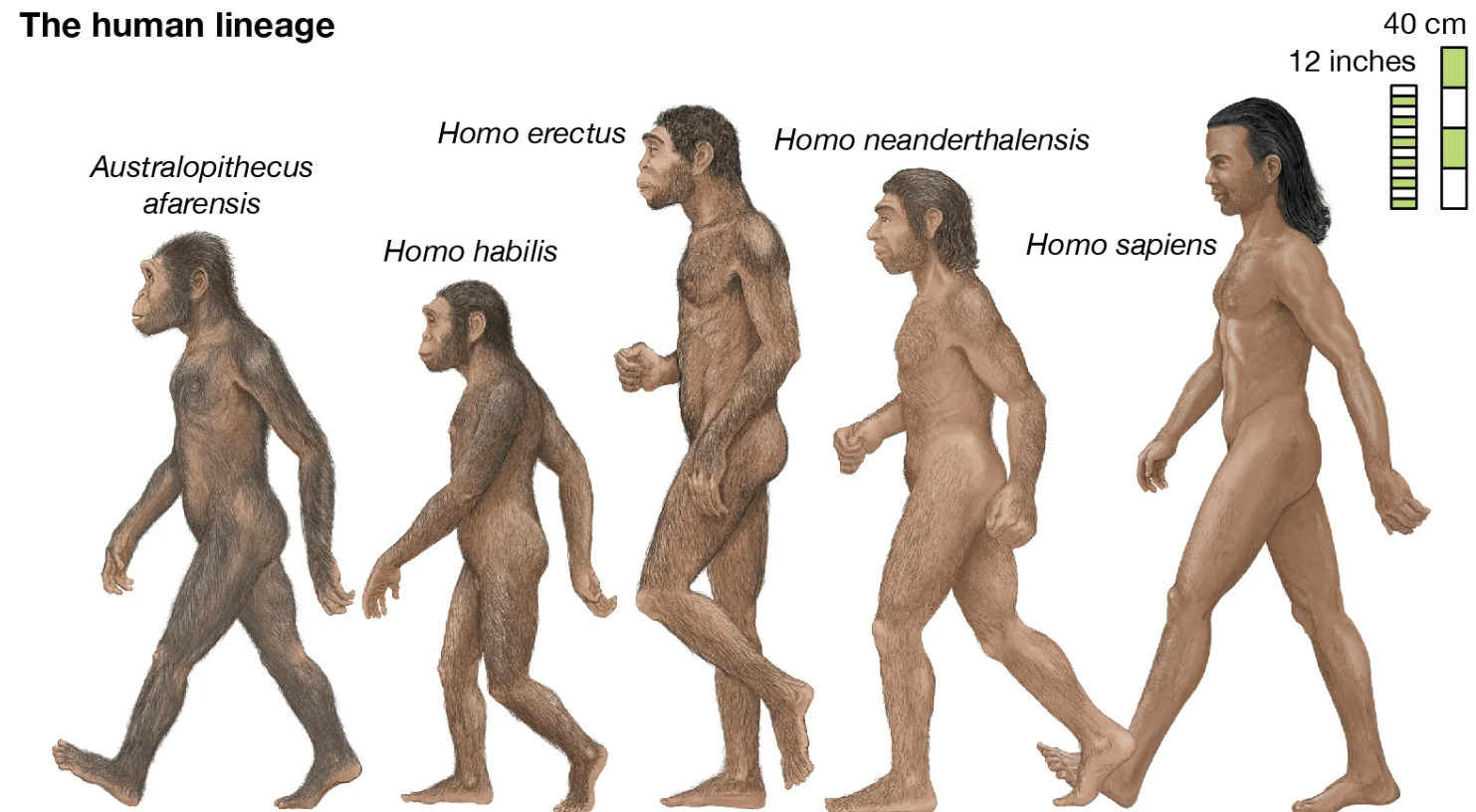
11.Human Evolution Dual-Ancestry Study (Human Evolution)

CambridgeUni
Illustration for Human Evolution Dual-Ancestry Study (Human Evolution)

What & Where

Homo sapiens arose via admixture of two ancestral populations, overturning single-origin model.

Lineages split ~1.5 million yr ago, re-united ~300 kyr ago, probably within Africa.

Evidence from worldwide 1000 Genomes Project modern‐DNA dataset, not fossil remains.

Quick Facts for MCQs

Genetic Evidence

  • Admixture inference drawn from linkage patterns, not ancient DNA fragments.
  • Minority-origin alleles show enriched neurological pathways, hinting adaptive advantage.

Timeline

  • Divergence 1.5 mya predates earliest accepted Homo sapiens fossils (~300 kya).
  • Gene flow 300 kya coincides with Moroccan Jebel Irhoud fossil horizon.

Population Dynamics

  • Majority lineage endured population crash, suggesting climatic or ecological stress.
  • Recovery coupled with minority introgression shaped present human diversity.

Comparative Interbreeding

  • Neanderthal-Denisovan introgression later (~50 kya) far smaller in magnitude.
  • Modern human core genome thus chiefly forged before Out-of-Africa dispersals.

Key Data Points

FeatureData-Point
Ancestral populationsTwo; one majority 80 %, one minority 20 %
Initial split≈ 1.5 million years ago
Re-admixture event≈ 300 000 years ago
Majority bottleneckSevere decline then recovery
Minority gene focusBrain function & cognition loci
Selection type seenPurifying (removal of deleterious alleles)
Genomic contribution~10 × Neanderthal-Denisovan input
Neanderthal-Denisovan share≈ 2 % of non-African DNA
Dataset used1000 Genomes Project (Africa, Asia, Europe, Americas)
GS-3Security

12.Africa-India Maritime Exercise AIKEYME (Naval Exercise)

DD News

What & Where

Exercise AIKEYME – multilateral naval drill enhancing India-Africa maritime interoperability

Co-hosted by India & Tanzania; first edition April 2025, Dar-es-Salaam

Focus on Indian Ocean security against piracy, trafficking, IUU fishing

Quick Facts for MCQs

Security Dimension

  • Objective strengthen regional maritime domain awareness and coordinated response
  • Targets piracy, narcotics trafficking, arms smuggling, IUU fishing in IOR
  • Information-sharing networks emphasised among participating navies

Operational Elements

  • Harbour phase includes tabletop exercises, boarding procedure rehearsals
  • Sea phase integrates SAR, helicopter cross-deck operations, live firing
  • Emphasis on interoperability in Visit-Board-Search-Seizure tactics

India’s Maritime Outreach

  • Exercise realises SAGAR vision of security and growth for all in region
  • MAHASAGAR initiative 2025 extends Indian training, maintenance, logistics support to African navies
  • INS Sunayna conducts month-long IOS Sagar surveillance with port calls in five littoral states

Key Data Points

FeatureData-Point
Full nameAfrica-India Key Maritime Engagement
First editionApril 2025
Host nationsIndia, Tanzania
Venue cityDar-es-Salaam
Total participants11 countries
African countriesComoros, Djibouti, Eritrea, Kenya, Madagascar, Mauritius, Mozambique, Seychelles, South Africa, Tanzania
Indian ship deployedINS Sunayna
Major phasesHarbour, Sea
Harbour focusTabletop piracy drills, seamanship, VBSS training
Sea focusSAR, small-arms firing, helicopter ops, VBSS
AlignmentSAGAR vision, MAHASAGAR initiative (2025)
Related patrolIOS Sagar joint surveillance in Tanzania, Mozambique, Mauritius, Seychelles, Maldives

Related UPSC Prelims PYQs

ESE_GS, GEO_GS 2025PYQ 1

Naseem-Al-Bahr, held in October 2024, was a joint maritime exercise between the navies of India and

ESE_GS, GEO_GS 2022PYQ 2

Which one of the following countries did the Indian Navy participate in the U.S. Navy-led Southeast Asia Cooperation and Training (SEACAT) military exercise, to demonstrate its maritime manoeuvres?

GS-2Scheme

13.Unified Pension Scheme Guidelines (Unified Pension)

Times of India

What & Where

Unified Pension Scheme (UPS) — contributory, guaranteed-payout pension option for Central Govt employees, regulated by PFRDA.

Covers serving, retired and future recruits of Union Government opting within stipulated window, all India.

Effective 1 Apr 2025; co-exists with National Pension System (NPS).

Quick Facts for MCQs

Eligibility

  • Serving NPS subscribers on 1 Apr 2025 may migrate to UPS within three-month window.
  • Central Govt recruits post-1 Apr 2025 allowed one-time UPS option within 30 days of appointment.
  • NPS retirees/voluntary retirees till 31 Mar 2025 and their legally-wedded spouses may join.

Contribution & Payout

  • Employee pays 10 % of Basic + DA; Govt deposits 18.5 % total (10 % match + 8.5 % guarantee buffer).
  • Pension floor ₹10,000 after qualifying service; higher amount equals 50 % of last-year basic with 25-year service.
  • Contributions invested through chosen PFRDA fund; returns supplement guarantee.

Flexibility & Portability

  • Existing PRAN continues; no new account needed when shifting from NPS.
  • Annual flexibility: one fund manager change plus two asset-allocation switches.
  • On exit/retirement, subscriber may withdraw 60 % lump-sum; balance funds lifelong annuity.

Key Data Points

FeatureData-Point
Government notificationJan 2025
Go-live date1 Apr 2025
Implementing agencyPFRDA
Option window length3 months (from 1 Apr 2025)
ReversibilityIrrevocable once chosen
Eligible new recruitsMust opt within 30 days of joining
Employee contribution10 % of Basic Pay + DA
Govt contribution10 % match + 8.5 % extra
Minimum service for pension10 years
Assured minimum pension₹10,000 / month
Full pension formula50 % of last 12-month avg. basic (≥25 y service)
PRAN statusSame number as under NPS
Fund manager choiceAny PFRDA-registered
Fund switch1 per FY
Asset-mix switch2 per FY
Partial withdrawalUp to 60 % corpus on exit
Eligible familyLegally-wedded spouse of deceased retiree

Related UPSC Prelims PYQs

ESE_GS, GS1 2017PYQ 1

Who among the following can join the National Pension System (NPS)?

ESE_GS, GS1 2022PYQ 2

Which one of the following statements is NOT correct regarding the Pension Fund Regulatory and Development Authority (PFRDA)?

GS-1Editorial

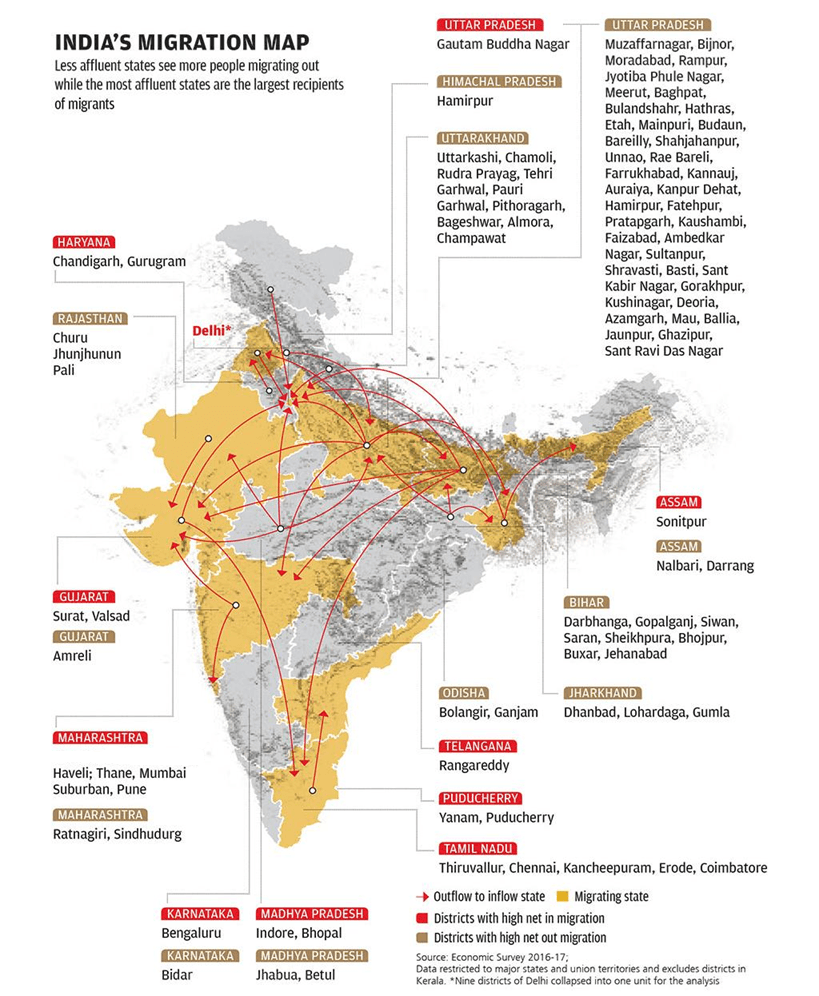
14.Post-Covid Indian Migration Patterns (Post-Covid Migration)

Indian Express
Illustration for Post-Covid Indian Migration Patterns (Post-Covid Migration)

What & Where

Migration = people’s spatial mobility for work/study/survival; two main streams: internal (rural↔urban, inter-state) & international.

Post-Covid India: large urban→rural reverse flow in 2020, now renewed rural→urban plus rising climate-led moves from coastal/agrarian belts.

Major external corridors: Gulf (low-skill), North America, EU, Australia (high-skill), new forays into Africa, Europe via EU Blue Card.

Quick Facts for MCQs

Post-Covid Internal Trends

  • Rebound: MGNREGA low wages + Smart Cities pull sending workers back to metros.
  • Climate push: Odisha, other agrarian states see distress moves due to floods, droughts.
  • Entitlement loss: weak ONORC portability hampers food security.

International Emigration

  • Shift: skilled Indians choosing Canada Express Entry, Australia, EU Blue Card over Gulf.
  • Healthcare demand: global spike kept remittances buoyant despite pandemic layoffs.
  • Student surge: post-pandemic outbound education a key remittance driver.

Governance Gaps

  • Data void: delayed Census 2021, under-counted donkey-route emigrants hinder planning.
  • Scheme lag: Four Labour Codes 2020 await rules; Inter-State Migrant Act poorly enforced.
  • Panchayat limits: minimal funds/capacity to track or aid migrants.

Schemes & Tech

  • e-Shram: voluntary unorganised worker e-registry, hampered by digital divide.
  • ONORC: ration portability across states, coverage still patchy.
  • PDOT: MEA-run pre-departure orientation expanding via India Centre for Migration.

Key Data Points

FeatureData-Point
Reverse migrants 1st lockdown44.13 million
Reverse migrants 2nd lockdown26.3 million
Urban share projected 2030>40 % (Econ Survey 23-24)
PLFS migration rate 2020-2128.9 %
Total remittances 2020USD 83.15 bn
Total remittances 2023-24USD 118.7 bn
Education remittances 2021USD 3,171 mn
Kerala student emigrants 20232.5 lakh (↑94 % vs 2018)
Smart Cities to be built100
e-Shram launch year2021

Related UPSC Prelims PYQs

CDS_GK, GEO_GS 2021PYQ 1

Which one of the following statements with regard to the World Immigration Report, 2020 prepared by the United Nations is NOT correct?

CDS_GK, GEO_GS 2020PYQ 2

2011 की जनगणना के अनुसार, भारत में ऐसे लोग, जिन्हें प्रवासी (आंतरिक) माना जा सकता है अर्थात् जो अपने पिछले निवास से हट कर किसी अन्य स्थान पर बस गए हैं, की प्रतिशतता (लगभग) कितनी है?

Ready to practice?

Test your knowledge with our UPSC test series.

Start Free Trial