UPSC Current Affairs

14 topicsGS-1: 2GS-2: 4GS-3: 8
0/14 done
GS-2Polity

1.National Commission for Women Functions (Statutory Body)

Times of India
Illustration for National Commission for Women Functions (Statutory Body)

What & Where

NCW – autonomous statutory body shielding, advancing women’s rights India-wide

Constituted by National Commission for Women Act 1990; operational since 31 Jan 1992

Rolling out 21 pre-marital communication centres across 9 states for marriage-related counselling

Quick Facts for MCQs

Legal & Policy

  • Reviews existing laws; recommends amendments enhancing gender justice
  • Monitors implementation of POCSO, Domestic Violence Act, Dowry Prohibition Act
  • Coordinates with police, courts ensuring speedy redressal of women’s rights violations

Monitoring & Enforcement

  • Can investigate complaints, call for documents, examine witnesses
  • Takes suo moto cognisance of media or public reports on women’s rights breaches
  • Reviews government schemes for effectiveness toward women’s welfare

Social Outreach

  • Conducts awareness drives, legal aid camps, counselling services nationwide
  • Supports victims of domestic violence, workplace harassment through referral networks
  • Pre-marital communication centres aim to reduce marital discord via early counselling

Key Data Points

FeatureData-Point
Parent ministryMinistry of Women & Child Development
Legal basisNational Commission for Women Act 1990
Statutory start date31 January 1992
StatusAutonomous, quasi-judicial
HQ locationNew Delhi
New initiative21 pre-marital communication centres
Coverage9 Indian states
Key powersSuo moto inquiry, summons, recommend legal reforms

Related UPSC Prelims PYQs

CDS_GK, GS1 2025PYQ 1

राष्ट्रीय महिला आयोग के बारे में निम्नलिखित में से कौन-से कथन सही हैं?

CDS_GK, GS1 2007PYQ 2

Consider the following statements:
GS-2Polity

2.Reasonable Classification Test Article 14 (Equality Principle)

Indian Express

What & Where

Reasonable Classification Test – yardstick for equality review under Article 14

Framed by Supreme Court in Anwar Ali Sarkar vs State of West Bengal (1952)

Operates pan-India whenever legislation or executive action is challenged for arbitrariness

Quick Facts for MCQs

Judicial Precedents

  • Anwar Ali Sarkar invalidated arbitrary case referral to special courts
  • Dalmia upheld single-person law if special circumstances constitute a class
  • Saurabh Chaudri distilled two-prong test, guiding modern Article 14 review

Test Components

  • Intelligible differentia distinguishes persons or things being treated separately
  • Rational nexus links that difference with the statute’s objective

Significance & Limits

  • Enables targeted legislation without breaching equality mandate
  • Acts as benchmark for courts to strike irrational state action
  • Risk subjective application leading to unjustified discrimination

Case Background

  • Anwar Ali Sarkar sentenced to transportation for life by Alipore Sessions Court
  • Special Courts Act allowed executive to pick cases, lacking clear guidelines
  • Supreme Court majority held such unguided discretion violates equal protection

Key Data Points

FeatureData-Point
Constitutional anchorArticle 14, Part III
Twin criteriaIntelligible differentia & Rational nexus
First articulationAnwar Ali Sarkar case 1952
Related statute struckWest Bengal Special Courts Act 1950
Later affirmationShri Ram Krishna Dalmia 1958
Burden of proofChallenger must rebut presumption of constitutionality
Notable restatementSaurabh Chaudri case 2004

Related UPSC Prelims PYQs

CDS_GK, GS1 2021PYQ 1

Equality before the law or equal protection of the laws within the territory of India is guaranteed under which one of the following Articles of the Constitution of India?

CDS_GK, GS1 2004PYQ 2

Match List I (Articles of the Constitution of India) with List II (Provision) and select the correct answer using the codes given below the lists:

GS-3Editorial

3.India Cryptocurrency Regulation Debate (Crypto Regulation)

Indian Express
Illustration for India Cryptocurrency Regulation Debate (Crypto Regulation)

What & Where

Cryptocurrency: decentralised virtual asset secured by cryptography; transactions logged on publicly shared blockchain.

Processes: mining for issuance, peer-validated ledger updates, no central intermediary.

Geography: US supportive, EU under MiCA, India unregulated, El Salvador first to legalise Bitcoin.

Quick Facts for MCQs

Legal & Policy

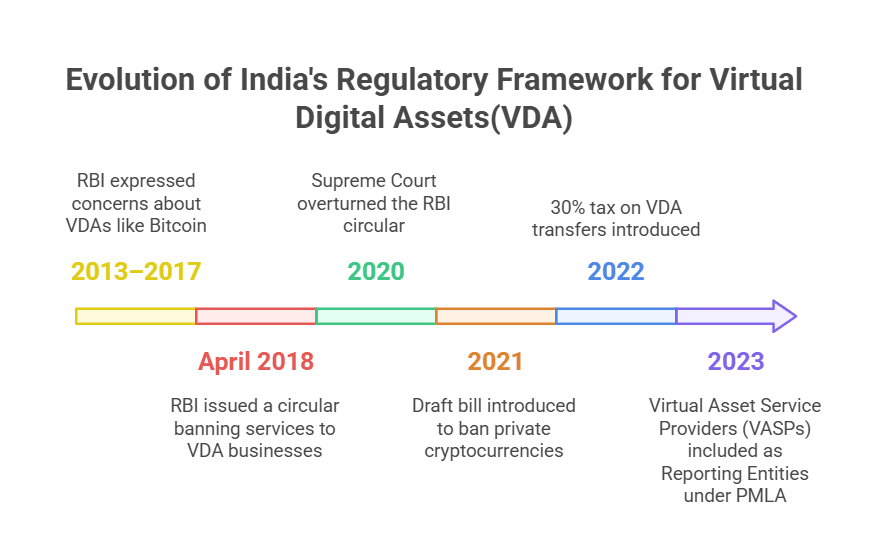
  • Regulation: Draft bill must classify crypto assets, differentiate stablecoins, recognise CBDC separately.
  • Taxation: 30 % plus TDS regime spurs offshore flight; balanced rates urged.
  • Framework: Stage-based adoption with industry consultations recommended.

Economic Angle

  • Investment: Clear norms could draw FDI, set up crypto export zones, curb talent exodus.
  • Innovation: Rising demand for scalable, secure blockchain can build Indian tech workforce.
  • Macroeconomy: Unchecked crypto flows may disturb traditional money circulation.

Security Dimension

  • Misuse: Borderless transfers facilitate laundering, terror finance, ransomware payouts.
  • Consumer risk: No dedicated grievance forum heightens fraud and volatility exposure.
  • Oversight: Commodity-style regulation with mandatory KYC proposed for protection.

Tech & Schemes

  • CBDC: Digital Rupee can run parallel to crypto via defined interoperability rules.
  • Scalability: Expanding blockchain size limits high-volume, emergency transactions.
  • Mining: Network miners solve cryptographic puzzles, validate blocks, receive new coins.

Key Data Points

FeatureData-Point
First Bitcoin legal-tender countryEl Salvador, Sept 2021
EU crypto rulebookMarkets in Crypto-Assets (MiCA)
RBI action 2018Banking ban on crypto dealings; later quashed
Indian legal status todayUnregulated, discussion paper awaited
Ledger characteristicPublic, append-only, decentralised

Related UPSC Prelims PYQs

GS1 2024PYQ 1

Consider the following statements in respect of the digital rupee:

GS1 2023PYQ 2

With reference to Central Bank digital currencies, consider the following statements:
GS-3Economy

4.US Strategic Bitcoin Reserve (Cryptocurrency Policy)

Indian Express
Illustration for US Strategic Bitcoin Reserve (Cryptocurrency Policy)

What & Where

Definition: US-government Strategic Bitcoin Reserve to store Bitcoin and select cryptocurrencies as national strategic assets

Geography: Operated by US Departments of Treasury & Commerce, conceptualised as a digital Fort Knox within US jurisdiction

Genesis: Created through President Trump executive order, March 2025, drawing on seized crypto assets

Quick Facts for MCQs

Legal & Policy

  • ExecutiveOrder: Treats Bitcoin reserve as strategic national interest asset
  • SeizureFramework: Utilises forfeiture statutes to divert confiscated crypto into reserve instead of auction
  • HoldingMandate: Prohibits premature liquidation to avoid legal or market disruptions

Economic Angle

  • ValueRetention: Long-term custody aimed at appreciating asset value for federal balance sheet
  • MarketStability: Government hoarding reduces sudden supply shocks from bulk auctions
  • LeadershipGoal: Positions US as dominant state actor in global digital-asset markets

Tech & Schemes

  • AssetDiversity: Includes major blockchains beyond Bitcoin for risk dispersion
  • CustodyInfrastructure: Centralised, government-audited wallets mirror physical bullion storage protocols
  • AcquisitionPlan: Agencies authorised to expand holdings through further seizures or cost-neutral purchases

Key Data Points

FeatureData-Point
Establishing instrumentPresidential executive order
Establishment month-yearMarch 2025
Founding PresidentDonald Trump
Managing agenciesTreasury + Commerce Depts
Initial capitalBitcoin from criminal & civil forfeitures
Primary assetBitcoin
Other assetsEthereum, XRP, Solana, Cardano
Sales policyNo immediate sales; long-term hold
Fiscal stanceBudget-neutral; no taxpayer cost
Strategic analogyDigital equivalent of Fort Knox
GS-3Economy

5.CPSE Capex Budget Reliance (Public Sector Capex)

Indian Express
Illustration for CPSE Capex Budget Reliance (Public Sector Capex)

What & Where

Definition; Central Public Sector Enterprises (CPSEs) have ≥51 % equity held by Union Government or other CPSEs

Financing; capex sourced through Internal & Extra Budgetary Resources (IEBR) or Budgetary Support (government equity/loans)

Oversight; Department of Public Enterprises monitors performance across India under respective administrative ministries

Quick Facts for MCQs

Fiscal Trend

  • Budgetary-support growth 150 % in five years signalling rising fiscal reliance
  • IEBR halved since FY20 reducing CPSE financial autonomy
  • High payouts; dividend focus curtails reinvestment capability

Private Investment

  • Deterrence; uncertain policy and CPSE debt discourage private capital participation
  • NHAI expected 38 % private funding yet raised none FY23-24
  • Committee warning; exclusive state funding may crowd out social expenditure

Governance Measures

  • Disinvestment; New PSE Policy 2021 pushes non-strategic CPSE privatisation via DIPAM
  • Efficiency; Sengupta Committee suggests biannual performance reviews for quicker decisions
  • Balance; 15th FC advises limiting dividends to sustain capex

Classification & Numbers

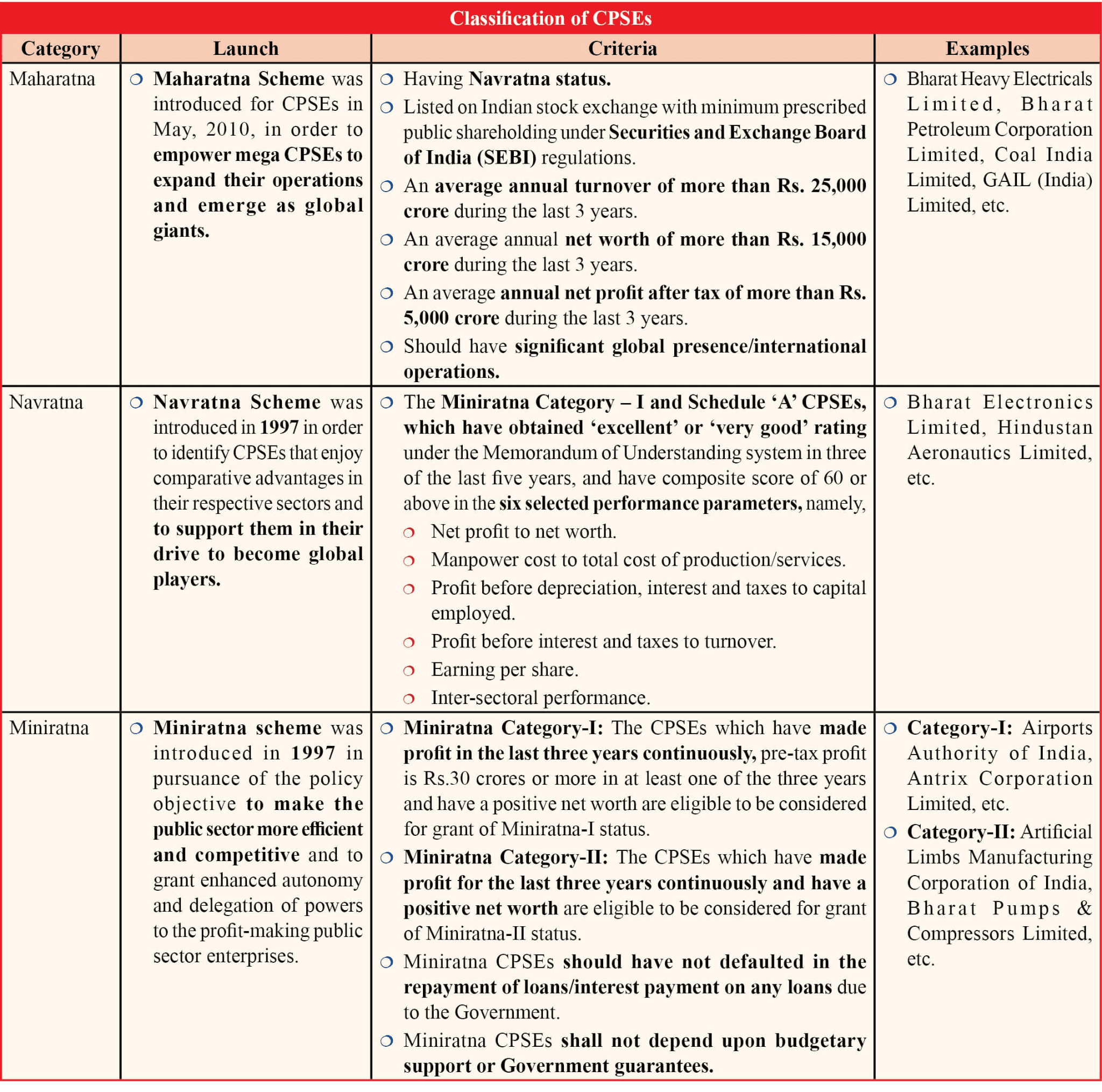
  • Categories; Maharatna, Navratna, Miniratna based on size and autonomy
  • Count; India now hosts 26 Navratnas after IRCTC & IRFC elevation
  • Employment, infrastructure and forex earnings underline CPSE macro significance

Key Data Points

FeatureData-Point
Budgetary support FY20₹2.1 lakh cr
Budgetary support FY25 (RE)₹5.48 lakh cr
IEBR FY20₹6.42 lakh cr
IEBR FY23₹3.63 lakh cr
IEBR FY25 (Est.)₹3.82 lakh cr
Total CPSEs Mar 2024448
Operating CPSEs FY24272
Gross revenue FY24₹36.08 lakh cr (-4.7 %)
Contribution to exchequer FY24₹4.85 lakh cr (+5.96 %)
CSR spend FY24₹4,900 cr (+19.08 %)
Forex earned FY24₹1.43 lakh cr
Latest Navratnas (Feb 2025)IRCTC, IRFC
NHAI debt 2022₹3.48 lakh cr
NHAI IEBR FY23-24Nil

Related UPSC Prelims PYQs

GS1 1995PYQ 1

95. The largest source of financing the public sector outlay of the Eighth Five-Year Plan comes from

GS1 2011PYQ 2

Why is the Government of India disinvesting its equity in the Central Public Sector Enterprises (CPSEs)?

GS-1MappingQuick Bite

6.Bangus Valley Kashmir Location (Kashmir Valleys)

The Hindu
Illustration for Bangus Valley Kashmir Location (Kashmir Valleys)

What & Where

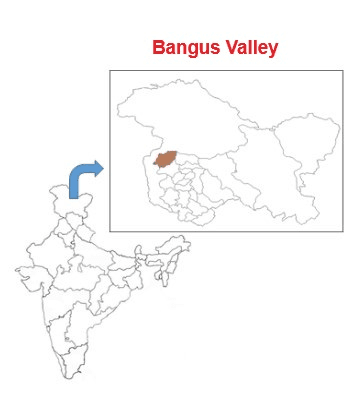
Bangus Valley: twin bowl-shaped alpine meadows in north Kashmir’s Kupwara, immediately south of the Line of Control.

Comprises Bodh Bangus (Big) and Lokut Bangus (Small) amid grasslands and Taiga-type conifer forests.

Flanked by Rajwar-Mawar (E), Shamasbury-Dajlungun (W), Chowkibal-Karnah Guli (N) mountain ranges.

Quick Facts for MCQs

Geography & Terrain

  • Altitudinal mix: lower grasslands transitioning to dense conifer slopes.
  • Bowl topography provides natural water retention and panoramic vistas.
  • Proximity-to-LoC adds strategic remoteness, limiting prior development.

Ecotourism Potential

  • Government push: sustainable tourism, minimal ecological footprint focus.
  • Meadow trekking, bird-watching, and forest trails identified as flagship activities.
  • Untapped locale expected to decongest Gulmarg-Pahalgam circuits.

Security Dimension

  • LoC adjacency requires army clearances, influencing visitor flow and infrastructure.
  • Ecotourism plan aligned with confidence-building and border-area livelihood goals.

Environmental Significance

  • Coniferous Taiga hosts high-altitude fauna: musk deer, Himalayan black bear (reported).
  • Meadow flora includes medicinal herbs prized by local Gujjar-Bakarwal communities.

Key Data Points

FeatureData-Point
Union TerritoryJammu & Kashmir
DistrictKupwara
Nearest geopolitical markerLine of Control (north side)
Sub-valleysBodh Bangus & Lokut Bangus
Surrounding rangesRajwar, Mawar, Shamasbury, Dajlungun, Chowkibal, Karnah Guli
Dominant biomesAlpine grassland; Coniferous Taiga
Government aim (2025)Develop as ecotourism destination
Key landscape imageLush green meadows with low mountains
GS-1Mapping

7.Djibouti Geography Overview (Horn of Africa)

NDTV

What & Where

Djibouti; small Horn of Africa state at Red Sea–Gulf of Aden junction, key maritime choke-point.

Functions as deep-water port and railhead linking land-locked Ethiopia to sea.

Terrain volcanic, arid; extremes from 2,028 m Mount Moussa to –155 m Lake Assal.

Quick Facts for MCQs

Topography

  • Highlands; Goda Massif hosts Mount Moussa and Day Forest micro-climate.
  • Coastal plains descending sharply to Danakil depression’s Lake Assal.
  • Desert dominates; sparse vegetation outside highlands.

Hydrology

  • Endorheic lakes Assal and Abbe collect runoff; intense evaporation yields hypersaline waters.
  • Absence of perennial rivers necessitates reliance on aquifers, fog harvesting.

Tectonics & Volcanism

  • Triple-junction rifting causes ground subsidence, basaltic fissure eruptions.
  • Ardoukoba 1978 eruption produced 8 km fissure, new basalt flows.

Migration Risks

  • Bab-el-Mandeb crossing; over 180 migrants missing after four boats sank 2024.
  • Strong currents, overloaded vessels, lack of regulation heighten fatalities.

Key Data Points

FeatureData-Point
CapitalDjibouti City
NeighboursEritrea, Ethiopia, Somalia, Gulf of Aden
Highest PeakMount Moussa – 2,028 m
Lowest PointLake Assal – 155 m below sea level (Africa’s lowest)
Saline LakeLake Assal
Border LakeLake Abbe (with Ethiopia)
Permanent RiversNone; only wadis, groundwater
Coolest RegionDay Forest on Goda Massif
Active VolcanoArdoukoba, erupted 1978
Tectonic SettingTriple junction: Red Sea, Gulf of Aden, East African Rift
SeismicityFrequent tremors, rifting
Key Migration RouteDjibouti–Yemen sea crossing
GS-3Editorial

8.AI Threatens Student Critical Thinking (AI in Education)

The Hindu
Illustration for AI Threatens Student Critical Thinking (AI in Education)

What & Where

Critical Thinking – logical, independent analysis, bias detection, evidence-based decision-making

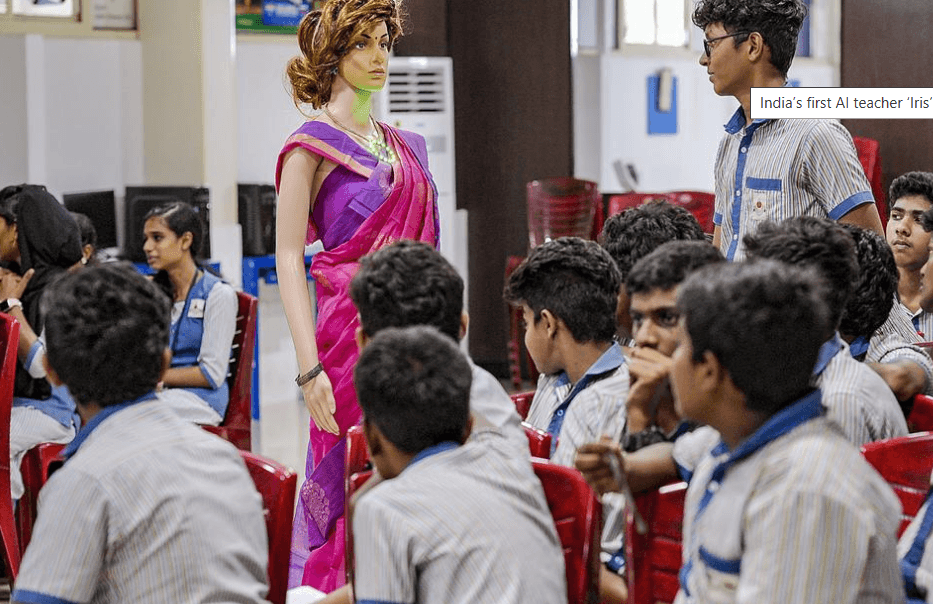
Classroom Context – rapid spread of generative-AI tools giving instant homework/answer support

Core Elements – problem-solving, logical reasoning, creativity, information evaluation

Quick Facts for MCQs

Classroom Dynamics

  • AI tools – chatbots, text generators supplying ready-made content in seconds
  • Overreliance – students skip reflection, outsource assignments, curiosity declines
  • Teacher response – craft tasks demanding original reasoning and stepwise explanation

Cognitive Risks

  • Memory retention – passive AI consumption weakens recall and synthesis
  • Questioning mindset – perceived AI authority reduces source scrutiny and doubt
  • Creativity erosion – habitual AI drafting stifles unique ideation and expression

Human Comparative Advantages

  • Contextual understanding – emotion, culture, ethics integrated into judgment
  • Adaptive problem-solving – humans handle novel, rule-less scenarios beyond AI patterns
  • Moral decision-making – fairness and justice evaluated via conscience, not statistics

Key Data Points

FeatureData-Point
Definition critical thinkingAnalyze, evaluate, interpret information independently
AI classroom riskInstant answers curb deep analysis & reflection
Cognitive downsideLower memory retention, weaker analytical pathways
Bias originAlgorithms mirror prejudices in training data
Human edge over AIContextual, ethical, emotional judgment capacity
Pedagogic needBalance AI use with reasoning skill cultivation

Related UPSC Prelims PYQs

CDS_GK, GS1 2025PYQ 1

Which one of the following is the characteristic of Artificial Intelligence?

CDS_GK, GS1 2020PYQ 2

विकास की वर्तमान स्थिति में, कृत्रिम बुद्धिमत्ता (Artificial Intelligence), निम्नलिखित में से किस कार्य को प्रभावी रूप से कर सकती है?

GS-3S&T

9.Growing Space Debris Hazards (Space Debris)

The Hindu

What & Where

Space debris = non-functional, man-made objects/fragments orbiting Earth or re-entering atmosphere (UN COPUOS).

Primary origin: on-orbit break-ups of satellites/rocket stages; pieces range baseball-size to sub-millimetre.

March 2025: 500 kg metal fragment landed in Kenya, illustrating global fall-zone unpredictability.

Quick Facts for MCQs

Risk Spectrum

  • Collision threat: debris > 10 cm can destroy satellites; 1 cm fragments suffice to cripple instruments.
  • Surface erosion: millimetre particles pit shielding, degrade solar arrays, shorten mission life.
  • Kessler Syndrome: cascading impacts could saturate orbits, blocking future launches.

Legal & Policy

  • Outer Space Treaty Article VI makes launching state answerable for all national activities; lacks enforcement.
  • 1972 Liability Convention: absolute Earth-surface liability, minimal precedent for compensation collection.
  • UN 25-year deorbit rule voluntary; only about one-third of operators comply.

Tech & Schemes

  • Active removal: ESA ClearSpace-1, RemoveDEBRIS; NASA OSAM-1 for robotic capture, refuel, deorbit.
  • Natural decay: atmospheric drag strengthened during solar maxima accelerates Low-Earth-Orbit debris fall.
  • India initiatives: Debris-Free Space Mission for mitigation, NETRA for tracking and analysis.

Event Trigger

  • Kenya crash incident revived debate on space-object identification, responsibility apportioning, and public safety preparedness.

Key Data Points

FeatureData-Point
Debris > baseball≈ 23,000 pieces
Marble-sized debris≈ 5 × 10⁵ pieces
Fragments > 1 mm≈ 1 × 10⁸ pieces
Critical size to disable satellite≥ 1 cm
Solar activity cycle11 years
Outer Space Treaty1967
Liability Convention1972
UN deorbit guidelineRemove within 25 years
Compliance with guideline~30 %
Recent re-entry mass500 kg object
Indian tracker systemNETRA
ESA removal missionClearSpace-1

Related UPSC Prelims PYQs

GS1 1998PYQ 1

The damage to the Spektr Module of the Russian Space Station Mir was due to

GS-3S&TQuick Bite

10.Probiotics Aid Vitiligo Treatment (Medical Research)

The Hindu

What & Where

Vitiligo — autoimmune loss of melanocytes causing depigmented skin patches worldwide.

Gut-friendly bacteria (probiotics) — live microbes restoring healthy intestinal microbiome.

Study context — probiotics modulate immune cells to treat vitiligo; prevalence notable in India.

Quick Facts for MCQs

Pathophysiology

  • Autoimmunity: misdirected T cells target melanocytes, causing melanin loss.
  • Triggers: genetic mutations, stress, environmental factors augment immune attack.
  • Result: patchy white lesions of varied size and location.

Therapeutic Research

  • Modulation: probiotic intake recalibrates gut–skin immune axis.
  • Outcome: decreased cytotoxic activity, increased protective regulatory T cells in models.
  • Promise: non-invasive adjunct to existing phototherapy or steroids.

Microbial Candidates

  • Lactobacillus: produces lactic acid, reinforces mucosal barrier.
  • Bifidobacterium: synthesises short-chain fatty acids, dampens inflammation.
  • S. boulardii: transient coloniser restoring microbial balance post-antibiotics.

Key Data Points

FeatureData-Point
Disorder typeAutoimmune depigmentation
Global prevalence0.5 – 2 % population
India prevalence0.25 – 4 % population
Key immune eventMelanocyte destruction by cytotoxic T cells
Research findingProbiotics suppress harmful T cells, boost regulatory T cells
Main probiotic generaLactobacillus, Bifidobacterium, Saccharomyces boulardii
Lactobacillus benefitAids lactose digestion, curbs diarrhoea
Bifidobacterium roleLowers gut inflammation, enhances immunity
Saccharomyces boulardiiYeast preventing antibiotic-associated diarrhoea
GS-3Security

11.Convention on Cluster Munitions Ban (Cluster Munitions)

CMW

What & Where

Convention on Cluster Munitions (CCM): 2008 treaty banning use, production, stockpile, transfer of cluster bombs globally.

Cluster munitions: weapons scattering many unguided bomblets; leave high unexploded-ordnance threat post-conflict.

Lithuania: first state to formally withdraw from CCM, breaking unanimous adherence since treaty’s 2010 enforcement.

Quick Facts for MCQs

Legal & Policy

  • Comprehensive prohibition covers use, development, transfer, stockpiling, production.
  • Article 21 disallows assistance, encouragement, or inducement of banned activities.
  • Victim assistance, clearance, reporting obligations embedded for all Parties.

Security Dimension

  • Designed to neutralise dispersed armour, infantry, artillery concentrations swiftly.
  • Free-fall, unguided submunitions cause wide-area, non-discriminatory impact.
  • High dud rate converts battlefields into long-term minefields, hindering post-war recovery.

International Examples

  • 112 ratified; 12 signed yet to ratify, reflecting mixed global buy-in.
  • Major military powers — US, Russia, China, India, Israel, Ukraine — remain outside citing strategic utility.
  • Treaty fosters international cooperation on demining, victim rehab, stockpile destruction funding.

Key Data Points

FeatureData-Point
Adoption year2008
Entry into force1 Aug 2010
Current States Parties112
Signatories pending ratification12
Stockpile destruction deadlineWithin 8 yrs of joining
First treaty withdrawalLithuania
Typical bomblets per bombSeveral to 600+
Delivery modesAircraft, artillery, missiles
Key non-signatoriesIndia, USA, Russia, China, Israel, Ukraine
Assist/induce banMembers barred from aiding prohibited acts

Related UPSC Prelims PYQs

GS1 1995PYQ 1

84. The signatories to the treaty banning chemical weapons include

GS-3Security

12.T-72 Tank Engine Upgrade (Main Battle Tank)

Economic Times
Illustration for T-72 Tank Engine Upgrade (Main Battle Tank)

What & Where

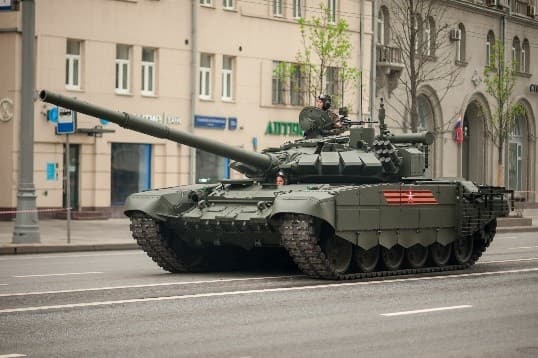
T-72 MBT — Soviet-designed, mass-produced tank forming Indian Army armour core

$248 mn India-Russia deal to re-engine 2,400-strong fleet with 1,000 HP power-packs

Transfer-of-Technology to Armoured Vehicles Nimam Ltd (AVNL), Avadi, Chennai, Tamil Nadu

Quick Facts for MCQs

Tech & Schemes

  • Upgrade increases mobility and power-to-weight for high-altitude and desert operations
  • TOT enables localisation under Atmanirbhar Bharat, reducing future import dependence
  • ERA and composite armour packages already fielded on Indian T-72M1 Ajeya variant

Security Dimension

  • Backbone of Indian armoured corps; majority of strike and pivot formations
  • Retrofit quicker, cheaper than new MBTs, maintaining readiness against China–Pakistan fronts
  • Proven deployment in Ladakh standoff and Thar desert exercises, showcasing versatility

Economic Angle

  • Engine swap lowers life-cycle cost versus procuring Arjun Mk-1A or foreign tanks
  • Avadi project sustains skilled jobs in Tamil Nadu Defence Industrial Corridor
  • Continues India–Russia defence trade despite evolving global sanction landscape

Key Data Points

FeatureData-Point
Contract valueUSD 248 million
SupplierRosoboronexport, Russia
Engine power (new)1,000 HP
Engine power (current)780 HP
Indian T-72 inventory≈2,400 tanks
Global introduction1970s
TOT recipientAVNL, Avadi (TN)
Main gun calibre125 mm smoothbore
Secondary armament7.62 mm coax, 12.7 mm AA
On-road range460 km
Off-road range300 km with drums
Armour typeComposite + Reactive
Night capabilityThermal imaging sights
DesignerUralvagonzavod, USSR
Indian makerHeavy Vehicles Factory, Avadi

Related UPSC Prelims PYQs

CDS_GK 2022PYQ 1

P-75 I (या P-75 भारत) परियोजना किनके निर्माण से संबंधित है?

GS-2Scheme

13.Namami Gange River Rejuvenation (River Conservation)

DD News
Illustration for Namami Gange River Rejuvenation (River Conservation)

What & Where

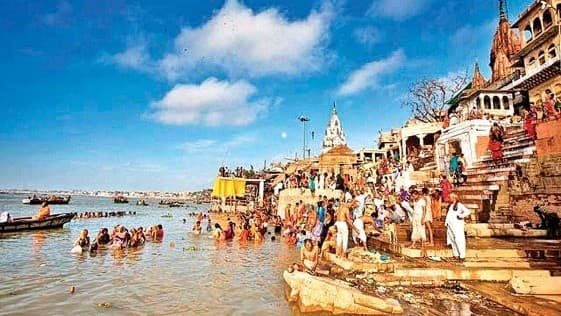
Flagship river-rejuvenation mission targeting the 2,525 km Ganga and its basin across Uttarakhand, UP, Bihar, Jharkhand, West Bengal.

Implemented by Ministry of Jal Shakti through National Mission for Clean Ganga (NMCG).

Core processes: sewage interception & treatment, riverfront modernisation, afforestation, biodiversity conservation, community stewardship.

Quick Facts for MCQs

Tech & Schemes

  • Sewage; modern STPs intercept waste before river entry, enable treated-water reuse.
  • Riverfront; upgraded ghats, CNG/electric crematoria reduce ash, improve tourism hygiene.
  • Village; Ganga Gram initiative delivers toilets, solid-liquid waste management, safe water in riparian settlements.

Environmental Impact

  • Biodiversity; rebound in Gangetic dolphins, richer fish diversity across middle–lower reaches.
  • Afforestation; 1.34 lakh ha riparian plantation curbs erosion, stabilises base flow.
  • Water quality; improved dissolved-oxygen & lower BOD levels in Uttarakhand, UP, Bihar, Jharkhand, West Bengal stretches.

International Recognition

  • UN; cited under Decade on Ecosystem Restoration 2022 for scalable river recovery.
  • Collaboration; MoUs with Denmark, Germany, Japan on clean-tech finance and expertise.
  • Model; showcased globally for integrated basin-management in developing economies.

Key Data Points

FeatureData-Point
LaunchJune 2014
Initial budget₹20,000 cr (now ₹42,500 cr)
Nodal ministryJal Shakti (NMCG)
Sewage-treatment projects>200 sanctioned
Varanasi STP boost4× capacity rise
Afforested area1.34 lakh ha
Ganga Gram coverage1,674 villages
UN recognition2022 Top-10 Restoration Flagship
Biodiversity signGangetic dolphin numbers rising

Related UPSC Prelims PYQs

GS1, NDA_GAT 2016PYQ 1

Which of the following are the key features of ‘National Ganga River Basin Authority (NGRBA)’?

GS1, NDA_GAT 2022PYQ 2

Which among the following has initiated a nationwide flagship campaign ‘Puneet Sagar Abhiyan’ to clean seashores/beaches and other water bodies of plastic and other waste materials?

GS-2SchemeQuick Bite

14.Jan Aushadhi Diwas Observance (Generic Medicines Scheme)

PIB
Illustration for Jan Aushadhi Diwas Observance (Generic Medicines Scheme)

What & Where

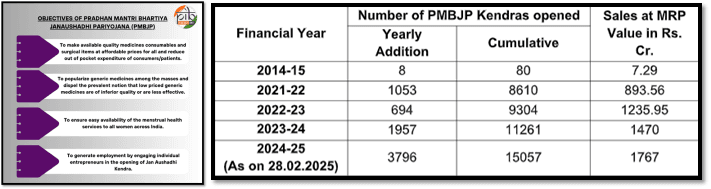
Jan Aushadhi Diwas: annual 7 March observance promoting affordable generics under Pradhan Mantri Bhartiya Janaushadhi Pariyojana, celebrated nationwide.

PMBJP: Ministry of Chemicals & Fertilisers scheme; launched 2008, revamped 2015, renamed 2016; runs Janaushadhi Kendras across India.

Janaushadhi Week: outreach campaign 1-7 March in all states/UTs, culminating in Diwas.

Quick Facts for MCQs

Legal & Policy

  • Governance: Implemented by Department of Pharmaceuticals to ensure drug price control via Janaushadhi Kendras network.
  • Inclusion: Rs 2 lakh establishment incentive reserved for women, SC/ST, divyang and ex-servicemen in underserved areas.

Economic Angle

  • Affordability: Generic medicines priced 50–80 % below branded versions, lowering out-of-pocket health spending.
  • Volume: 72 crore Suvidha pads sold till Jan 2025, each costing only Re 1.

Tech & Schemes

  • Digital: Jan Aushadhi SUGAM app locates Kendras, checks availability, suggests cheaper therapeutic equivalents.
  • Outreach: Janaushadhi Week conducts health camps, awareness drives 1–7 March leading to Diwas on 7 March.

Key Data Points

FeatureData-Point
First Diwas celebrated2019
Fixed Diwas date7 March
2025 theme“Daam Kam – Dawai Uttam”
Original scheme launch2008 (Jan Aushadhi Scheme)
Revamp year2015 (Pradhan Mantri Jan Aushadhi Yojana)
Final renaming2016 (PMBJP)
Price gap vs branded50–80 % cheaper
One-time Kendra incentiveRs 2 lakh
Suvidha pad priceRe 1 each
Suvidha pads sold72 crore by Jan 2025
Key mobile toolJan Aushadhi SUGAM app

Related UPSC Prelims PYQs

NDA_GAT 2022PYQ 1

भारत सरकार की प्रमुख टेलीमेडिसिन सेवा ‘ई-संजीवनी’ को हाल ही में किसके साथ एकीकृत किया गया?

Ready to practice?

Test your knowledge with our UPSC test series.

Start Free Trial