UPSC Current Affairs

17 topicsGS-1: 5GS-2: 2GS-3: 10
0/17 done
GS-2Polity

1.SC Quashes NMC Disability Rule (Disability Rights)

Hindustan Times

What & Where

Supreme Court 2024 judgment Anmol v Union of India on NMC disability guideline, India

Struck down “both hands intact” rule for MBBS admissions as arbitrary, discriminatory

Endorsed functional assessment over rigid physical eligibility for Persons with Disabilities

Quick Facts for MCQs

Legal & Policy

  • Article 41 secures education, work, assistance rights for disabled citizens
  • RPwD Act forbids exclusion from professional courses on disability alone
  • SC labelled NMC rule arbitrary, unconstitutional, antithetical to RPwD Act

Judicial Precedents

  • Omkar Ramchandra Gond 2024: disability percentage insufficient, assess functionality
  • Om Rathod v DGHS 2024: prioritise opportunities, functional competence for PwD aspirants
  • Bench held NMC Assessment Board ignored these precedents

Administrative Action

  • Court urged immediate guideline overhaul consistent with Constitution, RPwD Act, UNCRPD
  • Functional assessment to precede any blanket physical criteria in admissions
  • Expected ripple across all medical entrance counselling and reservation policies

Key Data Points

FeatureData-Point
Case decidedAnmol vs Union of India, 2024
Contested ruleBoth hands intact with sensation & strength
Regulator involvedNational Medical Commission (NMC)
Core statuteRights of Persons with Disabilities Act 2016
Constitutional articleArticle 41 (Right to work, education, assistance)
Global treaty citedUNCRPD
Assessment preferredFunctional ability evaluation
SC directiveNMC to revise disability admission norms

Related UPSC Prelims PYQs

GS1 2011PYQ 1

India is home to lakhs of persons with disabilities. What are the benefits available to them under the law?
GS-3Economy

2.Major Mineral Reclassification (Mineral Policy)

EET

What & Where

Major minerals – centrally regulated under MMDR Act 1957.

Reclassified list – Barytes, Feldspar, Mica, Quartz now tagged major.

Governance – IBM oversight; leases via competitive auction nationwide.

Quick Facts for MCQs

Legal & Policy

  • Gazette notification shifts four minerals from minor to major category.
  • Reclassification removes minor-mineral limits on extracting associated critical elements.
  • IBM supervision mandates scientific, sustainable mining standards.

Economic Angle

  • Longer 50-year leases give investors stability, boosting exploration capital.
  • States keep royalties, likely higher via improved recovery and auction premia.
  • Domestic supply cuts import bills for aerospace, electronics, energy sectors.

Security Dimension

  • Critical elements—Lithium, Niobium, Tantalum—essential for batteries, defence electronics.
  • Stronger oversight curbs illegal mining, protecting strategic resources.
  • Move supports Atmanirbhar Bharat mineral security agenda.

Key Data Points

FeatureData-Point
Regulating statuteMMDR Act 1957
Central regulatorIndian Bureau of Mines
Lease tenure cap50 years (Sec 8A)
Allocation modeCompetitive auction
Royalty recipientState governments
Reclassified mineralsBarytes, Feldspar, Mica, Quartz

Related UPSC Prelims PYQs

GS1 2020PYQ 1

Consider the following minerals:

GS1 2025PYQ 2

Consider the following statements:

GS-3Economy

3.Global Skilled Labor Shortage (Workforce Demographics)

The Hindu

What & Where

Global talent shortage: projected 85.2 million skilled-worker gap worldwide by 2030

High-demand geographies: Europe, GCC, Australia; key sectors—healthcare, services, AI-IoT, sustainability

India: largest young, English-speaking labour pool positioned for outbound mobility

Quick Facts for MCQs

Economic Angle

  • RevenueLoss $8.45 trn could be tapped via cross-border Indian talent supply
  • GDPBoost: capturing global demand supports India’s $9 trn 2030 target
  • RemittanceFlow bolsters forex, domestic consumption and tax receipts

Drivers of Shortage

  • Demographics: ageing Europe, GCC, Australia needing healthcare & service workers
  • SkillMismatch: legacy skills lag AI, IoT, big-data, sustainability needs
  • RegulatoryBarriers: complex visas, strict permits restrict skilled migration

India Opportunities

  • WorkforceScale: young, English-speaking cohort, trained 40 m under Skill India
  • BilateralPacts: FTAs, GCC skill agreements ease mobility & credential recognition
  • DigitalPlatforms: e-recruitment can cut fraud, ensure legal protections

Challenges & Gaps

  • RecognitionIssue: some nations deny Indian degrees; hampers placements
  • SkillGap: 44 % core skills to change by 2027; curricula lag global needs
  • IllicitRoutes: trafficking & forged documents tarnish India’s migration image

Key Data Points

FeatureData-Point
Global shortage 203085.2 million workers
Unrealised annual revenue$8.45 trillion (≈ GDP Germany + Japan)
AI market size 2027$266 billion; CAGR 33.2 %
Indian diaspora in Australia2nd-largest & fastest-growing
Skill India trainees (2015-23)40 million
India GDP projection 2030$6.5 – 9 trillion
India rank, Global Talent Competitiveness 202392nd

Related UPSC Prelims PYQs

CAPF_GAI 2025PYQ 1

भारत के सेवा निर्यात के संबंध में निम्नलिखित में से कौन-सा/कौन-से कथन सही नहीं है/हैं?

GS-3EconomyQuick Bite

4.Bharat Tex 2025 Textile Summit (Textile Sector)

PIB

What & Where

Bharat Tex 2025: global platform for textile engagement, collaboration, policy dialogue.

Hosted in New Delhi; delegates from 120 + countries.

Highlights India’s cotton, handloom and technical-textile strengths.

Quick Facts for MCQs

Economic Angle

  • Trade push: target tripling exports by 2030.
  • Value-addition: capitalize on technical textiles, MMF to cut cotton reliance.
  • Employment driver: largest industrial employer after agriculture.

Sectoral Challenges

  • Competition: Bangladesh, Vietnam undercut on cost & speed.
  • High logistics: erodes margin, raises delivery lead-time.
  • Sustainability: fast-fashion waste, water-intensive cotton cultivation.

Schemes & Policy

  • MITRA Parks: seven plug-and-play mega hubs with common infra.
  • Samarth: skilling for apparel, handloom, handicrafts.
  • Mission Cotton + GI tags: raise yield, protect niche handloom brands.

Key Data Points

FeatureData-Point
Textile share in GDP2.3 %
Share in exports12 %
Share in industrial output13 %
Workforce size45 million
Global exporter rank6th
Global producer rank2nd
FY 24 export value₹3 lakh crore
YoY export growth (23-24)7 %
2030 export goal₹9 lakh crore
Cotton dependence60 %
Logistics cost of GDP13-14 % (India) vs 8 % (China)
Nations at Bharat Tex 2025120 +

Related UPSC Prelims PYQs

CDS_GK 2025PYQ 1

Consider the following statements with reference to the Cotton textile industry in India:

GS-1History

5.Maratha Military Forts Nomination (UNESCO Candidature)

IT
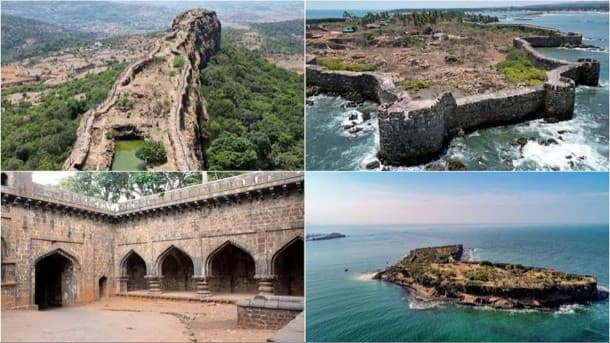
Illustration for Maratha Military Forts Nomination (UNESCO Candidature)

What & Where

Maratha Military Landscape = forts and defense systems built by Shivaji Maharaj and later Marathas during 17th–19th centuries.

Typology spans hill, hill-forest, hill-plateau, coastal, island; 12 exemplar forts nominated for UNESCO inscription.

Core geography across Sahyadri Mountains, Konkan Coast, Deccan Plateau; one fort (Gingee) in Eastern Ghats, Tamil Nadu.

Quick Facts for MCQs

Heritage Nomination

  • Delegation; Maharashtra Cultural Affairs lobbying UNESCO committee in Paris
  • Nomination titled Maratha Military Landscape of India covering 12 forts
  • Adds to state’s cultural list after 2018 Victorian Gothic success

Military Architecture

  • Features; layered walls, bastions, camouflaged escape routes, integrated water systems
  • Designs exploit natural ridges and cliffs reducing masonry needs
  • Reflects Shivaji’s asymmetric warfare doctrine and rapid fort-building strategy

Geographical Spread

  • Sahyadri belt holds majority; Konkan coast hosts island and sea forts
  • Gingee in Tamil Nadu extends Maratha footprint to Eastern Ghats
  • Landscape demonstrates defense adaptation across mountain, plateau, forest, maritime terrains

Key Data Points

FeatureData-Point
Time spanc. 1670s – 1818 CE
UNESCO Tentative List2021
Forts nominatedRaigad, Rajgad, Pratapgad, Panhala, Shivneri, Lohagad, Salher, Sindhudurg, Suvarnadurg, Vijaydurg, Khanderi, Gingee
Fort categories6 hill, 1 hill-forest, 1 hill-plateau, 1 coastal, 3 island
Key innovationsMulti-tier defenses, secret passages, rainwater harvesting
SymbolismEmbodied Shivaji’s guerrilla warfare and statecraft
Existing UNESCO sites in MaharashtraAjanta, Ellora, Elephanta, CSMT, Victorian Gothic & Art Deco, Western Ghats
Proposed site rank in state6th cultural nomination
Delegation venueParis
Nodal authorityMaharashtra Cultural Affairs Department

Related UPSC Prelims PYQs

CAPF_GAI, GS1 2005PYQ 1

Consider the following statements:

CAPF_GAI, GS1 2024PYQ 2

Which naval forts were erected by Shivaji?

GS-1History

6.Ratnagiri Buddhist Excavations (Vajrayana Centre)

The Hindu
Illustration for Ratnagiri Buddhist Excavations (Vajrayana Centre)

What & Where

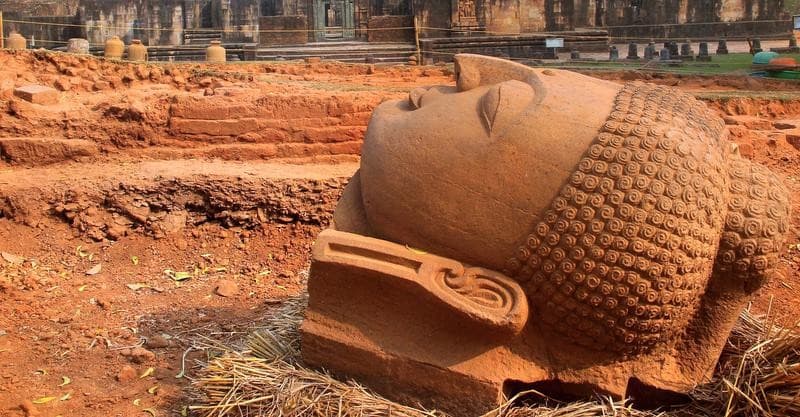
Ratnagiri: Buddhist monastic-cum-shrine complex, pre-eminent Vajrayana centre of eastern India.

Location: Jajpur district, Odisha; with Lalitgiri & Udayagiri forms Buddhist “Diamond Triangle”; flanked by Brahmani, Kimiria, Birupa.

Chronology: Occupied 5th–13th c CE; Tantric Buddhism practised uninterrupted till 16th c CE.

Quick Facts for MCQs

Archaeological Timeline

  • Discovery 1906 flagged Buddhist relics; site entered academic records.
  • Excavation 1958–61 exposed monasteries, central stupa, long votive stupa row.
  • Dig 2024–25 targets half-buried shrine complex, fresh structural mapping.

Key Artefacts

  • Buddha-head 1.4 m; largest recorded in Odisha, maybe India.
  • Votive stupas exceed 250, aligned processionally signalling ritual offerings.
  • Stone tablets inscribed with names of Amoghasiddhi, Ratnasambhava, Akshobhya, etc.

Religious Significance

  • Site matured into global Vajrayana study hub during 8th–13th c.
  • Figurines of Tara, Marici, five Dhyani Buddhas evidence full esoteric pantheon.
  • Inscriptions corroborate mantra-based Tantric liturgy adoption.

Architecture & Craftsmanship

  • Brick-core, stone-veneer buildings show lime-mortared precision and drainage planning.
  • Twin monasteries organised around square courtyards, echo Nalanda layout.
  • Masonry durability proven by minimal erosion after ~1500 years.

Key Data Points

FeatureData-Point
Location districtJajpur, Odisha
Heritage groupDiamond Triangle
Encircling riversBrahmani, Kimiria, Birupa
Earliest settlement5th c CE
Flourished till13th c CE
Vajrayana active till16th c CE
First discovery1906, Manmohan Chakravarti
Systematic dig1958–61, Debala Mitra (ASI)
Latest excavationDec 2024–Mar 2025, ASI
Tallest Buddha head1.4 m sandstone
Script on tabletsKutila / Siddhamatrika

Related UPSC Prelims PYQs

GS1 2015PYQ 1

With reference to the art and archaeological history of India, which one among the following was made earliest?

GS-1MiscQuick Bite

7.Buddhist Tri-Nation Bike Expedition (Buddhist Circuit)

PIB
Illustration for Buddhist Tri-Nation Bike Expedition (Buddhist Circuit)

What & Where

Expedition: Heartfulness Lord Buddha Trination Tri-Services Motorcycle ride covering Nepal-India-Sri Lanka Buddhist circuit

Start point: Lumbini, Nepal (birthplace of Gautam Buddha); flagged off Feb 2025

Aim: Showcase shared Buddhist heritage while involving Indian Army, Navy & Air Force riders

Quick Facts for MCQs

International Cooperation

  • Trination focus reinforces Buddha-link diplomacy among BIMSTEC/SAGAR rim neighbours
  • Soft-power projection complements India’s Cultural Exchange Agreements with Nepal & Sri Lanka

Culture & Heritage

  • Route traverses iconic Buddhist Maha-parikrama nodes; fosters awareness of transborder Buddhist circuit
  • Collaboration with IBC aligns with India’s flagship Vaishali-Lumbini Buddhist corridor plans

Security & Defence

  • Tri-Services participation builds jointmanship, endurance & civil-military outreach without combat overtones
  • Adventure training counted as ‘Mission-Based Activity’ under Indian Armed Forces adventure regulations

Key Data Points

FeatureData-Point
Full nameHeartfulness Lord Buddha Trination Tri-Services Motorcycle Expedition
Kick-off month-yearFebruary 2025
Flag-off locationLumbini, Nepal
Countries coveredNepal, India, Sri Lanka
Indian organisersInternational Buddhist Confederation; Land Port Authority of India (MHA); Nalanda University
Defence elementRiders drawn from Army, Navy, Air Force (Tri-Services)
Key SL sitesAnuradhapura; Polonnaruwa; Dambulla
Core themePromotion of Buddhist civilisational linkages
GS-1Mapping

8.Honduras Geographic Profile (Central America)

News on Air
Illustration for Honduras Geographic Profile (Central America)

What & Where

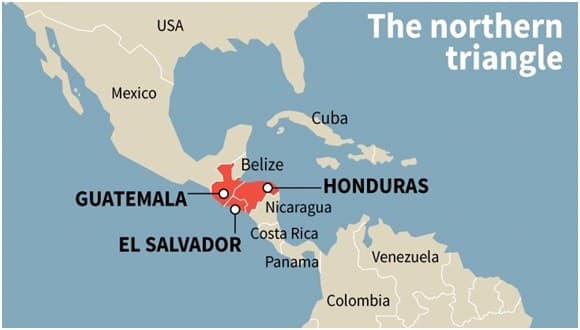
Honduras — Central American nation; >75 % terrain mountainous; coasts on Caribbean Sea (north) and Pacific Ocean (south-west, Gulf of Fonseca).

Tropical Storm SARA — Atlantic-born system; made landfall at Nicaragua–Honduras border causing floods, landslides across Central America.

India’s response — 26 tonnes humanitarian relief air-dispatched to Honduran capital Tegucigalpa post-storm.

Quick Facts for MCQs

Physical Geography

  • Mountains dominate, restricting arable land; valleys (Sula, Mosquitia) host agriculture and biodiversity hotspots.
  • Dual coastlines enable Caribbean and Pacific maritime access, influencing climate and trade routes.
  • Coco River demarcates lengthy eastern border, prone to flood during tropical systems.

Economic Angle

  • Coffee remains top foreign-exchange earner; fruit and sugar diversify agrarian revenue.
  • Textile maquiladoras clustered near Sula Valley, leveraging fertile plains and proximity to Caribbean ports.
  • Mineral resources (zinc, lead, silver) supplement export basket despite environmental concerns.

Disaster Impact

  • Storm SARA delivered intense rainfall, triggering catastrophic floods and landslides in multiple Central American states.
  • Mountainous relief exacerbated runoff, damaging remote communities and transport corridors.
  • Agricultural zones, especially Sula Valley, suffered crop losses, threatening export earnings.

International Aid

  • India airlifted 26 t of supplies, showcasing South-South solidarity and its expanding humanitarian footprint in Latin America.
  • Relief complements regional efforts by Central American Integration System (SICA) and UN agencies.
  • Timely aid may bolster India-Honduras diplomatic and trade engagement post-disaster.

Key Data Points

FeatureData-Point
Capital of HondurasTegucigalpa
Neighbouring countriesGuatemala, El Salvador, Nicaragua
Border-forming riverCoco River with Nicaragua
Fertile northwest valleySula Valley
UNESCO Biosphere ReserveRío Plátano, La Mosquitia
Mountainous terrain share>75 % of land
Key agricultural exportsCoffee, tropical fruits, sugarcane
Mineral/textile outputSignificant export sector
Storm SARA originAtlantic Ocean, off Honduran coast
Indian aid consignment26 tonnes relief material
GS-1Mapping

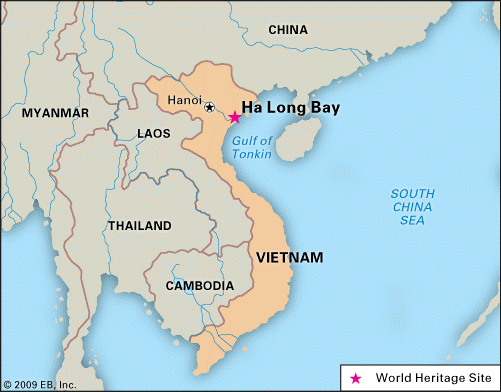
9.Gulf of Tonkin Maritime Baseline (South China Sea)

DD News
Illustration for Gulf of Tonkin Maritime Baseline (South China Sea)

What & Where

Gulf of Tonkin – semi-enclosed arm of north-western South China Sea between Vietnam and China.

Vietnam’s new straight-baseline map (Quang Ninh ➔ Quang Tri) asserts sovereign rights under UNCLOS 1982 & 2000 delimitation pact.

Baseline = low-water reference line used to measure territorial sea, contiguous zone, EEZ.

Quick Facts for MCQs

Legal & Policy

  • Vietnam baseline aligns with UNCLOS Art 7; seeks recognition of straight baselines around indented coasts.
  • 2000 pact delimited EEZ boundary; both sides agreed cooperative fisheries management.
  • Hanoi protests China’s 2023 baseline, framing compliance with international law as mandatory.

Security Dimension

  • 1964 Gulf of Tonkin Incident prompted large-scale U.S. military escalation in Vietnam War.
  • Current overlapping baseline claims intensify South China Sea strategic rivalry & naval deployments.

Physical Geography

  • Sediment-rich Red River delta dominates gulf hydrology, driving fisheries productivity.
  • Ka Long & Bach Dang rivers provide additional freshwater, affecting salinity gradients.

Key Data Points

FeatureData-Point
Basin locationNorthwestern South China Sea
Bordering statesVietnam (W, NW); China (N, E)
Vietnamese baseline spanQuang Ninh to Quang Tri provinces
Guiding treatyVietnam-China Gulf of Tonkin Delimitation, 2000
Global legal frameUNCLOS 1982
China’s baseline releaseMarch 2023
Largest river inflowRed River (Vietnam)
Other inflowsKa Long, Bach Dang & tributaries
Historic flashpoint year1964 Gulf of Tonkin Incident
GS-3Environment

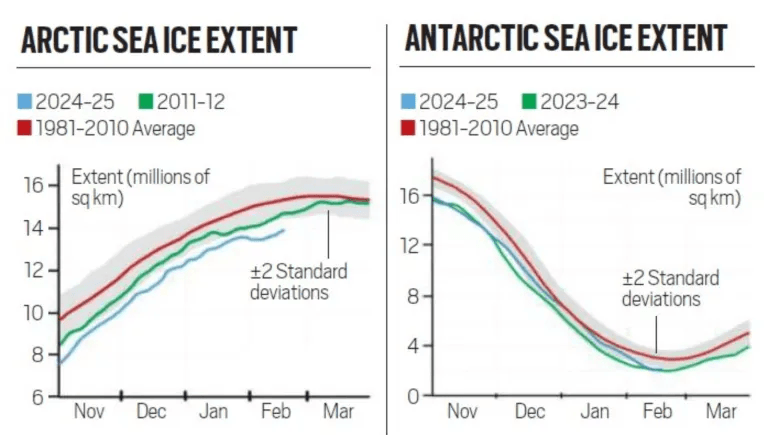
10.Global Sea Ice Decline (Polar Ice Loss)

Indian Express
Illustration for Global Sea Ice Decline (Polar Ice Loss)

What & Where

Sea ice – floating, frozen seawater around Arctic & Antarctic; waxes in winter, wanes in summer.

Formation – salt expelled, yielding porous, lower-salinity ice unlike land-born glaciers/icebergs.

Extent low – record 15.76 million sq km global cover logged February 2025 (NSIDC).

Quick Facts for MCQs

Drivers of Loss

  • Heatwaves; warm Gulf Stream & Arctic MHWs delay freeze, hasten melt.
  • Ice-breaking winds over Barents, Bering, Southern Ocean fracture thinner floes.
  • Elevated air temperatures around Svalbard, Antarctic margins erode ice shelves.

Climate Impact

  • Albedo drop intensifies ocean heat uptake, amplifying global warming feedback.
  • Freshwater influx lowers salinity, slowing thermohaline circulation and altering climate regimes.
  • Thinner ice cover encourages more frequent, stronger polar storms.

J&K Fallout

  • Melt-fed runoff erodes Karewa sediments, degrading saffron-almond soils.
  • Shrinking glaciers cut irrigation, undercutting crop yields and apple quality.
  • Pasture loss pushes Gujjar-Bakarwal communities toward distress migration.

Ice-Cap Genesis

  • Low volcanic CO₂, robust forest carbon sinks, and aggressive chemical weathering reduced greenhouse load.
  • Dispersed continents plus tall ranges raised rainfall, accelerating carbon drawdown.

Key Data Points

FeatureData-Point
Global sea-ice Feb 202515.76 million sq km
Arctic ice loss rate12.2 % per decade (1981-2010)
Cooling effect lost≈14 % since early-mid 1980s
J&K water-level fall75 % in rivers & springs
Rural share water-bodies J&K99.2 %
Apple economy J&K₹8,000 crore value
GS-3Environment

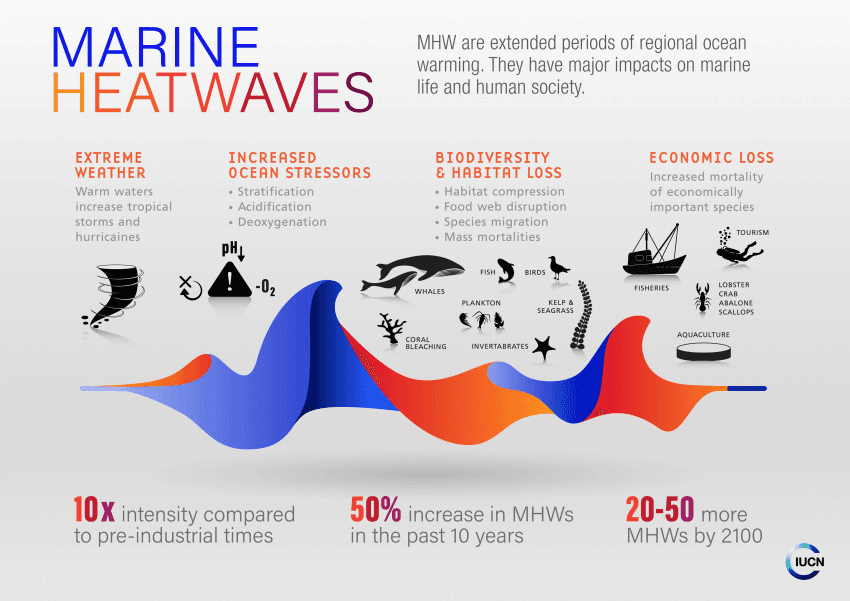
11.Marine Heatwaves Threaten Arctic Fauna (Marine Heatwaves)

Down to Earth
Illustration for Marine Heatwaves Threaten Arctic Fauna (Marine Heatwaves)

What & Where

Marine Heatwave: ≥3–4 °C sea-surface anomaly lasting ≥5 days, can persist weeks to basin scale

Core hotspot: Arctic–Subarctic seas now experiencing fastest escalation in frequency and intensity

Main drivers: anthropogenic warming, El Niño current shifts, Arctic ice loss exposing dark water

Quick Facts for MCQs

Biological Impact

  • Mortality spike; whales, seals, walruses register fewer calves and higher deaths during MHWs
  • Food stress; prey migration plus algal toxins and avian influenza reduce dietary intake
  • Entanglement rise; longer foraging trips increase interaction with fishing gear

Drivers & Trends

  • Greenhouse gases remain primary forcing, warming entire ocean column
  • Ice melt feedback; open water absorbs more solar heat, amplifying Arctic anomalies
  • Climate models foresee exponential MHW growth without emission cuts

Human Livelihoods & Economy

  • Fisheries disruption; mass fish kills and poleward species shift slash catches
  • Reef bleaching and kelp forest loss erode dive tourism and shoreline protection
  • Intensified storms raise infrastructure damage and insurance costs for coastal states

Mitigation & Adaptation

  • Paris Agreement compliance essential to restrain thermal extremes
  • Early warning systems aid fishers in route planning and gear protection
  • Expanded marine protected areas and kelp, seagrass, coral restoration bolster resilience

Key Data Points

FeatureData-Point
Ocean warming since 1900≈ 1.5 °C rise
Temperature jump defining MHW3–4 °C above mean
Minimum duration5 consecutive days
Projected frequency 210050 × pre-industrial
Most vulnerable zonesArctic and tropics
Key mammals at riskWhales, seals, walruses
Noted ecological knock-onToxic algal bloom surge
Major human sector hitFisheries and reef tourism
GS-3S&T

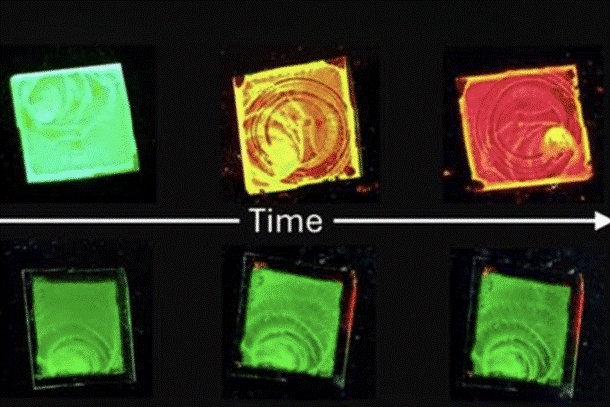
12.Perovskite LED Breakthrough (Display Technology)

SM
Illustration for Perovskite LED Breakthrough (Display Technology)

What & Where

Perovskite-based LEDs (PeLEDs): diodes using perovskite nanocrystals, merging OLED and QLED benefits.

Process: solution-processed, low-temperature deposition; enables flexible, low-cost manufacturing.

Geography: stability breakthrough by CeNS, Bengaluru, India, enhancing commercial viability.

Quick Facts for MCQs

Tech Advantages

  • Luminescence high; narrow emission gives vivid, saturated colours
  • Energy efficiency superior; minimal power for same brightness
  • Flexibility achievable; coatings on bendable substrates enable foldable displays

Current Limitations

  • Stability fragile; environmental exposure shortens device lifespan
  • Lead toxicity risk; disposal and regulation concerns persist
  • Scale-up hard; efficiency drops in large-area panels

Indian R&D

  • CeNS Bengaluru devised stabilisation strategy enhancing durability
  • Improvement raises PeLED lifespan, efficiency towards market standards
  • Supports indigenous next-gen lighting and display ecosystem

Key Data Points

FeatureData-Point
Crystal structureSame as CaTiO₃ (calcium titanate)
Light outputHigh luminescence, superior colour purity
Spectrum controlEasily tunable visible → infrared
Power needLower than conventional LEDs
FabricationSolution-processed; no high-vacuum step
SubstratesWorks on flexible plastics
Key vulnerabilityMoisture, heat, oxygen degradation
Toxic elementLead (Pb) present in most PeLEDs
Indian advanceCeNS method curbs colour & heat decay
GS-3S&T

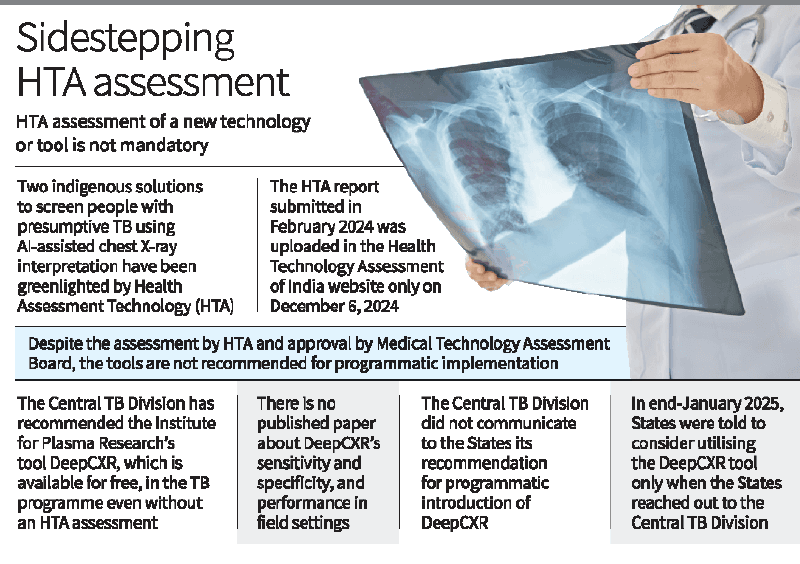
13.DeepCXR AI TB Screening (Medical AI)

The Hindu
Illustration for DeepCXR AI TB Screening (Medical AI)

What & Where

DeepCXR = AI chest-X-ray interpretation tool for tuberculosis screening under India’s National TB Elimination Programme

Built by Institute for Plasma Research, Gandhinagar; cleared by ICMR, yet to get HTA-India assessment

Recommended by Central TB Division for nationwide use but formal State-level notification pending

Quick Facts for MCQs

Tech & Schemes

  • Architecture: machine-learning model flags TB-related lung patterns autonomously
  • Integration: intended for mass radiographic screening where radiologists scarce
  • Output: instant abnormality score enabling same-day follow-up tests

Regulatory & Validation

  • Approval: only ICMR; lacks mandatory HTA-India evaluation for programmatic procurement
  • Evidence gap: zero peer-reviewed sensitivity/specificity publications unlike qXR, Genki
  • Communication: CTD has not circulated implementation guidelines to all States

Comparative Landscape

  • Peers: qXR (Qure.ai) & Genki (Mitsui) already vetted via HTA and published studies
  • DeepCXR uniqueness: public-sector development; aligns with Make-in-India ethos
  • Validation contrast: DeepCXR internal metrics vs multi-centre external validation for peers

Key Data Points

FeatureData-Point
DeveloperInstitute for Plasma Research, Gandhinagar
Primary useDetect presumptive & subclinical TB from chest X-rays
Programme linkNational TB Elimination Programme (NTEP)
Training images54,000 X-rays
Validation set14,000 images from 18+ sites
Claimed accuracy96 % on internal test data
Screening time< 1 minute per case
Regulator nodICMR approval
HTA statusNo Health Technology Assessment clearance
Key comparatorsqXR, Genki (both HTA-approved)
GS-3S&T

14.Solar Coronal Holes Analysis (Solar Physics)

PIB
Illustration for Solar Coronal Holes Analysis (Solar Physics)

What & Where

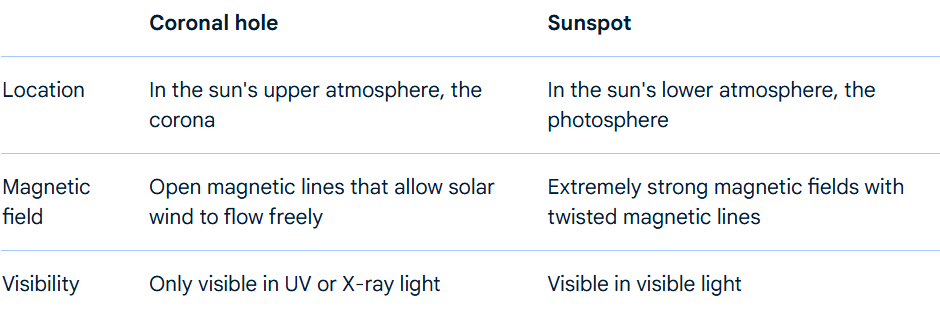
Solar Coronal Holes (SCH): large, darker, cooler, low-density regions on Sun where magnetic field lines stay open to interplanetary space

Geography: peak near solar poles, frequency highest during declining phase of 11-yr solar cycle

Key process: open fields let high-speed solar wind escape, triggering geomagnetic storms on reaching Earth

Quick Facts for MCQs

Physical Properties

  • Uniform-temperature indicates coronal holes rooted deep inside convection zone
  • Field-strength gradient explained by poleward Alfvén-wave disturbances
  • Low density lowers X-ray/EUV brightness, hence dark appearance

Space Weather Impact

  • Solar wind speeds from SCH often exceed 600 km/s, compressing magnetosphere
  • Geomagnetic storms generate widespread auroras, disturb navigation systems
  • Recurrent SCH can cause periodic 27-day space-weather patterns

Indian Monsoon Connection

  • Solar irradiance deficits from SCH correlate with reduced land-sea thermal contrast
  • Combined SCH and sunspot variability explains interannual monsoon rainfall swings
  • Ongoing ISRO-led studies refine predictive climate models

Comparative Note

  • Sunspots: closed, intense fields, visible dark dots; SCH: invisible in visible band, detected in X-ray/EUV
  • Sunspots warmer surroundings hotter; SCH cooler than adjacent corona
  • Sunspot maximum ≈ solar-cycle peak; SCH maximum ≈ declining phase

Key Data Points

FeatureData-Point
First satellite detection1970s X-ray missions
Magnetic field styleOpen, non-looping lines
Temperature profileUniform across latitudes; hints deep-seated origin
Field strength trendIncreases equator → poles
Wave influenceAlfvén waves modulate magnetic field, solar wind
Solar-cycle phase of max SCHDeclining phase
Prime Earth impactHigh-speed solar wind → geomagnetic storms
Tech risk listSatellites, GPS, power grids, HF radio
Indian monsoon linkRadiative effect alters rainfall variability
Difference vs sunspotLocation & openness of magnetic fields; SCH invisible in visible light
GS-3S&T

15.NOVA1 Gene and Speech Evolution (Genetics)

TW

What & Where

NOVA1 gene; RNA-splicing regulator vital for brain development, neuron activity, speech evolution

Unique Homo sapiens NOVA1 variant; absent in Neanderthals, Denisovans

CRISPR mouse model; human NOVA1 knock-in used to test vocalization impact

Quick Facts for MCQs

Genetics & Evolution

  • Mutation; human NOVA1 allele emerged post-Neanderthal split, likely under positive selection
  • Complementarity; NOVA1 plus FOXP2 form expanded language circuitry
  • Advantage; variant supports complex vocal communication abilities

Lab Experiment

  • CRISPR; murine Nova1 coding region swapped with human sequence
  • Vocalization; edited pups produced longer, lower-frequency distress calls than controls
  • Social squeaks; adult males emitted more varied ultrasonic calls, implying communication shift

Comparative Anthropology

  • Neanderthal; carries FOXP2 but ancestral NOVA1, suggesting limited speech complexity
  • Denisovan; mirrors Neanderthal NOVA1 pattern, reinforcing Homo sapiens uniqueness
  • Modern humans; sole lineage combining FOXP2 and derived NOVA1, enabling articulated language

Key Data Points

FeatureData-Point
Primary geneNOVA1
Human specialityUnique allele in modern Homo sapiens only
Earlier speech geneFOXP2 present in humans + Neanderthals
Research toolCRISPR-Cas9 editing
Test organismLaboratory mice
Key observationAltered infant distress calls, richer male social squeaks
Functional domainBrain RNA splicing, neuron signaling
GS-3Security

16.F-35 Lightning II Features (Stealth Fighter)

The Hindu
Illustration for F-35 Lightning II Features (Stealth Fighter)

What & Where

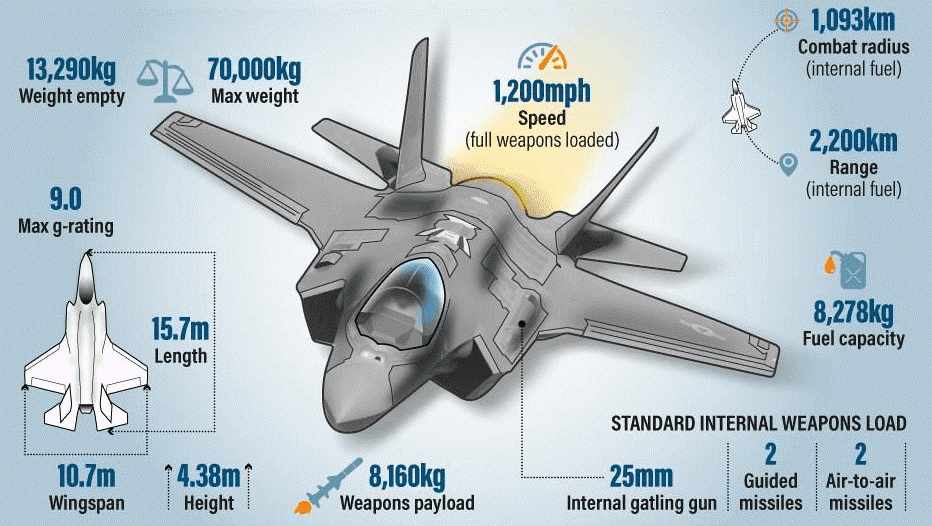
F-35 Lightning II: single-seat, single-engine, multirole, fifth-generation stealth fighter

U.S.-led multinational development; built by Lockheed Martin; operated by several NATO air forces

Variants: F-35A conventional, F-35B short take-off/vertical landing, F-35C carrier-capable

Quick Facts for MCQs

Tech & Capabilities

  • Stealth: blended airframe, internal weapons, radar-absorbent materials lower observability
  • Sensor-fusion: AESA radar, IRST, EW suite integrate data via onboard AI for 360° awareness
  • Networking: MADL and Link-16 enable secure real-time data-sharing with joint forces

Economic Angle

  • Acquisition: Fly-away price remains above $100 mn despite block upgrades and volume discounts
  • Sustainment: Operating expenses dominate, pushing lifetime programme cost beyond $2 trillion
  • Exports: Foreign Military Sales framework plus industrial offsets attract NATO and partner orders

Security Dimension

  • India-pitch: Trump hinted F-35 offer at Aero India 2025 amid IAF hunt for 114 MRFA jets
  • Deterrence: 5th-gen stealth allows first-strike penetration against advanced surface-to-air missiles
  • Interoperability: Common platform enhances coalition logistics, training and mission planning among allies

Key Data Points

FeatureData-Point
ManufacturerLockheed Martin
SpeedMach 1.6 (≈1,960 km/h)
Stealth classFifth-Generation Fighter Aircraft
VariantsA (CTOL), B (STOVL), C (Carrier)
Unit cost> $100 million each
Programme lifetime cost> $2 trillion
Service life projectionInto 2080s
Primary operatorsUSAF, USN, USMC, multiple NATO allies

Related UPSC Prelims PYQs

CAPF_GAI, GS1 2024PYQ 1

Consider the following aircraft:

CAPF_GAI, GS1 2022PYQ 2

निम्नलिखित कथनों पर विचार कीजिए :

GS-2Scheme

17.NEP 2020 Funding Dispute (Education Policy)

The Hindu

What & Where

Samagra Shiksha Abhiyan: centrally sponsored umbrella programme (pre-nursery–Class 12) launched 2018-19 for universal, quality schooling.

Issue spot: Union withheld Tamil Nadu’s SSA share over state’s refusal to adopt National Education Policy 2020.

Geography: Conflict involves Union Government versus Tamil Nadu; education lies on Concurrent List, enabling both legislative powers.

Quick Facts for MCQs

Federalism Angle

  • Withholding funds used as leverage; Tamil Nadu claims violation of cooperative federalism norms.
  • State drafting independent Education Policy to preserve linguistic, administrative autonomy.
  • Call for performance-based, not policy-compliance, fund allocation under CSS.

NEP 2020 Highlights

  • Structural reform replaces 10+2 with 5+3+3+4, introduces early childhood coverage.
  • Emphasis on experiential learning, vocational exposure, digital platforms like DIKSHA, PM e-VIDYA.
  • Proposes single higher-ed regulator merging UGC, AICTE, NCTE; legislation pending.

Scheme Landscape

  • Samagra Shiksha adopts sector-wide approach via single State Implementation Society for all schooling tiers.
  • Integrates funding, planning, monitoring; shares 60:40 Centre-state (90:10 NE, Himalayas).
  • Aligns with SDG 4.1 & 4.5, tracking gender parity and vulnerable group access.

Key Data Points

FeatureData-Point
NEP 2020 drafting headDr K Kasturirangan
School structure under NEP5 + 3 + 3 + 4 (ages 3–18)
Three-language policy mandateRegional tongue + Hindi/other Indian + English
Education entry in ConstitutionConcurrent List, Schedule VII
Samagra Shiksha launchUnion Budget 2018-19
Schemes merged into SSASSA, RMSA, Teacher Education
PM SHRI model schools target14,500 institutions
SDG aligned with SamagraSDG 4 (quality, equitable education)

Related UPSC Prelims PYQs

CDS_GK 2025PYQ 1

NEP 2020 के दिशा-निर्देश के अनुसार, 'पोषण और पढ़ाई पूर्व' (PPBP), निम्नलिखित में से किस कार्यक्रम के अंतर्गत प्रारंभ की गई है?

CDS_GK 2023PYQ 2

Consider the following statements concerning the National Education Policy, 2020:

Ready to practice?

Test your knowledge with our UPSC test series.

Start Free Trial