UPSC Current Affairs

16 topicsGS-1: 3GS-2: 5GS-3: 8
0/16 done
GS-2Polity

1.President’s Rule Provisions (Article 356)

Indian Express

What & Where

President’s Rule = direct Union administration when a state’s constitutional machinery fails

Invoked in any Indian state under Article 356; excludes Union Territories

Activated on Presidential satisfaction, usually after Governor’s report

Quick Facts for MCQs

Constitutional Provisions

  • Article 356 failure of machinery; Article 365 non-compliance with Union directives
  • Article 256 empowers Centre to issue binding instructions to states
  • Bommai judgment restricts arbitrary imposition; judicial review permitted

Procedure & Timelines

  • Governor report usually precedes Presidential proclamation
  • Parliament must endorse within 2 months; otherwise rule lapses
  • Each 6-month extension requires fresh resolutions in both Houses

Trigger Conditions

  • Political instability or loss of majority on Assembly floor
  • Serious law-and-order collapse or inability to hold timely elections
  • Non-implementation of constitutional obligations or Union directives

Governance Impact

  • Chief Minister & Council removed; bureaucrats run departments under Governor
  • Legislature functions shift to Parliament; President may promulgate ordinances
  • High Court jurisdiction intact; fundamental rights formally unaffected

Key Data Points

FeatureData-Point
Main articleArticle 356
Supporting articleArticle 365
Proclamation validity without Parliament2 months
Initial tenure after approval6 months
Maximum continuous duration3 years
Renewal intervalEvery 6 months
Extension beyond 1 yr allowed whenNational Emergency or EC says polls impossible
Houses approvingLok Sabha & Rajya Sabha
Executive during ruleGovernor on behalf of President
Assembly statusDissolved or kept under suspension

Related UPSC Prelims PYQs

GS1 2018PYQ 1

If the President of India exercises his power as provided under Article 356 of the Constitution in respect of a particular State, then

GS1 2004PYQ 2

Which one of the following Articles of the Constitution of India says that the executive power of every State shall be so exercised as not to impede or prejudice the exercise of the executive power of the Union?
GS-2Polity

2.Competitive vs Cooperative Federalism (Federalism)

BL

What & Where

Competitive federalism – state-state & Centre-state race for investment, jobs, services; performance judged by 15th FC indicators.

Cooperative federalism – Centre & states pool authority for GST, Ayushman Bharat, PM-KISAN, water dispute laws.

Geography of practice – across Indian Union; five Zonal Councils created 1956 for inter-state liaison.

Quick Facts for MCQs

Legal & Policy

  • Supremacy – Union prevails on Concurrent & residuary subjects, causing quasi-federal tension.
  • Conflict – Art 269A GST Council vs Art 270 Finance Commission over tax-share recommendations.
  • Remedy – Regular Inter-State Council meets urged; last full session 2016.

Economic Angle

  • Incentive – Performance-based devolution spurs fiscal discipline and policy innovation among states.
  • Risk – Subsidy wars, reckless freebies may erode stability without conditional grants framework.
  • PPP push – Budget 2025-26 mandates three-year PPP pipelines to intensify investment rivalry.

Schemes & Initiatives

  • State models – Rythu Bandhu (Telangana) & KALIA (Odisha) complement PM-Kisan income support.
  • National missions – India Infrastructure Project Development Fund offers technical aid for equitable projects.
  • Manufacturing drive – National Manufacturing Mission to benchmark EoDB, infra, investment attractiveness.

Key Data Points

FeatureData-Point
7th ScheduleDivides Union, State, Concurrent lists
Article 261Full Faith & Credit clause
Article 263 bodyInter-State Council (permanent since 28 May 1990)
Article 262Parliament may settle inter-state water rows
Zonal Councils countFive, set up by States Reorganisation Act 1956
15th FC new indicatorTax & fiscal effort for grants
Upcoming IFI launch year2025
BRAP 2024 focusCompliance cut, decriminalisation, B-READY alignment

Related UPSC Prelims PYQs

GS1 2017PYQ 1

Which one of the following is not a feature of Indian federalism?

GS1 2023PYQ 2

Consider the following:

GS-3Economy

3.Southern States Economic Performance (GSDP Growth)

The Hindu
Illustration for Southern States Economic Performance (GSDP Growth)

What & Where

Southern States Benchmarking: assessing economic metrics of Tamil Nadu, Karnataka, Kerala, Telangana, Andhra Pradesh against global peers

Key Processes: GSDP growth analysis, manufacturing share, skill-level mapping, infrastructure & social indicator tracking

Core Geography: peninsular India with major ports Chennai, Kochi, Visakhapatnam enabling trade integration

Quick Facts for MCQs

Drivers of Outperformance

  • Stability: fewer historical invasions fostered continuous trade hubs Vijayanagaram, Madurai, Kochi
  • Urbanization: early Presidency towns Madras, Bombay attracted FDI, later IT-auto clusters Bengaluru, Chennai
  • Social Capital: high literacy, midday meals, e-governance produced skilled workforce and investor confidence

Current Concerns

  • Productivity: only 26 % of national manufacturing output despite 33 % workforce signals efficiency gap
  • Skills: shortage in Levels 3-4 talents for AI, engineering; ageing demography plus out-migration aggravate
  • Infrastructure: urban congestion, energy deficits, uneven rural connectivity limit further industrialisation

Suggested Reforms

  • Benchmarking: measure Bengaluru against global tech hubs, not domestic metros
  • Upskilling: invest in higher education, Industry 4.0, migrant-friendly labour policies to offset workforce decline
  • Corridors: expedite Bharatmala, North-South & East-West industrial corridors, integrate coastal tourism for revenue

Key Data Points

FeatureData-Point
Southern share in India’s GDP30 %
Real GSDP CAGR (South vs Rest)6.3 % vs 5 %
Per-capita GDP growth5 %+ South; 4.2 % Rest
Factories located in South37.4 % of India
Fixed capital investment share25.6 %
Manufacturing workforce share33 %
Manufacturing output share26 %
Kerala infant mortality6 per 1,000 births
National Maternal Mortality Ratio103 (2020)
Telangana vaccine output≈33 % of global supply

Related UPSC Prelims PYQs

GS1 2001PYQ 1

Consider the following States:

GS-3Economy

4.HS Codes for GI Rice Exports (Customs Classification)

BL

What & Where

HS sub-codes 1006-30-11 (parboiled) & 1006-30-91 (white) earmark India’s GI-tagged rice for export

Added through 2025-26 Budget amendment to Customs Tariff Act, 1975; India first to create GI-specific HS lines

Codes let GI rice ship uninterrupted nationwide even when generic rice exports are banned

Quick Facts for MCQs

Legal & Policy

  • Amendment; GI sub-codes inserted into tariff schedule
  • Exemption; GI rice bypasses blanket export bans
  • Pioneer; India introduces world’s first GI-specific HS

Trade Mechanics

  • HS; six-digit global core, national extensions refine classification
  • Duties; codes drive tariff, quota, statistics decisions
  • Revision; WCO updates HS every five years

Geographical Indications

  • Tagged; 20 rice GIs inc. Navara, Palakkadan Matta, Pokkali
  • Pending; 20 more varieties like Seeraga Samba, Wada Kolam
  • Advantage; dedicated codes secure premium export markets

International Body

  • WCO; founded 1952, HQ Brussels, 183 members
  • Coverage; members manage ~98 % of global trade
  • Mandate; maintain HS, standardise customs worldwide

Key Data Points

FeatureData-Point
Amended lawCustoms Tariff Act, 1975
Budget referenceFY 2025-26
HS code – parboiled GI rice1006-30-11
HS code – white GI rice1006-30-91
GI-tagged rice varieties20 recognised
Pending GI rice applications20 varieties
HS overseerWorld Customs Organization
WCO headquartersBrussels, Belgium
WCO formation year1952
WCO membership183 customs, ≈98 % world trade

Related UPSC Prelims PYQs

GS1 2024PYQ 1

Consider the following statements:

GS-1Mapping

6.Baltic Sea Mapping (Baltic Sea)

The Hindu

What & Where

Semi-enclosed, shallow brackish arm of the North Atlantic in N. Europe; area ≈ 3.77 lakh sq km.

Separates Scandinavian Peninsula from continental Europe; 9 littoral states surround it.

Opens to Atlantic via Danish Straits; artificial links: Kiel Canal (North Sea), White Sea Canal (Arctic).

Quick Facts for MCQs

Physical Geography

  • Gulfs form deep indentations aiding freshwater inflow, maintaining low salinity.
  • Neva delivers major freshwater load near St Petersburg, influencing eastern basin ecology.
  • Gotland sits centrally, acting as climatic and strategic reference point.

Environmental Concerns

  • Oil-spill threat heightened by ageing, uninsured “shadow fleet” tankers transiting narrow, shallow waters.
  • Brackish ecosystem already stressed by eutrophication; major spill could collapse fish and plankton populations.
  • Semi-enclosed nature slows pollutant dispersal, prolonging contamination.

Security Dimension

  • Shadow fleet comprises older, technically deficient vessels rerouted after Western sanctions on Russian oil.
  • Absence of Western insurance complicates coordinated emergency response and compensation claims.
  • Increased tanker traffic through Danish Straits raises accident probability in congested chokepoints.

Key Data Points

FeatureData-Point
Littoral countriesDK, DE, PL, LT, LV, EE, RU, FI, SE
Surface area~377,000 sq km
Maximum length~1,600 km
Mean width~193 km
SalinityLower than oceans; brackish
Rivers draining>250; largest = Neva
Main gulfsBothnia, Finland, Riga
Largest islandGotland (Sweden)
Natural outletDanish Straits
Canal linksKiel Canal, White Sea Canal

Related UPSC Prelims PYQs

GEO_GS 2022PYQ 1

Volga River drains into which one of the following seas?

GEO_GS 2026PYQ 2

Consider the following statements regarding salinity of oceans:

GS-3Species

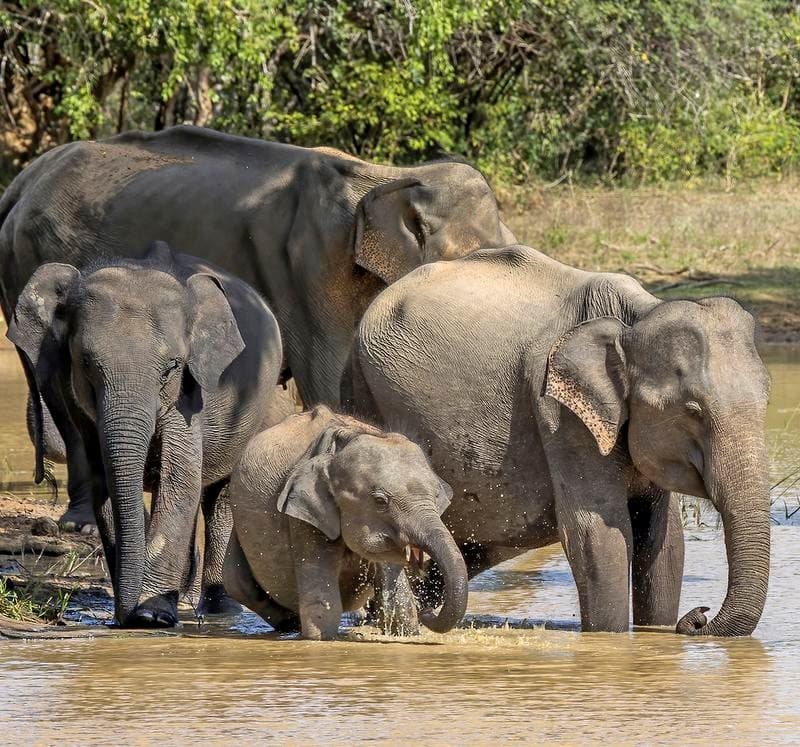
7.Asian Elephant Trumpeting Study (Elephant Communication)

The Hindu
Illustration for Asian Elephant Trumpeting Study (Elephant Communication)

What & Where

Definition: Loud, high-frequency trunk burst sound for elephant communication, distinct from rumble or roar

Geography: Newly documented multi-context use in Asian elephants; comparison drawn with African savanna populations

Contexts: Social bonding, play, distress, alarm, group coordination; overturns notion of disturbance-only usage

Quick Facts for MCQs

Sound Production

  • Mechanism: Rapid trunk air expulsion creates trumpet without obligatory vocal fold vibration
  • Combination: Rare trumpet-roar-rumble hybrids confirmed only in Asian elephants so far
  • Propagation: High frequencies cut through vegetation, enhancing long-distance herd contact

Species Comparison

  • African usage skewed to alarm; Asian repertoire spans play, greeting, maternal care
  • Asian calls shorter, higher, more uniform; African include variable lower frequencies
  • Combination calls virtually absent in African datasets, highlighting evolutionary divergence

Research Highlights

  • Dataset: 116 trumpet events analysed across multiple social behaviours
  • Finding: Multi-functional trumpeting contradicts earlier single-purpose disturbance theory
  • Application: Refined call libraries improve passive acoustic surveys and early-warning systems in conflict zones

Key Data Points

FeatureData-Point
Producer speciesElephas maximus; compared with Loxodonta africana
Air pathwaySudden trunk bursts, minimal vocal cord role
Acoustic rangeHigh frequency, audible kilometres through forest
African primary contextDistress / alarm signalling
Asian primary contextSocial interaction, play, coordination, alarm
Frequency patternAsian higher, consistent; African broader with lower notes
Combo call discoveryFirst roar-rumble trumpet recorded in Asian elephants
Study journal & yearMammalian Biology, 2023
Habitat adaptationHigh pitch suits dense forests; broader tones suit open savannas
Conservation utilityAcoustic monitoring aids conflict mitigation, population surveys

Related UPSC Prelims PYQs

NDA_GAT 2021PYQ 1

Elephants ________ when they perceive danger.

GS-3S&T

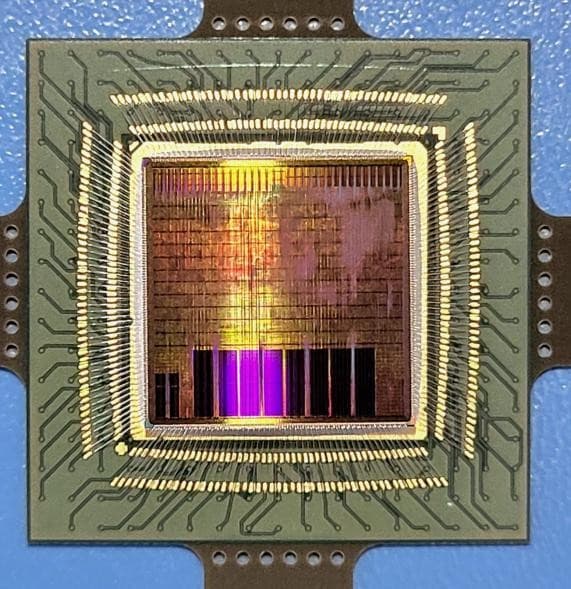
8.Shakti Indigenous Aerospace Chip (Indigenous Microprocessor)

IITM
Illustration for Shakti Indigenous Aerospace Chip (Indigenous Microprocessor)

What & Where

Chip Shakti: indigenous 64-bit RISC-V aerospace-grade microprocessor

Developer location: IIT Madras with ISRO, fabricated and tested in India

Deployment arena: space, defence, IoT-AI command-control systems

Quick Facts for MCQs

Tech & Schemes

  • RISC-V architecture enables licence-free customisation lowering royalty dependence
  • DIR-V targets self-reliant chips for 5G, AI, cloud, sensors
  • Partnership basket includes C-DAC, multiple IITs, ISRO, private fabs

Security Dimension

  • Fault-tolerant circuits sustain operation under radiation and hardware faults
  • Cybersecurity stack designed for classified defence and space workloads
  • Multiple boot modes allow secure update, rollback, isolation

Applications

  • Space use: satellite onboard computers, launch vehicle avionics
  • Defence use: rugged military electronics, real-time command-control networks
  • Civil use: IoT nodes and AI accelerators for smart infrastructure

Industry Ecosystem

  • End-to-end Indian fabrication boosts strategic autonomy and trims import bill
  • Indigenous chip R&D elevates India in global semiconductor value chain
  • Open IP catalyses domestic chip startups and academia-industry projects

Key Data Points

FeatureData-Point
ISA baseOpen-source RISC-V
Word length64-bit
Design attributeFault-tolerant, multiple boot modes
Lead instituteIIT Madras
Government schemeDigital India RISC-V (DIR-V)
Scheme launchApril 2022
Funding ministryMeitY
Core applicationSatellites, avionics, embedded controllers
Security focusDefence-grade cybersecurity
GS-3S&T

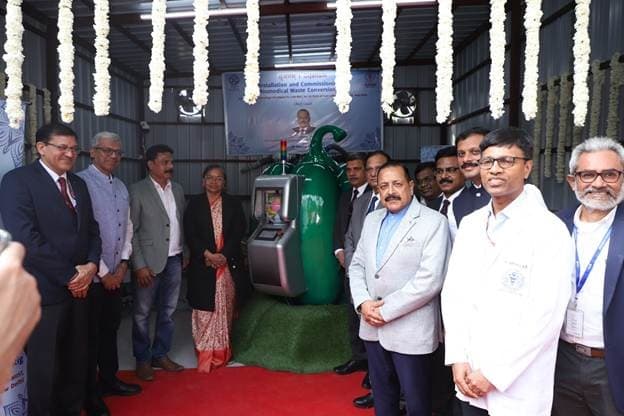
9.Sṛjanam Waste Treatment Rig (Biomedical Waste)

PIB
Illustration for Sṛjanam Waste Treatment Rig (Biomedical Waste)

What & Where

Definition: Sṛjanam — automated rig disinfecting biomedical waste through non-incineration antimicrobial technology.

Process: Converts blood, urine, lab disposables into safe organic material via pathogen-neutralising agents.

Geography: Commissioned at AIIMS New Delhi; devised by CSIR-NIIST, Ministry of Science & Technology.

Quick Facts for MCQs

Tech & Schemes

  • Automation eliminates manual handling, curbing spill or exposure risks.
  • Rig aligns with Central Pollution Control Board biomedical waste rules.
  • Prototype launch showcases indigenous waste-management R&D under CSIR programs.

Environmental Impact

  • Incineration avoidance slashes toxic gaseous emissions and carbon footprint.
  • Safer-than-fertiliser residue allows potential secondary uses, minimizing landfill load.
  • Scalable model aids hospitals in meeting zero-emission waste targets.

Institutional Setup

  • Collaboration: AIIMS hosts, CSIR-NIIST designs, MoS&T funds.
  • Unveiled by Union Science & Technology Minister at AIIMS premises.
  • Demonstrates public-sector capability in healthcare sustainability solutions.

Key Data Points

FeatureData-Point
Daily treatment capacity400 kg biomedical waste
Degradable medical waste share10 kg/day
Key technologyIncineration-free antimicrobial process
Main emission avoidedDioxins & furans
Output residueFragrance-infused, non-toxic organic matter
DeveloperCSIR-NIIST, Thiruvananthapuram
ImplementerAIIMS with CSIR
Supervising ministryScience & Technology
National BW generation (CPCB)743 tonnes/day
Validation statusAntimicrobial efficacy confirmed

Related UPSC Prelims PYQs

CAPF_GAI 2021PYQ 1

Scientists at CSIR-NCL Pune, with support from the Water Technology Initiative of the Department of Science and Technology (DST), Government of India, have recently developed a novel hybrid technology to bring safe and healthy drinking water. What is the name of the hybrid technology?

GS-3S&T

10.Rare Bombay Blood Group (Blood Typing)

Indian Express

What & Where

Definition: Bombay blood group (hh phenotype) lacks H antigen on RBC surface, unlike ABO groups.

Geography: Highest prevalence in South Asia; first detected Mumbai, 1952 by Dr Y M Bhende.

Types: hh individuals form anti-H antibodies, thus behave distinctly from O group despite similar absence of A/B antigens.

Quick Facts for MCQs

Medical Basics

  • Antibodies: hh plasma contains anti-A, anti-B and potent anti-H; rejects A, B, AB, O blood.
  • Identification: Standard ABO typing followed by H-antigen confirmation with anti-H lectin.

Genetic Prevalence

  • Inheritance: Autosomal recessive; both parents must supply h allele.
  • Population clusters: Notably higher among certain South Indian, Maharashtrian, Gujarati communities.

Transfusion Implications

  • Emergency risk: Severe haemolytic reaction if transfused non-hh blood.
  • Logistics: Donor registries critical due to rarity and short storage window.

Key Data Points

FeatureData-Point
Scientific symbolhh phenotype
Key absent antigenH (fucosylated)
DiscoveryMumbai, 1952, Dr Y M Bhende
Global incidence≈ 1 / 4 million
Indian incidence1 / 7,600–10,000
Compatible donorOnly another hh individual
Recipient rangeCan donate to any ABO type
Shelf-life of stored blood35–42 days; rarely banked
Usual misclassificationOften mistaken for O group
Cause for higher South Asian frequencyInbreeding & close-community marriages

Related UPSC Prelims PYQs

GS1 2001PYQ 1

A man whose blood group is not known meets with a serious accident and needs blood transfusion immediately. Which one of the blood groups mentioned below and readily available in the hospital will be safe for transfusion?

GS-3S&TQuick Bite

11.International Epilepsy Day Awareness (Neurological Disorders)

Indian Express

What & Where

International Epilepsy Day (IED): global awareness day held every 2nd Monday of February since 2015.

Epilepsy: central-nervous-system disorder marked by ≥2 unprovoked seizures; prevalent in children and elderly.

Organisers: International Bureau for Epilepsy (IBE) & International League Against Epilepsy (ILAE); observed worldwide including India.

Quick Facts for MCQs

Health Burden

  • Epilepsy among world’s oldest recorded disorders; documentation dating to 4000 BCE.
  • High global prevalence positions epilepsy as one of the commonest neurological diseases.

Institutional Actors

  • IBE represents patient/community interests; ILAE focuses on clinical/research fraternity.
  • WHO steers normative guidance via 2019 global report and mhGAP service-expansion framework.

Policy & Care

  • IED aims: awareness, destigmatisation, treatment improvement, research funding enhancement.
  • Management primarily pharmacological; early access reduces morbidity and social exclusion.

Key Data Points

FeatureData-Point
2022 IED date14 February 2022
Fixed timing2nd Monday of February
First IED year2015
Global epilepsy cases~50 million
Indian epilepsy cases~6 million
Lead organisersIBE & ILAE
WHO global report title“Epilepsy, a Public Health Imperative”
WHO report year2019
WHO scaling-up programmeMental Health Gap Action Programme (mhGAP)
Curative statusNo cure; controllable with medication & other strategies
GS-2Editorial

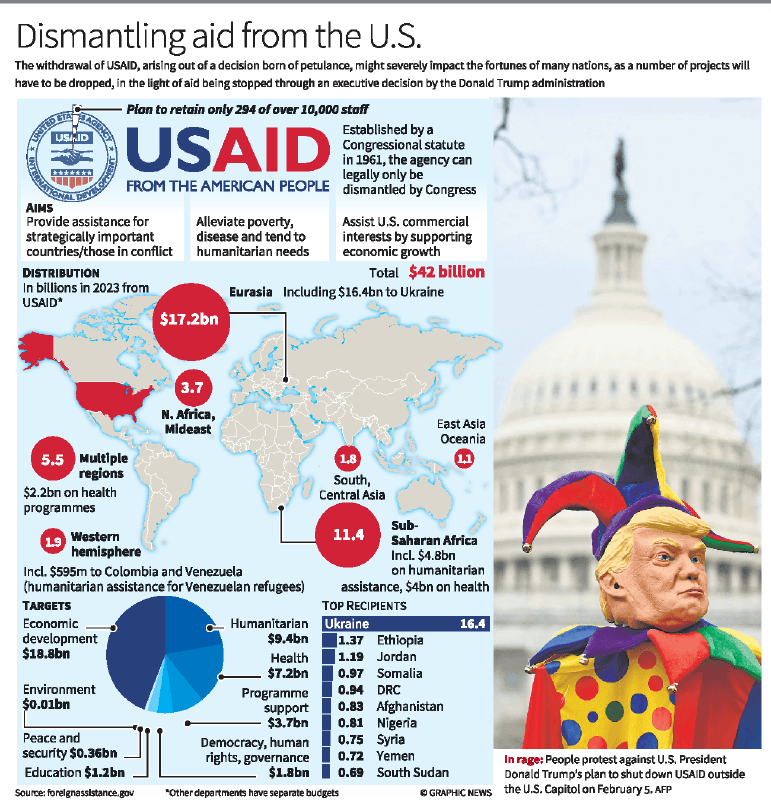
12.USAID Funding Freeze 2025 (USAID Freeze)

The Hindu
Illustration for USAID Funding Freeze 2025 (USAID Freeze)

What & Where

USAID: independent US agency (1961) delivering civilian foreign aid and development assistance worldwide

Freeze: 90-day suspension of new obligations ordered 20 Jan 2023 to reassess programme efficiency with U.S. foreign-policy goals

Footprint: works in >100 countries; major recipients—Ukraine, Ethiopia, Somalia, Yemen; India today <0.4 % of agency outlay

Quick Facts for MCQs

Legal & Policy

  • Executive-Order: mandates whole-of-government review of foreign assistance alignment to “America First” strategy
  • Political-motive: critics link move to rollback of Biden-era initiatives, partisan score-settling claims
  • Restructure-signal: Secretary Marco Rubio calls for aid serving “clear national interests”

Global Impact

  • Funding-gap: abrupt stop risks HIV, food, disaster programmes affecting millions in 70+ low-income states
  • Recipient-shock: Ukraine, Ethiopia, Somalia, Yemen face halted development, humanitarian pipelines
  • UN-alarm: large-scale HIV treatment attrition forecasted within months

India Angle

  • Reduced-dependency: Indian projects receive marginal USAID share, easing immediate shock
  • Sector-hit: HIV/TB health grants, WASH, clean-energy pilots most exposed
  • Self-reliance: domestic schemes, CSR, multilateral loans positioned to backfill gaps

Alternatives

  • Domestic-funding: central & state budgets instructed to prioritise at-risk social programmes
  • Multilateral-tie-ups: World Bank, WHO, UNDP eyed for co-financing displaced aid lines
  • Private-sector: CSR mandates and PPP frameworks encouraged to plug resource shortfalls

Key Data Points

FeatureData-Point
Establishing law1961 Foreign Assistance Act
Parent reporting lineIndependent, coordinates through U.S. Secretary of State
Executive Order date20 January 2023
Freeze length90 days
Share of USAID budget to India0.2 %–0.4 %
Top flagged programmesPEPFAR, Feed the Future, Power Africa
Key sectors fundedHealth, food security, education, governance, climate
Critic quotedElon Musk termed agency “criminal organization”
UN warning on HIV/AIDS haltPotential 6 million deaths in 4 years
Current India statusUSAID field operations suspended
GS-2Security

13.India-UK Defence Agreements 2025 (India-UK Defence)

Business Standard

What & Where

Bilateral focus: India–UK defence manufacturing and clean energy cooperation formalised Feb 2025 at Aero India and 4th Energy Dialogue

Key processes: technology transfer, joint R&D, supply-chain integration under Defence Partnership-India and ASPIRE-2 programmes

Core geography: facilities in Hyderabad, Indian Ocean Littoral presence, UK expertise in offshore wind

Quick Facts for MCQs

Security Dimension

  • STARStreak: LBR MANPADS contract supplies high-velocity missiles and launchers to Indian forces
  • LMM: co-production embeds Indian companies within UK global missile supply chains
  • IFEP: integrated full electric propulsion to power next-generation Landing Platform Docks

Tech & Schemes

  • ASPIRE-2: UK-India programme enables 24×7 power, efficiency gains, industrial decarbonisation
  • Offshore-Wind Taskforce: targets ecosystem, supply chain and finance for 30 GW by 2030
  • UKPACT: finances ongoing Indian power-sector reforms supporting low-carbon transition

Economic Angle

  • JETCO: 2005 platform strengthens bilateral commerce alongside prospective free trade agreement
  • MMP: 2021 migration pact facilitates professional mobility; YPS grants two-year visas to 18-30 graduates
  • Education: 2022 mutual recognition of academic qualifications boosts Indian enrolment to 185 000

Key Data Points

FeatureData-Point
Agreement launch year2025
Defence partnership labelDP-I
ASRAAM assembly siteHyderabad
LPD electric propulsion target2030
Bilateral trade 2024£42 billion
India rank in UK trade 202411th
UK FDI into India 2000-23USD 33.88 bn (6th)
Indian students in UK 2022-23185 000

Related UPSC Prelims PYQs

CDS_GK, ESE_GS 2026PYQ 1

What is the name of the initiative launched by India and Denmark in November 2025 to enhance bilateral ties?

CDS_GK, ESE_GS 2022PYQ 2

P-75 I (या P-75 भारत) परियोजना किनके निर्माण से संबंधित है?

GS-3Security

14.Su-57 Joint Production Offer (Fifth-Gen Fighter)

NDTV
Illustration for Su-57 Joint Production Offer (Fifth-Gen Fighter)

What & Where

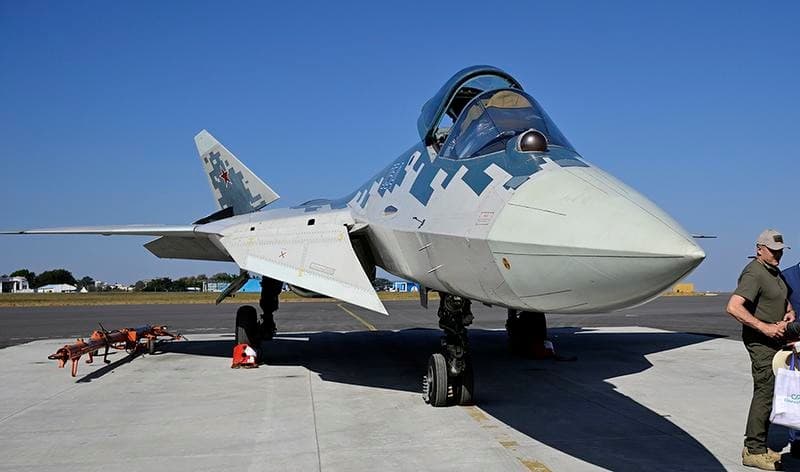
Su-57 FELON: fifth-generation stealth fighter by Russia’s United Aircraft Corporation for air-superiority & strike roles

India plan: joint production line at Hindustan Aeronautics Ltd (HAL) under proposed FGFA partnership with Russia

Core theatre: Russian Air Force service; offer targets Indian Air Force capability gap

Quick Facts for MCQs

Tech & Schemes

  • Offer: Russia seeks Make-in-India co-development, transferring stealth materials, radar modules, Saturn AL-41 engine assembly
  • Localisation goal: majority airframe, avionics, weapons integration to be indigenised at HAL Bengaluru & Nasik lines
  • Alignment: Complements AMCA timeline, advances Atmanirbhar Bharat in aerospace manufacturing

Security Dimension

  • Deterrence: Supercruise plus high-altitude agility optimised for Ladakh–Arunachal border interceptions
  • Payload: Larger bays accommodate BrahMos-NG, K-77M, Kh-59MK2 hypersonic/precision weapons
  • Sustainment: Lower maintenance burden than F-35 due to simpler stealth coating and modular avionics

Comparative Insight

  • Stealth: Su-57 front-aspect moderate all-round; F-35 full-spectrum ultra-low RCS
  • Maneuverability: Su-57 thrust-vectoring enables post-stall tricks; F-35 prioritises stealth penetration over dogfights
  • Economics: Su-57 flyaway ≈ USD 70 m vs F-35 A ≈ USD 100-110 m

Key Data Points

FeatureData-Point
Generation5th
Nation of originRussia
DeveloperUnited Aircraft Corporation
Indian partnerHAL
Primary roleAir superiority + ground attack
Stealth designLow-RCS composites & radar-absorbent coating
Radar typeMulti-band AESA + L-band arrays
Max speed~Mach 2
SupercruiseYes, no afterburner
Thrust vectoring3-D nozzles
Unit cost≈ USD 70 million

Related UPSC Prelims PYQs

CAPF_GAI, GS1 2024PYQ 1

Consider the following aircraft:

CAPF_GAI, GS1 2022PYQ 2

निम्नलिखित कथनों पर विचार कीजिए :

GS-2Scheme

15.Nari Adalat Grassroots Justice Scheme (Mission Shakti)

Indian Express

What & Where

Nari Adalat – community-based, alternative grievance redressal forum for women at gram panchayat level

Operates under Sambal sub-scheme of Mission Shakti, Ministry of Women & Child Development

Piloted 2023 in 50 gram panchayats each in Assam and Jammu & Kashmir; expansion proposals invited nationwide

Quick Facts for MCQs

Legal & Policy

  • Alternative forum complements formal judiciary; resolves civil matrimonial disputes without litigation
  • Anchored in Mission Shakti guidelines; no separate statutory act yet

Scheme Architecture

  • Sambal covers safety tools: OSC, WHL, BBBP, Nari Adalat; Samarthya covers empowerment tools: PMMVY, Palna, Shakti Sadan
  • Funding pattern follows Centrally Sponsored Scheme norms; state share applicable

Implementation Status

  • Training of Nyaya Sakhis coordinated by National Institute of Public Cooperation and Child Development
  • Monitoring via Poshan Tracker-like MIS proposed for real-time case disposal

Social Concerns

  • Grass-root female participation increases access to justice, reduces travel and cost barriers
  • Community mediation expected to de-escalate domestic conflicts and enhance gender trust

Key Data Points

FeatureData-Point
Parent missionMission Shakti (MWCD)
Sub-schemeSambal – Safety & Security
Launch year2023 pilot
Pilot coverage100 gram panchayats; Assam + J&K
Forum size7–11 Nyaya Sakhis
SelectionNominated by gram panchayat
Core methodsNegotiation, mediation, reconciliation
Disputes handledDomestic violence, dowry, child custody, other minor issues
Parallel women schemesOSC, WHL, BBBP, PMMVY, Palna
Next stepStates/UTs invited to send proposals for scale-up
GS-1Misc

16.State Higher Education Spending Report (Higher Education)

The Hindu
Illustration for State Higher Education Spending Report (Higher Education)

What & Where

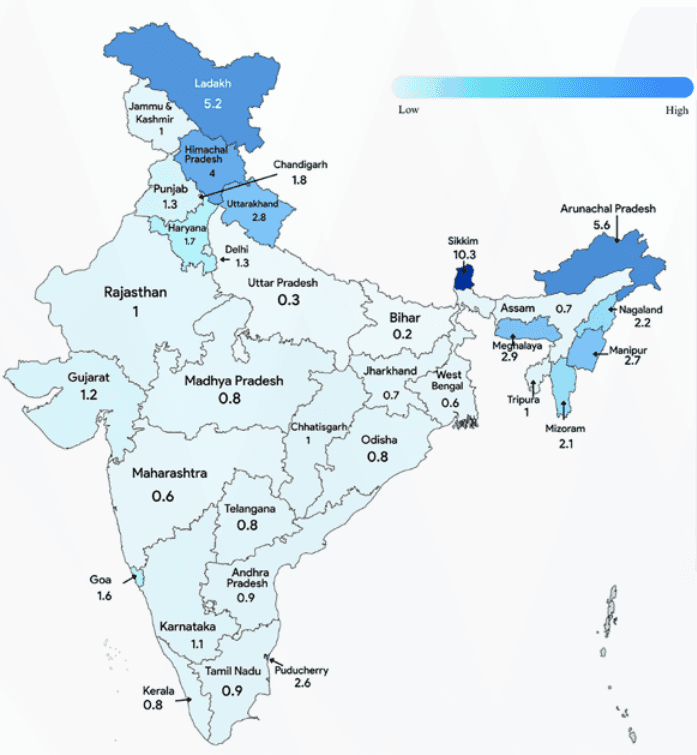
NITI Aayog’s “Expanding Quality Higher Education through States & SPUs” — first policy note dedicated to State Public Universities.

Maps state-wise spend, university density, gender parity for 18-23-year cohort.

Highlights Indian outliers: Sikkim (density), J&K (spend), Kerala (gender), Bihar & Telangana (low spend).

Quick Facts for MCQs

Fiscal Numbers

  • J&K tops spend 8.11 %; Delhi lags 1.67 %.
  • Bihar allocates 1.56 % to higher-ed; Telangana mere 0.18 %.
  • National education outlay grew 12 % CAGR, touching ₹9.2 lakh cr FY25.

Access & Equity

  • University density: Sikkim 10.3 vs national 0.8; Bihar bottom 0.2.
  • Female enrollment exceeds male in Kerala, Chhattisgarh, Himachal.
  • GER 28.4 %; needs 50 % by 2035.

Digital Divide

  • Internet penetration: rural 55 %, urban 69 %.
  • Connectivity gap hampers e-learning rollout in SPUs.

Targets & Reforms

  • Report urges per-youth spend hike; Kerala, TN already front-runners.
  • Recommends performance-linked funding, governance overhaul for SPUs.

Key Data Points

FeatureData-Point
Top overall education spendJ&K 8.11 % of budget
Second overall spenderManipur 7.25 %
Lowest overall spenderDelhi 1.67 %
Top higher-ed spendBihar 1.56 %
Lowest higher-ed spendTelangana 0.18 %
University density-India0.8 per 1 lakh youth
Highest density stateSikkim 10.3
Lowest density stateBihar 0.2
Female-majority enrolmentKerala, Chhattisgarh, Himachal
Balanced enrolment UTsChandigarh, Mizoram, A&N Islands
National edu outlay FY25₹9.2 lakh cr
Primary dropout rate1.9 %
Secondary dropout rate14.1 %
Enrolment growth 2014-2226.5 %
Current GER28.4 %
GER target 203550 %
Rural internet access55 %
Urban internet access69 %

Related UPSC Prelims PYQs

CDS_GK, ESE_GS 2021PYQ 1

Which one of the following statements in the context of social sector spending in India during 2014–19 (both States and the Union Government together) is true?

CDS_GK, ESE_GS 2021PYQ 2

Which one of the following statements is NOT correct regarding the National Education Policy 2020 in India ?

Ready to practice?

Test your knowledge with our UPSC test series.

Start Free Trial