UPSC Current Affairs

14 topicsGS-1: 1GS-2: 3GS-3: 10
0/14 done
GS-2Polity

1.OBC Creamy Layer Equivalence (OBC Creamy Layer)

Indian Express

What & Where

Creamy-Layer Equivalence: proposed uniform yardstick to exclude affluent OBCs from reservation benefits.

Scope: Central/State services, PSUs, universities, autonomous & govt-aided bodies across India.

Basis: Indra Sawhney 1992 verdict; operationalised through DoPT guidelines.

Quick Facts for MCQs

Legal & Policy

  • SC verdict allowed 27 % OBC quota, mandated creamy-layer exclusion.
  • DoPT 1993 listed elite categories; 2004 extended test beyond govt jobs.
  • Income ceiling periodically revised, now ₹8 lakh; due for review.

Implementation Gaps

  • Central-university professors’ wards eligible; aided-college counterparts excluded.
  • Same PSU executive grade creamy at Centre, non-creamy in some states.
  • Over 100 UPSC candidates lost selection after post-exam reclassification.

Proposed Criteria

  • Academia: Assistant Professor onward auto-creamy, equated to Group-A entry.
  • PSUs/statutory bodies: Executive posts on central/state pay scales deemed creamy.
  • Govt-aided bodies follow parent-govt scales; private sector judged only by income/wealth.

Challenges

  • Beneficiaries losing quota likely to litigate, sparking political pushback.
  • Varied PSU hierarchies complicate precise post-equivalence mapping.
  • ₹8-lakh ceiling of 2017 risks obsolescence amid inflation; periodic revisions essential.

Key Data Points

FeatureData-Point
Landmark caseIndra Sawhney vs UoI, 1992
First DoPT creamy-layer order1993 circular
Present income ceiling₹8 lakh p.a. (fixed 2017)
2004 clarification coversPrivate & non-govt sectors
UPSC aspirants hit (2016-24)>100 disqualifications
Proposed university cut-offAssistant Professor & above

Related UPSC Prelims PYQs

GEO_GS 2025PYQ 1

With reference to Article 16 of the Constitution of India, which of the following statements is/are correct?
GS-2Polity

2.Union Territories Assembly Nominations (UT Nominated MLAs)

The Hindu

What & Where

Provision: LG of Jammu & Kashmir may nominate up to five Assembly members under Reorganisation Act 2019 amended 2023

Category: Nominated seats supplement 90 elected seats, raising possible House strength to 95

Geography: Applies specifically to Union Territory of Jammu & Kashmir in northern India

Quick Facts for MCQs

Legal & Policy

  • J&K Reorganisation Act 2019 amended 2023 authorises LG nomination sans ministerial advice
  • Article 80 permits President to pick 12 Rajya Sabha experts in literature science art social service
  • Article 171 directs Governors to nominate nearly one sixth of State Council members

Union Territory Legislatures

  • Only Delhi J&K Puducherry send members to Rajya Sabha
  • Delhi 70 elected 0 nominated seats per GNCTD Act 1991
  • Puducherry 30 elected plus Union Government may nominate 3 under 1963 Act

Judicial Precedents

  • 2018 Madras HC upheld Centre power to nominate 3 Puducherry MLAs without cabinet advice
  • Supreme Court later set aside HC suggestions but retained nomination validity
  • 2023 Delhi judgment cited triple chain accountability and bound LG to ministerial advice except reserved areas

Key Data Points

FeatureData-Point
J&K elected seats90
J&K nomination limit5
Delhi elected seats70
Delhi nomination provisionNo nomination permitted
Puducherry elected seats30
Puducherry nomination limit3
Rajya Sabha nominated members12 by President
Anglo-Indian nomination statusAbolished by 104th Amendment 2020

Related UPSC Prelims PYQs

CDS_GK, GS1 2021PYQ 1

Which one of the following statements about the composition of the Parliament is not correct?

CDS_GK, GS1 2003PYQ 2

Which one of the following statements is correct?

GS-3Editorial

3.Tourism as Economic Growth Engine (Tourism Sector)

Business Standard

What & Where

Tourism in India: integrated travel-hospitality-experience sector spanning 28 States, 8 UTs and 44 UNESCO World Heritage Sites.

Prime source markets 2020-24: USA, Bangladesh, UK, Australia, Canada, Malaysia, Sri Lanka, Germany, France.

Flagship circuits: Buddhist, Himalayan wellness-adventure, Spiritual PRASAD sites, Lakshadweep beach-coral retreats.

Quick Facts for MCQs

Economic Angle

  • Contribution 2035 forecast WTTC: ₹42 trillion, 64 million jobs.
  • High-value segments: medical USD 13.42 bn (2026), luxury wildlife, cruises.
  • US 50 % tariff shock can be cushioned by tariff-free tourism receipts.

Bottlenecks

  • Visa rigidity; e-tourist visa limited, few visa-free nations.
  • Infrastructure gap; only 2 lakh rooms, weak last-mile roads, loss-making govt hotels.
  • Branding lapse; no major campaign post-Incredible India, low cleanliness & safety perception.

Schemes & Targets

  • Flagships: Swadesh Darshan, PRASAD, Dekho Apna Desh, Ek Bharat Shreshtha Bharat, Paryatan Parv.
  • 50 top destinations via challenge-mode Centre-State partnerships; hotels under Infrastructure HML to draw FDI.
  • Heal in India, Gyan Bharatam digitisation to boost wellness & cultural sub-sectors.

Key Data Points

FeatureData-Point
GDP share FY235 %
Direct & indirect jobs FY237.6 crore
Foreign Tourist Arrivals 20249.95 million
Forex Earnings 2024₹2.9 lakh cr (+10 %)
Global arrival share1.5 %
WTTC rank (tourism economy)8th; value USD 231.6 bn
Medical Tourism Index 2020-2110 / 46
Hotel room stock~2 lakh
FTAs projected 202830.5 million
Revenue projected 2028₹5.13 lakh cr
Vision 2047USD 3 tn tourism, 100 mn foreign visitors
Visa-free countriesOnly Bhutan, Nepal, Maldives
UNESCO sites vs Greece44 vs ~20; Greece gets 3× tourists

Related UPSC Prelims PYQs

GS1, NDA_GAT 1999PYQ 1

Tourism industry in India is quite small compared to many other countries in terms of India’s potential and size. Which one of the following statements is correct in this regard?

GS1, NDA_GAT 2025PYQ 2

The scheme PRASHAD (Pilgrimage Rejuvenation & Spiritual Heritage Augmentation Drive) provides assistance for

GS-3Economy

4.MMDR Amendment Bill 2025 (MMDR Amendment)

EET
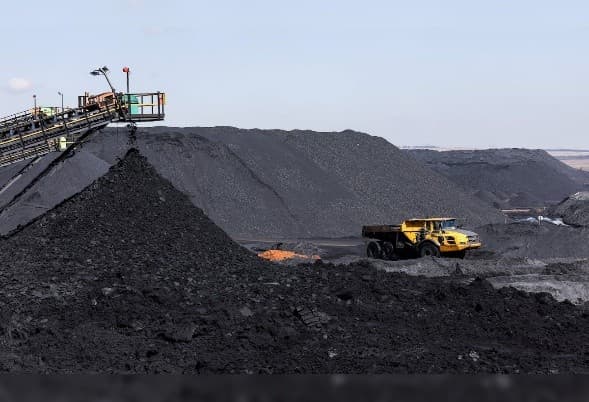
Illustration for MMDR Amendment Bill 2025 (MMDR Amendment)

What & Where

Amendment to MMDR Act 1957; passed by Parliament in 2025.

Covers exploration, leasing, sale of critical & strategic minerals pan-India.

Empowers National Mineral Exploration & Development Trust (NMEDT) for domestic and overseas projects.

Quick Facts for MCQs

Legal & Policy

  • Provision enables inclusion of additional minerals without fresh auction, easing compliance.
  • Bill removes prior state consent for captive mine sales, centralising regulation.
  • Exploration funding mandate expanded to overseas assets, boosting supply security.

Economic Angle

  • Liberalised leases and exchanges expected to attract FDI, spur jobs, raise GDP share.
  • 100 % sale from captive mines improves market liquidity and pricing transparency.
  • Higher NMEDT levy enlarges exploration kitty without direct budgetary burden.

Social & Sustainability

  • Community-participation clause ties mining approvals to local welfare investments.
  • Sustainability standards integrated to curb ecological damage and ensure ESG compliance.
  • Balanced approach aims faster clearances while upholding CSR obligations.

Security Dimension

  • Domestic sourcing of lithium, cobalt reduces import reliance amid fragile global supply chains.
  • Overseas exploration funding diversifies strategic reserves for EV and battery sectors.
  • Centralised data via exchanges enhances monitoring against illicit mineral trade.

Key Data Points

FeatureData-Point
Year of amendment2025
Parent ActMMDR Act, 1957
New focusCritical & strategic minerals (lithium, cobalt, nickel, etc.)
Leaseholder add-onOther minerals allowed in same lease
NMEDT contribution3 % of royalty (up from 2 %)
Captive mine sale cap100 % sale allowed post end-use fulfilment
Deep-seated mineral depth> 200 m qualifies for area expansion
Lease area hike10 %–30 % for deep deposits
Mineral exchangesRegulated electronic trading platforms permitted
Community clauseMandatory local welfare measures

Related UPSC Prelims PYQs

GS1 2025PYQ 1

Consider the following statements:

GS-1Mapping

5.Mithi River Profile (Mumbai River)

Hindustan Times
Illustration for Mithi River Profile (Mumbai River)

What & Where

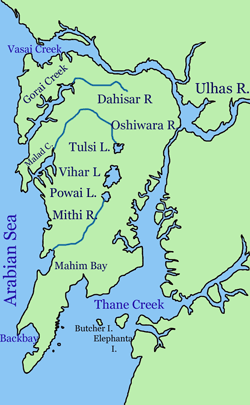
Seasonal river in Mumbai functioning as the city’s natural stormwater drain.

Originates from overflow of Vihar Lake; joined by Powai Lake ~2 km downstream; total course ≈18 km.

Empties into Arabian Sea at Mahim Creek; width ranges 5 m (upper reaches) to 70 m (near mouth).

Quick Facts for MCQs

Environmental Impact

  • Pollution hotspot; receives raw sewage, industrial effluents, solid waste.
  • Ecological degradation reduces flood-carrying capacity, heightening monsoon risk.
  • Dense encroachments hinder rejuvenation efforts.

Disaster Management

  • 300 mm downpour triggered 3.9 m river level; forced evacuation of 400 low-lying residents.
  • Post-2005 flood widening to 70 m near Mahim aimed at capacity enhancement.
  • Seasonal nature causes sharp monsoon surges, demanding continuous desilting.

Urban Geography

  • Traverses Powai, Saki Naka, Kurla, Kalina, Bandra-Kurla Complex, Dharavi, Mahim.
  • Functions as Mumbai’s primary stormwater drain before outfall to sea.
  • Nearly dry in summer, turns torrent during southwest monsoon.

Key Data Points

FeatureData-Point
Origin waterbodiesVihar Lake overflow & Powai Lake
MouthArabian Sea, Mahim Creek
Total length~18 km
Width upper reach5 m
Width near Mahim70 m (post-2005 widening)
Rainfall event300 mm in 24 hours
River swell height3.9 m (July 2023)
Residents evacuated400 persons
GS-3Environment

6.India Green Hydrogen Prospects (Green Hydrogen)

Down to Earth
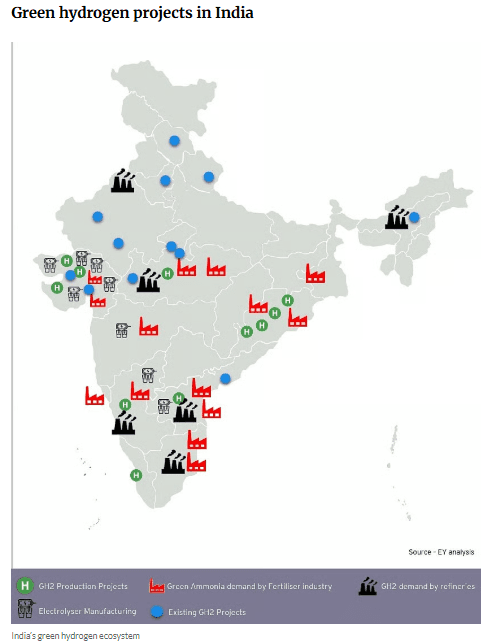
Illustration for India Green Hydrogen Prospects (Green Hydrogen)

What & Where

Green hydrogen: H₂ from water electrolysis powered by renewables, emits zero CO₂ at use.

Core applications: steel, fertilisers, heavy mobility, shipping; substitutes grey hydrogen.

India targets 5 MMT/yr production by 2030 under National Green Hydrogen Mission.

Quick Facts for MCQs

Tech & Schemes

  • National Green Hydrogen Mission anchors capacity, electrolyser manufacture, water logistics.
  • Tax incentives, cheaper solar-wind power projected to cut costs by 15–25 % by 2030.
  • Five funded pilots testing vehicles, refuelling, supply chains.

Economic Angle

  • Redirecting fossil-fuel subsidies could levelised cost, boost investor confidence.
  • Carbon tax and purchase obligations proposed to secure domestic offtake.
  • Structured demand aggregation to offer competitive long-term contracts.

Infrastructure Needs

  • 125 GW RE addition, pipelines, storage, desalination for water essential before 2030.
  • Transmission losses, high capex, low electrolyser efficiency inflate early costs.
  • Nine refuelling hubs to seed national transport corridors.

International Context

  • EU, Japan, South Korea building hydrogen import corridors—India eyes 10 % global share.
  • Global market poised to jump from US $8.78 bn (2024) to US $199 bn (2034).
  • Competitive pressure mandates rapid scale-up of domestic electrolyser production.

Key Data Points

FeatureData-Point
Mission launch year2023
Mission outlay₹19,744 crore
2030 production target5 MMT annually
Required RE capacity≈125 GW
Current green H₂ costUS $4–4.5 per kg
Projected 2030 costUS $3–3.75 per kg
Pilot project grant₹208 crore
Vehicles under pilots37 (15 fuel-cell, 22 H-ICE)
Refuelling stations planned9 in 18–24 months
Global market CAGR (’24-34)41.5 %
India export potential10 MMT/yr to EU, Japan, S Korea
India market size 2030US $2.81 bn; 56 % CAGR
Cost gap vs grey H₂~2 times higher

Related UPSC Prelims PYQs

CAPF_GAI, GS1 2023PYQ 1

Consider the following heavy industries:

CAPF_GAI, GS1 2025PYQ 2

Which of the statements given below is/are correct?

GS-3Species

7.Saltwater Crocodile Census (Saltwater Crocodile)

The Hindu

What & Where

Saltwater crocodile: world’s largest reptile, hypercarnivorous apex predator sustaining aquatic food-web balance.

Indian distribution: Sundarbans mangroves, Odisha river-swamps, Andaman & Nicobar coasts; thrives in fresh to saline waters.

Sundarban Biosphere Reserve 2025 survey: 220–242 crocs, dense in creeks/tidal rivers <180 m wide.

Quick Facts for MCQs

Conservation & Projects

  • Bhagabatpur centre: pioneering breeding, monitoring, habitat studies; continuous releases bolster wild stock.
  • Systematic boat surveys, GPS mapping refine range estimates and age-class data.
  • Ongoing protection crucial as salinity rise, climate shifts threaten mangrove nursery zones.

Population Trend

  • 2025 survey shows all-age surge, hatchlings up from 2 to 23, indicating successful nesting.
  • Adult count jumped 76% year-on-year, signalling improved survival or immigration.
  • Encounter density still low, underlining dispersed distribution in vast creek network.

Ecological Traits

  • Apex predation regulates fish, bird and mammal numbers, scavenges carcasses, preventing disease spread.
  • Salinity tolerance allows occupancy from freshwater rivers to open estuary mouths.
  • Territorial behaviour concentrates individuals in narrow channels, aiding survey visibility.

Key Data Points

FeatureData-Point
Scientific nameCrocodylus porosus
Male length ceiling>6 m
2025 direct sightings213 (125 A, 88 J, 23 H)
2024 direct sightings114 (71 A, 41 J, 2 H)
Encounter rate 20250.18/km ≈1 croc per 5.5 km
Population estimate 2025220–242 individuals
Preferred creek width<180 m tide span
Bhagabatpur project years1976–2022
Crocs released (1976-22)577
Key Indian statesWest Bengal, Odisha, Andaman & Nicobar

Related UPSC Prelims PYQs

GS1 2008PYQ 1

Consider the following statements:

GS1 2003PYQ 2

Consider the following animals of India:

GS-3Species

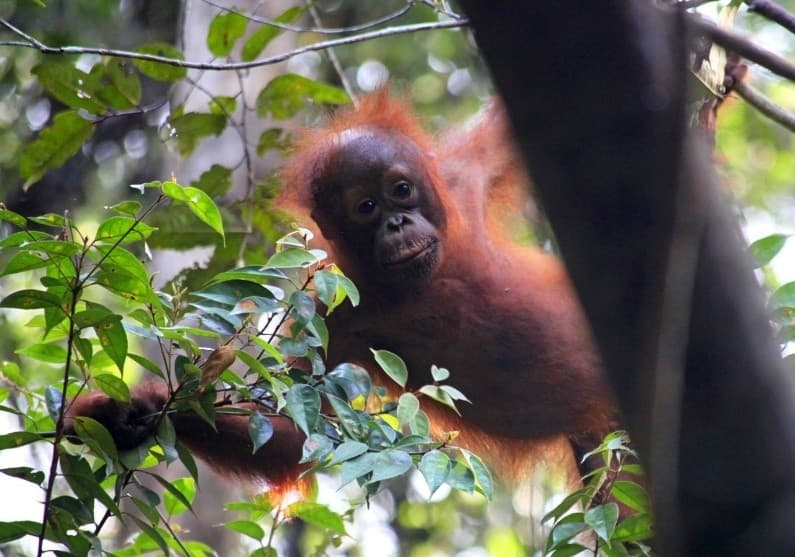
8.World Orangutan Day Awareness (Orangutan Conservation)

Down to Earth
Illustration for World Orangutan Day Awareness (Orangutan Conservation)

What & Where

Great apes; Malay root Orang = person, Hutan = forest.

Three species: Bornean, Sumatran, Tapanuli (2017 discovery).

Endemic to tropical rainforests of Sumatra & Borneo (Indonesia, Malaysia, Brunei).

Quick Facts for MCQs

Threat Drivers

  • Logging & large-scale palm-oil estates erase primary rainforest habitat.
  • Illegal hunting feeds bushmeat demand and lucrative pet markets.
  • Climate change raises Borneo-Sumatra fire frequency, accelerating canopy loss.

Reproductive Constraints

  • Late maturity; first breeding around 15 years restricts generational turnover.
  • Six-to-eight-year interbirth gap hinders population recovery from shocks.
  • Infant capture often involves killing mothers, spiking juvenile mortality.

Conservation Efforts

  • Awareness: 2025 slogan “save the orangutans, save the rainforest, save the planet”.
  • NGOs lobby for certified sustainable palm-oil supply chains.
  • Indonesian sanctuaries run rescue-rehabilitation-release programmes for seized pets.

Key Data Points

FeatureData-Point
World Orangutan Day19 Aug; started 2013
Human DNA shared≈ 97 %
Closest relatives rank4th after chimpanzee, bonobo, gorilla
Tapanuli population< 1,000 individuals
Female birth interval6–8 years
Dominant dietFruits 60–90 %
IUCN status all speciesCritically Endangered
Main threatsDeforestation, palm oil, hunting, pet trade, climate change
Tool useSticks for insects/honey
Arm adaptationLongest among primates; arboreal travel
GS-3S&T

9.Nepal Rubella-Free Status (Rubella Elimination)

Down to Earth
Illustration for Nepal Rubella-Free Status (Rubella Elimination)

What & Where

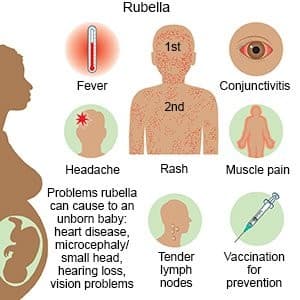
Rubella = contagious viral exanthema; aka German measles; respiratory‐droplet spread.

WHO certified Nepal “rubella-free” on 18 Aug 2025; 1st in South-East Asia Region.

Core risk zone: pregnancies; unchecked virus → congenital rubella syndrome (CRS).

Quick Facts for MCQs

Health Impact

  • CRS leads to deafness, cataract, heart defects; lifelong disabilities.
  • Many infections asymptomatic → silent community spread.

Global & Regional Status

  • WHO SEAR goal: measles & rubella elimination in all 11 member states.
  • Nepal joins 93 nations globally certified rubella-free (as of 2025).

Prevention & Treatment

  • Immunisation coverage ≥95 % with two MMR/MR doses needed for herd immunity.
  • Supportive care: rest, hydration, antipyretics; no WHO-approved antivirals.

India Initiatives

  • 34-state MR mass campaign targets 410 mn children (9 mo-15 yr).
  • Surveillance: integrated measles-rubella lab network with IgM ELISA confirmation.

Key Data Points

FeatureData-Point
Causative agentRubella virus, Togaviridae family
Primary transmissionRespiratory droplets, person-to-person
Incubation period~14 days (range 12–23)
Key symptomsMild fever, maculopapular rash, lymphadenopathy
Pregnancy dangerMiscarriage, stillbirth, CRS
Specific antiviralNone; only supportive care
Vaccine typeLive-attenuated MMR/MR
Nepal WHO status date18 Aug 2025
SEAR “first” achieverNepal
India MR campaign launch2017
India elimination targetMeasles & rubella by 2023-24

Related UPSC Prelims PYQs

CDS_GK 2021PYQ 1

Which one of the following countries has recently been awarded a malaria-free certification by the WHO?

GS-3S&T

10.Soap and Detergent Chemistry (Surfactant Chemistry)

The Hindu

What & Where

Soap = Na/K fatty-acid salt from natural oils; Detergent = synthetic surfactant mix from petrochemicals.

Key processes: soap—hydrolysis→saponification→drying; detergent—sulphonation→neutralisation→spray drying.

Plants usually co-located with edible-oil refineries or petrochemical complexes worldwide for feedstock proximity.

Quick Facts for MCQs

Chemicals & Additives

  • Surfactants: sodium lauryl sulphate common to both products
  • Additives: enzymes, bleaches, dyes, perfumes elevate cleaning & marketing appeal
  • Antimicrobials: neem oil, triclosan occasionally blended into premium bars

Manufacturing Process

  • Soap “noodles” act as intermediate stock for diverse bar grades
  • Detergent base first sulphonated hydrocarbon, then neutralised with alkali
  • Final formulations tailored via post-mixing of builders and fragrances

Environmental Impact

  • Phosphates trigger algal blooms in freshwater bodies
  • Some synthetic surfactants bio-accumulate, prompting shift to eco-labels
  • Regulatory push favouring biodegradable, phosphate-free detergent lines

Key Data Points

FeatureData-Point
Soap formulaR-COO⁻ Na⁺ / R-COO⁻ K⁺
Common soap alkaliNaOH or KOH
Major detergent surfactantLinear alkyl benzene sulphonate (LABS)
Builders in detergentsSodium carbonate, phosphates
Water suitabilitySoap soft-water only; detergent both hard & soft
BiodegradabilitySoap high; detergents vary, some persistent
Typical soap fillerTalc, sodium silicate
Powder detergent stepSpray drying / agglomeration
Bar-soap shapingExtrusion, cutting, stamping
Eco concernPhosphate runoff → eutrophication

Related UPSC Prelims PYQs

GS1, NDA_GAT 2025PYQ 1

Which one of the following statements is NOT correct ?

GS1, NDA_GAT 2003PYQ 2

Consider the following statements

GS-3S&T

11.Brain-Eating Amoeba Outbreak (Naegleria fowleri)

Indian Express
Illustration for Brain-Eating Amoeba Outbreak (Naegleria fowleri)

What & Where

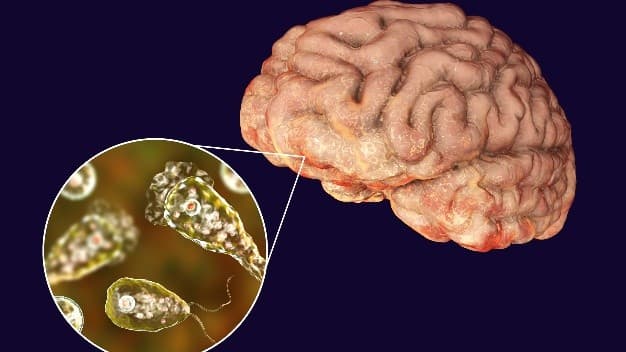
Naegleria fowleri — free-living amoeba causing Primary Amoebic Meningoencephalitis (PAM)

Invades via nose during swimming/bathing in warm freshwaters; then reaches brain

Recent cases in Kerala; organism thrives in lakes, rivers, poorly chlorinated pools ≤ 46 °C

Quick Facts for MCQs

Pathogenesis

  • Nasal olfactory nerve allows CNS entry; trophozoites destroy brain tissue
  • Rapid necrosis triggers fulminant meningoencephalitis
  • No cyst stage in human host

Clinical Course

  • Early nonspecific febrile illness rapidly turns neurological
  • Symptom onset to fatality often < 1 week post-neuro signs
  • Case-fatality exceedingly high despite ICU care

Treatment & Prognosis

  • Empiric combo of antifungals & antibiotics remains standard
  • Prompt IV/IT Amphotericin B plus oral Miltefosine improves odds
  • Survival hinges on ultrafast diagnosis

Public Health Angle

  • Summer swimming/diving in untreated warm waters raises risk
  • Adequate chlorination, nose clips, avoiding forceful water entry recommended
  • Kerala strengthening surveillance, rapid testing protocols

Key Data Points

FeatureData-Point
Causative organismNaegleria fowleri
DiseasePrimary Amoebic Meningoencephalitis
HabitatWarm freshwater, splash pads, ill-maintained pools
Temperature limitUp to 46 °C (115 °F)
Entry routeWater up nose; not ingestion
Human-to-humanNot reported
Incubation–death5–18 days after symptoms
Global survival rate≈ 3 %
Kerala trendBetter survival via early detection
First symptomsHeadache, fever, nausea, vomiting
Late symptomsStiff neck, confusion, seizures, coma
Drug comboAmphotericin B, Miltefosine, Fluconazole, Azithromycin
VectorNone; free-living
Recent death9-year-old child, Kerala
GS-3S&T

12.Bioactive Peptides in Nutrition (Bioactive Peptides)

PIB

What & Where

Definition: Bioactive peptides (BAPs) are 2–20-amino-acid chains released from parent proteins during digestion/fermentation.

Key process: Enzymatic breakdown of traditional fermented foods unlocks “encrypted” peptides that modulate body functions.

Core geography: Study focused on Indian dietary staples, enabling population-specific, precision-nutrition applications.

Quick Facts for MCQs

Health Effects

  • Regulation: BAPs lower hypertension, modulate immunity, combat oxidative stress.
  • Scope: Offer non-drug route for chronic disease management.

Biochemistry Basics

  • Composition: Peptides <50 amino acids; proteins >50.
  • Activation: Protein hydrolysis exposes functional peptide sequences.

Precision Nutrition

  • Customization: Same peptide may vary in efficacy across individuals.
  • Significance: Tailored diets crucial for India’s genetic and microbiota diversity.

Key Data Points

FeatureData-Point
Chain length2–20 amino acids
Parent moleculeLarger dietary proteins
Release triggerEnzymatic digestion, fermentation, food processing
Interaction forcesElectrostatic, hydrogen bonding, hydrophobic
Major bioactivitiesAntimicrobial, antihypertensive, antioxidant, immune-modulatory
Health targetsBlood pressure, blood sugar, inflammation, cardiac & metabolic health
Personal response factorsGenetics, gut microbiota, diet, overall health
Precision-nutrition needHigh in diverse Indian population
Essential amino acidsHistidine, leucine, lysine (cannot be synthesized)
Conditionally essentialArginine, cysteine, glutamine (stress/illness)
GS-3S&T

13.Sustainable Aviation Fuel Initiative (Sustainable Aviation Fuel)

Down to Earth

What & Where

SAF = drop-in bio-jet fuel from used cooking oil & non-edible oilseeds via CSIR-IIP process.

Indian pilot hub: CSIR-IIP, Dehradun; partners Boeing, IndiGo, SpiceJet, Air India, Vistara, AirAsia India.

Samples under US FAA ASTM D4054 clearance for global commercial use.

Quick Facts for MCQs

Benefits

  • GHG-cut: up to 80 % lifecycle emissions reduction versus fossil jet fuel.
  • Air-quality: lower sulphur & particulate output over urban flight paths.
  • Jobs-boost: new bio-refineries, rural feedstock markets, energy security.

Challenges

  • Cost-premium: SAF priced 2-4 × current ATF hindering airline uptake.
  • Feedstock-limit: competition with food/agri uses plus patchy collection logistics.
  • Certification-lag: multi-year, multi-agency testing slows commercial roll-out.

International Initiatives

  • ICAO CORSIA mandates offsets and promotes SAF adoption globally.
  • WEF Clean Skies for Tomorrow accelerates R&D and buyer-supplier coalitions.
  • EU staged mandate raises SAF blend every 5 yrs to 63 % by 2050.

Policy & Investment

  • Incentive-mix: tax breaks, subsidies, blending mandates can narrow price gap.
  • Collaboration-need: airlines-refiners-labs sharing risk capital & supply chains.
  • Feedstock-R&D: algae, agri-waste, MSW eyed to widen sustainable resource base.

Key Data Points

FeatureData-Point
Core instituteCSIR-Indian Institute of Petroleum, Dehradun
Industry partnersBoeing + 5 Indian carriers
Key feedstocksPalm-stearin, sapium, PFAD, algae, karanja, jatropha, used cooking oil
Target certificationASTM D4054 via FAA Clearinghouse
ICAO scheme baselineCORSIA offsets emissions above 2020 levels
EU SAF blend start2 % in 2025
EU 2050 blend goal63 % SAF
US incentive lawSustainable Skies Act; USD 1 bn grants/5 yrs
Sulphur contentLower than conventional ATF
Possible Indian co-fuelsBiodiesel, ethanol-blends, hydrogen fuel cell

Related UPSC Prelims PYQs

GS1 2024PYQ 1

Consider the following materials:

GS-2Editorial

14.India-ASEAN Strategic Partnership (India-ASEAN Ties)

ORF
Illustration for India-ASEAN Strategic Partnership (India-ASEAN Ties)

What & Where

ASEAN = regional inter-governmental body, formed 1967 Bangkok to foster economic growth and stability

Ten members: Indonesia, Malaysia, Philippines, Singapore, Thailand, Brunei, Vietnam, Laos, Myanmar, Cambodia; population ≈ 650 mn, GDP ≈ USD 3.2 tn

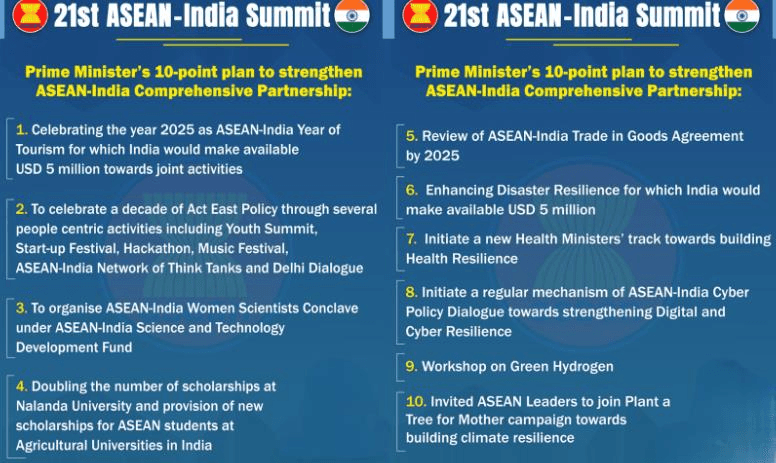
India a Dialogue Partner since 1995, Comprehensive Strategic Partner since 2022 under Act East & Indo-Pacific vision

Quick Facts for MCQs

Economic Angle

  • Trade imbalance widening; AITGA review and AITIGA upgrade sought for fairer tariff regime
  • RCEP exit 2019 avoided Chinese surge through ASEAN routes
  • Singapore leads ASEAN FDI inflow, services gateway for Indian firms

Security Dimension

  • BrahMos sale plus training, MRO assistance brand India a credible defence partner
  • Engagement via East Asia Summit, ARF, ADMM-Plus reinforces ASEAN centrality, rules-based order
  • Divergent threat perceptions; Cambodia–Laos neutrality dampens collective stance against China

Connectivity & Infrastructure

  • IMT Trilateral Highway and Kaladan Multi-Modal projects to anchor Northeast as trade hub
  • Delays from funding, security, bureaucracy undermine timelines and credibility
  • 2023 ASEAN-India Maritime Exercise strengthened interoperability in South China Sea

Tech & Sustainability

  • UPI-Singapore linkage prototype for regional digital payments; data sovereignty under DPDP Act contrasts ASEAN openness
  • 2022 Renewable Energy Conference launched cooperation in solar, offshore wind, semiconductors
  • Planned Regional Satellite for Sustainability to supply crop, pollution and disaster data for ASEAN

Key Data Points

FeatureData-Point
ASEAN founding year1967
Member states10
ASEAN population~650 million
Combined GDPUSD 3.2 trillion
India-ASEAN trade 2023-24USD 122.67 billion (11 % India trade)
India trade deficit 2024-25USD 45.2 billion
Top ASEAN trade partner for IndiaSingapore; ~3 % India trade
Singapore FDI into India FY 24USD 14.94 billion
ASEAN-China trade 2023-24USD 702 billion
BrahMos export customerPhilippines
ASEAN-India Tourism Year2025

Related UPSC Prelims PYQs

CAPF_GAI, GS1 2022PYQ 1

Which of the following statements is/are correct?
CAPF_GAI, GS1 2015PYQ 2

India is a member of which among the following?

Ready to practice?

Test your knowledge with our UPSC test series.

Start Free Trial