UPSC Current Affairs

12 topicsGS-1: 2GS-2: 3GS-3: 7
0/12 done
GS-2Polity

1.Aircraft Accident Investigation Bureau Overview (Aviation Investigation)

Times of India

What & Where

Statutory Aircraft Accident Investigation Bureau; probes civil aviation accidents/serious incidents in Indian airspace.

Key processes: occurrence classification, fact-finding investigation, safety recommendations, public report per ICAO Annex 13.

HQ New Delhi; jurisdiction entire Indian Flight Information Region; operates under Ministry of Civil Aviation.

Quick Facts for MCQs

Legal & Policy

  • Rule alignment; 2017 Rules embed ICAO Annex 13 standards into Indian law.
  • Provides legal aid to courts/assessors per Rule 12.
  • Statutory status ensures independence from regulator DGCA’s operational oversight.

Mandate & Jurisdiction

  • Investigates civil occurrences within Indian airspace; military excluded.
  • Can extend to foreign-registered aircraft accidents happening in India.
  • May re-open closed probes if new evidence surfaces.

Core Functions

  • Investigation; on-site evidence collection, data analysis, causal determination.
  • Safety recommendations forwarded to DGCA or foreign regulators for systemic fixes.
  • Conducts periodic safety studies to flag emerging aviation risks.

International Linkage

  • Shares final reports with ICAO for global safety database.
  • Coordinates with States of Registry, Operator, Design, Manufacture during probes.

Operational Workflow

  • Immediate notification; formation of Investigation Team; preliminary report within 30 days.
  • Draft final report sent for stakeholder comments before publication.

Key Data Points

FeatureData-Point
Establishment date30 July 2012
Parent ministryCivil Aviation
Legal basisAircraft (Investigation of Accidents & Incidents) Rules 2017
Global frameworkChicago Convention 1944, Annex 13
Mandatory probe weightAUW > 2,250 kg
Mandatory probe typeAll turbojet aircraft
Discretionary probeSmaller aircraft if public-safety issue
Report approval authorityAAIB Director-General
Report recipientsICAO, affected States
HeadquartersNew Delhi
Core categoriesAccident, Serious Incident, Incident

Related UPSC Prelims PYQs

GS1 2003PYQ 1

Which one of the following statements is correct?
GS-3Economy

3.Totapuri Mango Cultivation Dispute (Horticulture Crop)

DH

What & Where

Totapuri mango: medium-sized, elongated, parrot-beak tip; staple for juice / pulp industry.

Core belts: Karnataka, Andhra Pradesh, Tamil Nadu—esp. Chittoor, Kolar, Ramanagara, Bengaluru Rural.

Needs tropical warmth, dry summers, moderate rainfall, well-drained loamy soils.

Quick Facts for MCQs

Economic Angle

  • Price differential prompted AP to block cheaper Karnataka inflow, protecting local farmers’ returns.
  • Chittoor Collector order halted Totapuri truck entry at district borders.
  • AP subsidy lowers processor cost, indirectly supporting farmgate ₹8/kg rate.

Legal & Policy

  • Constitution mandates nationwide trade freedom; executive bans need statutory backing.
  • Article 304(b) demands “reasonable” restriction passed by legislature, President-approved.
  • Collector’s order likely ultra vires without Assembly act or assent.

Agro Features

  • Edible skin reduces peeling losses; boosts processor preference.
  • Crop suits warm, dry zones; moderate rain vital during flowering.
  • Karnataka–AP belt supplies bulk raw fruit to national pulp factories.

Key Data Points

FeatureData-Point
Alternate namesGinimoothi, Sandersha, Banglora
Fruit skinGreenish-yellow, low bitterness, edible
Industrial useHigh-yield pulp for F&B processing
Ideal climateWarm tropics; dry summer
Preferred soilWell-drained loam
Main cultivation statesKA, AP, TN
AP processor price₹8/kg (₹4 state subsidy)
Karnataka farm-gate price₹5–6/kg
Free inter-state trade articleArticle 301
Restriction clauseArticle 304(b) + Presidential assent
GS-1History

4.Sant Kabir Das Birth Anniversary (Bhakti Movement)

PIB
Illustration for Sant Kabir Das Birth Anniversary (Bhakti Movement)

What & Where

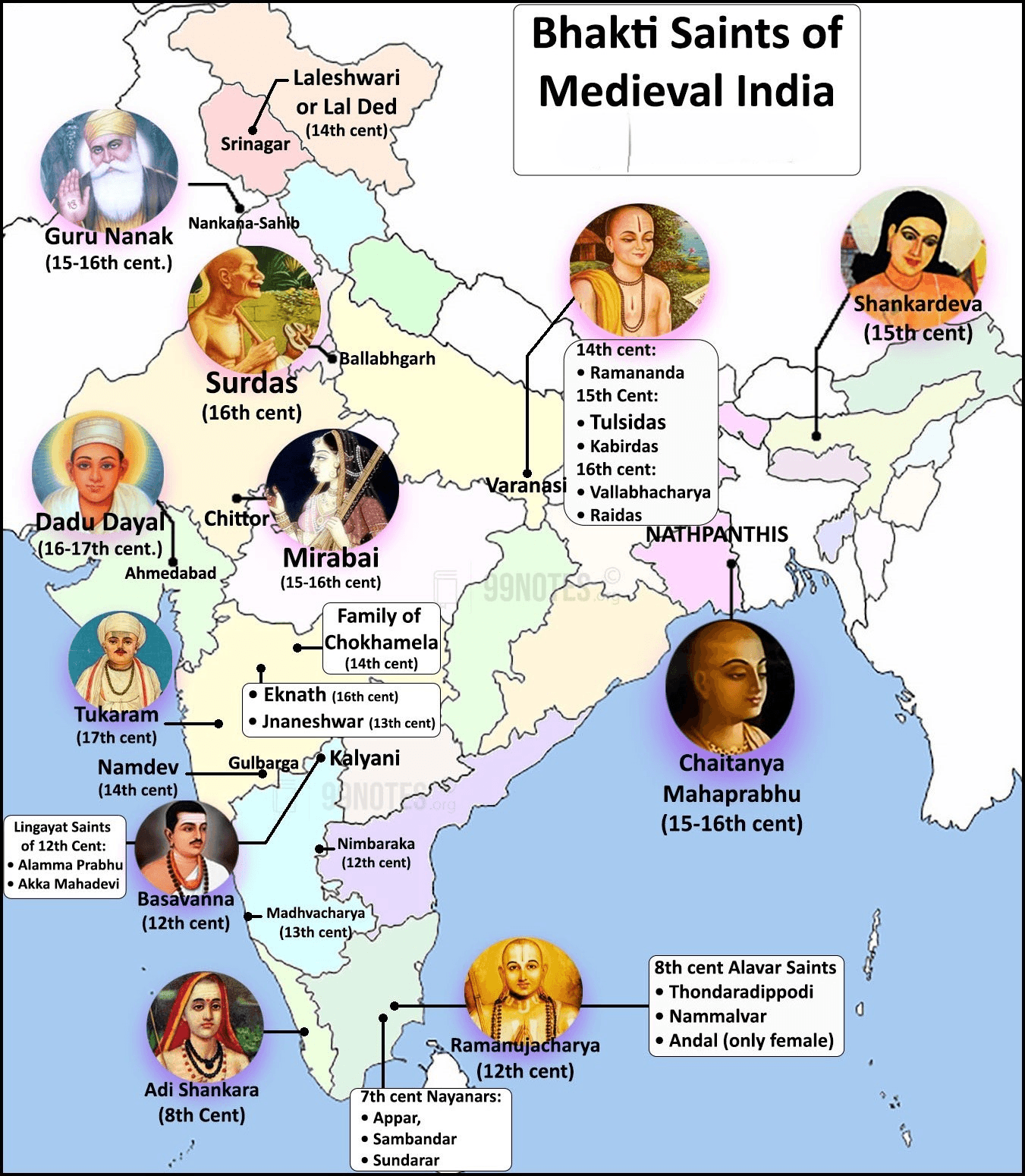
Mystic-poet Sant Kabir Das (1440-1518), iconic saint of Nirguna Bhakti tradition.

Born Varanasi (Uttar Pradesh); livelihood weaving; self-styled julaha/kori to signal caste solidarity.

Verses radiated across North India; many enshrined in Sikh Guru Granth Sahib.

Quick Facts for MCQs

Teachings & Philosophy

  • Devotion: Formless Brahman; rejects idol worship, ritualism, caste barriers.
  • Values: Truth, compassion, equality, personal God-experience over texts.
  • Syncretism: Hindu-Bhakti base enriched by Sufi interactions.

Literary Output

  • Genres: Crisp dohas, soulful bhajans, paradoxical ulatbansi for introspection.
  • Languages: Vernacular usage propelled early Hindi literary evolution.
  • Preservation: Bijak guarded by Kabirpanth; Granthawali by Dadupanth.

Bhakti Movement Role

  • Catalysis: Took vernacular devotion to masses during 15th-century upsurge.
  • Reform: Critiqued both Brahmanical and Islamic orthodoxies.
  • Influence: Inspired Sikh gurus; enriched inter-faith devotional corpus.

Legacy & Sect

  • Sect: Kabir Panth spans Hindus, Muslims, Sikhs; centres in UP, MP, Chhattisgarh, Bihar.
  • Ethos: Communal harmony, egalitarianism, inner awakening remain guiding ideals.

Key Data Points

FeatureData-Point
Birth–Death1440 CE – 1518 CE
Commemoration 2025648th Kabir Prakat Divas, 11 June
BirthplaceVaranasi, Uttar Pradesh
Bhakti StrandNirguna (formless) devotion
Spiritual GurusRamananda; Sufi Sheikh Taqi
Literary FormsDoha, Bhajan, Ulatbansi
Main LanguagesBrajbhasha, Awadhi, Sant Bhasha
Key CompilationsBijak, Parachai, Sakhi Granth, Anurag Sagar, Granthawali
Sikh Scripture LinkMultiple hymns in Guru Granth Sahib
Followers’ SectKabir Panth; adherents called Kabir Panthis

Related UPSC Prelims PYQs

CAPF_GAI, GS1 2021PYQ 1

Who among the following Bhakti saints did not belong to Nirguna School of Bhakti?

CAPF_GAI, GS1 2002PYQ 2

Who among the following was the first Bhakti saint to use Hindi for the propagation of his message?

GS-3Environment

5.AviList Global Bird Checklist (Avian Taxonomy)

Down to Earth

What & Where

AviList: first unified, global checklist standardising scientific names of all bird species.

Produced by Working Group on Avian Checklists, International Ornithologists’ Union (IOU).

Applicable worldwide; harmonises data across conservation laws, treaties, research portals.

Quick Facts for MCQs

Institutional Framework

  • IOU: provides governance, maintains voting protocol for taxonomic changes.
  • BirdLife: aligns Red List, CITES, CBD targets with AviList nomenclature.

Tech & Schemes

  • Integrative taxonomy: merges phenotypic, genetic and ecological evidence for species delimitation.
  • Digital platform: online, open-access, enabling instant updates for databases and apps.

Conservation Utility

  • Harmonised list: facilitates precise threat assessment, funding & habitat prioritisation.
  • Taxonomic stability: critical for long-term biodiversity monitoring and reporting obligations.

Key Data Points

FeatureData-Point
PurposeOne-stop global bird taxonomy list
Developed byIOU-led Working Group on Avian Checklists
Partner bodiesBirdLife International, other ornithological networks
Build time4 years of expert consensus
Species conceptIntegrative (morphology + genetics + ecology + biogeography + reproductive isolation)
Update cycleAnnual revisions announced
Decision modeCore taxonomists vote on proposals
Core benefitRemoves mismatch among multiple earlier checklists
Key usersOrnithologists, policymakers, educators, citizen scientists
Conservation gainCommon language for laws, treaties, resource allocation
GS-3Environment

7.FAO Marine Fishery Resources 2025 (Marine Fisheries)

FAO

What & Where

FAO’s “State of World Marine Fishery Resources 2025” gauges biological sustainability of global marine stocks.

Assesses species groups: tuna, sharks, deep-sea fauna; contrasts sustainable vs overfished categories.

Geographic focus spans all FAO statistical areas; red flags in Mediterranean–Black Sea, positives in NE & SW Pacific.

Quick Facts for MCQs

Legal & Policy

  • RFMOs; success stories in tuna due to observers, catch limits, real-time reporting.
  • FAO urges subsidy bans, ecosystem-based management, precautionary deep-sea closures.
  • Governance gaps evident in Mediterranean & Black Sea, artisanal overcatch persists.

Species Status

  • Tuna; model for sustainability, 87 % within safe limits.
  • Sharks; high by-catch, 43.5 % stocks overfished, Indo-Pacific worst.
  • Deep-sea fishes; slow growth, only 29 % sustainable, recovery extremely prolonged.

Regional Variations

  • Northeast & Southwest Pacific; strongest compliance, high stock health.
  • Mediterranean–Black Sea; weakest, just 35.1 % sustainable owing to lax enforcement.
  • Eastern Indian Ocean; 72.7 % tagged sustainable, but reliability lowered by sparse species-level data.

Data & Tech

  • Call for satellite-linked e-reporting, onboard cameras, AI analytics to plug data gaps.
  • Capacity-building for African & SE Asian nations prioritized for stock assessments.
  • 600-expert multi-disciplinary methodology underpins report credibility.

Key Data Points

FeatureData-Point
Global stocks biologically sustainable64.5 %
Global stocks overfished35.5 %
Deep-sea species sustainable29 %
Tuna & tuna-likes sustainable87 %
Migratory shark stocks unsustainable43.5 % (of 23 assessed)
Mediterranean–Black Sea sustainability35.1 %
Northeast Pacific sustainabilityHigh (exact % not stated)
Southwest Pacific sustainabilityHigh (exact % not stated)
Eastern Indian Ocean sustainability72.7 %*
Experts contributing600+ from 90 nations
Launch venueUN Ocean Conference 3, Nice
Urged management toolStrengthened RFMOs
GS-3SpeciesQuick Bite

8.Lesser Flamingo Migration to Kutch (Lesser Flamingo)

The Hindu
Illustration for Lesser Flamingo Migration to Kutch (Lesser Flamingo)

What & Where

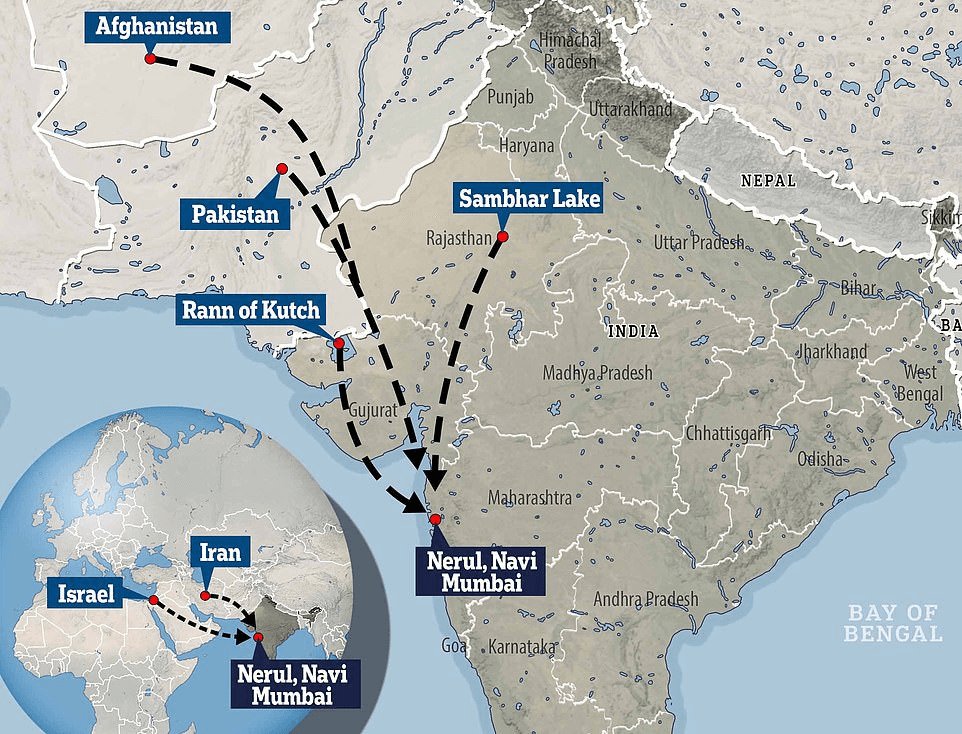
Lesser Flamingo (Phoeniconaias minor) smallest flamingo; fresh influx at Chhaya pond, Porbandar, Gujarat

Breeds in Great Rann of Kutch along India-Pakistan border; wintering range spans sub-Saharan Africa, Arabia, South Asia

Favors shallow saline or alkaline wetlands including lagoons, saltpans, brackish coastal lakes

Quick Facts for MCQs

Legal & Policy

  • IUCN Near Threatened denotes habitat loss risk to saline lakes
  • CITES Appendix II regulates international trade via export permits
  • WPA Schedule IV offers protection but lower penalties than Schedule I

Species Diversity

  • Family Phoenicopteridae houses 6 species: Greater, Lesser, Chilean, American, Andean, James’s
  • Only Greater (Ph. roseus) and Lesser (P. minor) occur naturally in Indian subcontinent
  • Lesser remains most numerous globally yet faces episodic die-offs in degraded wetlands

Biology & Behaviour

  • Sociality: forms dense colonies; synchronized courtship enhances breeding success
  • Feeding: filter-feeds using specialized beak lamellae trapping blue-green algae
  • Colouration: diet-derived carotenoids convert to pink-red feather pigments via liver enzymes

Key Data Points

FeatureData-Point
Global flamingo species6
Species in IndiaGreater & Lesser
IUCN status (Lesser)Near Threatened
CITES listingAppendix II
WPA 1972 listingSchedule IV
DietAlgae, molluscs, crustaceans
Plumage colour sourceCarotenoid pigments from diet
Current stopoverChhaya pond, Porbandar
Main Indian breeding siteGreat Rann of Kutch
GS-3S&T

9.Heat-Tolerant Pigeonpea Variety ICPV 25444 (Crop Breeding)

BL

What & Where

Variety: ICPV 25444, heat-tolerant pigeonpea bred via speed breeding.

Geography: Suited to India’s hot, semi-arid belts and 12 M ha post-kharif rice fallows.

Process: Speed breeding manipulates light, temperature, humidity to get 4 generations/year.

Quick Facts for MCQs

Tech & Schemes

  • Speed-breeding allows rapid trait fixation, quadrupling crop cycles annually.
  • PSS triggers government buy when market dips below MSP, covering pulses, oilseeds, copra.
  • Budget mission focuses on Tur, Urad, Masur for import elimination.

Economic Angle

  • Import substitution could save USD 800 million yearly.
  • Bridging 1.5 Mt gap aligns with Atmanirbhar Bharat goals.
  • Higher yields and shorter crops enhance farmer profit margins.

Agricultural Resources

  • Heat tolerance enables cultivation in 45 °C zones, mitigating climate stress.
  • Utilising rice fallows adds 12 M ha to pulses acreage without extra irrigation.
  • Faster 4-month crop supports better rotation with rabi wheat or oilseeds.

Key Data Points

FeatureData-Point
Heat toleranceUp to 45 °C
Yield potential≈ 2 t/ha (vs 1.1–1.2 t/ha)
Harvest duration4 months (usual 6–7)
Breeding time cut15 → 5 years
Generations/year4
Rice fallow scope12 million ha
Import shortfall bridged1.5 million t
Import bill 2023-24≈ USD 800 million
Top pulses statesMadhya Pradesh, Maharashtra, Rajasthan
Self-sufficiency target2028
Budget 2025-26 move6-year Mission for Self-Reliance in Pulses
Procurement schemePrice Support Scheme (PSS) at MSP
GS-3SecurityQuick Bite

10.India–UK PASSEX Naval Exercise (PASSEX Exercise)

The Hindu

What & Where

PASSEX: ad-hoc joint naval drill for interoperability when friendly deployments intersect.

June 2025 India–UK edition held in North Arabian Sea.

Core focus: tactical manoeuvres, ASW synergy, maritime domain awareness.

Quick Facts for MCQs

Security Dimension

  • Interoperability: secure voice/data links, formation tactics, cross-deck helicopter ops validated.
  • ASW emphasis: combined sonar, sonobuoys, sub tracking demonstrate chokepoint defence ability.
  • Indo-Pacific posture: signals commitment to rules-based order, deters extra-regional threats.

Key Platforms

  • INS Tabar: Barak-1 SAM, BrahMos, 100 mm gun, Klub torpedoes for multi-domain combat.
  • P-8I: AN/APY-10 radar, MAD boom, Harpoon missiles extend kill radius beyond 1,000 nmi.
  • Royal Navy unit: provides Merlin/Wildcat helicopter, advanced EW suites, cooperative targeting.

Strategic Framework

  • Partnership: PASSEX supplements scheduled Konkan exercise, offering low-cost readiness boost.
  • Roadmap 2030: maritime security, tech transfer, climate resilience identified as joint pillars.
  • SAGAR doctrine: India promotes “Security & Growth for All” via persistent naval presence.

Key Data Points

FeatureData-Point
Participating naviesIndian Navy & UK Royal Navy
Sea areaNorth Arabian Sea
Indian warshipINS Tabar, Talwar-class stealth frigate
Aircraft deployedP-8I long-range maritime patrol/ASW
Other Indian assetConventional diesel-electric submarine
First Indian frigate with BrahMosINS Tabar
INS Tabar commission year2004 (Russia)
P-8I range>1,200 nautical miles
P-8I max speed907 km h⁻¹
Key drillsHelicopter control, fleet manoeuvres, joint ASW ops, officer exchanges
Data exchangeReal-time tactical links tested
Strategic vision servedSAGAR & India–UK 2030 Roadmap
Broader partnershipIndia–UK Comprehensive Strategic Partnership (2021)

Related UPSC Prelims PYQs

CDS_GK, GEO_GS 2021PYQ 1

Indian Naval Ship INS Tabar had recently participated in a two-day naval exercise with the Italian Navy. The exercise was conducted in

CDS_GK, GEO_GS 2025PYQ 2

Naseem-Al-Bahr, held in October 2024, was a joint maritime exercise between the navies of India and

GS-2Scheme

11.Gyan Post Affordable Book Delivery (Postal Scheme)

News on Air
Illustration for Gyan Post Affordable Book Delivery (Postal Scheme)

What & Where

Gyan Post – India Post service delivering non-commercial educational & socio-cultural printed matter at subsidised rates.

Operates pan-India via low-cost surface transport under Ministry of Communications.

Retail booking only; parcels tagged “Gyan Post” and open to inspection.

Quick Facts for MCQs

Eligibility & Content

  • Eligibility: material from recognised boards, universities, statutory bodies only.
  • Requirement: each book must display printer/publisher name, no promotional inserts.
  • Frequency: items must not be periodicals like journals or weeklies.

Operational Conditions

  • Inspection: postal officials may open and verify content compliance.
  • Addressing: full sender & receiver address with PIN mandatory on package.
  • Marking: “Gyan Post” label compulsory for concessional rate recognition.

Social Objective

  • Inclusion: aims Har Ghar Gyan vision, bridging rural-urban educational resource gap.
  • Support: facilitates affordable material access for students & competitive-exam aspirants.

Key Data Points

FeatureData-Point
Launch AgencyDepartment of Posts
Parent MinistryCommunications
Service ScopeAll India, last-mile delivery
Permitted MatterPrinted educational, social, religious, cultural books
ProhibitedMagazines, ads, commercial publications, personal letters
Weight Range300 g minimum – 5 kg maximum
FormatsRoll & non-roll within PO dimensions
Transport ModeSurface (road/rail) only
Booking ModePost-office counter; no bulk dispatch
Pricing ModelSlab-based, weight-tiered
Optional Add-onsTracking, Proof of Delivery, Insurance
Packaging RuleUnsealed/open for easy inspection
GS-1Editorial

12.Global Gender Gap Report 2025 (Gender Gap Index)

The Hindu
Illustration for Global Gender Gap Report 2025 (Gender Gap Index)

What & Where

Index; annual WEF metric since 2006 assessing gender parity in 148 nations

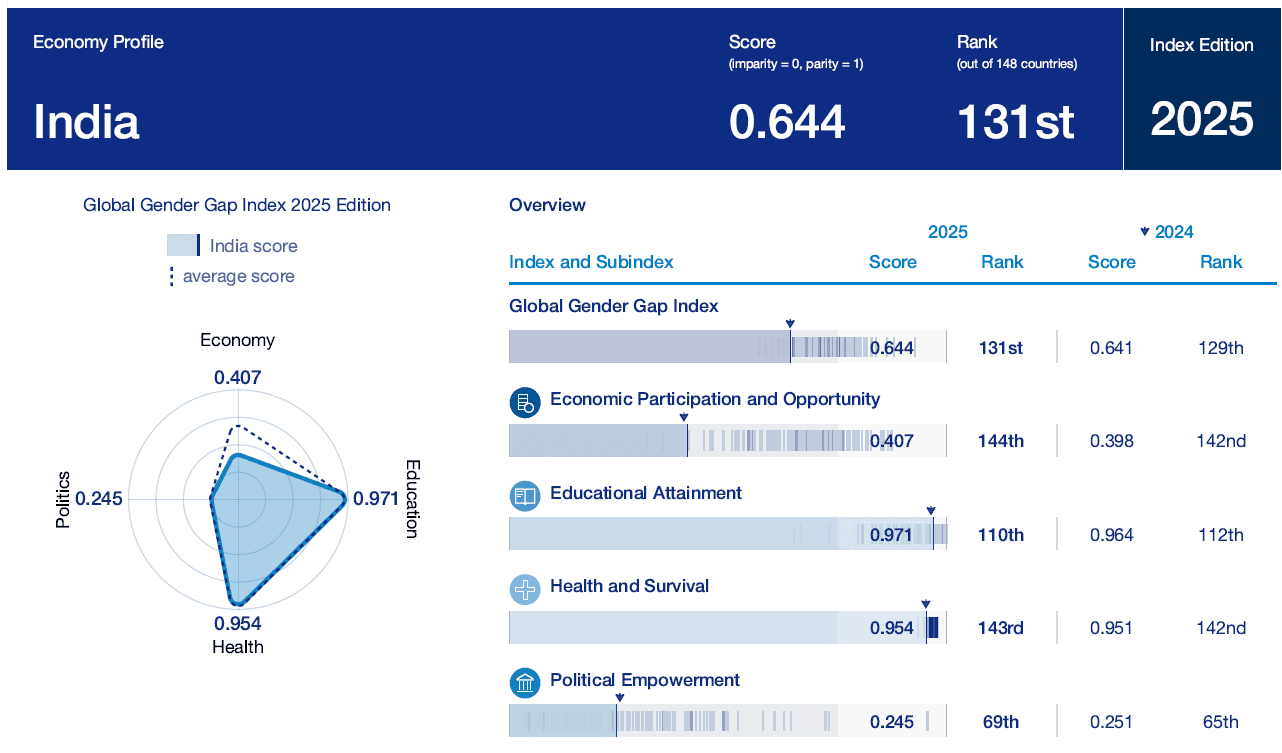
Dimensions; Economic Participation, Educational Attainment, Health & Survival, Political Empowerment scored 0–1

India; rank 131 (score 64.1 %) in 2025, down two places from 2024

Quick Facts for MCQs

Global Rankings

  • Iceland retains 1st, followed by Finland, Norway, UK, New Zealand
  • South Asia; Bangladesh jumps 75 places to 24, Bhutan 119, Nepal 125, Sri Lanka 130
  • Bottom; Pakistan 148, widest recorded disparity

India Strides

  • Legislation; Nari Shakti Vandan Adhiniyam reserves one-third seats in Parliament and assemblies
  • Education; female GER in higher studies reached 46.3 % (2022-23) under Beti Bachao initiatives
  • Employment; female labour force share climbed to 41.7 % (2023-24) via Stand-Up India, Mahila e-Haat

Persistent Gaps

  • Wage; women earn ~73 % of male wages, unpaid care load 289 min daily
  • Leadership; only 17 % CXOs and 20 % board seats occupied by women
  • Literacy; 17-point gender gap, 40 % girls (15–18) out of school

Policy Initiatives

  • Safety; One-Stop Centres and Nirbhaya Fund bolster support for violence survivors
  • Budgeting; Gender Budget Cells mandated across ministries for evidence-based spending
  • Health; PM Matru Vandana Yojana & NHM cut MMR to 97 (2018-20)

Key Data Points

FeatureData-Point
India rank 2025131 / 148
India parity score64.1 %
Economic Participation (Ind)40.7 %
Educational Attainment (Ind)97.1 %
Parliament women share13.8 %
Ministers women share5.6 %
Global gap closed68.8 %
Years to full parity123
Top country 2025Iceland
South Asia best rankBangladesh 24

Related UPSC Prelims PYQs

CAPF_GAI, GEO_GS 2024PYQ 1

Consider the following statements with reference to a Report titled 'The Paths to Equal', published in 2023, prepared by 'UN Women' and 'UNDP' (United Nations Development Programme):

CAPF_GAI, GEO_GS 2023PYQ 2

निम्नलिखित में से भारत की G20 प्राथमिकताएँ क्या हैं?

Ready to practice?

Test your knowledge with our UPSC test series.

Start Free Trial