UPSC Current Affairs

17 topicsGS-1: 5GS-2: 3GS-3: 9
0/17 done
GS-2Polity

1.Lokpal Jurisdiction Limitations Case (Lokpal Jurisdiction)

The Hindu

What & Where

Lokpal of India – statutory anti-corruption ombudsman under 2013 Act, functioning at Union level.

Receives corruption complaints against PM (with security exceptions), Ministers, MPs, Groups A-D officials, aided bodies’ heads.

Swadesh Darshan Scheme: 2014-15 MoT project funding theme-based tourist circuits; Phase-II rolled out 2023.

Quick Facts for MCQs

Jurisdiction & Powers

  • Coverage: PM, Ministers, MPs, Central Groups A-D, NGOs financed by Centre, abettors and bribe-givers.
  • Exclusion: No remit on parliamentary speech/vote; PM exempt on security, foreign affairs, atomic energy, space.
  • Authority: May refer cases to CBI; forwarded UP tourism plea to Union Secretary due to state-level limit.

Operational Concerns

  • Vacancy: Lack of full-time chair weakens decision-making and perceived autonomy.
  • Output: Despite thousands of complaints, no prosecution recorded, signalling enforcement deficit.
  • Transparency: Experts flag limited public disclosure, hindering accountability to citizens and Parliament.

Tourism Scheme Link

  • Pressure: Deceased UP official allegedly forced to certify Swadesh Darshan works, sparking suicide-related complaint.
  • Circuits: Key themes include Buddhist, Ramayana, Spiritual; states receive Ministry of Tourism capital grant.
  • Action: Lokpal cited no jurisdiction over state officials, highlighting federal gap in scheme-related corruption redress.

Key Data Points

FeatureData-Point
Establishing lawLokpal & Lokayukta Act, 2013
Constitutional statusPurely statutory; no constitutional backing
Chairperson vacancySince May 2022
Complaints (FY 2019-23)8,703 received; 5,981 disposed
Prosecutions till Apr 20230 cases
Power over CBISuperintendence; IO transfer needs Lokpal nod

Related UPSC Prelims PYQs

GS1 2025PYQ 1

Consider the following statements about Lokpal:
GS-2Polity

2.Supreme Court Remission Guidelines 2025 (Prison Remission Policy)

The Hindu

What & Where

Remission: executive reduction of sentence tenure; early release without altering conviction

Governing tools: Constitution Arts 72 & 161; BNSS 2023 §§473–475 (ex-CrPC 432, 433A)

Jurisdiction rule: “appropriate government” is place of sentence, per SC precedent

Quick Facts for MCQs

Legal & Policy

  • Directive: States draft clear remission policy aligning with constitutional and SC principles within 2-month window
  • BNSS §473 allows conditional remission any time; §475 blocks life convicts before 14 years
  • Due-process: cancellation needs notice, recorded reasons, opportunity to reply, preventing arbitrary revocation

Judicial Rulings

  • Laxman Naskar 2000 listed five factors: societal impact, crime severity, recidivism risk, conduct, reintegration
  • Epuru Sudhakar 2006 permitted judicial review where remission order is mala fide, arbitrary, or ignores relevant materials
  • V Sriharan 2015 upheld life-till-death sentences and fixed place-of-sentence rule for appropriate government

Prison Statistics

  • Occupancy: prisons at 131.4 % capacity per NCRB 2022 indicating acute overcrowding
  • Undertrials: 75.8 % of total inmates, reflecting systemic delay and bail hurdles
  • Releases: premature releases rose from 2,321 (2020) to 5,035 (2022), doubling in two years

Key Data Points

FeatureData-Point
Directive window2 months for state remission policy
Occupancy rate 2022131.4 %
Undertrial share 202275.8 %
Premature releases 20202,321
Premature releases 20225,035
Life-convict minimum14 years imprisonment
Reasonableness caseMafabhai Motibhai Sagar 2024
Presidential power articleArticle 72
GS-3Economy

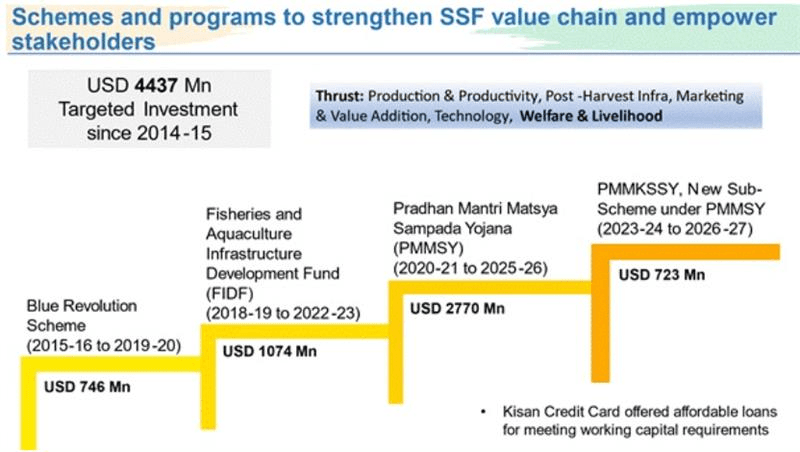
3.India Chairs BOBP-IGO Fisheries Body (Small-Scale Fisheries)

PIB
Illustration for India Chairs BOBP-IGO Fisheries Body (Small-Scale Fisheries)

What & Where

BOBP-IGO, 2003 regional fisheries body, supports Small-Scale Fisheries and Blue Economy in Bay-of-Bengal waters

Littoral scope covers Bangladesh, India, Maldives, Sri Lanka; cooperation Indonesia, Malaysia, Myanmar, Thailand

India assumed 2025 chairmanship, pledging livelihood, sustainability and economic development gains for coastal communities

Quick Facts for MCQs

Legal & Policy

  • Organisation aims collaborative SSF management and conservation among Bay-of-Bengal littorals
  • India emphasises livelihoods, sustainability, economic development of SSF during chairmanship

Economic Angle

  • Fisheries underpin income for 28 million Indians, ranking sector as major rural employer
  • Productivity gains in SSF seen as driver of Blue Economy growth along 13 coastal States/UTs

Social Concerns

  • SSF defined by traditional, low-capital, near-shore fishing trips run by household units
  • Women constitute about half the fisheries workforce, needing gender-responsive interventions

Key Data Points

FeatureData-Point
Founding year2003
Current chair (2025)India
Full membersBangladesh, India, Maldives, Sri Lanka
Cooperating partiesIndonesia, Malaysia, Myanmar, Thailand
India fish production rank2nd globally
India marine capture rank6th globally; ≈33 % of national output
Fisheries workforce India28 million people
Active marine fishermen5 million
Female workforce share~50 %
Indian coastline7,516 km across 13 coastal States/UTs
Indian EEZ area2.20 million sq km

Related UPSC Prelims PYQs

CDS_GK, ESE_GS 2026PYQ 1

Which institution released the report titled “India’s Blue Economy: Strategy for Harnessing Deep-Sea and Offshore Fisheries”?

CDS_GK, ESE_GS 2023PYQ 2

The joint multinational maritime exercise named IBSAMAR is conducted by the Navies of which of the following countries?

GS-1History

4.Soliga, Pardhi and Irula Tribes (Indian Tribes)

Times of India

What & Where

Tribes in focus: Soliga (Karnataka), Pardhi (MP-MH-GJ-AP), Irula (TN-KL-KA)

All three are Scheduled Tribes practicing forest-linked livelihoods and nature-centric faiths

Locations span Western Ghats, Deccan plateau and Eastern Ghats fringe forests

Quick Facts for MCQs

Cultural Elements

  • Soliga worship Vishnu aspect; Pardhi venerate nature deities; Irula combine animism with Hindu motifs
  • Unique art: Irula Ramar Koothu nine-day revival in Attappady
  • Languages Dravidian branch; none have written script tradition

Livelihood & Economy

  • Soliga and Irula rely on honey, tubers, minor forest produce; Pardhi pivoting to handicrafts and farming
  • Ecotourism emerging income for Soliga at BRT reserve
  • Plantation and construction wage work absorbing many Irula youths

Governance & Rights

  • MP surveillance order on Pardhi flagged by activists for human-rights concerns
  • Soliga participation in tiger conservation at BRT praised by Prime Minister
  • Revival workshops funded by Kerala cultural bodies for Irula art form

Social Concerns

  • Pardhi face historical criminal tribe stigma leading to policing bias
  • Irula cultural erosion due to migration and livelihood change
  • All three communities experience poverty despite resource-rich habitats

Key Data Points

FeatureData-Point
Soliga core habitatBRT & Male Mahadeshwara Hills, Karnataka
Soliga languageSholaga, Dravidian family
Soliga deityBiligiri Ranganatha Swamy (Vishnu form)
Soliga livelihoodShifting farming, honey, minor forest produce, ecotourism
Pardhi spreadMaharashtra, Madhya Pradesh, Gujarat, Andhra Pradesh
Pardhi subgroupsVaghri, Phase, Pal, Gav, Takankar, Takari
Pardhi recent issueMP order on search-surveillance of nomadic tribes opposed
Pardhi shiftFrom hunting to agriculture, handicrafts, petty trade
Irula core areasNilgiris-Coimbatore-Dharmapuri (TN); Attappady (KL); Bengaluru Rural-Chikkaballapur (KA)
Irula languageIrula, Dravidian
Irula art formRamar Koothu (Ramayana dance-drama) revival workshop
Irula skillTraditional snake-catching; herbal medicine

Related UPSC Prelims PYQs

GS1 2014PYQ 1

Every year, a month-long ecologically important campaign/festival is held during which certain communities/tribes plant saplings of fruit-bearing trees. Which of the following are such communities/tribes?

GS-1History

5.Jhumoir Binandini Folk Dance (Assam Folk Dance)

Indian Express
Illustration for Jhumoir Binandini Folk Dance (Assam Folk Dance)

What & Where

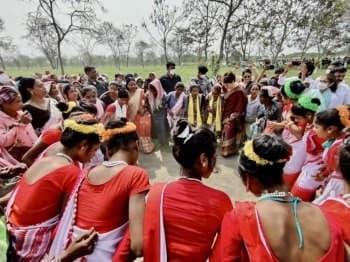
Folk dance Jhumoir (Jhumur) Binandini of Assam’s tea-garden communities

Staged at agricultural festivals and social meets in tea-estate districts of Assam

Originated with 19th-century migrant tea-tribe labourers from Jharkhand-Odisha-Chhattisgarh-Bengal

Quick Facts for MCQs

Performance Elements

  • Circular chorus movement synchronised with percussion-flute ensemble
  • Uniform red-white attire mirrors tea-blossom tones enhancing visual rhythm
  • Multilingual lyrics embody heterogeneous plantation workforce

Socio-Cultural Significance

  • Oral chronicle of tea-tribe struggle and aspiration
  • Strengthens community bonding during plucking-season and harvest festivities
  • Serves gratitude ritual for successful agricultural cycles

Historical Context

  • British-era indenture brought tribes to Assam tea gardens under harsh terms
  • Dance evolved as leisure and cultural preservation amid plantation drudgery
  • Post-Independence recognised as distinct folk heritage of Assam plains

Recent Event

  • 200th year of Assam tea industry marked by mass Jhumoir performance in Guwahati
  • Prime Minister’s participation propelled national visibility of the form
  • Event set record for largest gathering of Jhumoir Binandini dancers

Key Data Points

FeatureData-Point
First appearanceMid-1800s Assam plantations
Core performersWomen dancers; men musicians
Costume highlightRed-white sarees, traditional jewellery
Main instrumentsMadal, dhol, dhak, kartal, flute
Dance formationHand-linked circular moves
Song languagesNagpuri, Khortha, Kurmali, Assamese
Associated tribesSanthal, Munda, Kurukh (Oraon), Kharia
Lyrical themesMigration, labour exploitation, resilience
Cultural functionIdentity symbol and social cohesion
2024 milestoneLargest-ever show in Guwahati attended by PM
GS-1Mapping

6.Ancient Tea Horse Trade Route (Ancient Trade Route)

Indian Express
Illustration for Ancient Tea Horse Trade Route (Ancient Trade Route)

What & Where

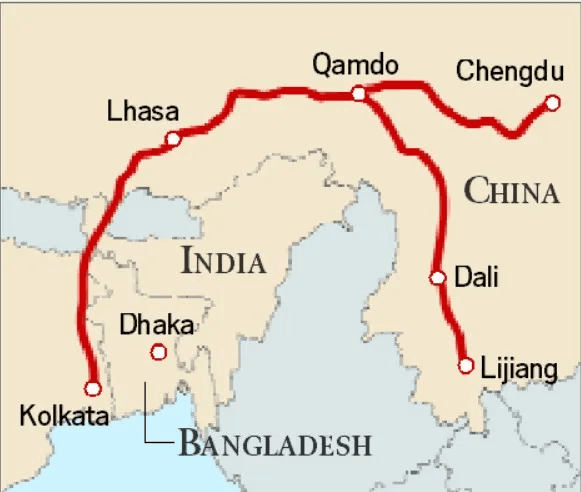
Caravan-network; Tang-era Southern Silk Road linking China-Tibet-India

Route; Yunnan & Sichuan → Lhasa → Nepal → Kalimpong/Kolkata seaports

Main branches; Ya’an–Kangding–Lhasa and Lijiang–Zhongdian–Deqin–Lhasa corridors

Quick Facts for MCQs

Historical Timeline

  • Tang-origin; sugar textiles noodles first cargo
  • Song-reforms; state tea-for-horse bureau standardised exchange
  • Mongol expansion 13th c; cavalry demand boosted route strategic value

Trade Commodity Pattern

  • Outbound China; tea sugar silk rice-noodles later brick-tea monopolised
  • Inbound Tibet; horses gold saffron medicinal herbs yak products

Decline Drivers

  • Qing collapse 1912; political disorder disrupted caravans
  • Motor roads railways post-1949 ended porter mule logistics

Key Data Points

FeatureData-Point
Origin dynastyTang (618-907 CE)
Formalised underSong (960-1279 CE)
Core Chinese hubsLijiang, Dali, Ya’an
Key Tibetan nodeLhasa
Indian end pointsKalimpong, Kolkata
China → Tibet cargoBrick tea (later), sugar, silk
Tibet → China cargoWar horses, gold, saffron
Decline onsetPost-1912 Qing fall + modern roads
GS-3Editorial

7.Environmental Impact of Artificial Intelligence (AI Carbon Footprint)

The Hindu
Illustration for Environmental Impact of Artificial Intelligence (AI Carbon Footprint)

What & Where

Artificial Intelligence: machine-simulated learning, reasoning and decision-making capabilities

AI life-cycle: develop → deploy → maintain models powered by high-performance, energy-hungry data centres

Geography focus: COP29 at Baku flagged greener AI; India’s “AI for India 2030” eyes domestic Large Language Model

Quick Facts for MCQs

Environmental Impact

  • Emissions: generative models need 10–100× power of predecessors raising fossil-based electricity demand
  • Resources: AI chips rely on rare-earth mining; water-intensive cooling strains local supplies
  • Waste: hazardous mercury/lead from obsolete hardware intensifies global e-waste crisis

Tech & Schemes

  • Data-centre features: GPUs-driven HPC, massive cloud storage, high-speed interconnect, liquid or air cooling
  • Google DeepMind wind-forecasting shows AI optimising renewable grids
  • Firms urged to use pre-trained, smaller domain models to cut energy 100–1000×

Legal & Policy

  • COP29 ITU call for greener AI practices adopted by 190 countries via UNESCO ethics recommendation
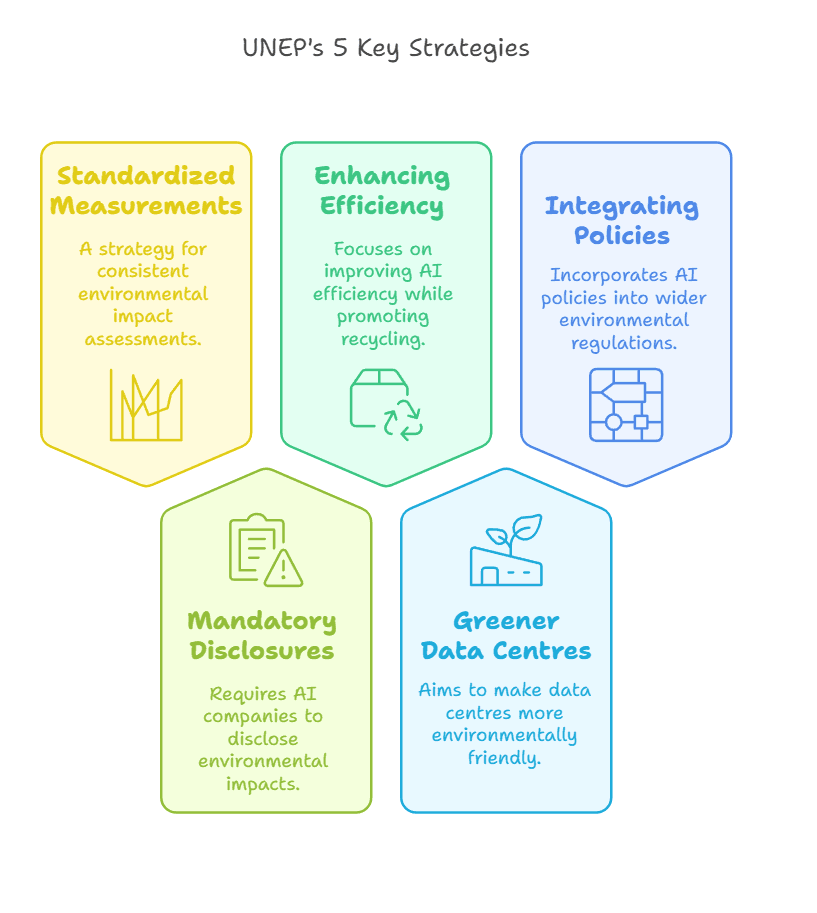
  • EU AI Act and US Environmental Impacts Act mandate carbon footprint reporting and sustainable design
  • UN AI Action Summit 2025 pushed smart-grid integration and low-energy algorithms

Mitigation Measures

  • Renewable siting: place data centres in solar or wind rich zones; buy carbon credits for residuals
  • Hardware optimisation: specialised chips, algorithm pruning, energy-efficient cloud regions reduce load
  • Transparency: global standard metrics for tracking AI-related emissions ensure accountability

Key Data Points

FeatureData-Point
Global AI market valueUSD 200 billion (2024)
Potential GDP boostUSD 15.7 trillion by 2030
Data-centre GHG share1 % now; expected 2 % by 2026
CO₂ for one LLM training≈ 3 lakh kg (≈5 cars’ lifetime)
Power per LLM query2.9 Wh vs 0.3 Wh regular search
Projected AI e-waste5 million t by 2030
India national planAI for India 2030 initiative
Key EU statuteEU AI Act 2024
First US green-AI billAI Environmental Impacts Act 2024

Related UPSC Prelims PYQs

GS1 2025PYQ 1

ग्रैण्ड पैलै (Grand Palais) पेरिस में नवम्बर 2025 में आयोजित होने वाले AI शिखर सम्मेलन के सन्दर्भ में, निम्नलिखित कथनों पर विचार कीजिए :

GS1 2025PYQ 2

विश्व बैंक ने यह चेतावनी दी है कि भारत वह पहला देश बन सकता है जहाँ आर्टिफ़िशियल इंटेलिजेंस-आधारित ऑटोमेशन (डेटा-ड्रिवन ऑटोमेशन) के कारण 35% से अधिक नौकरियाँ प्रभावित होंगी। निम्नलिखित कथनों पर विचार कीजिए:

GS-3Environment

8.Ethiopia’s Mount Fentale Methane Emission (Volcanic Methane)

IDR
Illustration for Ethiopia’s Mount Fentale Methane Emission (Volcanic Methane)

What & Where

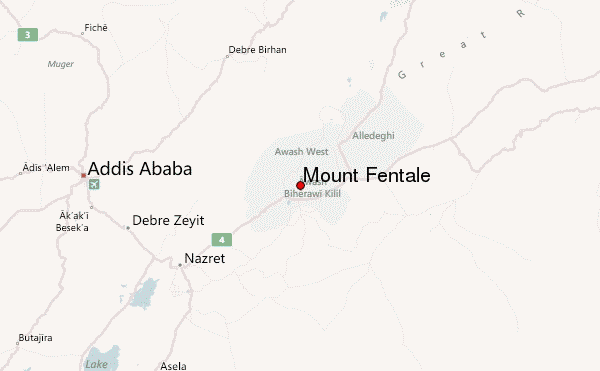
Mount Fentale, northern Ethiopia, suddenly vented vast methane plumes from Jan 31 2025

Event dubbed “volcanic burp”; gas escaped via magma-opened underground pockets, not surface eruption

First flagged by satellite instruments, later validated by private operator GHGSat

Quick Facts for MCQs

Geological Insight

  • Magma-induced fracturing created escape pathways for trapped methane, bypassing explosive eruption
  • Absence of SO₂ plume indicates deep, sealed conduit rather than fresh lava at surface

Climate Impact

  • Short-term methane spike multiplies radiative forcing, elevating near-term warming risk
  • Natural event highlights need to include episodic geologic CH₄ in carbon budgeting models

Monitoring & Tech

  • High-resolution GHGSat overpass quantified plume size, demonstrating commercial satellites’ growing role in GHG surveillance
  • Incident urges integration of thermal anomaly data with gas spectroscopy for rapid volcanic gas alerts

Key Data Points

FeatureData-Point
CountryEthiopia
RegionNorthern Rift Valley
Volcano typeMount Fentale (dormant)
Event start31 Jan 2025
Main gas emittedMethane (CH₄)
Usual volcanic gasesCO₂, SO₂
Methane GWP vs CO₂ (100 yr)28 ×
Methane share of global GHGs≈ 11 %
Detection toolsSatellite thermal & gas sensors
Confirmation agencyGHGSat
Thermal anomaly timingEarly Jan 2025
Probable triggerMagma movement opening deep gas pockets
GS-3Environment

9.Toxicity of Black Plastic Products (Plastic Toxicity)

Indian Express

What & Where

Definition: Black plastic from recycled e-waste, coloured with carbon pigment, difficult to identify in recycling streams

Process: Shredded PP, PS, PE re-melted, carrying legacy brominated flame retardants and heavy-metal residues

Use-sites: Utensils, take-away containers, electronics housings, auto interiors across global consumer markets

Quick Facts for MCQs

Composition & Additives

  • Bromine, BDE-209, other PBDEs persist from original electronic casings
  • Heavy-metal stabilisers accompany polymer melt, surviving multiple recycling loops
  • Additives seldom disclosed, hampering consumer safety assessments

Health Risks

  • Leaching risk increases with high temperature, fatty foods, prolonged contact
  • Chronic exposure linked to neurotoxicity, endocrine disruption, cancer pathways
  • Scientific consensus: Long-term low-dose effects still poorly quantified

Environmental Impact

  • Infrared sorting failure leaves black plastic in mixed waste or incinerators
  • Non-biodegradable fragments pollute soil, water; additive release continues post-disposal
  • Policy momentum towards colour bans and safer feedstock segregation

Manufacturing Challenges

  • Mixed e-waste inputs obscure material provenance, complicating compliance audits
  • Meeting food-contact or RoHS norms requires costly testing or additive removal
  • Industry exploring alternative pigments, clear polymers, chemical-recycling routes

Key Data Points

FeatureData-Point
Primary polymersPolypropylene, Polystyrene, Polyethylene
Key flame retardantDecabromodiphenyl ether (BDE-209)
Halogen markerBromine detected in many samples
Heavy metalsLead, Mercury, Cadmium traces
Major feedstockDiscarded TVs, computers, appliances
Sorting issueCarbon black absorbs NIR, thwarts optical recyclers
Leaching triggerHeat from cooking/microwaving
Recycling success rateSignificantly lower than coloured/clear plastics
Human hazard classNeurotoxic and potentially carcinogenic compounds
Regulatory trendMany brominated additives restricted or banned
GS-3Environment

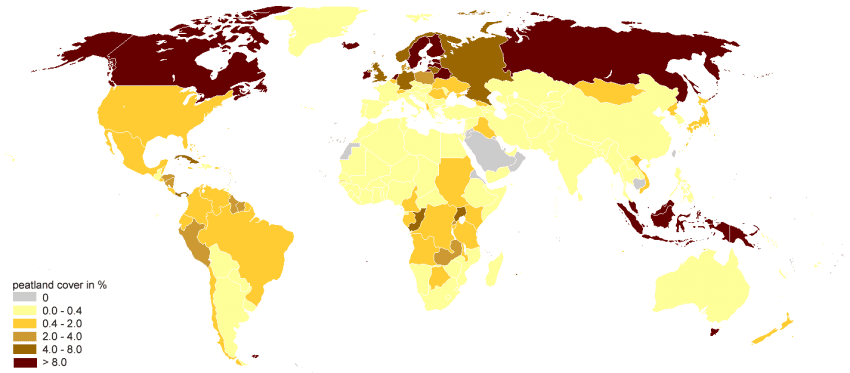
10.Global Peatland Conservation Gaps (Peatland Protection)

Down to Earth
Illustration for Global Peatland Conservation Gaps (Peatland Protection)

What & Where

Definition: Waterlogged terrestrial wetlands accumulating peat soil and acting as planet’s largest land carbon store

Types: Northern–temperate bogs and fens versus tropical peat-swamp forests adjoining rainforests and mangroves

Geography: 4.23 mn km² worldwide, 70 % located in Canada Russia Indonesia USA Brazil

Quick Facts for MCQs

Protection Gap

  • Coverage: Only 17 % legally safeguarded vs mangroves 42 % saltmarshes 50 %
  • Enforcement: Weak laws bureaucratic delay competing land claims stall restoration
  • Indigenous: 27 % on tribal lands yet 85 % lack formal protection

Ecological Significance

  • Carbon: Stores 600 Gt crucial for climate mitigation
  • Water: Natural sponge moderating floods droughts seawater intrusion
  • Biodiversity: Supports Bornean orangutan retains archaeological pollen records

Threat Drivers

  • Drainage: Palm oil rice forestry urban expansion accelerate peat loss
  • Climate: Warming and drought boost wildfire frequency CO₂ emissions
  • Finance: Short term profits limited funds impede conservation

Policy Pathways

  • Protect: Ban new drainage promote sustainable peat harvesting
  • Restore: Rewet degraded areas enhance long term carbon sink
  • Integrate: Embed peat targets in NDCs adopt global peatland definition

Key Data Points

FeatureData-Point
Global cover4.23 million km² (2.84 % land)
Carbon stock~600 Gt, more than all forests
Legal protection share17 % peatlands protected
High human pressure22 % area, mainly Europe & USA
Indigenous lands share27 % peatlands; 85 % unprotected
Unfrozen freshwaterHolds 10 % of global supply
Comparative protectionMangroves 42 %, Saltmarshes 50 %, Tropical forests 38 %
GHG emission share when degraded2–5 % of annual anthropogenic total

Related UPSC Prelims PYQs

GS1 2024PYQ 1

One of the following regions has the world’s largest tropical peatland, which holds about three years worth of global carbon emissions from fossil fuels; and the possible destruction of which can exert detrimental effect on the global climate. Which one of the following denotes that region?

GS-3Species

11.Gharial Conservation in Chambal (Endangered Species)

Indian Express
Illustration for Gharial Conservation in Chambal (Endangered Species)

What & Where

Gharial = critically endangered, fish-eating crocodilian (Gavialis gangeticus) with bulbous-tipped male snout.

10 captive-reared gharials released into Chambal River inside National Chambal Sanctuary, Madhya Pradesh.

MP now shelters > 80 % of India’s gharial population; largest wild group on Chambal stretch.

Quick Facts for MCQs

Legal & Policy

  • Schedule I tag ensures highest Indian legal protection, offences invite maximum penalties.
  • Critically Endangered status prioritises funding under Centrally Sponsored Project Crocodile.
  • Sanctuary declared eco-sensitive zone, restricts polluting industries within buffer.

Conservation Measures

  • Captive rearing centres raise hatchlings to safer size before river release.
  • Sandbank restoration programmes recreate nesting habitat lost to mining and embankments.
  • Local community eco-guides employed, incentivising anti-poaching vigilance.

Threats

  • Habitat loss via dams, irrigation canals, intensive sand mining erodes nesting sites.
  • Gill-net bycatch causes high juvenile and adult mortality.
  • River pollution from industrial effluents and pesticides weakens prey base.

Key Data Points

FeatureData-Point
IUCN listingCritically Endangered
Wildlife Protection Act slotSchedule I
Prime river strongholdChambal (MP-UP-Rajasthan)
Other Indian riversGanga, Yamuna, Son, Gandak, Mahanadi, Brahmaputra
Male length ceiling≈ 6 m
Female length range2.6 – 4.5 m
Peak mating monthsNovember – January
Nesting substrateExposed sandbanks & islands
National Chambal Sanctuary reach435 km
Captive-release start year1975

Related UPSC Prelims PYQs

GS1 2017PYQ 1

If you want to see gharials in their natural habitat, which one of the following is the best place to visit?

GS1 2013PYQ 2

Consider the following fauna of India:

GS-3EnvironmentQuick Bite

12.PRAKRITI 2025 Carbon Market Dialogue (Carbon Markets)

PIB

What & Where

PRAKRITI 2025 – International Conference on Carbon Markets hosted in India by Bureau of Energy Efficiency.

Carbon markets – Article 6 Paris Agreement systems enabling trade of carbon credits to offset greenhouse-gas emissions.

EU CBAM – Carbon Border Adjustment Mechanism levying EU-equivalent carbon price on imported steel and other high-emission goods.

Quick Facts for MCQs

Legal & Policy

  • CBAM compliance urgency for Indian steel, aluminium, cement exporters.
  • Domestic carbon market reforms highlighted to cushion EU levy impacts.
  • Paris Agreement Article 6 enables international transfer of mitigation outcomes.

Tech & Schemes

  • Perform Achieve & Trade (PAT) links efficiency targets to tradable energy-saving certificates.
  • Clean Development Mechanism projects generate Certified Emission Reductions sellable in global markets.

Institutional Framework

  • BEE drafts energy-efficiency policies, coordinates stakeholders, promotes voluntary self-regulation.
  • Operates National Carbon Market platform, monitors trading compliance.

Key Data Points

FeatureData-Point
Organiser of PRAKRITI 2025Bureau of Energy Efficiency (Ministry of Power)
India’s CDM project rank2nd globally
PAT scheme emission cut106 million t CO₂ saved since 2015
BEE establishment year2002 (Energy Conservation Act 2001)
Article governing carbon tradeArticle 6, Paris Agreement
EU CBAM intentImport carbon-price parity with EU goods

Related UPSC Prelims PYQs

CAPF_GAI, GS1 2024PYQ 1

CBAM (कार्बन बॉर्डर एडजस्टमेंट मेकेनिज़्म) के संबंध में निम्नलिखित में से कौन-सा/कौन-से कथन सही है/हैं?

CAPF_GAI, GS1 2009PYQ 2

In the context of CO₂ emission and Global Warming, what is the name of a market-driven device under the UNFCCC that allows developing countries to get funds/incentives from the developed countries to adopt better technologies that reduce greenhouse gas emissions ?

GS-3S&T

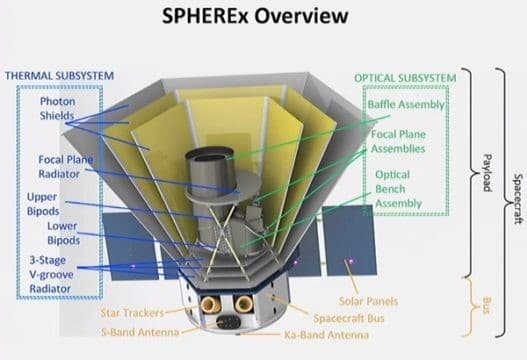
13.NASA SPHEREx Space Telescope (SPHEREx Telescope)

DD News
Illustration for NASA SPHEREx Space Telescope (SPHEREx Telescope)

What & Where

SPHEREx: NASA low-Earth, Sun-synchronous space telescope surveying optical–near-IR sky.

Builds 3-D map to test cosmic inflation & trace galaxy formation.

Also hunts water + organic ices inside Milky Way star-forming regions.

Quick Facts for MCQs

Science Objectives

  • Inflation probe; measures large-scale clustering to constrain Big-Bang expansion models.
  • Galaxy evolution mapping across redshifts; star-formation history statistics.
  • Astro-chemistry survey for H₂O, CH₃OH, CO₂ ices in protostars, disks.

Technology & Instruments

  • 20 cm telescope with linear-variable filters; passive 90 K cryogenic system.
  • Near-IR detectors yield 1 TB/day; 6-arcsec pixels at 0.75–5 µm.
  • Data pipeline produces calibrated spectra for community within 18 months.

Launch & Operations

  • Planned liftoff 2025, Vandenberg SLC-4E rideshare.
  • 90-min orbit enables continuous scanning; two full-sky maps per year.
  • JPL mission ops; Caltech/IPAC public archive; JWST follow-up target list.

International Collaboration

  • KASI supplies cryocooler electronics & science analysis; other partners span Europe, Israel, Canada.
  • Global science team > 200 researchers encourages open-data policy.

Key Data Points

FeatureData-Point
Full formSpectro-Photometer for the History of the Universe, Epoch of Reionization & Ices Explorer
Launch agencyNASA
Launch vehicleSpaceX Falcon 9
Mission duration2 years (baseline)
Spectral bands102 (0.75–5 µm)
Sky coverageEntire sky every 6 months
Galaxy census≈ 450 million
OrbitSun-synchronous LEO (~600 km)
Key targetsWater ice, organic molecules
Intl partnerKorea Astronomy & Space Science Institute
GS-3Security

14.INS Tamal Stealth Frigate (Stealth Frigate)

The Hindu
Illustration for INS Tamal Stealth Frigate (Stealth Frigate)

What & Where

INS Tamal: stealth guided-missile frigate of Project 11356 for Indian Navy

Constructed at Yantar Shipyard, Kaliningrad, Russia; delivery to India in 2025

Last foreign-built warship before complete switch to indigenous naval construction

Quick Facts for MCQs

Tech & Schemes

  • Stealth: Hull shaping and materials cut radar cross-section
  • Weaponry: Ship carries advanced missile suites plus 100 mm naval gun
  • Integration: Russian sensors blended with Indian communication and CMS for efficiency

Security Dimension

  • Deterrence: Adds credible sea denial in Indian Ocean Region
  • Readiness: Complements P-8I, SSBN fleet for layered maritime security
  • Transition: Marks capability leap as indigenous warships follow

International Collaboration

  • Partnership: Deal reinforces longstanding India–Russia defence cooperation
  • Training: Russian experts schooling Indian crew for smooth takeover
  • Transfer: Project enables technology absorption for domestic follow-on frigates

Key Data Points

FeatureData-Point
Vessel nameINS Tamal
Class / ProjectProject 11356 frigate
BuilderYantar Shipyard, Russia
Deal value & year$2.5 bn, 2016
Expected commissioningJune 2025
Sister shipINS Tushil, commissioned Dec 2024
Primary roleStealth, guided-missile operations
Import statusFinal overseas-built Indian warship

Related UPSC Prelims PYQs

CDS_GK, GS1 2024PYQ 1

Which one of the following statements about 'INS Tarmugli' is not correct?

CDS_GK, GS1 2004PYQ 2

INS Trishul acquired by the Indian Navy in 2003 has been built by

GS-2Scheme

15.SWAYATT Inclusive Procurement Initiative (Public Procurement Inclusion)

PIB

What & Where

Definition: SWAYATT is GeM initiative integrating startups, women & youth into public procurement

Process: Digital e-transactions enable direct seller-buyer linkage, bypass intermediaries, encourage competitive bidding

Geography: Nationwide scheme under Commerce & Industry Ministry, open to all Central, State, PSU procurers

Quick Facts for MCQs

Tech & Schemes

  • Storefronts: Startup Runway, Womaniya provide focused listings for eligible sellers
  • Verification: Udyam linkage auto-validates MSE, woman ownership, easing onboarding
  • Transactions: GeM ensures paperless procurement, transparent bidding, timely payments

Social Inclusion

  • Target: Initiative favours women entrepreneurs, youth, SHGs, backward districts
  • Impact: Women now form 8 % of GeM seller base
  • Objective: Inclusive procurement backs Vocal for Local, Atmanirbhar vision

Economic Angle

  • Orders: Women MSEs ₹46,615 cr; startups ₹35,950 cr cumulative
  • Jobs: Hyper-local procurement stimulates youth employment, production clusters
  • Growth: Direct market access cuts marketing costs, raises MSME margins

Capacity-Building

  • Training: GeM conducts virtual, field sessions on bidding, invoicing
  • Collaboration: FICCI-FLO MoU upskills 9,500 + women entrepreneurs
  • Outreach: Regular SWAYATT events link buyers, sellers nationwide

Key Data Points

FeatureData-Point
Launch date19 Feb 2019
Full formStartups, Women & Youth Advantage Through e-Transactions
Implementing ministryCommerce & Industry
Platform hostGovernment e-Marketplace
Women sellers share8 % of total sellers
Women-led MSE order value₹46,615 crore
Startup order value₹35,950 crore
Registered startups29,000 +
Dedicated storefrontsStartup Runway; Womaniya
MoU partnerFICCI-FLO (9,500 + women)
Years completed6 (2024)

Related UPSC Prelims PYQs

GS1 2016PYQ 1

'SWAYAM', an initiative of the Government of India, aims at

GS-1MiscQuick Bite

16.Regional Dialogue on Social Justice (Social Justice Dialogue)

PIB

What & Where

Regional Dialogue on Social Justice, New Delhi, Feb 2025; first under ILO’s Global Coalition for Social Justice.

Global Coalition: 2023 ILO launch; voluntary, multi-stakeholder, SDG-oriented platform; India member.

Employees’ State Insurance Corporation (ESIC): statutory insurer since 24 Feb 1952; covers organised-sector workers.

Quick Facts for MCQs

Legal & Policy

  • Article 38: State to reduce social, economic inequalities for welfare.
  • Articles 23–24: prohibit trafficking, forced labour, hazardous child labour.
  • Article 39A: free legal aid; Article 46: promote SC/ST & weaker sections.

Tech & Schemes

  • ESIC financed by employer-employee contributions, administered by Labour & Employment Ministry.
  • Hazardous units (firecrackers, toxic chemicals) covered even with <10 workers.
  • Benefits include cash sickness (26 weeks), maternity (26 weeks), lifelong medical for disabled.

Social Metrics

  • ILO coalition targets inclusive, sustainable growth via policy coherence and solidarity.
  • India’s social-protection jump reflects expanded schemes like e-Shram, PM-Shram Yogi Maan-dhan.
  • Rising employability signals skill-development push under programs such as PM-KVY.

Key Data Points

FeatureData-Point
Coalition launch year2023
Convening bodyInternational Labour Organization
Membership natureVoluntary, open to govts/NGOs/business/academia
First Regional Dialogue venueNew Delhi
ESIC foundation date24 Feb 1952
ESIC parent ActEmployees’ State Insurance Act 1948
Salary eligibility ceiling₹21,000 / month
Establishment size norm≥10 employees (any size if hazardous)
Key ESIC benefitsMedical, sickness, maternity, disability, dependants, unemployment
India social-protection (non-health)24.4 % (2021) → 48.8 % (2024)
Graduate employability33.95 % (2013) → 54.81 % (2024)
GS-1Misc

17.Time Use Survey 2024 Findings (Time Use Survey)

PIB

What & Where

Time Use Survey (TUS): MoSPI quinquennial study tracking daily time allocation across activities.

Scope: All Indian states/UTs; population aged 6 years and above.

Objective: Quantify paid work, unpaid care, learning, leisure for evidence-based gender and labour policy.

Quick Facts for MCQs

Gender Gap

  • Disparity: Women still devote 201 extra minutes to domestic chores despite higher workforce entry.
  • Employment: Women work 132 minutes fewer than men even when employed.
  • Careload: Only 4 % men primary caregivers, reinforcing unequal burden.

Learning & Leisure

  • Education: Learning time fell by ~10 minutes for both sexes since 2019.
  • Leisure: Culture/mass-media activities now consume 11 % daily schedule, signalling better work–life balance.
  • Socialising: Female time static at 139 min; male time dipped to 138 min.

Policy Implications

  • Need: Flexible jobs, childcare, skill schemes to lift female labour share.
  • Awareness: Campaigns promoting equal household division can cut domestic time gap.
  • Rural focus: Enhance self-employment programs to narrow rural–urban activity differentials.

Key Data Points

FeatureData-Point
Survey round2024 (previous 2019)
Women (15-59 yr) in paid work25 % (↑ from 21.8 %)
Men vs women paid-work minutes473 vs 341 (gap 132 min)
Women unpaid domestic minutes289 (men 88)
Women caregiving participation41 % (men 21.4 %)
Avg caregiving minutesWomen 137, men 75
Children 6-14 in learning89.3 %; 413 min/day
Leisure, culture, sports share11 % of day (↑ from 9.9 %)
Self-care minutes (age 6+)Women 706; men 710

Ready to practice?

Test your knowledge with our UPSC test series.

Start Free Trial