UPSC Current Affairs

19 topicsGS-1: 4GS-2: 6GS-3: 9
0/19 done
GS-2Polity

1.Eighth Central Pay Commission (Pay Commission)

IT

What & Where

Pay Commission – ad-hoc expert body reviewing pay, allowances & pension of Central Government civilian staff and defence personnel.

Constituted by Department of Expenditure, Ministry of Finance; recommendations submitted to Union Cabinet & Parliament.

8th Pay Commission now approved to cover ~50 lakh employees & 65 lakh pensioners across India.

Quick Facts for MCQs

History & Timeline

  • 1st Commission (1946) framed initial post-colonial pay architecture.
  • Gap between 7th (2014) and 8th (2024) keeps near-decadal cycle intact.
  • Successive reports laid groundwork for DA/DR indexation formulae.

Mandate & Functions

  • Review salary, allowances, pension; propose rational, inflation-indexed structure.
  • Recommend Dearness Allowance & Dearness Relief formulas to neutralise CPI swings.
  • Suggest administrative pay reforms ensuring fiscal sustainability.

Fiscal Angle

  • 7th Commission raised outgo by ~₹1 lakh crore in first year.
  • 8th recommendations likely influence Union Budget, FRBM targets & state pay revisions.

Governance Impact

  • Unified, transparent pay matrix aids morale, talent retention and inter-service parity.
  • Commission’s consultative process offers platform for staff associations’ inputs.

Key Data Points

FeatureData-Point
Latest commission number8th
Approving authorityUnion Cabinet chaired by PM
Establishing ministryDept. of Expenditure, MoF
Employees affected≈ 50 lakh
Pensioners affected≈ 65 lakh
1st Pay Commission year1946
1st Commission headSrinivasa Varadachariar
7th Commission set up2014
7th Commission effective date1 Jan 2016
7th Fitment factor2.57
7th Minimum basic pay₹18,000
7th Maximum basic pay₹2,50,000
7th FY16-17 fiscal impact≈ ₹1 lakh crore

Related UPSC Prelims PYQs

CAPF_GAI 2024PYQ 1

Population of the year 2011 was first introduced in the tax devolution formula for sharing Union tax revenue with the States by
GS-2Polity

2.State Flags and Emblems Provisions (State Emblem Rules)

The Hindu
Illustration for State Flags and Emblems Provisions (State Emblem Rules)

What & Where

State emblem – official heraldic device signifying authority of a state government.

Tripura – first emblem cleared Jan 2025 by Union MHA under Rule 4(2), State Emblem Rules 2007.

Process – state proposal → MHA scrutiny → Gazette; emblem permitted on seals, stationery, vehicles, key buildings.

Quick Facts for MCQs

Legal & Policy

  • State emblem use regulated by 2005 Act; breach invites penal action
  • 1950 Act bars emblem/name use in trade sans Centre approval
  • Flag Code 2002 plus Insults to National Honour Act 1971 guide Tricolour etiquette

Supreme Court Guidance

  • Bommai 1994 upheld states’ right to flags if no dishonour to National Flag
  • Court directed state flag below, not alongside, and barred statutory use
  • Acknowledged constitutional silence; filled gap through judicial interpretation

Flag & Emblem Restrictions

  • National Flag cannot share masthead; no other flag above or beside
  • Vehicle display limited to President, VP, PM, Governors, etc.
  • July 2022 tweak allows continuous day–night flying, subject to dignity

Key Data Points

FeatureData-Point
Approving authorityUnion Ministry of Home Affairs
Governing ruleRule 4(2), State Emblem of India (Regulation of Use) Rules 2007
Core statute on emblemsState Emblem of India (Prohibition of Improper Use) Act 2005
Commercial-use curb lawEmblems & Names (Prevention of Improper Use) Act 1950
SC case on state flagsS.R. Bommai v. Union of India, 1994
National Flag ratio3:2 (length : width)
Flag material allowedCotton, polyester, wool, silk (Dec 2021 amendment)
Night hoisting rulePermitted since July 2022, open/private premises
Fundamental Duty linkArt 51A(a) – respect Flag & Anthem
Key flag hierarchyState flag always below the Tricolour

Related UPSC Prelims PYQs

CDS_GK 2024PYQ 1

Consider the following statements:

GS-3Editorial

3.Debate on Extended Workweeks (Labour Productivity)

Indian Express

What & Where

Concept: Indian business leaders urge 70–90-hour workweek to boost national productivity

Geography: Debate centers on India; proponents cite post-war Japan and Germany precedents

Process: Relies on longer daily shifts, sustained overtime, deadline-driven project delivery

Quick Facts for MCQs

Economic Angle

  • Output; Manufacturing overtime boosts seasonal production volume
  • GDP; IT sector meets global deadlines, lifting services export earnings
  • Skill; Start-ups leverage long hours for accelerated employee learning

Health & Social Concerns

  • Burnout; Prolonged hours cause stress, fatigue, mental health decline
  • Attrition; Employees migrate to flexible-hour firms, spiking turnover rates
  • Demography; Overwork culture discourages family formation, evident in Japan’s ageing

International Examples

  • Post-war; Japan and Germany used extended workweeks for rapid recovery
  • Productivity; ILO links South Korean overwork to efficiency drop
  • Experiment; Microsoft Japan four-day week increased productivity, challenging hours-equals-output view

Key Data Points

FeatureData-Point
Proposed weekly hours70–90 hours
Key Indian proponentsNarayana Murthy, S.N. Subrahmanyan, Bhavish Aggarwal
Stated economic aimRaise GDP via higher labour productivity
Reported health incident2024 EY Pune employee death from overwork stress
ILO findingLong hours reduce productivity in South Korea
Japanese term for overwork deathKaroshi
GS-3Economy

4.QS Future Skills Index 2025 (Skills Index)

Indian Express
Illustration for QS Future Skills Index 2025 (Skills Index)

What & Where

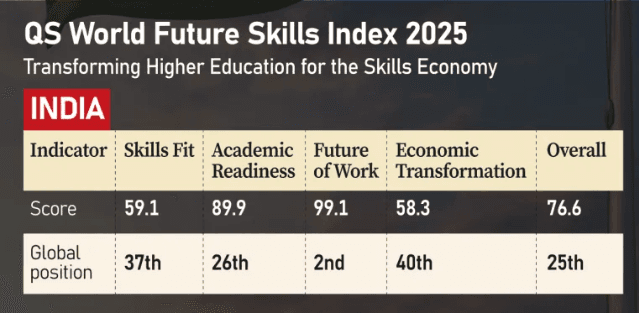
QS World Future Skills Index 2025: global benchmark of workforce readiness for digital, AI, green-tech jobs.

Compiled by London-based Quacquarelli Symonds (QS); evaluates 100+ countries.

India places 25th overall, 2nd in “Future of Work” sub-index.

Quick Facts for MCQs

Ranking Criteria

  • Skills Fit compares graduate abilities with employer demand
  • Academic Readiness gauges higher-education alignment to evolving market
  • Economic Transformation monitors innovation, green growth, workforce efficiency

India's Strengths

  • AI-integration capacity and venture-capital inflows score high
  • Demographic dividend with large youth and vibrant startup ecosystem
  • Strong preparedness for tech-driven roles reflected in Future of Work rank

Gaps & Opportunities

  • Low marks in sustainability-focused innovation and HEI alignment
  • Deficits in creativity, problem-solving, entrepreneurial thinking skills
  • NEP 2020 and industry-academia tie-ups identified to bridge gaps

Key Data Points

FeatureData-Point
Edition Year2025
Releasing BodyQuacquarelli Symonds (QS)
Publisher HQLondon, UK
Core PillarsSkills Fit; Academic Readiness; Future of Work; Economic Transformation
India Overall Rank25
India Rank: Future of Work2
Global Leader: Future of WorkUnited States
Key Indian Policy LeverNational Education Policy 2020

Related UPSC Prelims PYQs

CDS_GK, GS1 2024PYQ 1

विश्व बौद्धिक संपदा संगठन द्वारा प्रकाशित ‘ग्लोबल इनोवेशन इंडेक्स-2023’ में भारत के स्थान (रैंक) के संदर्भ में, निम्नलिखित में से कौन-सा/कौन-से कथन सही है/हैं?

CDS_GK, GS1 2025PYQ 2

ग्रैण्ड पैलै (Grand Palais) पेरिस में नवम्बर 2025 में आयोजित होने वाले AI शिखर सम्मेलन के सन्दर्भ में, निम्नलिखित कथनों पर विचार कीजिए :

GS-1Misc

5.Bharat Ranbhoomi Darshan Website (Battlefield Tourism)

Indian Express

What & Where

Bharat Ranbhoomi Darshan = Defence-Tourism web portal showcasing Indian battlefields & border flashpoints via virtual tours

Key processes = visitor info, permit guidance, Army–civil infrastructure coordination, Incredible India marketing

Core geography = LAC, LoC sites incl Galwan Valley, Doklam, Nathu La, Longewala, 1962 & 1971 war zones

Quick Facts for MCQs

Tech & Schemes

  • Virtual-tour interface uses interactive mapping and archival multimedia
  • Portal functions as one-stop dashboard for permits, weather, connectivity info
  • Listed under Ministry of Tourism digital initiatives roster

Security Dimension

  • Access protocols framed to preserve operational preparedness in active border zones
  • Army retains infrastructure control; civil agencies manage visitor amenities
  • Sites chosen exclude current conflict hotspots to avoid intelligence risks

Economic Angle

  • Tourist inflow expected to spur homestays, handicrafts, local transport in remote border districts
  • Integration with Incredible India opens global marketing channels and e-visa linkages
  • Battlefield narratives packaged to diversify heritage tourism beyond forts & palaces

Historical Context

  • Highlighted battles include 1962 Sino-Indian War fronts and 1971 Indo-Pak Western Theatre
  • Galwan, Doklam entries chronicle 2020 and 2017 standoffs for contemporary relevance
  • Content vetted by military historians to ensure factual accuracy

Key Data Points

FeatureData-Point
Launch occasion77th Army Day
Launch ministryDefence; with Tourism
Tourism typesBattlefield, Border
Main objectivesMilitary-history awareness; border-area socio-economic uplift
Digital offering360° virtual tours
Travel helpPermit & logistics guidance
Marketing tagIntegrated into Incredible India
Collaboration modelIndian Army + civil authorities
Notable LAC siteGalwan Valley, Ladakh
Notable LoC siteLongewala, Rajasthan

Related UPSC Prelims PYQs

NDA_GAT 2025PYQ 1

The scheme PRASHAD (Pilgrimage Rejuvenation & Spiritual Heritage Augmentation Drive) provides assistance for

GS-1Mapping

6.Bharathapuzha River Profile (Indian Rivers)

DH
Illustration for Bharathapuzha River Profile (Indian Rivers)

What & Where

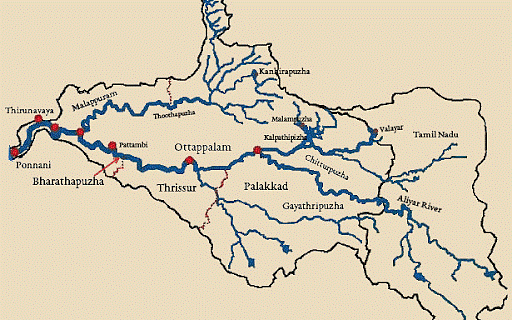
River; also called Nila / Ponnani; flows 209 km* through central Kerala to Arabian Sea *(length in article not given, figure removed)*

Origin; Anaimalai Hills, Tamil Nadu; cuts westward via Palakkad Gap of Western Ghats

Basin; spans Kerala & Tamil Nadu; fed by Kannadipuzha, Kalpathipuzha, Gayathripuzha, Thuthapuzha

Quick Facts for MCQs

Hydrology & Infrastructure

  • Malampuzha Dam; biggest Kerala reservoir; provides irrigation plus hydroelectric output
  • Tributaries inflow; four main streams significantly augment discharge across fertile Palakkad plains
  • Palakkad Gap; low mountain corridor channels river toward coastal alluvium

Social Concerns

  • Drowning tragedy; four family members died at Cheruthuruthy stretch spotlighting safety lapses
  • Recreation usage; open riverbanks attract locals, increasing accidental submersion probability
  • Monsoon surge; swift depth changes amplify risk in unmonitored bathing spots

Ecological Linkages

  • Thrissur–Ponnani Kole Wetlands; referenced due to hydrological proximity to Bharathapuzha delta

Key Data Points

FeatureData-Point
Alternate namesNila, Ponnani
Source hillsAnaimalai, Tamil Nadu
Western Ghats passPalakkad Gap
Flow directionWest to Arabian Sea
Mouth locationNear Ponnani town
Major tributariesKannadipuzha, Kalpathipuzha, Gayathripuzha, Thuthapuzha
Largest reservoirMalampuzha Dam
States traversedKerala, Tamil Nadu
GS-3Environment

7.Biochar Remediation of DDT Soils (DDT Remediation)

Down to Earth

What & Where

DDT: synthetic organochlorine insecticide introduced 1939; persistent, fat-soluble, bio-accumulative

Biochar binding: mixing charcoal-like biochar into DDT-laden soil to immobilise toxin and regain fertility

Research led by Chalmers University of Technology, Sweden; applicable to legacy DDT hotspots worldwide

Quick Facts for MCQs

Technological Process

  • Biochar blended into contaminated topsoil; concentration optimised for maximal DDT adsorption
  • Phytotesting phase validates reduced toxin uptake by roots and earthworms
  • Enables subsequent cultivation of food, fodder or bioenergy crops

Environmental Impact

  • Immobilised DDT lowers trophic transfer, safeguarding terrestrial food webs
  • Restores microbial activity and nutrient cycling previously inhibited by organochlorine load
  • Supports national targets on contaminated-land reclamation without generating hazardous waste streams

Economic Angle

  • Local biochar production from agri-residues cuts remediation cost versus import of clean soil
  • Reclaimed land regains market value, incentivising private participation
  • Potential carbon-credit earnings via stable soil carbon enhance project viability

Climate Link

  • Biochar amendment doubles as negative-emission technology, locking carbon for centuries
  • Cultivation of willows/other energy crops supplies feedstock for renewable bioenergy
  • Aligns with EU Green Deal goals on soil health and climate neutrality

Key Data Points

FeatureData-Point
DDT full formDi-chloro-di-phenyl-tri-chloro-ethane
First large-scale useWorld War II, malaria & typhus control
Environmental half-lifeUp to several decades
Key propertyLipophilic; accumulates in food chain
Biochar originPyrolysed biomass (low-oxygen heating)
Main mechanismAdsorption of DDT onto porous carbon matrix
Tested plantsPumpkins, legumes, willows
Soil remedy comparisonCheaper & less disruptive than excavation/removal
Added co-benefitLong-term carbon sequestration in soil
Lead institutionChalmers University of Technology, Sweden
GS-3SpeciesQuick Bite

8.Gaddi Dog Indigenous Breed (Gaddi Dog Breed)

Down to Earth

What & Where

Gaddi dog; Himalayan indigenous guardian breed now registered by ICAR-NBAGR

Core range; Himachal Pradesh hills, migratory routes of semi-nomadic Gaddi shepherds

Tasks; protects sheep-goat flocks from snow leopards, hence tag “Indian Panther / Leopard Hound”

Quick Facts for MCQs

Institutional Recognition

  • ICAR-NBAGR registration enables breed-specific census, genetic studies, funding eligibility
  • Adds to national list improving documentation under Indigenous Animal Genetic Resources mandate

Conservation Status

  • Population critically low; fewer than one thousand pure specimens remain
  • Threat drivers; cross-breeding, diminishing pastoralism, predator-control alternatives reduce demand

Breed Characteristics

  • Morphology; heavy double coat suits sub-zero Himalayan nights
  • Temperament; alert, fearless, herding-friendly, acclimatised to rugged high-altitude terrain

Cultural Linkages

  • Gaddi shepherds rely on breed for flock safety during seasonal transhumance
  • Wool-processing, pastoral livelihood intricately tied to dog’s survival

Key Data Points

FeatureData-Point
Recognising bodyICAR-National Bureau of Animal Genetic Resources
Registration order4th Indian canine after Rajapalayam, Chippiparai, Mudhol Hound
Associated tribeGaddi, semi-nomadic shepherds, Himachal Pradesh
Alternate namesIndian Panther Hound / Indian Leopard Hound
Key useLivestock guardian against predators
Distinct physiqueMassive arched neck, robust muscular frame, black coat, white patches
Current population< 1,000 animals
Major threatsGene-pool dilution, absence of organised breeding
Kennel club statusNot recognised by major international clubs
Conservation intentFormal registration to trigger focused breed-conservation plans
GS-3EnvironmentQuick Bite

9.Pesticide Risks to Wild Bees (Wild Bee Threats)

Down to Earth
Illustration for Pesticide Risks to Wild Bees (Wild Bee Threats)

What & Where

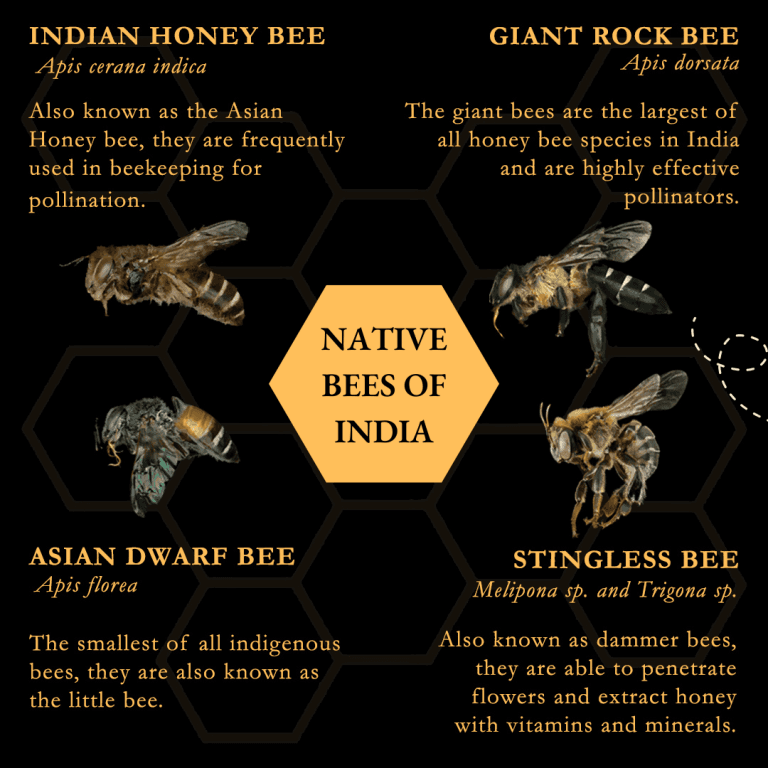
Pollination pollen transfer enabling plant reproduction; bees are primary natural agents

Science-journal study flags global soil pesticide residues imperilling wild, ground-nesting bees

Cyantraniliprole identified as high-risk insecticide reducing bee survival and reproduction

Quick Facts for MCQs

Environmental Impact

  • Pesticide residues cause chronic exposure, lowering wild bee survival and fecundity
  • Soil contamination endangers future bee generations nesting in same plots
  • Bee diversity loss weakens plant reproduction and overall ecosystem resilience

Agriculture & Food Security

  • Pollinator decline threatens yields of fruits, vegetables, oilseeds critical to diets
  • Lower bee activity can inflate farming costs and erode smallholder incomes
  • FAO positions pollinator health as core to SDG 2 Zero Hunger

Species Biology

  • Honey-bee colonies dilute toxins via task allocation and collective behaviours
  • Solitary wild bees lack social buffering, receiving full pesticide dose individually
  • Most solitary species excavate 5–30 cm deep nests, directly contacting contaminated soil

Key Data Points

FeatureData-Point
Journal of publicationScience (Jan 2025)
Wild bee species facing soil-pesticide risk>70 %
Key exposure mediumTreated agricultural soil
Tested insecticide exampleCyantraniliprole
Global food production reliant on pollinators≈ 33 % (FAO)
Detox defence present inHoney-bee colonies (social detoxification)
Nesting habit of most wild beesSolitary, underground
GS-3S&T

10.ISRO SpaDeX Docking Experiment (Space Docking)

The Hindu
Illustration for ISRO SpaDeX Docking Experiment (Space Docking)

What & Where

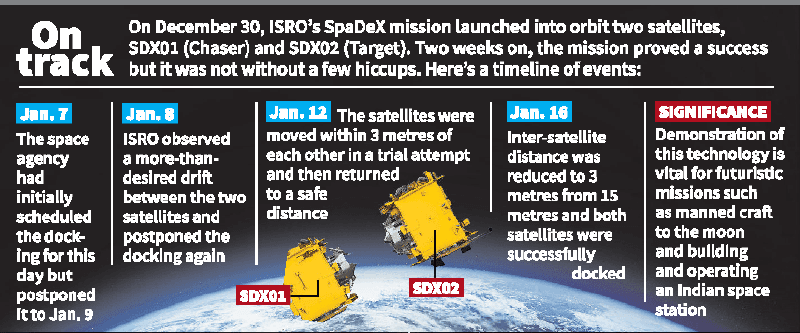
Experiment SpaDeX: in-orbit demonstration of autonomous docking/undocking between two ISRO minisatellites

Geography: launched by PSLV-C60 from Sriharikota into low-Earth orbit; first Indian attempt at orbital docking

Process: SDX01 (chaser) closed from 15 m to 3 m, sensor-guided soft capture, rigidization, power transfer to SDX02

Quick Facts for MCQs

Tech & Schemes

  • Capability: enables on-orbit servicing, refuelling, debris mitigation under ISRO’s future satellite-servicing roadmap
  • Automation: docking sensors, alignment cameras, micro-thrusters, onboard GNC algorithms; minimal ground intervention
  • Support: building block for Gaganyaan follow-on stations and lunar logistics platforms

International Examples

  • USA: first docking Gemini VIII, 1966; matured through Apollo, Shuttle, ISS
  • Russia: Soyuz missions pioneered automatic “Kurs” docking system
  • China: Tiangong modules docked 2011-22, forming three-module station

Future Applications

  • Human spaceflight: crew transfer, emergency escape, station expansion
  • Exploration: assembly of large interplanetary craft in orbit
  • Commercial: life-extension servicing for communication satellites

Key Data Points

FeatureData-Point
Mission date16 Jan 2025
Launch vehiclePSLV-C60
Programme umbrellaNext-Generation Space Technologies
Satellite pairSDX01 (Chaser) & SDX02 (Target)
Individual mass220 kg each
Mission life2 years
Hold points15 m → 3 m
Post-capture rigidizationProvided
Power/control handoverDemonstrated both ways
Global rankIndia 4th nation after USA, Russia, China

Related UPSC Prelims PYQs

CDS_GK 2025PYQ 1

Which one of the following PSLVs, launched by ISRO, is not correctly matched with their Missions?

CDS_GK 2024PYQ 2

भारत का ‘मिशन शक्ति’ (DRDO) निम्नलिखित में से किससे संबंधित है?

GS-3S&T

11.Sriharikota Third Launch Pad (Launch Infrastructure)

PIB
Illustration for Sriharikota Third Launch Pad (Launch Infrastructure)

What & Where

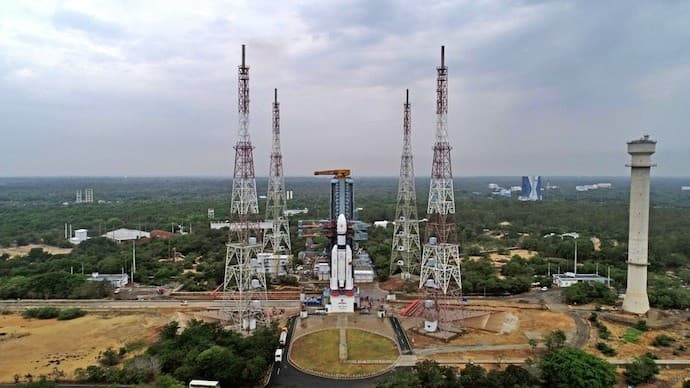
Third Launch Pad (TLP): new launch complex at Satish Dhawan Space Centre, Sriharikota, Andhra Pradesh.

Purpose: handle Next Generation Launch Vehicles, LVM3 and human-rated Gaganyaan flights; standby for Second Launch Pad.

Outlook: Cabinet-cleared asset to sustain national launch capacity for the next 25–30 years.

Quick Facts for MCQs

Tech & Schemes

  • NGLV: reusable, high-payload rocket family set to replace PSLV/GSLV in 2030s.
  • LVM3: heaviest operational rocket; baseline launcher for crewed capsule.
  • Gaganyaan: 3-member crewed mission; demands human-rated pad and vehicle systems.

Launch Pad Comparison

  • FLP: supports polar/sun-synchronous launches; minimal cryogenic infrastructure.
  • SLP: equatorial/GEO capable, cryogenic, swing arms for LVM3; now undergoing human-rating.
  • TLP: modular, high-capacity, engineered for rapid turnaround and new safety norms.

Strategic Significance

  • Capacity: mitigates launch bottlenecks amid rising commercial and governmental demand.
  • Redundancy: ensures mission continuity if FLP/SLP unavailable.
  • Export potential: positions India for larger share of global launch services market.

Key Data Points

FeatureData-Point
Approving bodyUnion Cabinet chaired by PM
SiteSDSC, Sriharikota, Andhra Pradesh
Core usersNGLV, LVM3, crewed missions
Backup roleActs as contingency for Second Launch Pad
Design horizon~25–30 years of operations
First Launch Pad usePSLV, SSLV
Second Launch Pad useGSLV, LVM3
Notable SLP missionChandrayaan-3 (2023)
FLP hallmarkFoundation of India’s early satellite launches
SLP futureBeing human-rated for Gaganyaan

Related UPSC Prelims PYQs

GS1 2018PYQ 1

भारत के उपग्रह प्रक्षेपित करने वाले वाहनों के संदर्भ में, निम्नलिखित कथनों पर विचार कीजिए :

GS-3S&T

12.Semi-Dirac Fermion Discovery (Semi-Dirac Fermion)

The Hindu
Illustration for Semi-Dirac Fermion Discovery (Semi-Dirac Fermion)

What & Where

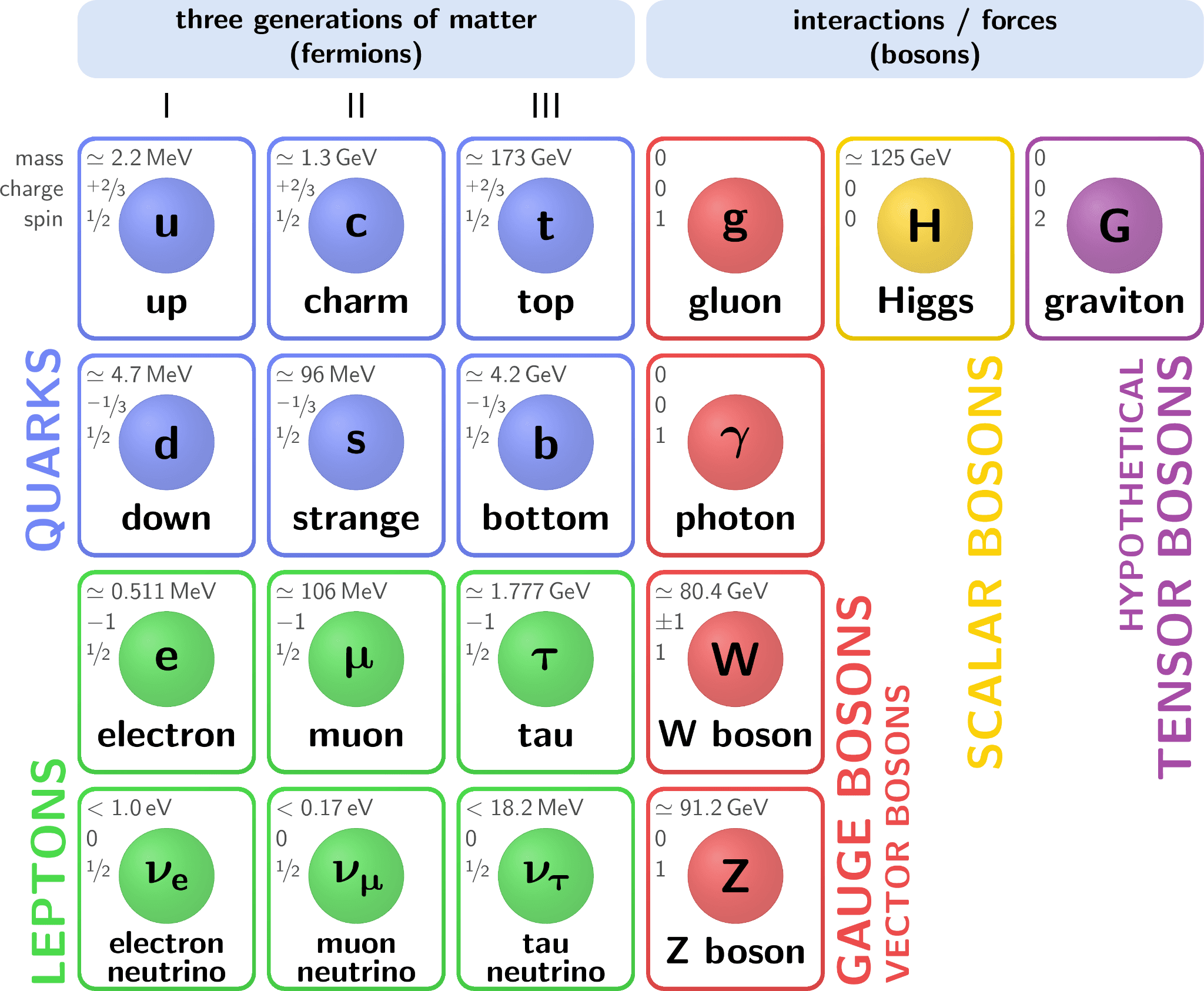
Semi-Dirac fermion – quasiparticle with mass in one crystal direction, massless orthogonal

Observed inside zirconium silicon sulphide (ZrSiS) single crystal by Columbia & Penn State teams

Bridges conventional massive fermions and massless Dirac fermions; niche for next-gen quantum materials

Quick Facts for MCQs

Particle Classification

  • Fermion types: Dirac ≠ antiparticle; Majorana = own antiparticle; Semi-Dirac shows anisotropic mass
  • Boson group transmits forces; ignores Pauli principle; subdivided into gauge and scalar

Material Science Angle

  • ZrSiS exhibits symmetry permitting mixed linear–quadratic energy dispersion creating semi-Dirac state
  • Electric & magnetic field tuning expected to manipulate anisotropic charge transport

Technological Applications

  • Quantum-computing: direction-selective mass may yield controllable qubits, robust edge modes
  • Electronics: anisotropic carriers promise low-power, high-mobility transistors in 2D devices

Key Data Points

FeatureData-Point
Year reported2025
Discovering institutesColumbia University; Pennsylvania State University
Host crystalZirconium Silicon Sulphide (ZrSiS)
Mass behaviourMassive along one axis; massless perpendicular
Particle natureQuasiparticle (collective excitation)
Parent categoryFermion subtype
Dirac fermion traitDistinct from antiparticle
Semi-Dirac uniquenessDirection-dependent effective mass
Standard-Model count17 fundamental particles
Fermion spin typeHalf-integer (½, 3/2, 5/2)
Boson spin typeInteger (0, 1, 2…)
Gauge-boson examplesPhoton, Gluon
Scalar-boson exampleHiggs boson
Pauli exclusion appliesOnly to fermions
GS-3S&TQuick Bite

13.Alternative Obesity Measurements (Obesity Metrics)

Hindustan Times

What & Where

Body Mass Index: weight-to-height² indicator long used worldwide to flag obesity

The Lancet: urges shift to waist circumference, waist-hip and waist-height ratios accounting for sex, age, ethnicity

India: 70 % urban adults overweight/obese; country ranks 3rd after USA & China in absolute obese numbers

Quick Facts for MCQs

Health Metrics

  • Limitation: BMI overestimates muscular athletes, underestimates high-fat low-muscle individuals
  • Advantage: Waist-based ratios better capture visceral fat linked to cardiometabolic risk
  • Inclusivity: Alternatives adjust for gender, age, ethnicity variations ignored by BMI

India Statistics

  • Prevalence: Rapid urban lifestyle change driving 70 % overweight/obese figure
  • Burden: Large population propels India to top-three slot despite lower per-capita rates
  • Policy need: Refined metrics vital for targeted NCD programmes like NPCDCS

Clinical Classification

  • Pre-clinical obesity: Excess fat present yet organ function normal, no activity impairment
  • Clinical obesity: Organ dysfunction evident; daily activities restricted
  • Intervention: Early waist-metric screening enables prevention before transition to clinical stage

Key Data Points

FeatureData-Point
BMI formulaweight (kg) ÷ height² (m²)
Obesity BMI cut-off≥ 30
Urban India overweight/obese70 %
India global obesity rank3rd (after US, China)
Lancet suggested measuresWaist circumference, Waist-hip ratio, Waist-height ratio
Obesity stagesPre-clinical (no organ dysfunction), Clinical (organ dysfunction & activity limits)
GS-2Editorial

14.India and Global South Engagement (Global South)

PIB

What & Where

Global South = developing nations of Asia, Africa, Latin America sharing colonial past, lower income, limited resources.

Concept positions them against wealthier, industrialised “Global North” (N. America, Europe, Oceania parts).

Gained popularity as neutral replacement for “Third World” in development discourse.

Quick Facts for MCQs

Economic Angle

  • Wealth-shift: Asia-Pacific driving majority of global growth; BRICS economic bloc expanding influence.
  • Dependency risk: Belt & Road loans raising debt burdens, skewing trade in favour of lenders.
  • Diversification push: Atmanirbhar Bharat, Skill India aim to widen manufacturing, services base.

Demographic Edge

  • Youth bulge: Larger working-age cohorts provide labour and consumption boost.
  • Policy support: Skill India, NEP 2020 focus on employability, innovation.
  • Contrast: Aging Global North facing shrinking workforce, higher social costs.

Challenges

  • Climate finance gap: Promised $100 bn/year still unmet, hampers green transitions.
  • Conflict shocks: Russia-Ukraine war spiked wheat, energy prices hurting import-dependent nations.
  • Pandemic scars: Sri Lanka, Pakistan debt distress underscores uneven recovery.

Indian Initiatives

  • Vaccine Maitri: Soft-power health diplomacy during COVID-19, reduced vaccine inequity.
  • Global South Centre of Excellence: Platform for best-practice sharing in tech, governance.
  • National Green Hydrogen Mission: Sets template for affordable, clean energy pathways.

Key Data Points

FeatureData-Point
Main regionsAsia, Africa, Latin America
Alternate term replaced“Third World”
Summit showcasing leadershipVoice of Global South 2023 (India)
GDP comparisonBRICS now > G7 combined GDP
Key Indian aid initiativeVaccine Maitri, 200 + million doses shipped
Innovation exampleUPI digital payments adopted in multiple Global South economies
Climate platformInternational Solar Alliance (121 potential members)
Youth statisticIndia’s median age ≈ 28 yrs vs Global North ≈ 40+

Related UPSC Prelims PYQs

CAPF_GAI, CDS_GK 2024PYQ 1

BRICS देशों की UNDP द्वारा जारी मानव विकास रिपोर्ट, 2023-24 में उनकी रैंक के आरोही क्रम में व्यवस्थित कीजिए:

CAPF_GAI, CDS_GK 2023PYQ 2

निम्नलिखित में से भारत की G20 प्राथमिकताएँ क्या हैं?

GS-2Editorial

15.WEF Global Risks Report 2025 (Global Risks)

LiveMint
Illustration for WEF Global Risks Report 2025 (Global Risks)

What & Where

Global Risks Report: yearly WEF study on events threatening world GDP, population or natural resources.

Scope: dual horizon—short-term 2 yrs & long-term 10 yrs—across environmental, geopolitical, social, economic risks.

Produced by World Economic Forum, HQ Geneva; 2025 edition is 20th.

Quick Facts for MCQs

Risk Rankings

  • India: water, mis/disinformation, human-rights erosion, pollution, talent shortages lead.
  • Global 2 yr: mis/disinformation, extreme weather, armed conflict dominate.
  • Global 10 yr: extreme weather, biodiversity loss, earth-system shifts headline.

Geoeconomic Trends

  • Protectionism rising via subsidies & industrial policy, not tariffs.
  • US Inflation Reduction Act 2022 and Make in India flagged as geoeconomic confrontation cases.
  • Multilateral cooperation urged to counter trust fractures and climate-economic shocks.

Geopolitical Bridges

  • India & Gulf states emerging as alternatives tempering US-China rivalry.
  • Act as West–East connectors, fostering dialogue and reduced tensions.
  • Illustrate shift toward multipolar mediation platforms.

Institutional Insights

  • Origin: European Management Forum; broadened to economic & social issues by 1973.
  • Membership: leading 1,000 companies engage in public-private agendas.
  • Annual Davos meeting, plus flagship indices on competitiveness, gender, energy, tourism, risk.

Key Data Points

FeatureData-Point
Report edition20th (2025)
Publishing bodyWorld Economic Forum
Short-term horizon2 years
Long-term horizon10 years
Immediate global risk #1Misinformation & disinformation
Immediate global risk #2Extreme weather events
Immediate global risk #3State-based armed conflict
Long-term global risk #1Extreme weather events
Long-term global risk #2Biodiversity loss & ecosystem collapse
Long-term global risk #3Critical earth-system changes
India’s top listed riskWater supply shortages
Other India risksMis/disinformation, rights erosion, pollution, labour-talent gap
WEF founderKlaus Schwab
Year founded1971
HQ cityGeneva, Switzerland
Renamed to WEF1987
Recognised as IO2015
Other WEF reportsGCI, GGGI, ETI, T&T Competitiveness

Related UPSC Prelims PYQs

CAPF_GAI, GEO_GS 2025PYQ 1

वर्ष 2025 में निम्नलिखित में से किसके तत्वावधान में आयोजित की गई बैठक का विषय 'दुश्मान युग के लिए सहयोग (Collaboration for the Intelligent Age)' था?

CAPF_GAI, GEO_GS 2020PYQ 2

According to the Global Climate Risk Index 2020, published by environmental think tank Germanwatch, in the year 2018 India’s rank in the list of top most climate affected nations is:

GS-2Scheme

16.Fast Track Immigration Trusted Traveller (Trusted Traveller)

Business Standard

What & Where

Programme; Fast Track Immigration–Trusted Traveller uses biometric e-gates for frictionless international entry-exit.

Geography; live at Delhi IGI plus Mumbai, Chennai, Kolkata, Bengaluru, Hyderabad, Cochin, Ahmedabad.

Implementer; Ministry of Home Affairs through Bureau of Immigration for Indian citizens, OCI holders, later foreigners.

Quick Facts for MCQs

Tech & Schemes

  • Automation; boarding pass and passport scanned, biometrics verified, gates unlock automatically.
  • Contactless; minimal officer interaction, e-gate clearance within seconds reduces queue length.
  • Digital; backend integrates Advance Passenger Information for risk profiling.

Security Dimension

  • Biometric; two-factor match limits identity fraud and impostor entry.
  • Database; traveller data stored in Immigration Visa Foreigners Tracking system for intelligence use.
  • Oversight; Home Minister inaugurations signal high political priority on secure but swift borders.

Implementation Phases

  • Phase-1; 21 airports targeted, Indian nationals plus OCI eligible.
  • Phase-2; post-stabilisation, system opens to all foreign passport holders.
  • Scalability; modular e-gate banks can be added per passenger volume.

Key Data Points

FeatureData-Point
First launchJune 2024, Delhi IGI Airport
Nationwide roll-out date16 Jan 2025
Present airports count8 major international hubs
Supervising ministryHome Affairs
Executing agencyBureau of Immigration
Core hardwareAutomated e-gates
Verification modeBiometric facial-fingerprint match
Registration mediumDedicated FTI-TTP online portal
Validity periodPassport tenure or 5 yrs, earlier one
Phase-1 coverageIndian citizens and OCI cardholders, 21 airports planned
Phase-2 coverageForeign travellers
Key documentsPassport, recent photo, OCI card pages (if any)
GS-2Scheme

17.PM Surya Ghar Rooftop Solar Scheme (Rooftop Solar)

LiveMint

What & Where

PM Surya Ghar—Muft Bijli Yojana: ₹75,000 cr central rooftop-solar scheme giving 300 free monthly units to 1 cr homes.

Two execution models: RESCO (private owns ≥5 yrs) & ULA (DISCOM owns ≥5 yrs then transfers).

Nationwide roll-out; MNRE as nodal ministry, DISCOMs as state implementation agencies.

Quick Facts for MCQs

Legal & Policy

  • Draft guidelines introduce RESCO & ULA for CFA disbursal and payment security.
  • Pre-existing rooftop solar homes excluded from both models.
  • Model Solar Village planned per district; ULBs/PRIs incentivised for outreach.

Economic Angle

  • Household benefit: lower bills plus revenue from surplus sale to DISCOMs.
  • 30 GW addition expected to unlock ₹75k cr market and 17 lakh jobs across value-chain.

Environmental Impact

  • 720 million t CO₂ cut over 25 years aligns with India’s NDC targets.
  • Rooftop focus decentralises generation, trimming transmission losses.

Implementation Challenges

  • Reluctance persists in states already offering free power.
  • Limited roof area complicates 1–2 kW segment deployment in dense habitats.
  • Net-metering burdens DISCOM finances; storage mandate still absent, risking duck-curve issues.

Key Data Points

FeatureData-Point
Union Cabinet approvalFeb 2024
Total outlay₹75,000 crore
Target beneficiary homes1 crore
Free power quota300 units / month
Subsidy up to 2 kW60 % of cost
Subsidy 2–3 kW40 % of cost
CFA cap3 kW
Payment-security corpus₹100 crore
Expected added capacity30 GW
Lifetime generation1,000 BU
CO₂ avoided720 million t
Direct jobs projected17 lakh
RESCO ownership period≥5 years
ULA ownership transferAfter 5 years
Eligible meteringNet, Group Net, Virtual Net

Related UPSC Prelims PYQs

CDS_GK, GS1 2025PYQ 1

Consider the following statements about ‘PM Surya Ghar Muft Bijli Yojana’ :

CDS_GK, GS1 2020PYQ 2

Saubhagya, a Government of India Scheme, relates to which of the following areas?

GS-1Editorial

19.Adolescent Pregnancy Challenges (Adolescent Pregnancy)

Down to Earth

What & Where

Adolescent/teenage pregnancy: conception between 15-19 yrs, closely tied to child marriage and gender inequality in India.

National prevalence NFHS-5: 6.8 % girls 15-19 already mothers/pregnant; persists despite fall in child marriage.

Hotspots: West Bengal 16 %, Bihar 11 %, Rajasthan high clusters, mostly rural-poor belts.

Quick Facts for MCQs

Health Impact

  • Anaemia, pre-term labour, higher maternal mortality among teen mothers; low birth weight & infant deaths in offspring.
  • Stunting, underweight prevalence 11 % points higher for children of adolescent mothers.
  • Unsafe abortions widespread due to limited SRH services and stigma.

Social Concerns

  • Early marriage used as poverty coping; societal pressure for early motherhood validates marital success.
  • School dropout spikes; inter-generational poverty and curtailed economic prospects for young mothers.
  • Patriarchal norms escalate domestic violence and gender inequality.

Schemes & Policy

  • PMMVY, JSY incentivise adult motherhood; RKSK, Beti Bachao, School Health programme impart SRH education.
  • Implementation gaps: age-based exclusion leaves teen mothers outside nutrition, cash and health schemes.
  • Enforcement of PCMA 2006 and community surveillance units urged to curb under-age marriages.

Data & Governance

  • Call for national teenage-pregnancy database and longitudinal studies for evidence-based interventions.
  • Need cross-scheme convergence at village level; incentivise ASHA, AWW, Police Sakhi for early-warning system.

Key Data Points

FeatureData-Point
NFHS-5 teen pregnancy (15-19 yrs)6.8 %
West Bengal rate16 % (highest)
Bihar rate11 %
Child marriage fall47 % (2005) ➜ 24 % (2020)
Added child stunting risk+11 % points (IFPRI)
Unsafe abortion share (LMIC, 2019)55 % of unintended teen pregnancies
PMMVY cash transfer₹5,000 for 1st live birth, ≥19 yrs
JSY age eligibilityIncentives only ≥19 yrs
RKSK target groupAdolescents 10-19 yrs
Prohibition of Child Marriage Act2006, bans <18 yrs weddings

Ready to practice?

Test your knowledge with our UPSC test series.

Start Free Trial